
Test 25 of 25 · 20 questions · Free 2026
NC Permit Practice Test 25
Jump to the test ↓A fixed 20 question set from the North Carolina bank with answers and plain English explanations.
Question 1 of 20 · 0 right so far
All 20 questions in test 25
Every question below comes from the North Carolina question bank on this page. Open a question to see the correct answer and the explanation. Nothing here is hidden behind a signup.
1. It has not rained for weeks, and a light shower has just started. When is the road likely to be most slippery?
- After an hour of steady rain
- Only once puddles have formed
- Only after the rain stops
- During the first 10 to 15 minutes
Show answer
During the first 10 to 15 minutes. Roads turn especially dangerous right after rain starts, the handbook warns, most of all after a dry spell. For the first 10 to 15 minutes, rain mixes with oil from asphalt and vehicles, along with dirt, dust, and rubber, to create a slick surface. Drive with extreme caution then, slow down at least five to 10 mph below your dry-road speed, and leave at least twice your normal following distance.
Study this in the handbook: Turn signals, headlights and bad weather
2. At an intersection with no traffic signals, a pedestrian with a guide dog but no cane starts across the street. What should you do?
- Go ahead, since only a white cane counts
- Honk so the dog leads the person back
- Yield; a guide dog also qualifies
- Drive slowly around behind the person
Show answer
Yield; a guide dog also qualifies. Under North Carolina law, a blind pedestrian gets special consideration where no traffic signals control the crossing, if the person extends a white cane, a white cane with a red tip, or has a guide dog. A guide dog alone is enough. Stop and let the person cross completely. Honking or driving around the person is not yielding. This applies even where no crosswalk is painted, since unmarked crosswalks count at intersections.
Study this in the handbook: Pedestrians, school buses and emergency vehicles
3. You are driving on a four-lane road with no median. A school bus on the other side of the road stops with its red lights flashing. What must you do?
- Keep going, since the bus is on the other side
- Slow down and pass in the far lane
- Stop only if you are in the inside lane
- Stop, since traffic in both directions must stop
Show answer
Stop, since traffic in both directions must stop. On a four-lane roadway without a median separation, North Carolina requires all traffic from both directions to stop when a school bus stops for passengers. Being on the other side of the road, or in the far lane, does not excuse you. Only a median on a divided highway of four or more lanes, or a road of four or more lanes with a center turning lane, limits the stop to traffic following the bus.
Study this in the handbook: Pedestrians, school buses and emergency vehicles
4. You are giving a ride to a 6-year-old who weighs 50 pounds. How must the child be secured?
- With the adult seat belt alone
- On an adult's lap with a belt
- In a weight-appropriate child restraint
- In the front seat with the air bag on
Show answer
In a weight-appropriate child restraint. North Carolina law says a child under age 8 who weighs less than 80 pounds must be properly secured in a weight-appropriate child passenger restraint system. A 6-year-old at 50 pounds meets both conditions, so an adult belt alone is not enough. Booster seats are used once a child outgrows a standard safety seat, until the adult belt fits. The handbook also says children age 12 and under should ride buckled in a rear seat.
Study this in the handbook: Seat belts, child restraints and window tint
5. After drinking at a party, a friend says three cups of coffee will make them fine to drive in half an hour. What does the North Carolina handbook say?
- Coffee works if the drinks were only beer
- Coffee and a big meal together will work
- A cold shower plus coffee will work
- Only time sobers a person up
Show answer
Only time sobers a person up. The handbook is clear that the only thing that sobers up a drinker is time; coffee, a big meal, or cold showers will not work. Combining them does not help either. Your friend may feel more awake after coffee but can still be impaired, because alcohol slows brain functions and gives false confidence. The handbook's advice is to plan ahead: ride with a driver who has not been drinking, share a taxi, or stay overnight.
6. Which reason does the North Carolina handbook give for night driving being more dangerous than daytime driving?
- There are more impaired drivers on the road
- Speed limits are higher on most roads after dark
- Roads are always wetter at night
- Traffic signals stop working at night
Show answer
There are more impaired drivers on the road. The handbook lists several reasons night driving is more dangerous: you cannot see as well, there are more impaired drivers on the road, drivers tend to be tired and less alert, oncoming headlights can blind you, and dirty windshields or poor lights cause problems. Speed limits do not rise at night, and signals keep working. Wildlife and unexpected debris may also be in the road after dark.
Study this in the handbook: Turn signals, headlights and bad weather
7. Water covers the road ahead after a heavy storm, and it looks only a few inches deep. What does the North Carolina handbook say?
- Drive through slowly in a low gear
- Never drive through standing water on a roadway
- Drive through quickly to avoid stalling
- Follow another car's path through the water
Show answer
Never drive through standing water on a roadway. The handbook's rule is to never drive through standing water on a roadway. The water may be much deeper than it appears, and part of the road under it may be washed away. If water is moving across the road, your vehicle may stall and be swept into deeper water. Going slowly, going fast, or following another car does not change what you cannot see under the surface.
Study this in the handbook: Turn signals, headlights and bad weather
8. Which road surfaces does the North Carolina handbook say are especially hazardous for motorcyclists?
- Steel bridge joints and metal bridge grating
- Freshly paved smooth asphalt on a dry day
- Concrete highways with fresh painted lane lines
- Brick crosswalks in downtown business districts
Show answer
Steel bridge joints and metal bridge grating. Steel bridge expansion joints, metal grating on bridges, and other metal surfaces are hazardous for motorcycle and moped riders, the handbook says, so leave plenty of space between yourself and the rider. Sand, gravel, wet leaves, or water on the pavement can also make a rider lose control. Riders may need to slow down on rough surfaces, so do not crowd them.
Study this in the handbook: Bicycles, mopeds, trucks and insurance
9. Because an exhaust leak can let carbon monoxide into the car, what does the North Carolina handbook suggest while traveling?
- Keep a window open about one inch
- Keep all windows tightly closed
- Run the heater on its highest setting
- Keep the air conditioning on recirculate
Show answer
Keep a window open about one inch. A leak in the exhaust system can let poisonous carbon monoxide into the passenger compartment. The handbook says carbon monoxide poisoning can often be fatal, and even small amounts can make you sleepy or unconscious so that you lose control. For that reason, it suggests keeping a window open about one inch while traveling and checking the exhaust system often for leaks. Every vehicle must also have a muffler in good working order.
10. You are parked at the right curb and ready to pull out of a parallel space into traffic. What should you do first?
- Pull out quickly before cars arrive
- Signal right and back into the lane
- Honk twice and pull out slowly
- Check for traffic and signal a left turn
Show answer
Check for traffic and signal a left turn. Before pulling out from a parallel parking space, the handbook says to check for approaching traffic and give a left-turn signal. The exception is when you are parked on the left side of a one-way street. Drivers coming up behind you are told to slow down and be ready to stop when they see a car pulling out, but you should not rely on them. Honking or rushing out does not replace checking traffic and signaling.
Study this in the handbook: Passing, backing and parking
11. You see this orange sign on a North Carolina road. What should you be ready to do?
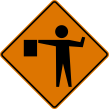
- Stop when a flagger with a paddle tells you to
- Pull over because a police checkpoint is ahead
- Speed up to clear the work area quickly
- Watch for a school crossing guard
Show answer
Stop when a flagger with a paddle tells you to. The Flagger sign warns of construction or maintenance ahead where a flagger in an orange vest is stationed to control traffic. The flagger uses a STOP/SLOW paddle to either stop traffic or let it proceed. When you see this sign, stay alert and be prepared to stop. Orange signs with black letters are reserved for work zones, so this is not a police checkpoint or a school crossing, and speeding up through the area is the wrong response.
12. You see this yellow diamond sign on a curving road. What should you be ready for?

- A traffic signal ahead that may be red
- A railroad crossing with flashing lights
- A fire station driveway just ahead
- A school crossing guard in the road
Show answer
A traffic signal ahead that may be red. Diamond-shaped signs that are black on yellow are caution or warning signs. The handbook explains that warning signs alert drivers to unusual features or conditions they are about to encounter. This one shows a traffic signal, so a signal you may not see yet is ahead, possibly around the curve. Slow down and be ready to stop if it is red or turns yellow. Railroad crossings have their own round yellow advance sign.
13. On a two-lane road, the center line has a solid yellow line next to your lane and a broken yellow line next to the oncoming lane. Who may pass?
- You may, if the road ahead looks clear
- Traffic in both directions, with care
- Oncoming drivers, who have the broken line
- No one in either direction, ever
Show answer
Oncoming drivers, who have the broken line. On a two-lane road, the handbook says passing with care is permitted when the skipped, or broken, yellow line is on your side of the center. A solid yellow line in your lane is among the places where passing is always unsafe and usually illegal. So here, only the oncoming drivers, who have the broken line, may pass when it is safe. Double solid yellow lines would bar passing in both directions.
Study this in the handbook: Traffic signals and pavement markings
14. A bicyclist is riding in the middle of the travel lane ahead of you. What does the North Carolina handbook say drivers should understand?
- Cyclists must always ride on the shoulder
- Cyclists may need to use the full lane
- Cyclists may ride only in marked bike lanes
- Cyclists in the lane must pull over for cars
Show answer
Cyclists may need to use the full lane. North Carolina law treats bicycles as vehicles and allows bicyclists to ride among other road users in the roadway. The handbook tells motorists to expect bicyclists in the road and to understand that traffic operations may require them to use the full travel lane. Bicyclists may choose bike lanes, paved shoulders, or regular travel lanes based on road conditions and hazards. Pass only with abundant clearance; changing lanes is the safest way.
15. An oncoming vehicle drifts across the center line into your lane. What does the North Carolina handbook tell you to do first?
- Swerve left into the empty oncoming lane
- Flash your high beams and hold your speed
- Slow down right away and sound your horn
- Stop in your lane and wait for it to pass
Show answer
Slow down right away and sound your horn. An oncoming vehicle crossing the center line into your path is a serious danger. The handbook says to reduce speed immediately, sound your horn, and keep to the right even if that means running off the road. Swerving left is not the handbook's advice; the escape route it describes is to the right. Holding your speed or simply stopping in your lane leaves you in the other vehicle's path.
Study this in the handbook: Blowouts, breakdowns and crashes
16. What does a steady yellow arrow mean at a North Carolina intersection?
- Turns are allowed after yielding to oncoming cars
- The protected green arrow is about to change
- The turn lane is closed for the rest of the cycle
- Turning traffic must stop right away, even if close
Show answer
The protected green arrow is about to change. A steady yellow arrow tells you the protected green arrow is ending. The handbook says it is about to change to a regular circular green, a circular red, or a red arrow. On the flashing yellow arrow signal heads, a solid yellow arrow means prepare to stop. Do not confuse it with a flashing yellow arrow, which permits a turn after yielding to oncoming traffic and pedestrians.
Study this in the handbook: Traffic signals and pavement markings
17. Which of these is a warning sign of drowsy driving listed in the North Carolina handbook?
- Feeling hungry after a long stretch of highway driving
- Noticing that traffic is lighter than usual
- Wanting to change the radio station often
- Hitting a rumble strip or drifting from your lane
Show answer
Hitting a rumble strip or drifting from your lane. The handbook says drowsy driving can happen to anyone and lists warning signs: you cannot remember the last few miles, you hit a rumble strip or drift from your lane, you yawn repeatedly, or you struggle to keep your eyes open. Hunger, light traffic, and restlessness with the radio are not on that list. If you notice these signs, stop driving. A short nap of 15 to 45 minutes and some caffeine can help, but only temporarily.
Study this in the handbook: Speed limits and stopping distance
18. What is the highest maximum speed limit listed for North Carolina interstates?
- 55 mph
- 70 mph
- 65 mph
- 75 mph
Show answer
70 mph. The handbook's table of maximum speed limits tops out at 70 mph for interstates. Roads outside cities and towns are listed at 55, and cities and towns at 35 unless posted otherwise. The handbook describes interstates as safer roads because opposing traffic is separated and there are no railroad crossings, sharp curves, stop signs, or traffic signals. Even there, rain, fog, or heavy traffic can make the posted limit unwise, and the speed law requires adjusting to conditions.
Study this in the handbook: Speed limits and stopping distance
19. Where does the North Carolina handbook say passing is always unsafe and usually illegal?
- On any straight road with a broken yellow line
- At railroad crossings and city intersections
- On highways with two lanes in each direction
- On a long, level road in clear daylight
Show answer
At railroad crossings and city intersections. The handbook lists places where passing is always unsafe and usually illegal. The list starts with intersections in cities and towns and railroad crossings, and it also includes marked rural intersections, curves or hills where you cannot see at least 500 feet ahead, and anywhere a solid yellow line is in your lane. A broken yellow line, a highway with two lanes each way, or a clear level road can all allow a careful, legal pass.
Study this in the handbook: Passing, backing and parking
20. Fire trucks are working at a house fire and a hose lies across your street. What does the North Carolina handbook say?
- Drive over it slowly if no firefighter is nearby
- Drive over it only where it lies flat
- Never drive a motor vehicle over a fire hose
- Honk and wait for a firefighter to move it
Show answer
Never drive a motor vehicle over a fire hose. Among its guidelines for emergency vehicles, the handbook says never drive a motor vehicle over a fire hose. Driving slowly or picking a flat spot does not make it acceptable. The same list says not to drive or park closer than one block from fire trucks responding to a fire alarm, so in most cases you should not be close enough to reach a hose at all. If a hose blocks your street, wait or choose another route.
Study this in the handbook: Pedestrians, school buses and emergency vehicles
Every question is written from the official North Carolina Driver Handbook. Need paper? Printable NC practice test with answer key.
Last verified 2026-10-05. How we check every question · Study all 500 as flashcards
Frequently asked questions
How many questions are on this North Carolina practice test?
This fixed set has 20 questions. It is test 25 of 25 from the 500 question North Carolina bank.
How does this fixed test relate to the full North Carolina bank?
Each numbered test is a fixed set of questions in a fixed order, so you can retake the same test later and compare. Every test mixes road signs and the other topics in about the same proportion as the full bank. Tests 1 to 25 together cover every question in the North Carolina bank once. The full practice page mixes the whole bank at random.
Last verified 2026-10-05. See the North Carolina DMV facts page for sourced state details.
Return to the full North Carolina practice test · Study road signs