
Test 15 of 25 · 20 questions · Free 2026
NC Permit Practice Test 15
Jump to the test ↓A fixed 20 question set from the North Carolina bank with answers and plain English explanations.
Question 1 of 20 · 0 right so far
All 20 questions in test 15
Every question below comes from the North Carolina question bank on this page. Open a question to see the correct answer and the explanation. Nothing here is hidden behind a signup.
1. The temperature is just above freezing and the road feels wet but not icy. You are approaching a bridge. What should you expect?
- Bridges stay warmer than the road
- Ice forms on bridges only at night
- The bridge may freeze before the road does
- Bridges are salted, so they are always safe
Show answer
The bridge may freeze before the road does. The handbook says to watch for shady spots, bridges, and overpasses, because these places are often the first to freeze as the temperature drops. A road that feels merely wet can turn icy on the next bridge. Slow down before you reach it rather than braking on it. If you must drive in snow, reduce speed, use your wipers, turn on low beams, and allow at least three times the normal stopping distance.
Study this in the handbook: Turn signals, headlights and bad weather
2. Fast-moving water about six inches deep is flowing across the road ahead after a storm. What should you do?
- Do not drive into it; it can sweep a car away
- Drive through slowly in a low gear
- Drive through quickly before it rises
- Follow the pickup truck ahead through it
Show answer
Do not drive into it; it can sweep a car away. The handbook cites reports that six inches of fast-moving water can sweep a car off the highway, and 12 inches can float a car or turn it over. It says never to drive through standing water, because the water may be deeper than it looks and part of the road may be washed away. Since 1970, inland flooding has caused 85 percent of tropical weather deaths in North Carolina, half from driving into known flooded roads.
Study this in the handbook: Turn signals, headlights and bad weather
3. You are driving beside and slightly behind another car in city traffic. How can you tell you are probably in that driver's blind spot?
- You cannot see the inside rear-view mirror of that car
- You can see the driver's face in their side mirror
- Your front bumper is even with their front bumper
- Their brake lights are not glowing at the moment
Show answer
You cannot see the inside rear-view mirror of that car. The handbook's city driving rules tell you to avoid driving side by side, especially in another driver's blind spot. Its test is simple: if you cannot see the inside rear-view mirror of the car ahead, you are probably in that driver's blind spot. Either drop back or move ahead so the other driver is more likely to notice you. Brake lights and bumper position say nothing about whether that driver can see your car.
4. What does a smaller sign mounted below a railroad crossbuck tell you?
- How far away the next train is
- That there is more than one track
- That the crossing has no gates
- The speed limit for crossing the tracks
Show answer
That there is more than one track. The crossbuck is the X-shaped sign mounted at the railroad crossing itself. The handbook says a smaller sign below the crossbuck shows whether there is more than one track. That matters because a second train may be coming on another track after the first one passes, so you should not move immediately once a train clears. The small sign does not give train distance, gate information, or a speed limit.
Study this in the handbook: Railroad crossings and funeral processions
5. A North Carolina passenger says the car has air bags, so a seat belt is not needed. What does the seat belt law say?
- Air bags replace belts for adults in the front seat
- Belts are needed only on roads over 45 mph
- Only the driver must buckle when air bags are present
- All occupants must wear belts even with air bags
Show answer
All occupants must wear belts even with air bags. North Carolina's seat belt law requires the driver and every passenger to have a belt properly fastened whenever the vehicle is moving forward on a street or highway. The handbook adds that all occupants must wear seat belts even if the vehicle is equipped with air bags. Air bags are supplemental protection that work best when everyone is buckled. The law does not change with the speed limit, and it covers passengers as well as the driver.
Study this in the handbook: Seat belts, child restraints and window tint
6. A North Carolina driver wants to sip a beer on a quiet road while staying well under 0.08. What does the law say?
- Drinking any alcoholic beverage while driving is prohibited
- It is legal while the driver stays below 0.08
- Beer is allowed, but liquor and wine are not
- It is legal outside city and town limits
Show answer
Drinking any alcoholic beverage while driving is prohibited. One of North Carolina's DWI laws prohibits drivers from consuming any alcoholic beverage while driving, and the handbook names beer specifically so no one assumes a light drink is exempt. The ban has nothing to do with staying under 0.08, and it applies on every road, not just in towns. The 0.08 figure is one way impairment can be proven; it is not permission to drink at the wheel. The handbook also reminds drivers that alcohol reduces the ability to drive safely.
Study this in the handbook: Driving while impaired and alcohol limits
7. How do you give a right-turn hand signal from the driver's window?
- Left arm straight out, forearm and hand up, palm forward
- Left arm straight out with the first finger pointing
- Left arm pointing down with the palm facing back
- Right arm out the passenger window, pointing right
Show answer
Left arm straight out, forearm and hand up, palm forward. Hand signals are given from the driver's window with the left arm and hand. For a right turn, the handbook says to hold the arm straight out with the forearm and hand straight up and the palm facing forward. Holding the arm straight out and pointing signals a left turn, and pointing the arm down with the palm back signals slowing or stopping. Signals use the left arm, not the right.
Study this in the handbook: Turn signals, headlights and bad weather
8. Sun glare is making it hard to see the road. What should you do if adjusting the visor and wearing sunglasses does not help?
- Speed up to get out of the glare faster
- Turn on your high beams to cut the glare
- Stop on the roadside until you can drive safely
- Follow the car ahead more closely
Show answer
Stop on the roadside until you can drive safely. The handbook says direct or reflected sunlight creates a dangerous driving situation. To reduce glare, adjust your sun visor and wear sunglasses. If those steps do not help, stop on the roadside until you can drive safely. Speeding up or following closely cuts the time you have to react to whatever the glare is hiding. Headlights do not reduce glare from the sun.
Study this in the handbook: Turn signals, headlights and bad weather
9. A motorcycle ahead of you wobbles as it starts to move, and the rider hesitates at intersections. What does the North Carolina handbook say this suggests?
- An experienced rider showing off
- A rider signaling you to pass
- A motorcycle with a flat front tire
- A new rider who needs extra room
Show answer
A new rider who needs extra room. The handbook asks drivers to watch for motorcycles that wobble or jerk while starting to move and for riders who hesitate while making traffic decisions. These are signs of a beginning rider, so allow plenty of room. Any rider can lose control when sand, gravel, wet leaves, or water is on the pavement. Hesitation is not a signal for you to pass, and it does not point to a tire problem.
Study this in the handbook: Bicycles, mopeds, trucks and insurance
10. On a two-lane road, you approach a police car stopped on the shoulder with its blue lights flashing. What must you do?
- Keep your speed, since it is off the road
- Stop completely until the officer waves you on
- Cross the center line to give extra room
- Slow down and pass at a reduced, safe speed
Show answer
Slow down and pass at a reduced, safe speed. North Carolina's Move Over law applies when an authorized emergency vehicle is parked or standing within 12 feet of the roadway with its warning lights on. On a highway with only one lane in your direction, you must slow down and drive at a reduced, safe speed until you are completely past it. Keeping your speed is not allowed, and the law does not require a full stop. On roads with two or more lanes your way, you must move out of the nearest lane.
11. Before crossing a railroad track, how many times does the North Carolina handbook suggest checking in each direction?
- Once in each direction
- Twice in each direction
- Only toward the nearest train horn
- Not at all if there is a crossbuck
Show answer
Twice in each direction. At a railroad crossing, you must stop whenever a flagger, signal, or gate shows a train is coming, and stay stopped until the gate lifts or the signal or flagger shows it is safe. Even then, the handbook says to take the time to check twice in each direction before crossing. Trains can approach at any time from any direction, and a second train may follow the first. A crossbuck alone still means you must yield to trains.
Study this in the handbook: Sign shapes and colors
12. It is mid-afternoon, but heavy rain has cut visibility to about 300 feet. Are headlights required?
- Yes, visibility is 400 feet or less
- No, headlights are needed from sunset onward
- Just when the wipers are switched off
- When you are on an interstate highway
Show answer
Yes, visibility is 400 feet or less. North Carolina law requires headlights from sunset to sunrise and whenever visibility is 400 feet or less. Heavy rain that cuts your view to about 300 feet is inside that 400 foot line, so headlights are required even in the afternoon. The test is how far you can see, not the time on the clock or the type of road. The handbook also tells drivers to use their headlights whenever visibility becomes poor.
Study this in the handbook: Turn signals, headlights and bad weather
13. You pass this sign near a school at 8 a.m. on a school day. What should you expect about the speed limit ahead?

- The limit rises once you pass the school
- School zone limits apply only on weekends
- A reduced limit may apply during school hours
- The sign has no effect on speed at all
Show answer
A reduced limit may apply during school hours. This pentagon marks a school zone or school crossing, where the handbook says to be especially watchful for children. It adds that in many school zones the speed limit is reduced during certain school hours. A school-day morning is exactly when a lower limit is likely to be in effect, and school buses are also running. Slow down, obey any posted school zone limit, and watch for children.
14. On a multi-lane road, you notice a yellow line between your lane and the lane to your left. What does that tell you about the traffic in that lane?
- It moves the same way you are going
- It is set aside for bicycles
- It is a lane reserved for buses
- It moves in the opposite direction
Show answer
It moves in the opposite direction. The handbook explains that yellow lines separate travel lanes moving in opposite directions, while white lines separate lanes moving in the same direction. So a yellow line between you and the lane on your left means that lane carries oncoming traffic. Stay to the right of it unless you are passing where the markings allow. On divided highways, a solid yellow line marks the left edge of the road instead.
Study this in the handbook: Traffic signals and pavement markings
15. You drive into a North Carolina town and see no speed limit signs on its streets. What is the speed limit?
- 25 mph
- 35 mph
- 45 mph
- 55 mph
Show answer
35 mph. North Carolina sets a default speed limit for cities and towns: unless otherwise posted, it is 35 mph. Outside cities and towns the maximum is 55 mph, and interstates top out at 70. Special speed limits, such as in school zones, may be posted for special areas. Even at 35, pedestrians, parked cars, and school zones may call for driving slower than the limit.
Study this in the handbook: Speed limits and stopping distance
16. You see this sign on a highway. You feel nervous in the fast traffic and want to drive well below the number it shows, even in good conditions. What does the handbook say?
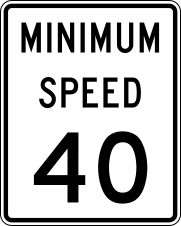
- Drive as slowly as feels comfortable
- Go below it if your flashers are on
- Do not go below it in normal conditions
- Go below it if you stay in the right lane
Show answer
Do not go below it in normal conditions. The handbook warns that driving well below the posted limit can be dangerous, but it also recognizes that some drivers must go slower. Even then, you should still observe the posted minimum speed limit. In good conditions, that minimum is the slowest you should go on that road. Use the right lane when moving slower than traffic on a multi-lane highway, and pull over to let a line of traffic pass when it builds behind you.
Study this in the handbook: Speed limits and stopping distance
17. You are behind a funeral procession on a two-lane North Carolina road. When may you pass it?
- Whenever the center line is broken and clear
- Once the procession has crossed a green light
- Only where two or more lanes go your direction
- When the lead car signals that you may go around
Show answer
Only where two or more lanes go your direction. North Carolina says a driver traveling the same direction as a funeral procession shall not pass or try to pass it. The handbook's one exception is a highway marked for two or more lanes of moving traffic in the procession's direction. On a two-lane road, a broken center line does not create that exception. You also may not knowingly drive between vehicles in the procession, so stay behind it until the road widens.
Study this in the handbook: Railroad crossings and funeral processions
18. You pulled over and stopped for an ambulance with its siren on. It has not passed you yet, but a traffic officer waves you forward. What do you do?
- Stay stopped, because the ambulance has not passed yet
- Move ahead the way the officer directs you
- Wait about thirty seconds and then pull out
- Move ahead as soon as the car behind you does
Show answer
Move ahead the way the officer directs you. The handbook says to drive to the right-hand curb or edge of the road and stop completely when an emergency vehicle approaches. You then stay stopped until the emergency vehicle has passed or until a traffic officer directs you to move. Here the officer is giving that direction, so you may go ahead as signaled. The handbook gives no set wait time, and the movement of other drivers does not tell you when it is safe.
Study this in the handbook: Pedestrians, school buses and emergency vehicles
19. On a three-lane North Carolina highway, when may you pass in the center lane?
- When the center lane looks clear for a long way
- Never, since the center lane is for left turns
- When traffic in both directions is light
- Where it is marked for passing in your direction
Show answer
Where it is marked for passing in your direction. On a three-lane highway, the handbook says you must not pass except in the center lane, and then only where that lane is marked for passing in your direction. The pavement markings decide, not how empty the lane looks or how light traffic seems. The handbook does note an exception to the rule for a vehicle in the center lane that is making a left turn. Passing in either outside lane is not allowed.
Study this in the handbook: Passing, backing and parking
20. You want to turn left at an intersection, and an oncoming car arrives at the same time going straight. What should you do?
- Turn first, since you signaled
- Signal and wait until the turn is safe
- Go first, since left turns have priority
- Turn quickly before the car gets close
Show answer
Signal and wait until the turn is safe. When two facing vehicles approach an intersection together and one is going straight while the other wants to turn left, the driver turning left must wait. The handbook says that driver must give the proper signal and wait until the turn can be made safely, so the straight-through driver has the right of way. Signaling does not give you priority, and rushing ahead of the oncoming car ignores that rule.
Study this in the handbook: Right of way at intersections and roundabouts
Every question is written from the official North Carolina Driver Handbook. Need paper? Printable NC practice test with answer key.
Last verified 2026-10-05. How we check every question · Study all 500 as flashcards
Frequently asked questions
How many questions are on this North Carolina practice test?
This fixed set has 20 questions. It is test 15 of 25 from the 500 question North Carolina bank.
How does this fixed test relate to the full North Carolina bank?
Each numbered test is a fixed set of questions in a fixed order, so you can retake the same test later and compare. Every test mixes road signs and the other topics in about the same proportion as the full bank. Tests 1 to 25 together cover every question in the North Carolina bank once. The full practice page mixes the whole bank at random.
Last verified 2026-10-05. See the North Carolina DMV facts page for sourced state details.
Return to the full North Carolina practice test · Study road signs