
Test 21 of 25 · 20 questions · Free 2026
NC Permit Practice Test 21
Jump to the test ↓A fixed 20 question set from the North Carolina bank with answers and plain English explanations.
Question 1 of 20 · 0 right so far
All 20 questions in test 21
Every question below comes from the North Carolina question bank on this page. Open a question to see the correct answer and the explanation. Nothing here is hidden behind a signup.
1. You pass a car on a two-lane road, but the driver you passed has to brake to let you back into the lane. What does this mean?
- The other driver was going too slowly
- You did not leave enough room to pass safely
- You passed correctly, since you got back in
- The other driver broke the law by braking
Show answer
You did not leave enough room to pass safely. The handbook says you have not passed safely if the vehicle you passed must slow down to allow you back into your correct lane. Before passing, you need enough room ahead to return to your lane without forcing anyone to brake, and you must pass at least two feet to the left. Keep a steady speed during the pass. The other driver's braking is a sign of your mistake, not theirs.
Study this in the handbook: Passing, backing and parking
2. On a North Carolina interstate posted at 70 mph, most traffic is moving at about 78 mph. What does the handbook advise?
- Match the 78 mph flow, since it is safer
- Drop to 50 mph and stay in the right lane
- Use the left lane and keep up with the fastest cars
- Stay at or below 70, even if others speed
Show answer
Stay at or below 70, even if others speed. The handbook says driving far below the posted limit on an interstate is dangerous, since crashes are more likely when a vehicle moves much slower than the flow. But it adds a limit: follow the flow of traffic only if you can do so without speeding. North Carolina's interstate maximum is 70 mph, so stay at or below that, keep right, and use the left lane for passing.
3. A flashing yellow arrow is showing for your left turn. What may you do?
- Turn without yielding, because the turn is protected now
- Stop and wait, since no turns are allowed yet
- Prepare to stop because the light will turn red
- Turn after yielding to oncoming cars and pedestrians
Show answer
Turn after yielding to oncoming cars and pedestrians. Flashing yellow arrow signal heads are designed to make turning decisions clearer. When the flashing yellow arrow is shown, the turn is permitted, but you must first yield to oncoming traffic and pedestrians. A solid green arrow is the protected turn where you should not need to yield. A solid yellow arrow means prepare to stop, and a solid red arrow means stop with no turns allowed.
Study this in the handbook: Traffic signals and pavement markings
4. You want to pass a car towing a trailer on a two-lane road. About how much clear roadway may you need?
- About 500 feet
- About a half mile
- About a quarter mile
- About two miles
Show answer
About a half mile. When you approach a vehicle towing a trailer, the handbook says to watch for sway and hazards such as crosswinds or slippery curves, and to be aware that sudden braking might cause the trailer to jackknife. Passing calls for extreme caution, because it may take a half mile of clear roadway to pass the trailer and towing vehicle safely. Towing a trailer or boat takes special skill, and other drivers should show consideration too.
Study this in the handbook: Bicycles, mopeds, trucks and insurance
5. You have a minor crash in a main highway lane. No one is hurt and both cars can be driven safely. What should happen to the vehicles?
- Leave both cars where they stopped until police arrive
- Move them out of the travel lane onto the shoulder
- Push both cars into the grassy median by hand
- Drive them home and report the crash later
Show answer
Move them out of the travel lane onto the shoulder. After any crash you must stop immediately. If it happened on a main lane, ramp, shoulder, median, or nearby area of the highway and no one is injured or killed, the handbook says each vehicle should be moved out of the travel lane onto the shoulder, as long as it can be driven safely under its own power without further damage. The handbook also says to take precautions to prevent further crashes at the scene. Driving away is not allowed.
Study this in the handbook: Blowouts, breakdowns and crashes
6. What daily driving limit does the North Carolina handbook suggest setting to help prevent drowsy driving?
- 300 to 400 miles
- 100 to 200 miles
- 500 to 600 miles
- 700 to 800 miles
Show answer
300 to 400 miles. Among its tips for preventing drowsy driving, the handbook suggests trying to limit yourself to 300 to 400 miles of driving per day. The limit is one of several habits meant to keep you from becoming tired at the wheel, since a tired driver cannot react to road dangers. The other tips work alongside it: rest a full night first, take regular breaks to walk around, and avoid medications that cause drowsiness. If you become tired anyway, stop driving.
7. Oncoming cars are on your left and a child on a bicycle is on your right. How should you position your car?
- Give the child more room, even if closer to oncoming cars
- Stay exactly in the middle of your lane
- Give the oncoming cars more room and pass close to the child
- Stop in your lane until both have passed
Show answer
Give the child more room, even if closer to oncoming cars. When two unavoidable dangers come at once, the handbook says to give the most room to the greatest or most likely danger. Its own example is approaching cars on your left and a child on a bicycle on your right. The child is the one most likely to make a sudden move, so give the child more room, even if that means moving closer to the oncoming vehicles. Passing close to an unpredictable young cyclist is the risk to avoid.
Study this in the handbook: Turn signals, headlights and bad weather
8. What does the North Carolina handbook call a major cause of rear-end crashes in work zones?
- Using headlights during the day
- Following the posted work zone limit
- Changing lanes well before the work area
- Driving slower than the surrounding traffic
Show answer
Driving slower than the surrounding traffic. The handbook says driving slower than the surrounding traffic is a major cause of rear-end crashes in work zones. Driving areas there may be confined, with no room to maneuver or escape when a driver comes up on a slow vehicle unexpectedly. That does not mean speeding is allowed: it is unlawful to drive faster than the posted work zone limit. The goal is to keep pace with traffic within that limit and stay alert.
Study this in the handbook: Turn signals, headlights and bad weather
9. You are driving your 15-year-old neighbor to school in North Carolina. Who is responsible for making sure the teen is buckled?
- You, since the rider is under 16
- The teen, who is old enough to decide
- The teen's parents or guardian
- No one, since the teen is past age 12
Show answer
You, since the rider is under 16. North Carolina puts the duty on the driver: every driver carrying passengers younger than 16 must make sure each of them is properly secured in a child passenger restraint system or a seat belt that meets federal standards. A 15-year-old is still under 16, so you, as the driver, are responsible. The teen's own choice or a parent's absence does not change that. Children under 8 and under 80 pounds need a weight-appropriate child restraint.
Study this in the handbook: Seat belts, child restraints and window tint
10. Your signal is flashing red at a quiet intersection. After you stop, when may you go?
- Right away, since flashing red means caution
- Only after the light turns green
- When entering will not interfere with traffic
- After waiting one full minute at the line
Show answer
When entering will not interfere with traffic. A flashing red signal has the same meaning as a stop sign. The handbook says to stop and not proceed until you can enter the intersection without interfering with approaching traffic. It does not have to turn green first, and no fixed waiting time applies. Flashing yellow, by contrast, means slow down and proceed with caution. At a flashing red, treat cross traffic just as you would at a stop sign.
Study this in the handbook: Traffic signals and pavement markings
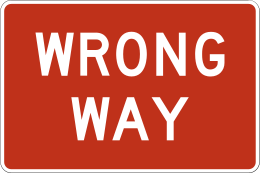
11. You pass this sign, realize you are heading the wrong way onto an interstate, and pull onto the right shoulder. What should you do next?
- Back up the ramp as fast as you can
- Keep going and exit at the next ramp
- Stop in the lane and wait for police
- Turn around once the way is clear
Show answer
Turn around once the way is clear. If you enter an interstate headed in the wrong direction, the handbook says to pull over to the right shoulder and stop. Then, when the way is clear, turn around and head in the proper direction. Continuing the wrong way to look for an exit keeps you in the path of oncoming traffic, and backing up quickly or stopping in a lane adds danger. Watching for DO NOT ENTER signs helps you avoid the mistake.
12. A 20-year-old North Carolina college student tries to buy a six-pack for a party. What does state law say?
- It is legal for anyone 18 or older
- It is legal with a parent's permission
- It is illegal, since the purchase age is 21
- It is legal if the beer is for others
Show answer
It is illegal, since the purchase age is 21. The legal age to purchase any alcoholic beverage in North Carolina is 21, and it is against the law for anyone younger than 21 to buy or even try to buy alcohol. Buying it for other people does not change that, and a parent's permission is not an exception in the handbook. A conviction for an underage purchase or attempt brings a one-year driver license revocation, even though no driving was involved.
Study this in the handbook: Driving while impaired and alcohol limits
13. You find an open curb space whose front edge is about 10 feet from a fire hydrant. May you park there?
- Yes, 10 feet is far enough
- Yes, if someone stays in the car
- No, you must be at least 15 feet away
- Yes, if you leave within 15 minutes
Show answer
No, you must be at least 15 feet away. North Carolina's list of places not to park includes within 15 feet of a fire hydrant or the entrance to a fire station. A space 10 feet from a hydrant is too close, no matter how short the stop or whether someone stays in the car. Look for another space at least 15 feet away. Compare this with the 25-foot rule for the curb line of an intersecting street, which is a different distance.
Study this in the handbook: Passing, backing and parking
14. You plan to turn right onto a side street from a neighborhood road posted at 25 mph. When should your turn signal start?
- Just as you begin turning the wheel
- At least a quarter mile before the turn
- Only if another car is behind you
- At least the last 100 feet before the turn
Show answer
At least the last 100 feet before the turn. North Carolina's minimum signaling distance before a turn or stop is the last 100 feet. On roads with a speed limit of 45 mph or more, that grows to at least 200 feet. At 25 mph, 100 feet is the minimum, giving others time to see your plan. Signal even when you do not see anyone else, since the handbook says to be in the habit of signaling whether or not others are around.
Study this in the handbook: Turn signals, headlights and bad weather
15. A friend claims alcohol adds no crash risk until a driver reaches the legal limit of 0.08. According to the research in the North Carolina handbook, when does the risk start to rise?
- At 0.02 percent, a very low level
- At 0.08 percent, the legal limit
- At 0.05 percent, below the legal limit
- At 0.10 percent, well above the limit
Show answer
At 0.05 percent, below the legal limit. The handbook says everyone's driving is impaired at a BAC of 0.08 percent, but many people are affected at much lower levels. Research shows that the risk of being involved in a crash increases when the alcohol level is 0.05 percent, and at 0.08 percent the risk of causing a fatal crash is even greater. Your friend is wrong because risk begins to climb before the legal limit.
Study this in the handbook: Driving while impaired and alcohol limits
16. Several cars are stopped at a North Carolina railroad crossing on a two-lane road. How should you line up behind them?
- Pull alongside them to form a second lane
- Stay as far right as possible in a single line
- Wait on the left side so you can see the tracks
- Stop beside the gate arm so you can go first
Show answer
Stay as far right as possible in a single line. When stopping as required at a railroad crossing, North Carolina law says to keep as far to the right of the highway as possible and not to form two lanes of traffic. The statute allows a second line only when the roadway is marked for four or more lanes. Pulling alongside other stopped cars or waiting on the left side puts you where oncoming traffic travels. Stop in a single line, at least 15 feet from the nearest rail.
Study this in the handbook: Railroad crossings and funeral processions
17. According to reports cited in the North Carolina handbook, how deep must fast-moving water be to sweep a car off the highway?
- About 6 inches
- About 18 inches
- About 2 feet
- About 3 feet
Show answer
About 6 inches. The handbook warns never to drive through standing water, because it may be much deeper than it looks and part of the road may be washed away. It cites reports that six inches of fast-moving water can sweep a car off the highway, and 12 inches can float a car or turn it over. Since 1970, inland flooding has caused 85 percent of tropical weather deaths in North Carolina, half of them from driving into known flooded roads.
Study this in the handbook: Turn signals, headlights and bad weather
18. You are driving toward a school bus on a four-lane road that has a center turning lane. The bus stops for passengers. Do you have to stop?
- Yes, traffic in both directions must stop for the bus
- No, only traffic following the bus must stop
- Yes, but only if children are already crossing
- Yes, but only if you are in the lane beside the turn lane
Show answer
No, only traffic following the bus must stop. On a road of four lanes or more with a center turning lane, the handbook says that when a school bus stops for passengers, only traffic following the bus must stop. You are coming from the opposite direction, so you are not required to stop. The rule is different on an ordinary two-lane road, where traffic from both directions must stop.
Study this in the handbook: Pedestrians, school buses and emergency vehicles
19. At a corner with no traffic signal and no painted crosswalk, a pedestrian steps off the curb to cross. Who has the right of way?
- The pedestrian, in the unmarked crosswalk
- You, because no crosswalk is painted
- Whichever of you is moving faster
- You, unless the pedestrian waves first
Show answer
The pedestrian, in the unmarked crosswalk. At intersections without traffic signals, pedestrians have the right of way in marked crosswalks and in unmarked crosswalks. The handbook describes an unmarked crosswalk as the imaginary lines extending from the sidewalks across the street. So a missing paint line does not take away the pedestrian's right of way at a corner. Slow down, stop if needed, and let the person cross.
Study this in the handbook: Pedestrians, school buses and emergency vehicles
20. You see this yellow sign as you approach a North Carolina intersection. What should you do?

- Prepare to make a U-turn ahead
- Expect two-way traffic on the road ahead
- Slow down for a roundabout ahead
- Speed up to merge into the circle
Show answer
Slow down for a roundabout ahead. As you approach a roundabout, the handbook says you will see a yellow roundabout ahead sign, which tells you to slow down. Modern roundabouts are built for speeds of about 15 to 20 mph, and drivers entering must yield to vehicles and bicyclists already circulating. The circling arrows show traffic moving counterclockwise around a central island, not a U-turn or two-way traffic. Entering slowly makes it easier to yield to the vehicles already inside.
Study this in the handbook: Right of way at intersections and roundabouts
Every question is written from the official North Carolina Driver Handbook. Need paper? Printable NC practice test with answer key.
Last verified 2026-10-05. How we check every question · Study all 500 as flashcards
Frequently asked questions
How many questions are on this North Carolina practice test?
This fixed set has 20 questions. It is test 21 of 25 from the 500 question North Carolina bank.
How does this fixed test relate to the full North Carolina bank?
Each numbered test is a fixed set of questions in a fixed order, so you can retake the same test later and compare. Every test mixes road signs and the other topics in about the same proportion as the full bank. Tests 1 to 25 together cover every question in the North Carolina bank once. The full practice page mixes the whole bank at random.
Last verified 2026-10-05. See the North Carolina DMV facts page for sourced state details.
Return to the full North Carolina practice test · Study road signs