
Test 5 of 10 · 20 questions · Free 2026
NC Permit Practice Test 5
Jump to the test ↓A fixed 20 question set from the North Carolina bank with answers and plain English explanations.
Question 1 of 20 · 0 right so far
All 20 questions in test 5
Every question below comes from the North Carolina question bank on this page. Open a question to see the correct answer and the explanation. Nothing here is hidden behind a signup.
1. How early may a North Carolina driver renew a license, and how often is online renewal allowed?
- Up to one year early, online every time
- Up to six months before expiration, online every other renewal
- Only in the last 30 days, in person only
- Any time, online every time
Show answer
Up to six months before expiration, online every other renewal. North Carolina drivers may renew a license up to six months before its expiration date. Online renewal is available every other time a driver renews, so alternate renewals must be done in person, and the online process takes just a few minutes at NCDMV.gov. Waiting until the last 30 days is not required, and a full year early is not allowed.
Study this in the handbook: Keeping your license: points, suspensions and renewal
2. In which direction do vehicles travel around a traffic circle or roundabout?
- To the right around the circle in a counterclockwise direction
- Straight across the center whenever traffic is light
- In either direction according to the driver’s preferred lane
- To the left around the circle in a clockwise direction
Show answer
To the right around the circle in a counterclockwise direction. Vehicles in a traffic circle travel to the right around the circle in a counterclockwise direction until reaching the road where they intend to turn. The clockwise choice reverses the required flow, while crossing the center would create a direct conflict with circulating traffic. A driver should enter carefully, stay in the proper lane, look and signal before changing lanes, and leave by making a right turn. The direction cue prevents wrong way movement in the circle.
Study this in the handbook: Right of way at intersections and roundabouts
3. Where do crashes caused by drowsy driving most often happen, according to the North Carolina handbook?
- In parking lots
- In city traffic during rush hour
- On high-speed rural highways when the driver is alone
- At school crossings
Show answer
On high-speed rural highways when the driver is alone. The National Sleep Foundation reports that crashes caused by drowsy driving are often serious and occur most often on high speed rural highways when the driver is alone, and that the problem is seriously under reported. The handbook's prevention tips are to get a full night of rest, stop if you become tired, get out of the car at least every 2 hours on long trips, and try to limit driving to 300 to 400 miles a day. Parking lots, rush hour city traffic, and school crossings are not the setting the handbook names.
Study this in the handbook: Speed limits and stopping distance
4. If a vehicle stalls on or near railroad tracks, what should the occupants do first?
- Remain inside and try to restart the engine
- Stand behind the vehicle to warn traffic
- Wait for the crossing gate to rise before leaving
- Get out immediately
Show answer
Get out immediately. A stalled vehicle near tracks creates an immediate risk because a train may require more than a mile to stop. The handbook’s first instruction is to get out immediately, then move away from the vehicle and tracks along the roadway to a safe location. Staying inside or waiting for a gate ignores the possibility of a train arriving before help comes. Once safe, locate the blue Emergency Notification System sign and use its information to report the problem.
Study this in the handbook: Railroad crossings and funeral processions
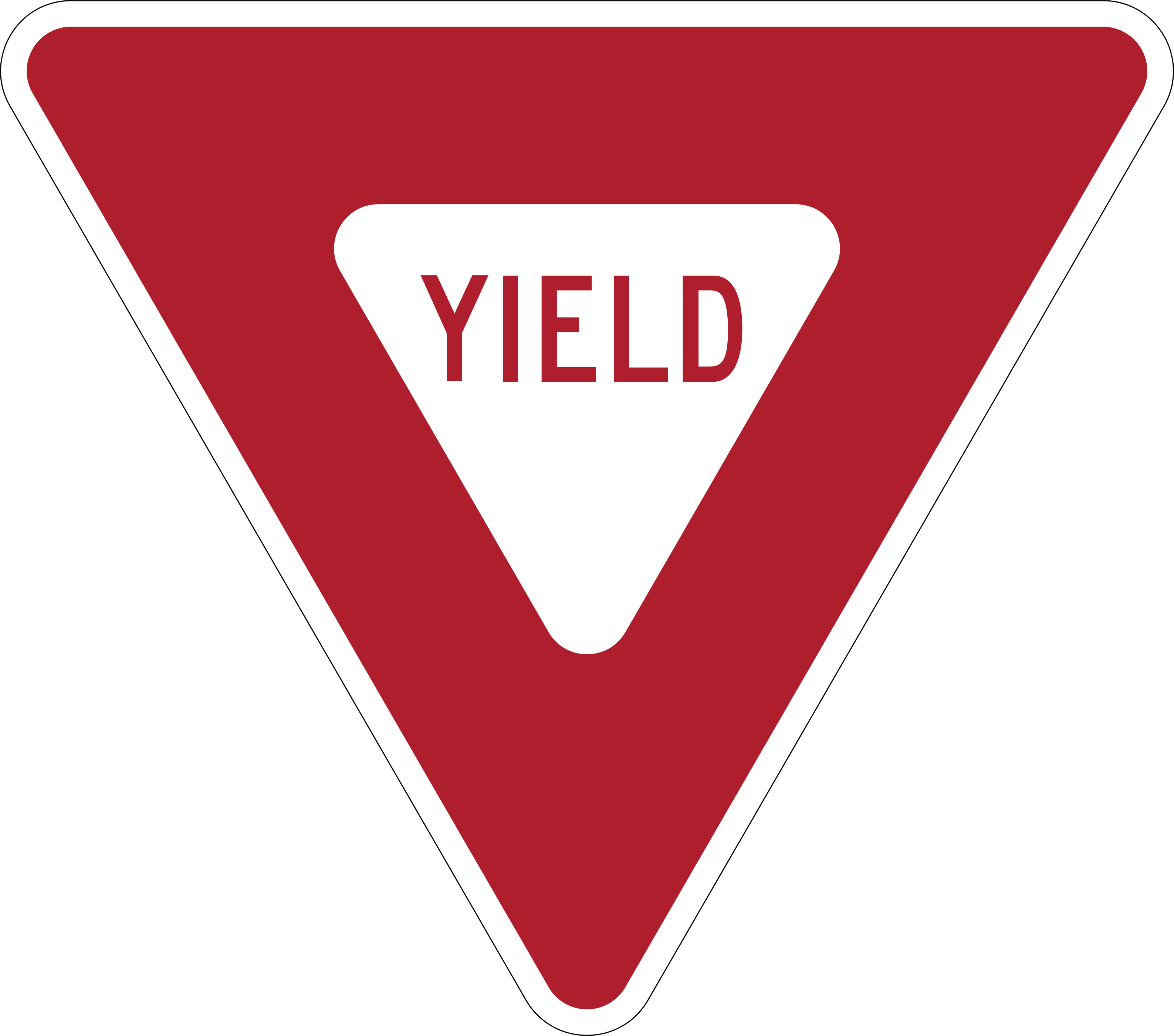
5. At the pictured YIELD sign, when is a complete stop required?
- Every time, even when the intersection is empty
- Never, because a yield sign requires continued motion
- Only when a police officer is present
- When stopping is needed to avoid interfering with traffic on the intersecting street
Show answer
When stopping is needed to avoid interfering with traffic on the intersecting street. A YIELD sign tells the driver to slow down and give the right of way. A complete stop is needed when traffic on the intersecting street would otherwise be interfered with, so stopping is conditional rather than automatic. The sign does not authorize rolling through a conflict, and it does not require an officer to be present. Approach slowly, assess the crossing traffic, and wait whenever continuing would interfere.
Study this in the handbook: Sign shapes and colors
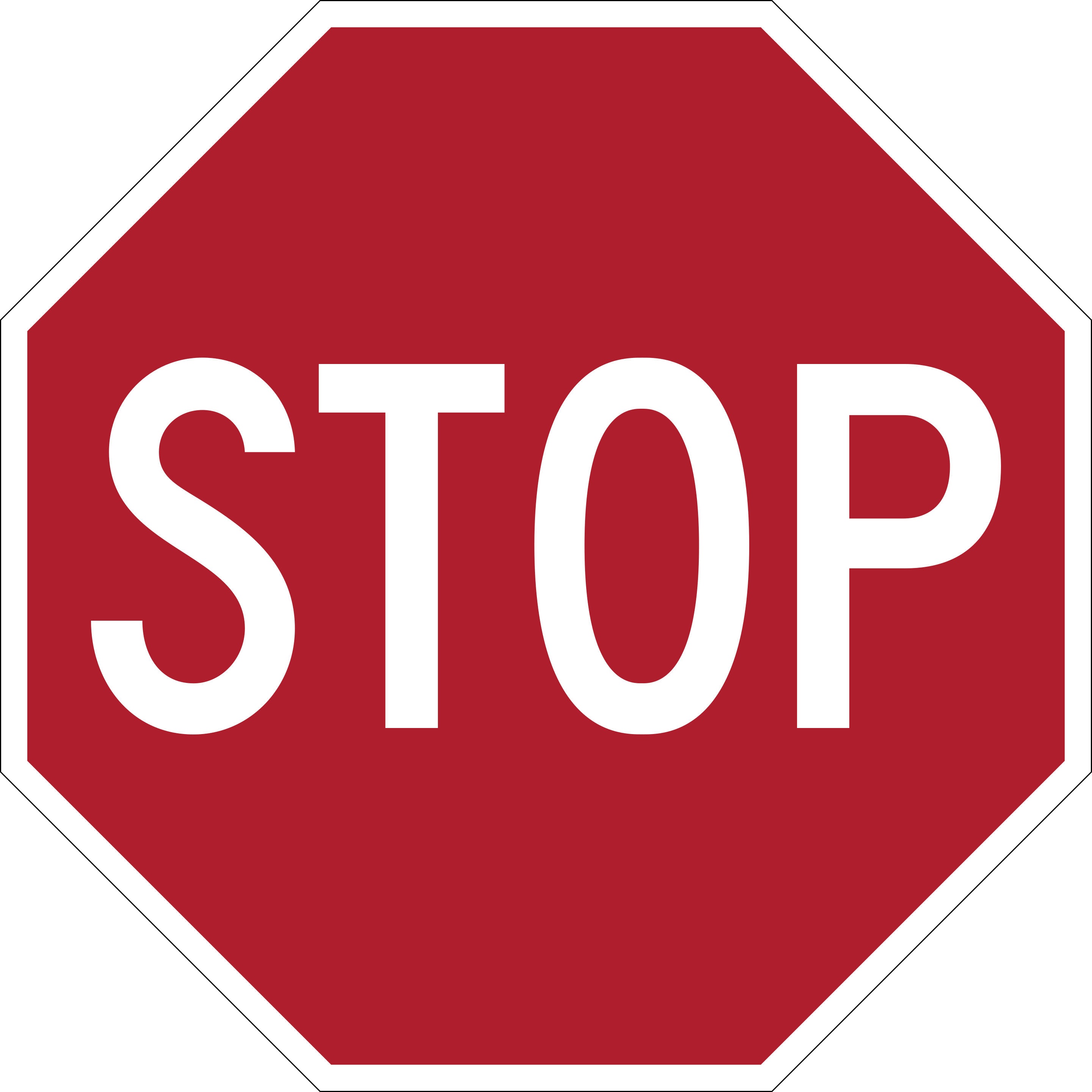
6. At the pictured STOP sign, where must the driver stop?
- Only after entering the intersection for a better view
- At the marked stop line, or before the intersection if no line is marked
- Only when another vehicle is approaching
- At least 50 feet before the sign in every case
Show answer
At the marked stop line, or before the intersection if no line is marked. A STOP sign requires a full stop at the appropriately marked stop line. If there is no stop line or marked crosswalk, the driver stops before entering the intersection at a point with a view of the intersecting street. Waiting for another vehicle is unnecessary, and stopping after entering the intersection is too late. Use the line or crosswalk as the first reference, then stop before the intersection when those markings are absent.
Study this in the handbook: Sign shapes and colors
7. A driver is transporting passengers younger than 16 in North Carolina. What must the driver ensure?
- Only the front-seat child is restrained
- Each passenger under 16 is secured in an approved restraint or seat belt
- Children may ride unrestrained for short trips
- Only passengers under eight need any restraint
Show answer
Each passenger under 16 is secured in an approved restraint or seat belt. The driver must make sure every passenger under age 16 is properly secured in a child passenger restraint system or a seat belt meeting federal safety standards in effect when it was manufactured. The rule is not limited to the front seat, short trips, or children under eight. Younger children have additional weight and age requirements, but the broad starting point is every passenger under 16 must be secured.
Study this in the handbook: Seat belts, child restraints and window tint
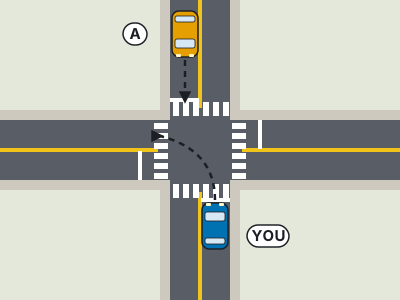
8. Two facing vehicles arrive together, one going straight and one turning left. Which vehicle must wait?
- The straight moving vehicle must yield to the turning vehicle
- Both vehicles must reverse from the intersection
- The vehicle turning left must wait for the straight moving vehicle
- The vehicle with the brighter headlights may turn first
Show answer
The vehicle turning left must wait for the straight moving vehicle. When facing drivers arrive together and one intends to turn left while the other travels straight, the left turning driver waits. The straight moving driver has priority, while the turning driver signals and proceeds only when the path is safe. This is not a contest decided by headlights, and both vehicles do not need to back away. Before beginning the turn, look for the straight vehicle and keep the intersection clear until its movement is complete.
Study this in the handbook: Right of way at intersections and roundabouts
9. How often does the North Carolina handbook suggest checking the mirrors for a vehicle following too closely?
- About once a minute
- About every 10 seconds
- Only when changing lanes
- Constantly, keeping the eyes on the mirrors
Show answer
About every 10 seconds. The North Carolina handbook pairs looking ahead with regular glances behind. About every 10 seconds, check the mirrors to see if any vehicle is following too closely. Mirror checks are also important when changing lanes, backing, slowing down or driving down a long hill, but they are not limited to those moments. Once a minute leaves long gaps, and staring into the mirrors is unsafe because the handbook says not to take your eyes off the road for more than an instant, since the vehicle in front could stop suddenly.
10. What do red reflective pavement markers indicate to motorists in North Carolina?
- A nearby fire hydrant
- A lane reserved for buses
- Wrong-way movements
- A legal passing area
Show answer
Wrong-way movements. Red reflective markers identify wrong-way movements for motorists. Seeing red markers should prompt an immediate correction of direction rather than continued travel. Blue markers have a different purpose: they can show nearby fire hydrants or water supplies. The marker color is therefore an operational warning, not a decoration or a passing guide. If the roadway layout seems reversed, slow down, reassess the signs and lanes, and avoid creating a head-on conflict.
Study this in the handbook: Traffic signals and pavement markings
11. On a divided highway with four or more lanes and a median, a school bus stops for passengers. Who must stop?
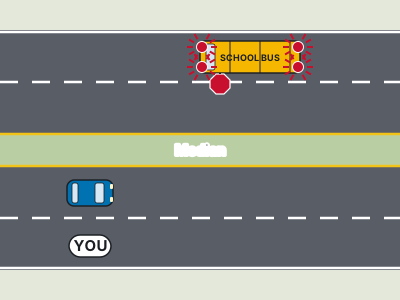
- Only traffic following the bus
- Only traffic traveling toward the front of the bus
- No one if the median is paved
- All traffic in both directions
Show answer
Only traffic following the bus. On a divided highway of four or more lanes with a median separation, only traffic following the school bus must stop when it stops for passengers. The median separates opposing traffic, creating a different rule from a two-lane roadway or a four-lane roadway without a median, where traffic from both directions stops. The material of the median does not remove the requirement for vehicles behind the bus. Identify the roadway layout first, then watch the bus's stop signal and flashing red lights. Drivers behind must wait until the signal is withdrawn, the lights are off, and the bus starts moving.
Study this in the handbook: Pedestrians, school buses and emergency vehicles
12. During which hours may a North Carolina Level Two Limited Provisional License holder drive without supervision?
- From 6 a.m. until 10 p.m.
- From sunrise until midnight
- From 5 a.m. until 9 p.m.
- At any hour once the license has been issued
Show answer
From 5 a.m. until 9 p.m.. Level Two permits unsupervised driving from 5 a.m. until 9 p.m. The driver may also have an exception for direct travel to or from qualifying work or volunteer emergency service, but ordinary unsupervised driving is limited to that daytime window. Sunrise and midnight do not define the handbook's hours, and issuance does not remove the restriction. Before a late trip, ask whether it falls inside the stated window or requires a supervising driver or listed exception.
Study this in the handbook: Graduated licensing: learner permit to full license
13. Which conduct is prohibited for a North Carolina driver under 18 while the vehicle is moving?
- Using a hands free device to call a parent
- Calling a hospital during an emergency
- Pulling off the roadway and stopping before using the phone
- Making a nonemergency phone call to a friend while driving
Show answer
Making a nonemergency phone call to a friend while driving. North Carolina prohibits a driver under 18 from using a mobile phone or associated technology while the vehicle is moving on a public street, highway, or public vehicular area. Exceptions allow calls to listed emergency services and to the driver’s parent, legal guardian, or spouse. A routine call to a friend does not qualify. Hands-free operation alone does not remove this age-specific restriction. Pull off the roadway and stop before making a call that is not covered by an exception.
Study this in the handbook: Graduated licensing: learner permit to full license
14. Before passing another vehicle in North Carolina, what should the driver do if the pass appears safe?
- Signal the intention to drivers ahead and behind
- Turn on hazard flashers and remain beside the vehicle
- Sound the horn without checking traffic
- Move left without signaling if the road is empty
Show answer
Signal the intention to drivers ahead and behind. After looking ahead and behind, a driver who determines that passing is safe should signal the intention so drivers ahead and behind can plan their movements. A horn may be used as an additional communication step, but it does not replace the required check and signal. Hazard flashers are not the passing signal, and an empty-looking road does not remove the duty to communicate. Scan, signal, then complete the maneuver with room to return safely.
Study this in the handbook: Passing, backing and parking
15. If a North Carolina driver refuses a required breath or blood test after an impaired driving charge, what immediate license consequence is listed?
- At least a 30 day revocation, plus an additional minimum 12 month DMV revocation
- A seven day suspension followed by unrestricted driving
- A permanent revocation on the first refusal
- A warning with no license action unless a crash occurred
Show answer
At least a 30 day revocation, plus an additional minimum 12 month DMV revocation. Refusing a required chemical test causes immediate license revocation for at least 30 days and an additional minimum 12 month revocation by DMV. The handbook does not make the consequence dependent on a crash, and it does not describe either a seven day result or automatic permanent loss for a first refusal. The useful cue is two time periods: 30 days immediately, then at least 12 months from DMV. In some circumstances, after six months of the willful refusal revocation, a judge may issue a limited driving privilege, but that possibility does not erase the revocations.
Study this in the handbook: Driving while impaired and alcohol limits
16. On a North Carolina curve or hill, when is passing always unsafe and usually illegal?
- When the driver cannot see at least 100 feet ahead
- When the driver cannot see at least 500 feet ahead
- Only when a NO PASSING sign is posted
- Never, if the vehicle ahead is going under the limit
Show answer
When the driver cannot see at least 500 feet ahead. Passing needs enough clear road to get around the other vehicle and back before meeting oncoming traffic. The North Carolina handbook lists places where passing is always unsafe and usually illegal, and one is any curve or hill where the driver cannot see at least 500 feet ahead. A hundred feet is nowhere near enough at highway speeds. The rule does not depend on a posted sign, and the fact that the vehicle ahead is going slowly does not change how far you can see. If a hill crest or bend hides the road, stay in your lane.
Study this in the handbook: Passing, backing and parking
17. Which speed rule applies even when a driver is traveling below the posted limit?
- Never drive at a speed that is unreasonable or unwise given existing conditions
- Always drive exactly at the posted limit
- Drive faster than the limit when traffic is light
- Use the posted limit without regard to weather
Show answer
Never drive at a speed that is unreasonable or unwise given existing conditions. North Carolina’s handbook says a driver must never travel faster than the posted speed limit or at a speed that is unreasonable or unwise given existing conditions. That means the posted number is not a command to maintain speed through rain, congestion, poor visibility or another hazard. The other choices remove the judgment the rule requires and could encourage unsafe travel. Treat the limit as an upper boundary, scan the road and surroundings, and reduce speed whenever conditions make the posted maximum imprudent.
Study this in the handbook: Speed limits and stopping distance
18. What must a North Carolina teen avoid for six months before moving from Level One to Level Two?
- Any parking tickets
- Any trips on interstate highways
- Driving after 9 p.m. with a supervisor
- Convictions for moving violations, seat belt infractions, or cell phone infractions
Show answer
Convictions for moving violations, seat belt infractions, or cell phone infractions. North Carolina requires a teen to have no convictions for moving violations, seat belt infractions, or cell phone infractions in the six months before graduating to Level Two, and the same rule applies before Level Three. Parking tickets are not on the list. Interstate driving is not barred, and driving after 9 p.m. with a supervisor is allowed once the permit is six months old. The permit must also be held nine months.
Study this in the handbook: Graduated licensing: learner permit to full license
19. During the first six months of a North Carolina Level One Limited Learner Permit, when may the teen drive?
- Any time, with the supervising driver
- Between 5 a.m. and 9 p.m., with the supervising driver
- Between 6 a.m. and 10 p.m., alone
- Only on weekends
Show answer
Between 5 a.m. and 9 p.m., with the supervising driver. For the first six months, a North Carolina Level One permit allows driving only between 5 a.m. and 9 p.m., and only with the supervising driver. Driving at any hour with a supervisor is allowed only after six months from issuance. A Level One permit never allows solo driving, and 6 a.m. to 10 p.m. is not the window. Weekends are not a rule in the handbook. The permit must be held nine months before a Level Two license.
Study this in the handbook: Graduated licensing: learner permit to full license
20. What does North Carolina require of a person convicted of DWI for the second time?
- Only a fine
- Only an alcohol class
- A written warning
- A jail sentence
Show answer
A jail sentence. North Carolina's DWI laws require anyone convicted of DWI for the second time to serve a jail sentence. A fine alone, an alcohol class alone, or a warning understate the law. The DWI laws also allow checkpoints, ban drinking while driving and carrying open containers, require alcohol screening for repeat offenders and high BACs, and require a substance abuse assessment before any DWI offender's license is reinstated.
Study this in the handbook: Driving while impaired and alcohol limits
QualitySpace is expanding to North Carolina
We are a California-based independent insurance brokerage working on licensing in more states. We cannot help with North Carolina insurance yet. Leave your email and we will let you know when we can.
Every question is written from the official North Carolina Driver Handbook. Need paper? Printable NC practice test with answer key.
Last verified 2026-10-05. How we check every question · Study all 207 as flashcards
Frequently asked questions
How many questions are on this North Carolina practice test?
This fixed set has 20 questions. It is test 5 of 10 from the 207 question North Carolina bank.
How does this fixed test relate to the full North Carolina bank?
Each numbered test is a fixed set of questions in a fixed order, so you can retake the same test later and compare. Every test mixes road signs and the other topics in about the same proportion as the full bank. Tests 1 to 10 together cover 200 of the 207 questions in the North Carolina bank, each once. The full practice page mixes the whole bank at random.
Last verified 2026-10-05. See the North Carolina DMV facts page for sourced state details.
Return to the full North Carolina practice test · Study road signs