
Test 9 of 10 · 20 questions · Free 2026
NC Permit Practice Test 9
Jump to the test ↓A fixed 20 question set from the North Carolina bank with answers and plain English explanations.
Question 1 of 20 · 0 right so far
All 20 questions in test 9
Every question below comes from the North Carolina question bank on this page. Open a question to see the correct answer and the explanation. Nothing here is hidden behind a signup.
1. For a driver age 21 or older, which BAC level is the North Carolina per se DWI threshold?
- A BAC of 0.08 percent or more
- A BAC of 0.05 percent or more
- A BAC of 0.10 percent or more
- A BAC of 0.15 percent or more
Show answer
A BAC of 0.08 percent or more. North Carolina treats a BAC of 0.08 percent or more as one way to prove impaired driving for the ordinary driver. The 0.05 figure signals increased crash risk in the handbook, but it is not the stated per se threshold. A 0.10 reading is higher than the legal benchmark, not the benchmark itself. The 0.15 figure triggers an ignition interlock consequence in another rule. On a knowledge question, separate the proof threshold from risk statistics and later sentencing requirements.
Study this in the handbook: Driving while impaired and alcohol limits
2. Before a North Carolina driver under 18 may take the learner permit or license test, what driver education instruction is required?
- Ten classroom hours and two road hours
- At least 30 classroom hours and six behind-the-wheel hours
- Six classroom hours and 30 road hours
- Twenty classroom hours with no driving instruction
Show answer
At least 30 classroom hours and six behind-the-wheel hours. The handbook requires a certificate for an approved driver education course with at least 30 hours of classroom instruction and six hours behind the wheel. The other combinations swap the figures or omit one part of the course. This requirement comes before testing for the permit or license, so the memory cue is classroom first in the larger number, road practice second in the smaller number: 30 and 6.
3. On a North Carolina road with a 55 mph speed limit, what is the minimum signaling distance before a turn?
- At least the last 50 feet
- At least the last 100 feet
- At least one mile
- At least the last 200 feet
Show answer
At least the last 200 feet. North Carolina asks for more warning on faster roads. The general rule is to signal at least the last 100 feet before turning or stopping, but if the speed limit is 45 mph or more, the handbook raises the minimum to at least the last 200 feet before turning. A 55 mph road falls into that higher band, so the 100 foot figure is not enough there. Fifty feet is far too short, and a full mile is not a stated requirement. The faster the traffic, the farther ahead the signal should start.
Study this in the handbook: Turn signals, headlights and bad weather
4. A North Carolina license holder moves to a new home within the state. By when must the holder update the physical address with the DMV?
- Within 10 days of moving
- Only at the next license renewal
- Within 60 days of moving
- Never, because the address only matters for out of state moves
Show answer
Within 60 days of moving. Chapter 7 of the North Carolina handbook covers a move inside the state. Within 60 days of moving within North Carolina, a license or ID holder must update the physical address with the DMV and get a duplicate license or ID. Vehicle owners also need a duplicate registration card. Most people can handle these steps online or at a local office. Waiting until the next renewal or assuming that only out of state moves matter would leave the DMV record wrong past the 60 day limit, and a ten day deadline is not what the handbook states.
5. How close to a fire hydrant may a North Carolina driver park?
- No closer than 5 feet
- No closer than 50 feet
- Any distance, as long as the driver stays in the vehicle
- No closer than 15 feet
Show answer
No closer than 15 feet. The North Carolina handbook lists places where a driver should not park, and one of them is within 15 feet of a fire hydrant or the entrance to a fire station. Firefighters need room to connect hoses and move equipment quickly, so the space around a hydrant must stay open. Five feet leaves too little room, and fifty feet is a larger distance than the rule requires. Remaining behind the wheel does not create an exception. When looking for a curb space, measure from the hydrant and leave at least 15 feet clear.
Study this in the handbook: Passing, backing and parking
6. A 17-year-old North Carolina provisional licensee is convicted of a second moving violation within 12 months. What suspension can follow?
- A 7-day suspension
- A 30-day suspension
- A 90-day suspension
- A one-year suspension
Show answer
A 30-day suspension. A North Carolina provisional licensee under 18 can have the license suspended for 30 days after a second moving violation within 12 months, 90 days after a third, and six months after a fourth. Seven days is not in the handbook. Ninety days is the third violation step, and one year is not listed for moving violations. Examples include speeding, following too closely, running a stop sign or red light, and passing a stopped school bus.
Study this in the handbook: Keeping your license: points, suspensions and renewal
7. How should a North Carolina driver steer while backing to keep the fullest view behind the vehicle?
- Look through the side window while steering with the right hand
- Use both mirrors without turning the head
- Use the left hand and look over the right shoulder through the back window
- Turn around only after the vehicle begins moving
Show answer
Use the left hand and look over the right shoulder through the back window. For backing, the handbook directs the driver to steer with the left hand and look over the right shoulder through the back window. Mirrors alone do not provide the full view the instruction seeks, and looking through the side window or waiting until movement begins can hide children or small objects. Before entering the vehicle, the driver should also check behind it. The cue is left hand on the wheel, right shoulder toward the back window, and a slow controlled movement. This technique is specifically tied to maintaining a full view behind the vehicle.
Study this in the handbook: Passing, backing and parking
8. A flashing red signal at a North Carolina intersection means you must first:
- Slow down but continue without stopping
- Turn around before reaching the intersection
- Wait for the signal to become a steady yellow
- Stop and wait until entering will not interfere with approaching traffic
Show answer
Stop and wait until entering will not interfere with approaching traffic. A flashing red signal carries the same stopping obligation as a stop sign. Come to a complete stop, then assess approaching traffic before moving. The light does not authorize a rolling approach, even when the intersection looks empty. A driver who merely slows may enter while another vehicle still has priority. Remember the sequence as stop, check, and proceed only after the movement can be made without interference.
Study this in the handbook: Traffic signals and pavement markings
9. Before changing lanes on a North Carolina highway, which check is specifically required beyond the mirrors?
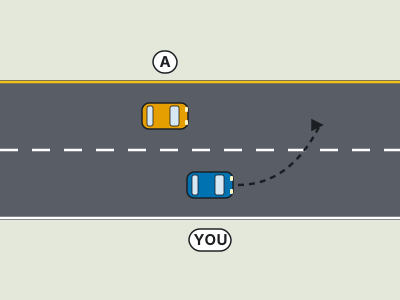
- Sound the horn continuously for ten seconds
- Look over your shoulder to clear the blind spot
- Look only at the vehicle directly ahead
- Turn off the signal before moving
Show answer
Look over your shoulder to clear the blind spot. Mirrors cannot show every area beside and just behind your vehicle, so the handbook calls for a shoulder check to confirm that the blind spot is clear. Signal in advance, inspect the mirrors, look beyond the new lane, and then move smoothly when the space is open. The horn is not a substitute for seeing. Turning off the signal before moving also removes useful information from nearby drivers who need to anticipate your maneuver.
10. How many points does North Carolina assess for running a red light or a stop sign?
- 1 point
- 3 points
- 4 points
- 5 points
Show answer
3 points. North Carolina assigns 3 points each for running a stop sign, running a red light, failing to yield the right of way, and speeding in excess of 55 mph. Driving with no liability insurance and failing to stop for a siren also count 3. One point is for littering from a vehicle. Four and 5 points are for more serious offenses like following too closely or passing a stopped school bus.
Study this in the handbook: Keeping your license: points, suspensions and renewal
11. When making a turn on a circular green traffic signal, whom must the turning driver yield to?
- Only vehicles approaching from behind
- No one because green gives turning traffic exclusive priority
- Oncoming traffic and pedestrians
- Only bicycles traveling in a marked lane
Show answer
Oncoming traffic and pedestrians. A circular green signal permits a driver to proceed cautiously, but a turning vehicle must yield to oncoming traffic and pedestrians. Green does not create an exclusive protected turn. The choices limited to traffic behind or bicycles leave out people and vehicles directly in the turning path. Before turning, scan the crosswalk and opposing approach, signal the movement, and continue only when the path is clear enough to protect everyone using the intersection.
Study this in the handbook: Traffic signals and pavement markings
12. Why does the North Carolina handbook say the closure time is quicker when approaching farm equipment?
- Farm equipment always has priority at intersections
- The equipment is required to use high beams
- Farm equipment can legally exceed the posted limit
- The equipment travels slowly
Show answer
The equipment travels slowly. Farm equipment moves slowly, so a vehicle approaching from behind closes the distance quickly relative to that equipment's progress and may reach it sooner than expected. The handbook uses this point to urge extra care. It does not grant farm equipment universal intersection priority, require high beams, or allow it to exceed speed limits. Reduce speed early, watch for turns and wide movements, and be ready for the short closure time.
Study this in the handbook: Railroad crossings and funeral processions
13. A 19-year-old in North Carolina tries to buy beer with a friend's ID. What license consequence follows a conviction?
- A 30 day suspension
- A warning
- No license action, since no driving occurred
- License revocation for a full year
Show answer
License revocation for a full year. North Carolina requires a one year license revocation when an underage person is convicted of obtaining or trying to obtain alcohol with a fake ID or someone else's license or ID. It is not a short suspension or a warning, and the rule applies even though no driving was involved. The person who lends the ID, and anyone who gives alcohol to an underage person, also face a one year revocation.
Study this in the handbook: Driving while impaired and alcohol limits
14. At a North Carolina roundabout, which road users have priority over a driver approaching the circle?
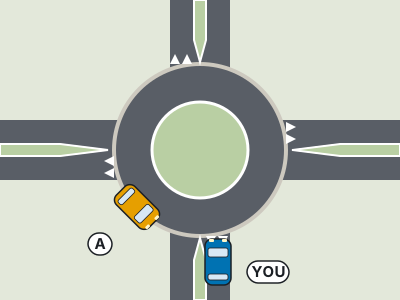
- Only vehicles entering from the right
- Approaching vehicles whenever they signal
- Vehicles or bicyclists already in the roundabout
- Pedestrians outside the marked crosswalk
Show answer
Vehicles or bicyclists already in the roundabout. Drivers approaching a roundabout must yield to vehicles or bicyclists already circulating in it. The approaching driver does not gain priority merely by signaling or arriving from a particular side. Pedestrians have their own right to use marked crosswalks, but the handbook’s stated priority for entering traffic is the road users already in the roundabout. A useful cue is yield before entry, then travel counterclockwise and signal when exiting. In a multi lane roundabout, choose the proper lane before entering and do not change lanes inside the circle.
Study this in the handbook: Right of way at intersections and roundabouts
15. If a North Carolina driver is already inside a roundabout when an emergency vehicle approaches with lights and sirens, what should happen?
- Stop immediately in the circle
- Exit the roundabout first, then pull over for the emergency vehicle
- Reverse around the circle to make room
- Enter the roundabout again after stopping at the entrance
Show answer
Exit the roundabout first, then pull over for the emergency vehicle. A driver already in the roundabout should exit first and then pull over so the emergency vehicle can pass. Stopping in the circle or reversing around it can block circulating traffic and create a collision hazard. The handbook separately says never to enter while an emergency vehicle using lights and sirens is passing through. The cue is to finish the current movement safely, leave the circle, and then yield. Drivers approaching the entrance should wait, while a driver already inside should complete the exit rather than make a sudden stop.
Study this in the handbook: Right of way at intersections and roundabouts
16. How many points does North Carolina assess for passing a stopped school bus in a private vehicle?
- 5 points
- 2 points
- 3 points
- 8 points
Show answer
5 points. North Carolina assigns 5 points for passing a stopped school bus, the same as aggressive driving, while reckless driving is 4. Eight points is the value when the violation happens in a commercial motor vehicle. Two points is for most other moving violations, and 3 points is for offenses like running a stop sign or red light. Seven points can bring a driver improvement clinic.
Study this in the handbook: Keeping your license: points, suspensions and renewal
17. What passenger restraint rule applies to all occupants in a North Carolina Level Two limited provisional vehicle?
- Every passenger must use a seat belt or child safety seat
- Only front-seat passengers must be restrained
- Only passengers younger than 16 must be restrained
- Restraints are optional when the trip is under five miles
Show answer
Every passenger must use a seat belt or child safety seat. The Level Two limited provisional rules require every passenger to be restrained by a seat belt or child safety seat. The requirement is not limited to the front row, a particular age, or a short trip. A quick drive can still produce a crash, so distance does not create an exception. Before moving, check that each occupant has the appropriate restraint secured. The useful cue is the license level and the word all: a Level Two vehicle may carry passengers only when each person is protected by the required belt or child seat.
Study this in the handbook: Seat belts, child restraints and window tint
18. How should a North Carolina driver pass a bicyclist safely?
- Pass immediately whenever the bicyclist is near the right edge
- Use the shoulder without checking opposing traffic
- Pass only with abundant clearance and no oncoming traffic
- Sound the horn and remain in the same position
Show answer
Pass only with abundant clearance and no oncoming traffic. Passing a bicyclist requires abundant clearance and no oncoming traffic in the opposing lane. The safest method identified by the handbook is changing lanes, while still following the ordinary vehicle passing laws. The handbook notes that a bicyclist staying to the right in the lane is helping following drivers see when it is safe to pass, but that position alone does not make an immediate pass safe. The shoulder is not a passing lane, and a horn does not replace clearance. Wait for a clear opportunity before moving out.
Study this in the handbook: Bicycles, mopeds, trucks and insurance
19. A sharp-turn warning should prompt the driver to do what before the turn?

- Reduce speed early and approach with control
- Maintain the posted speed without adjustment
- Accelerate to finish the turn quickly
- Stop in the travel lane before turning
Show answer
Reduce speed early and approach with control. A sharp turn leaves less room for a late correction, so the safe response is to lower speed before entering and keep the vehicle controlled throughout the bend. Holding speed automatically, accelerating, or stopping in the travel lane can create a hazard for following traffic. The right-angle arrow is a cue that the change in direction is more abrupt than an ordinary curve. Ease off early and set a manageable pace before steering into the turn.
Study this in the handbook: Speed limits and stopping distance
20. Where is the pennant-shaped yellow warning sign located, and what does it mark?
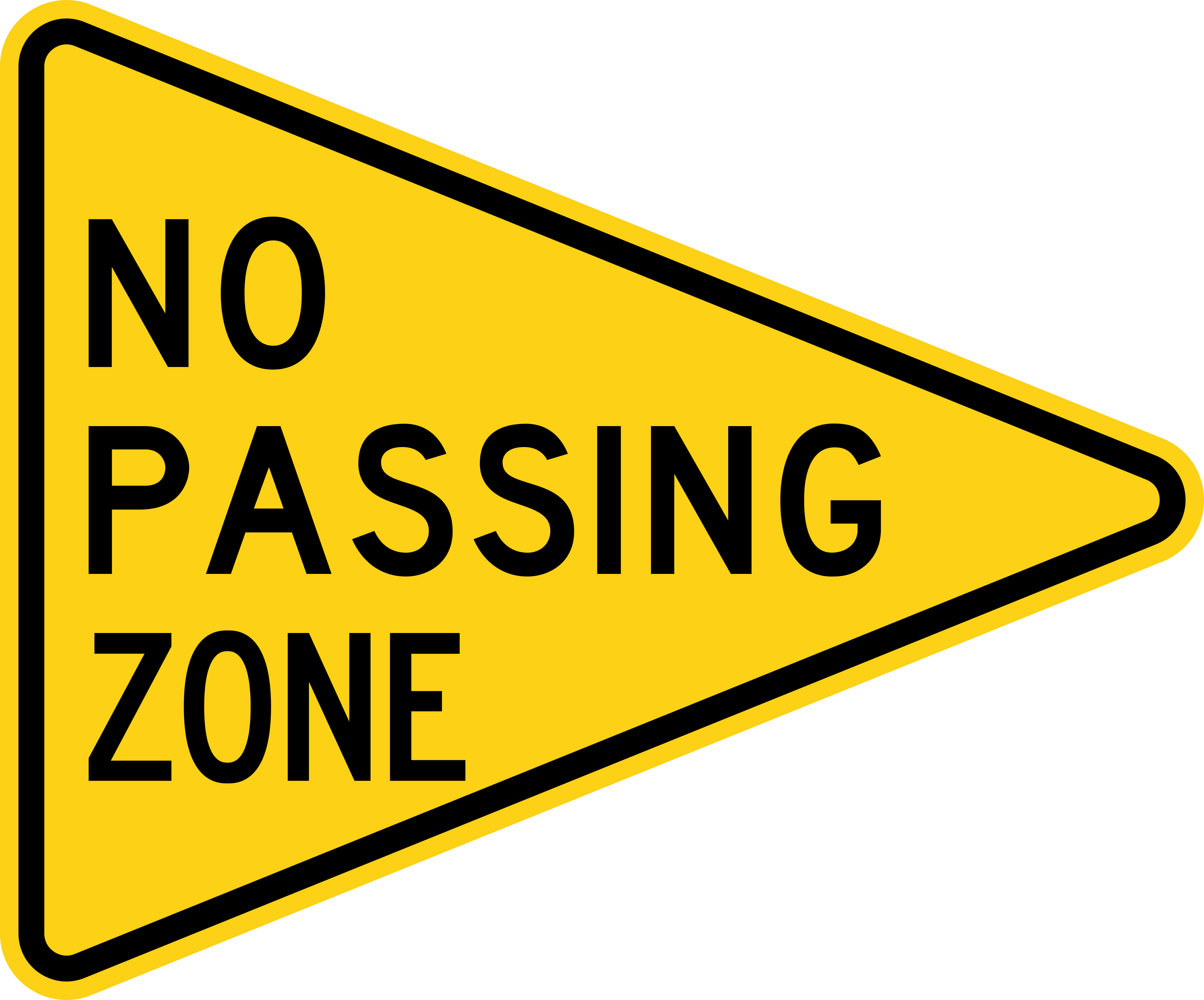
- On the left side of the road, at the beginning of a no-passing zone
- Above the lane, where a railroad crossing begins
- Beside the shoulder, where a school zone ends
- On the right side of the road, at the end of a passing zone
Show answer
On the left side of the road, at the beginning of a no-passing zone. The pennant is placed on the left side of the road and points to the beginning of a no-passing zone. The handbook connects that point with the continuous yellow pavement marking beside the driver’s lane. It is not an end marker, an overhead railroad notice, or a school-zone sign. A driver who sees the pennant should stop planning a pass and check the pavement marking before continuing. Its location on the left and its distinctive pennant shape provide an early cue that the passing restriction is about to begin.
Study this in the handbook: Sign shapes and colors
QualitySpace is expanding to North Carolina
We are a California-based independent insurance brokerage working on licensing in more states. We cannot help with North Carolina insurance yet. Leave your email and we will let you know when we can.
Every question is written from the official North Carolina Driver Handbook. Need paper? Printable NC practice test with answer key.
Last verified 2026-10-05. How we check every question · Study all 207 as flashcards
Frequently asked questions
How many questions are on this North Carolina practice test?
This fixed set has 20 questions. It is test 9 of 10 from the 207 question North Carolina bank.
How does this fixed test relate to the full North Carolina bank?
Each numbered test is a fixed set of questions in a fixed order, so you can retake the same test later and compare. Every test mixes road signs and the other topics in about the same proportion as the full bank. Tests 1 to 10 together cover 200 of the 207 questions in the North Carolina bank, each once. The full practice page mixes the whole bank at random.
Last verified 2026-10-05. See the North Carolina DMV facts page for sourced state details.
Return to the full North Carolina practice test · Study road signs