
Test 24 of 25 · 20 questions · Free 2026
NC Permit Practice Test 24
Jump to the test ↓A fixed 20 question set from the North Carolina bank with answers and plain English explanations.
Question 1 of 20 · 0 right so far
All 20 questions in test 24
Every question below comes from the North Carolina question bank on this page. Open a question to see the correct answer and the explanation. Nothing here is hidden behind a signup.
1. On a city street with curbs, you see a parking space that starts 20 feet from the curb line of a cross street. May you park there?
- Yes, 20 feet is plenty of room
- No, you must stay at least 25 feet away
- Yes, if you are on the right side
- No, you must stay 100 feet away
Show answer
No, you must stay at least 25 feet away. On streets with curbs, the handbook says not to park within 25 feet of the curb line of an intersecting street, or within 15 feet of the intersecting right-of-way lines where there is no curb. A space 20 feet from the cross street's curb line is too close. Parking on the right side is required, but it does not change the distance. The 100-foot figure belongs to the rule for emergency vehicles stopped at a crash.
Study this in the handbook: Passing, backing and parking
2. You reach an intersection during a storm and the traffic lights are completely dark. No officer is directing traffic. What should you do?
- Treat it as a four-way stop
- Drive through if your road is wider
- Slow down and go if no one is close
- Wait until the power comes back
Show answer
Treat it as a four-way stop. When a traffic light has failed because of a power outage or another problem, the handbook says to approach and proceed as though the intersection had a stop sign on every approach. Come to a complete stop, then go when it is safe, following the usual right-of-way rules. The rule does not apply if a law enforcement officer or another authorized person is directing traffic, or if another traffic control device is operating.
Study this in the handbook: Traffic signals and pavement markings
3. Under North Carolina DWI laws, where is it illegal to carry an open container of an alcoholic beverage in a car?
- Within reach of the driver's seat, and nowhere else
- When the driver has already been drinking
- Anywhere in the passenger area of the car
- Nowhere, as long as the driver is 21 or older
Show answer
Anywhere in the passenger area of the car. North Carolina's DWI laws prohibit transporting an open container of any alcoholic beverage, and the handbook spells out that this includes the passenger area of the car. The rule is not limited to containers the driver can reach, and it does not depend on whether the driver has been drinking. A driver's age does not create an exception either. These laws exist alongside the separate ban on consuming alcohol while driving, so an open bottle in the passenger area is a violation on its own.
Study this in the handbook: Driving while impaired and alcohol limits
4. About how fast can an air bag come out of the dashboard in a crash?
- Up to 20 miles per hour
- Up to 50 miles per hour
- Up to 500 miles per hour
- Up to 200 miles per hour
Show answer
Up to 200 miles per hour. The handbook stresses that an air bag is not a soft, billowy pillow. To do its job, it comes out of the dashboard at up to 200 miles per hour, faster than the blink of an eye. That force can hurt people who sit too close to it, which is why children riding in front can be seriously injured or killed. The handbook's answer is to buckle everyone and keep children properly restrained in the back seat.
Study this in the handbook: Seat belts, child restraints and window tint
5. You reach a freeway ramp meter, but its signal is dark. What should you do?
- Stop and wait until it turns green
- Proceed and merge or yield as normal
- Back up and use a different ramp
- Treat it as a flashing red and stop
Show answer
Proceed and merge or yield as normal. A ramp meter controls traffic entering a freeway from an entrance ramp. When it shows a circular red, vehicles facing it must stop; when it shows green, a vehicle may go ahead and merge. When the display is dark or showing neither red nor green, the handbook says you may proceed without stopping and enter the freeway by merging or yielding as normal conditions allow. A dark ramp meter is handled differently from a broken intersection signal.
6. A tractor-trailer ahead of you appears to be starting a left turn. What should you do before trying to pass?
- Check which way the driver is signaling
- Pass on the right while it swings wide
- Honk and pass on the left quickly
- Follow closely so you can slip past
Show answer
Check which way the driver is signaling. Large trucks need extra turning room because their rear wheels do not follow the path of their front wheels, so a truck may move in a way that looks like one turn while setting up another. When following a tractor-trailer, the handbook says to watch its turn signals before trying to pass, and if it seems to be starting a left turn, check which way the driver is signaling first. Following closely also blocks your view.
7. Your brake pedal suddenly sinks to the floor in a car with an automatic transmission. What does the North Carolina handbook advise?
- Turn off the engine and coast to a stop
- Shift into park while the car is moving
- Apply the emergency brake and shift into low
- Pump the gas pedal to slow the engine
Show answer
Apply the emergency brake and shift into low. For brake failure in a vehicle with an automatic transmission, the handbook says to apply the emergency brake and move the gear control lever into the low-range position. It admits this could damage the emergency brake and transmission, but under brake failure there is no better choice. Shifting into park while moving or shutting off the engine is not the advice. Do not panic; react promptly and look for a safe place to stop.
8. Your 11-year-old asks to ride in the front passenger seat, which has an air bag. Where does the North Carolina handbook say the child should ride?
- In front, with the seat moved forward
- Buckled up in a rear seat
- In front, if wearing a lap belt only
- In any seat, since the child is over 8
Show answer
Buckled up in a rear seat. Among its child safety points, the handbook says children age 12 and under should ride buckled up in a rear seat. Children riding in front can be seriously injured or killed when an air bag deploys, since it comes out at up to 200 miles per hour. An 11-year-old falls within the age the handbook names. Moving the front seat forward would put the child closer to the air bag, the opposite of the advice.
Study this in the handbook: Seat belts, child restraints and window tint
9. How do you check that you are following the car ahead by at least two seconds?
- Keep one car length for every 10 mph
- Stay far enough back to see its rear tires
- Watch its brake lights come on, then count to two
- Count from when it passes a point until you reach it
Show answer
Count from when it passes a point until you reach it. The two-second rule says to allow two seconds between the time the vehicle ahead passes a given point, such as a sign or a mark on the pavement, and the time your vehicle reaches the same point. If you get there before you count two seconds, you are following too closely. In rain, the handbook says to allow at least twice the normal following distance. Car-length rules and tire sightings are not the method the handbook gives.
10. A motorcycle is riding in the left part of your lane ahead of you, and there seems to be room on its right. May you pass it within the same lane?
- No, it is entitled to the full lane
- Yes, if you stay two feet away
- Yes, if the rider waves you by
- Yes, at low speed only
Show answer
No, it is entitled to the full lane. Under the handbook's rules, a motorcycle is entitled to the full width of its lane. To pass a motorcycle, you must change lanes and pass the same way you would pass a larger vehicle, even if the rider is using only part of the lane. Leave enough room that your vehicle's windstream cannot cause the rider to lose control. About two-thirds of North Carolina motorcycle crashes involve a car, usually with the car driver at fault.
Study this in the handbook: Bicycles, mopeds, trucks and insurance
11. After passing this sign, you reach a worker who turns a paddle to show SLOW. What should you do?
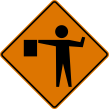
- Stop and wait for the paddle to turn
- Proceed slowly and with care
- Speed up to clear the work area
- Pull onto the shoulder and stop
Show answer
Proceed slowly and with care. The Flagger sign warns that a flagger in an orange vest is controlling traffic at a work site ahead. One side of the flagger's paddle says STOP and the other says SLOW. When the paddle shows SLOW, traffic may go ahead carefully at a reduced speed, staying alert in case the flagger signals a stop. Keep within the posted work zone speed limit through the area.
12. On a four-lane road with no median, an ambulance with lights and siren approaches from the opposite direction. Must you pull over and stop?
- No, you may keep going since it is opposite
- Only if the ambulance crosses into your lane
- Yes, the median exception does not apply here
- No, only the lane next to it must stop
Show answer
Yes, the median exception does not apply here. North Carolina requires all vehicles, regardless of direction, to yield to an approaching emergency vehicle by pulling to the right edge and stopping. The only exception the handbook lists is for traffic going the opposite way on a four-lane, limited-access highway with a center median. A four-lane road without a median does not qualify, so you must pull to the right and stop until the ambulance passes or an officer directs you.
Study this in the handbook: Pedestrians, school buses and emergency vehicles
13. While you are crossing, the gate on the far side of the tracks comes down in front of you. What should you do?
- Drive through the gate; it is flexible
- Stop and wait on the tracks for the gate to rise
- Back up quickly to get behind the near gate
- Stop and call 9-1-1 from inside the car
Show answer
Drive through the gate; it is flexible. If the gate on the far side comes down before you get across, the handbook says do not panic. Crossing gates cannot trap you or your vehicle: drive through the gate, because it is flexible and will not block you in. Stopping and trying to back up is risky, since your vehicle may stall on the tracks. Waiting on the tracks for the gate to rise leaves you in the train's path.
Study this in the handbook: Railroad crossings and funeral processions
14. In a traffic circle with more than one lane, where should you be before reaching your exit?
- In the inside lane
- In whichever lane is empty
- Stopped at the center island
- In the outside lane
Show answer
In the outside lane. In a traffic circle, all vehicles travel to the right in a counterclockwise direction and leave by making a right turn. If the circle has more than one lane, the handbook says to be in the outside lane before you reach your exit, and it adds that you should never make a right turn from an inside lane. Look and signal before you turn or change lanes. Vehicles already in the circle have the right of way.
15. On a two-lane highway, you see a long line of vehicles coming toward you. What does the North Carolina handbook tell you to watch for?
- A driver pulling out of that line to pass
- A police escort leading the line of cars
- A school bus about to stop for children
- A detour that is sending traffic your way
Show answer
A driver pulling out of that line to pass. Among its highway driving tips, the handbook says that if you see a line of vehicles approaching, watch for drivers who might be trying to pass. On some two-lane, undivided highways, oncoming vehicles are only a few feet away, so a driver who pulls out to pass can end up in your lane. The handbook also says to always have a possible escape route to avoid colliding with an oncoming vehicle.
16. A stopped school bus turns off its flashing red lights and pulls in its stop arm, but it has not started moving yet. May you pass it?
- Yes, once the lights are off
- Yes, if no children are visible
- No, wait until the bus starts to move
- No, wait one minute after the lights stop
Show answer
No, wait until the bus starts to move. North Carolina sets three conditions before you may pass a school bus that stopped for passengers: the mechanical stop signal must be withdrawn, the flashing red lights must be turned off, and the bus must have started to move. Lights going off is not enough by itself. Not seeing children is not a reason to go either, since children at a bus stop may dart into the street. No fixed waiting time is set; the bus moving is the signal.
Study this in the handbook: Pedestrians, school buses and emergency vehicles
17. Unless a different limit is posted, what is the maximum speed limit outside North Carolina cities and towns?
- 45 mph
- 65 mph
- 70 mph
- 55 mph
Show answer
55 mph. North Carolina's table of maximum speed limits lists 35 mph in cities and towns, 45 mph for school buses, 55 mph for school activity buses, 55 mph outside cities and towns, and 70 mph for interstates. So on a road outside a city or town, 55 mph is the maximum unless signs say otherwise. A posted limit is a maximum, not a target: the handbook says you must often drive slower than the posted limit to be safe, but you should not drive faster.
Study this in the handbook: Speed limits and stopping distance
18. Partway through a curve, you realize you need to slow down more. How should you brake?
- Brake hard right away so speed drops as quickly as possible
- Stay off the brakes completely and shift into neutral
- Apply the brakes gradually until steady pressure feels safe
- Pump the brakes rapidly all the way through the curve
Show answer
Apply the brakes gradually until steady pressure feels safe. The handbook's best approach is to slow down before entering a curve so you do not need to brake in it. If you must brake while in the curve, apply the brakes gradually until you are sure it is safe to keep continuous pressure on the pedal. Sudden hard braking is the opposite of that gradual approach. The handbook also says to begin the turn just before the road bends and to stay as far to the right as you can.
19. A driver is leaving a private driveway while cars pass on the street and a person walks along the sidewalk. Who has the right of way?
- The driver leaving the driveway, once stopped
- Only the vehicles traveling on the street
- The vehicles on the street and the pedestrian
- Whoever gets to the end of the driveway first
Show answer
The vehicles on the street and the pedestrian. A driver leaving a private driveway must stop and yield to all other vehicles and pedestrians. That means both the cars on the street and the person on the sidewalk go first. Stopping alone does not give you priority, and arriving at the end of the driveway first does not either. The handbook gives similar advice for unmarked intersections where it is hard to see in all directions: stop, then move forward slowly and cautiously.
Study this in the handbook: Right of way at intersections and roundabouts
20. You see this yellow sign on a rural North Carolina road. Why is it placed there?

- Hunting is allowed along this stretch of road
- The area is a known hot spot for animal collisions
- A wildlife park entrance is just ahead
- Animals are fenced off from the road here
Show answer
The area is a known hot spot for animal collisions. The handbook tells drivers to look for yellow wildlife crossing signs and explains that their placement is purposeful: they mark areas that are well-known hot spots for vehicle collisions with animals. When you see one, slow down and scan the road edges for movement and eye shine, especially at dawn, dusk, and in the first hours after dark. The sign does not mean hunting is allowed or that a fence keeps animals away from the road.
Every question is written from the official North Carolina Driver Handbook. Need paper? Printable NC practice test with answer key.
Last verified 2026-10-05. How we check every question · Study all 500 as flashcards
Frequently asked questions
How many questions are on this North Carolina practice test?
This fixed set has 20 questions. It is test 24 of 25 from the 500 question North Carolina bank.
How does this fixed test relate to the full North Carolina bank?
Each numbered test is a fixed set of questions in a fixed order, so you can retake the same test later and compare. Every test mixes road signs and the other topics in about the same proportion as the full bank. Tests 1 to 25 together cover every question in the North Carolina bank once. The full practice page mixes the whole bank at random.
Last verified 2026-10-05. See the North Carolina DMV facts page for sourced state details.
Return to the full North Carolina practice test · Study road signs