
Test 7 of 10 · 20 questions · Free 2026
NC Permit Practice Test 7
Jump to the test ↓A fixed 20 question set from the North Carolina bank with answers and plain English explanations.
Question 1 of 20 · 0 right so far
All 20 questions in test 7
Every question below comes from the North Carolina question bank on this page. Open a question to see the correct answer and the explanation. Nothing here is hidden behind a signup.
1. A 16-year-old North Carolina driver is driving. Whom may the teen call on a cell phone in an emergency?
- Emergency responders, a hospital or clinic, law enforcement, or a parent, legal guardian, or spouse
- Anyone, if the call is hands free
- Only friends in the car
- No one, even in an emergency
Show answer
Emergency responders, a hospital or clinic, law enforcement, or a parent, legal guardian, or spouse. North Carolina bars drivers under 18 from using a cell phone or related technology while driving, with an exception for emergency calls to an emergency response operator, a hospital, physician's office, or health clinic, an ambulance service, a fire department, a law enforcement agency, or a parent, legal guardian, or spouse. Hands free use is not a general exception. The ban is not lifted for friends, and emergencies are allowed.
Study this in the handbook: Graduated licensing: learner permit to full license
2. How long is the first suspension under North Carolina's point system?
- 30 days only
- 60 days
- 6 months
- 12 months
Show answer
60 days. A North Carolina point system suspension can be 60 days for the first, 6 months for the second, and 12 months for the third. Thirty days is too short for a first point suspension, and 6 and 12 months apply to later ones. A license may be suspended when 12 points build up within three years, and 8 points within three years after reinstatement can bring a second suspension.
Study this in the handbook: Keeping your license: points, suspensions and renewal
3. With properly working high-beam headlights at night, how far away should a North Carolina driver be able to see a person?
- 75 feet
- 200 feet
- 50 feet
- 1,000 feet
Show answer
200 feet. The North Carolina handbook gives a simple check for headlights. With the high beams on at night, a driver should be able to see a person who is 200 feet away. With the low beams, the distance drops to 75 feet, which is why the two numbers are easy to mix up. Fifty feet is the distance at which the plate light must make the license numbers visible, and a thousand feet is not a stated standard. Headlights that fall short may be out of adjustment, which vehicle vibration can cause.
4. After a North Carolina DWI conviction with a BAC of 0.15 or more, what vehicle equipment may be required?
- A second passenger side air bag
- A commercial vehicle speed governor
- A replacement catalytic converter
- An ignition interlock device
Show answer
An ignition interlock device. A DWI conviction with a BAC of 0.15 or more requires an ignition interlock device to be installed on the vehicle under the handbook’s listed conditions. The other equipment choices concern unrelated vehicle systems and are not the device used to monitor alcohol before driving. Another conviction within the past seven years can also trigger the same requirement, so the rule is not limited to high BAC alone. The test cue is the number 0.15 paired with ignition interlock, rather than a general repair or safety feature.
Study this in the handbook: Driving while impaired and alcohol limits
5. Within what period can accumulating as many as 12 North Carolina driver license points lead to suspension?
- Within six months only
- Within a five year period
- Within a three year period
- Within one calendar month
Show answer
Within a three year period. The handbook identifies as many as 12 points within a three year period as a possible basis for license suspension. The six month, five year, and one month periods change the time window and therefore do not describe the point system threshold. Do not confuse this with the separate rule that eight points within three years after reinstatement can produce a second suspension. The concrete cue is twelve over three, which describes the initial suspension possibility in the general driver license point system.
Study this in the handbook: Keeping your license: points, suspensions and renewal
6. A traffic light has malfunctioned because of a power outage. What should you do when approaching the intersection?
- Wait for the light to display green before moving
- Continue through if cross traffic is not visible
- Yield only to vehicles on your left
- Treat every approach as controlled by a stop sign
Show answer
Treat every approach as controlled by a stop sign. A dark or malfunctioning traffic light is handled as a stop sign on all approaches. That means you must approach carefully, stop as required, and proceed only when the intersection can be entered safely. Simply checking whether cross traffic is visible does not replace the required stop. The rule also changes if a law enforcement officer or another authorized person is directing traffic, or if another traffic-control device is operating. Remember the practical cue: a dead signal creates an all-approaches stop condition, rather than granting a free passage to the driver who arrives first or sees an empty roadway.
Study this in the handbook: Traffic signals and pavement markings
7. Where does the North Carolina handbook direct drivers for information about the state's toll roads?
- The N.C. Quick Pass office or website
- The State Highway Patrol
- The county sheriff
- The local DMV office
Show answer
The N.C. Quick Pass office or website. For information about North Carolina's toll roads, the handbook says to call the N.C. Quick Pass office at 1-877-769-7277 or visit www.myncquickpass.com. The sheriff, the State Highway Patrol, and the local DMV office are not the contacts the handbook gives for toll road information. The same interstate section reminds drivers to plan the trip in advance and to check the vehicle's water, oil, tires, and gas before leaving. Interstates are described as safer roads because traffic directions are separated and access points are fewer.
8. On a two-lane North Carolina road, when is passing permitted according to the center marking?
- Whenever double solid yellow lines are present
- When the skipped-yellow line is in your lane and the pass is careful
- Only when the solid yellow line is in your lane
- Whenever a vehicle ahead is moving below the limit
Show answer
When the skipped-yellow line is in your lane and the pass is careful. A skipped or broken yellow center line permits passing with care in both directions. The handbook adds a lane-specific point: on a two-lane road, the pass is permitted when the skipped-yellow line is in your lane. You still need adequate sight distance and no conflicting traffic. Double solid yellow lines prohibit crossing to pass, and a slow vehicle alone never makes an unsafe or prohibited pass lawful.
Study this in the handbook: Traffic signals and pavement markings
9. When vehicles reach an uncontrolled intersection together, which vehicle has the right of way?
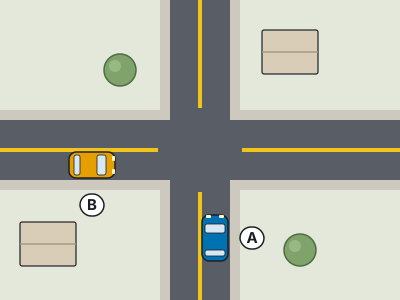
- The vehicle to the left
- The larger vehicle
- The vehicle going straight
- The vehicle to the right
Show answer
The vehicle to the right. When two vehicles arrive at an intersection at the same time and signs or signals do not decide the movement, the vehicle on the right receives priority. The left-side driver must yield, even if that driver is traveling straight. Vehicle size does not create a special exception, and a larger vehicle should not pressure the other driver into moving. Reduce speed as you approach, compare the other vehicle’s position with your own, and allow the right-side vehicle to proceed first. This right-side tie breaker is the cue to remember when arrival occurs simultaneously.
Study this in the handbook: Right of way at intersections and roundabouts
10. What restriction follows a second or subsequent license restoration after a North Carolina DWI suspension?
- The driver returns to the regular 0.08 standard
- The restriction remains 0.04 for every restoration
- The alcohol concentration restriction is 0.00
- The restriction applies only if the driver operates at night
Show answer
The alcohol concentration restriction is 0.00. A later restoration is treated more strictly than the first one. North Carolina sets the alcohol concentration restriction at 0.00 after a second or subsequent restoration following a DWI suspension. Returning to 0.08 confuses the ordinary DWI benchmark with a restoration condition. The 0.04 choice describes the first restoration, and the night driving limitation has no connection to this alcohol rule. Track the count of restorations, since that count changes the restriction from four hundredths to zero.
Study this in the handbook: Driving while impaired and alcohol limits
11. A North Carolina driver fails to yield at a stop sign and the crash causes serious bodily injury. What penalty does the handbook list?
- 3 points only
- A 90-day suspension and a $500 penalty
- A 1-year suspension with no fine
- A warning
Show answer
A 90-day suspension and a $500 penalty. North Carolina lists a 90 day suspension and $500 for failing to yield the right of way when entering an intersection, turning at a stop or yield sign, entering a roadway, approaching an emergency vehicle, or in a work zone, when the offense causes serious bodily injury. Failure to yield alone is 3 points, but serious injury adds this suspension. One year with no fine and a warning do not match the table.
12. A white sign displaying a numerical speed limit is what kind of sign?
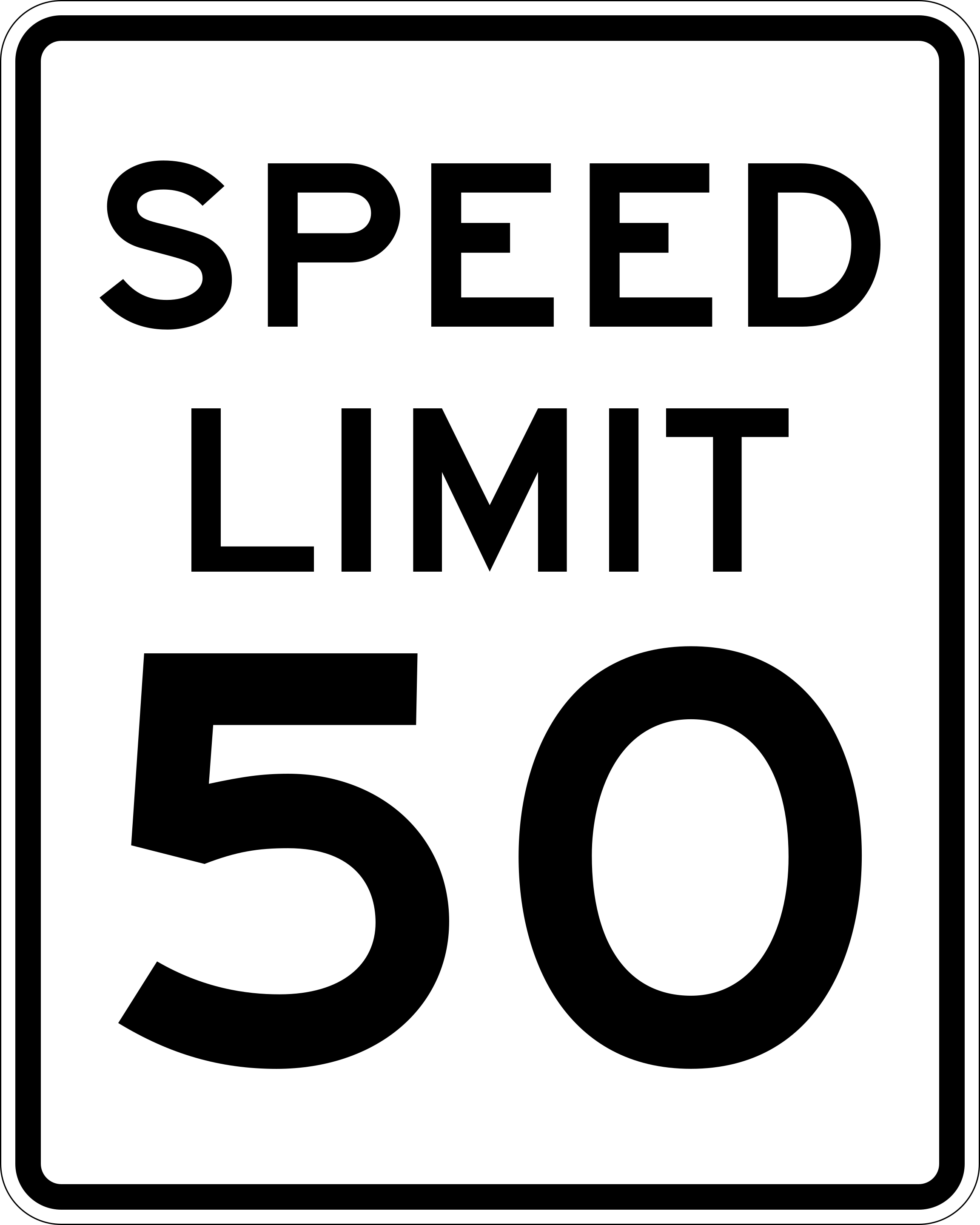
- A regulatory sign showing a traffic limit
- A guide sign naming a highway
- A warning sign that may be ignored in daylight
- A construction sign marking a detour
Show answer
A regulatory sign showing a traffic limit. A numerical speed limit is a regulation, so the white panel is a regulatory sign. It states the posted maximum that applies at that roadway location, subject to the conditions and other rules governing safe driving. It is not merely advisory, a route marker, or a construction detour notice. The handbook groups rectangular and square signs with speed limits alongside other regulations. The number on the panel is your immediate cue to check your speed before continuing.
Study this in the handbook: Sign shapes and colors
13. The diamond-shaped traffic signal panel is what kind of sign?
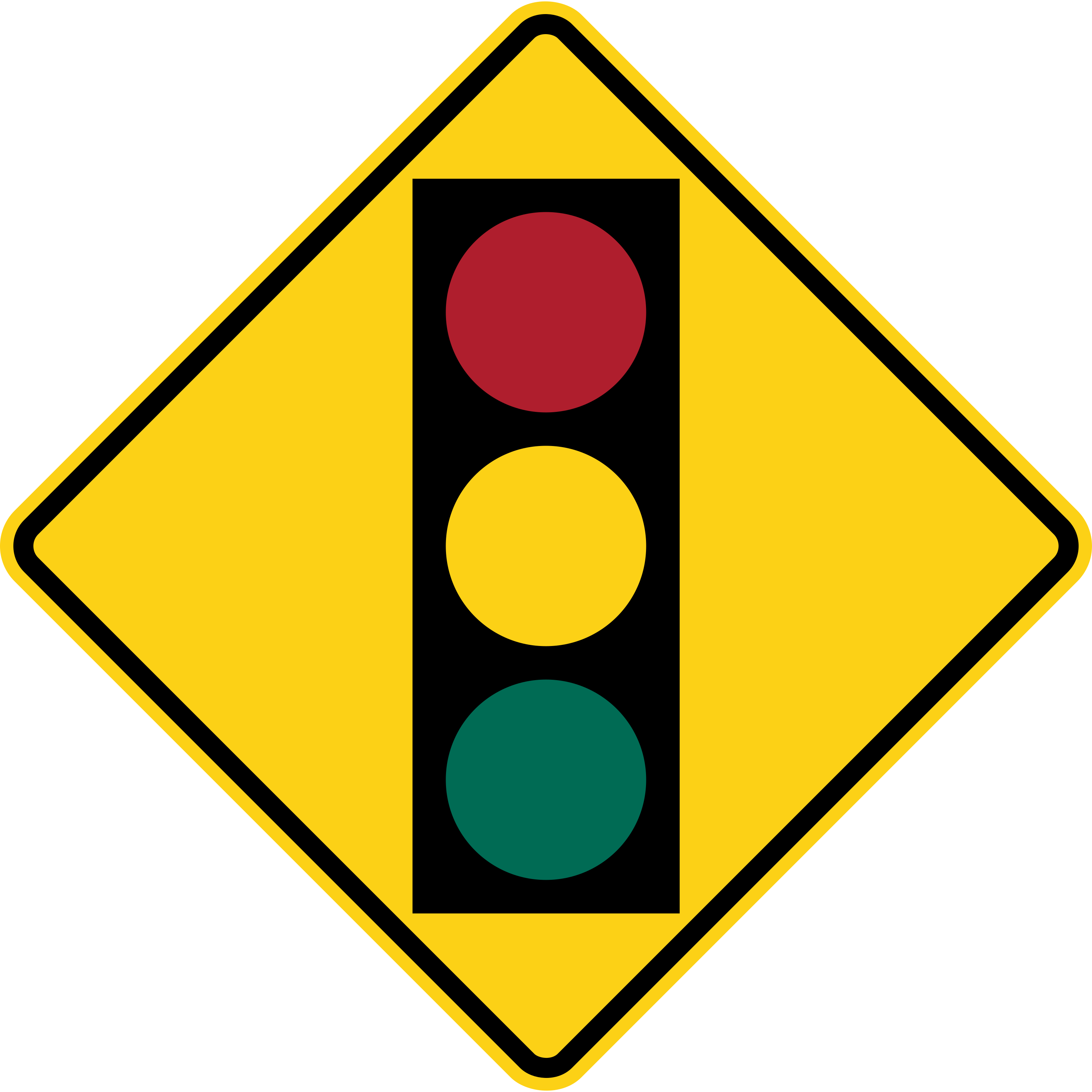
- A regulatory sign imposing a speed limit
- A guide sign identifying a route
- A warning sign that alerts drivers to a condition ahead
- A service sign identifying a nearby facility
Show answer
A warning sign that alerts drivers to a condition ahead. The traffic signal symbol appears on a diamond-shaped warning panel, so it alerts drivers to a condition ahead rather than imposing a direct movement rule. The actual signal controls traffic once you reach it, but the warning sign gives advance notice to scan forward and prepare. A regulatory sign would state a limit or other requirement, a guide sign would provide route information, and a service sign would identify a facility. The diamond outline is the quick visual cue to expect caution and an upcoming signal.
Study this in the handbook: Sign shapes and colors
14. When rain reduces visibility on a North Carolina roadway, which combination does the handbook require?
- Keep normal speed and use parking lights only
- Use high beams without windshield wipers
- Drive more slowly and use headlights and windshield wipers
- Stop in the travel lane until the rain ends
Show answer
Drive more slowly and use headlights and windshield wipers. Rain reduces visibility and makes pavement dangerous, so the handbook directs drivers to travel more slowly and use both headlights and windshield wipers. Parking lights alone do not provide the stated lighting response, high beams can create glare, and stopping in a travel lane creates another hazard. The road cue is to reduce speed before visibility worsens, switch on the required equipment, and leave additional following space for slippery pavement.
Study this in the handbook: Turn signals, headlights and bad weather
15. According to the North Carolina handbook, when should a driver travel below the posted speed limit?
- Only when another driver is following closely
- When conditions make the posted limit unsafe
- Never, because the posted limit is always required
- Only on roads outside cities and towns
Show answer
When conditions make the posted limit unsafe. North Carolina tells drivers that safe operation may require a speed below the posted limit. The posted number is a maximum for ordinary conditions, not a command to maintain that speed through rain, congestion, poor visibility, or hazards. A following vehicle does not determine the safe speed, and the advice applies in every road setting. The handbook also warns against driving faster than the posted limit. Use the condition of the roadway as the cue: if traction, sight distance, or traffic changes, reduce speed while staying within the legal maximum.
Study this in the handbook: Speed limits and stopping distance
16. How far from a fire truck responding to a fire alarm may a driver drive or park?
- Not closer than one block
- Not closer than 100 feet
- Not closer than one car length
- Any distance is allowed after the siren starts
Show answer
Not closer than one block. The handbook prohibits driving or parking closer than one block from fire trucks responding to a fire alarm. The distance is not the 100-foot rule that applies near an emergency vehicle stopped to investigate an accident or give assistance. A car length is far shorter than the stated buffer, and the presence of a siren does not authorize stopping beside the truck. Keep the route open for the response, remain outside the one-block boundary, and follow any directions from emergency personnel. The cue is a fire truck actively responding to a fire alarm.
Study this in the handbook: Pedestrians, school buses and emergency vehicles
17. In a North Carolina roundabout, how far around do you travel to continue straight?
- A quarter of the way around
- Three-quarters around
- A full circle
- Halfway around
Show answer
Halfway around. Once inside a roundabout, simply exit at the desired street. You go a quarter of the way around to turn right at the next street, halfway around to continue straight, three quarters around to turn left instead of making a left turn across traffic, and a full circle to make a U-turn. In a multi-lane roundabout, choose the lane for your exit before entering, typically the right lane to exit right.
Study this in the handbook: Right of way at intersections and roundabouts
18. How often does the North Carolina handbook say tire air pressure must be checked?
- At least once each month
- Once a year
- Only before long trips
- Only when the warning light comes on
Show answer
At least once each month. The air pressure of tires must be checked at least once each month. Underinflated tires wear out faster and raise the chance of a blowout, while overinflated tires reduce traction and wear the middle of the tread. Proper pressure gives safe handling and better fuel economy. Waiting for a warning light or a long trip leaves tires low for weeks at a time.
19. What does the North Carolina handbook recommend as the normal following interval?
- One car length at every speed
- Half a second when traffic is light
- At least two seconds behind the vehicle ahead
- Ten seconds in all conditions
Show answer
At least two seconds behind the vehicle ahead. The two-second rule calls for allowing two seconds between the moment the vehicle ahead passes a fixed point and the moment your vehicle reaches that point. A single car length changes meaning with speed, and half a second leaves little reaction time. Ten seconds is not the normal interval named here. Choose a roadside object, count after the lead vehicle passes it, and increase the gap when weather, traffic, or speed makes extra room sensible.
20. According to the North Carolina handbook, where should children age 12 and under ride?
- Unrestrained in the front seat
- In the cargo area if supervised
- In the front seat whenever an air bag is present
- Buckled in a rear seat
Show answer
Buckled in a rear seat. Children age 12 and under should ride buckled up in a rear seat. The handbook emphasizes that an air bag can seriously injure a child, so the presence of an air bag is a reason for caution, not a reason to place a child in front. The cargo area is not a substitute for a seating position. Pair the age cue with both parts of the guidance: rear seat and buckled up.
Study this in the handbook: Seat belts, child restraints and window tint
QualitySpace is expanding to North Carolina
We are a California-based independent insurance brokerage working on licensing in more states. We cannot help with North Carolina insurance yet. Leave your email and we will let you know when we can.
Every question is written from the official North Carolina Driver Handbook. Need paper? Printable NC practice test with answer key.
Last verified 2026-10-05. How we check every question · Study all 207 as flashcards
Frequently asked questions
How many questions are on this North Carolina practice test?
This fixed set has 20 questions. It is test 7 of 10 from the 207 question North Carolina bank.
How does this fixed test relate to the full North Carolina bank?
Each numbered test is a fixed set of questions in a fixed order, so you can retake the same test later and compare. Every test mixes road signs and the other topics in about the same proportion as the full bank. Tests 1 to 10 together cover 200 of the 207 questions in the North Carolina bank, each once. The full practice page mixes the whole bank at random.
Last verified 2026-10-05. See the North Carolina DMV facts page for sourced state details.
Return to the full North Carolina practice test · Study road signs