
Test 1 of 10 · 20 questions · Free 2026
WY Permit Practice Test 1
Jump to the test ↓A fixed 20 question set from the Wyoming bank with answers and plain English explanations.
Question 1 of 20 · 0 right so far
All 20 questions in test 1
Every question below comes from the Wyoming question bank on this page. Open a question to see the correct answer and the explanation. Nothing here is hidden behind a signup.
1. What information does a rectangular Wyoming traffic sign generally provide?
- A reminder that a vehicle cannot exceed 25 miles per hour
- A warning that animals are near the roadway
- The number of tracks at a railroad crossing
- Regulatory information about lawful speeds and directions
Show answer
Regulatory information about lawful speeds and directions. Rectangular signs communicate regulatory information, including lawful speeds and directions that govern how traffic should proceed. A diamond shape is the warning shape for road hazards, while the track count belongs on a sign below a railroad crossbuck. The slow vehicle symbol is a separate warning. If weather or darkness makes lettering hard to read, the rectangle still signals that the message controls movement rather than merely describing a hazard.
2. What does Wyoming law require of a driver at a railroad crossbuck?
- Always stop for five seconds even with clear tracks
- Yield the right of way to trains
- Speed up because trains must yield to vehicles
- Ignore the crossing unless a gate is present
Show answer
Yield the right of way to trains. Wyoming says railroad crossbuck signs are yield signs and that you are legally required to yield the right of way to trains. Slow down, look and listen for the train, and stop if a train approaches. A fixed five second stop at every clear crossing is not the stated rule, the duty to yield does not depend on a gate, and speeding up to cross ahead of a train reverses the rule. When more than one set of tracks is present, a sign below the crossbuck shows how many there are.
Study this in the handbook: Road sign shapes and colors
3. When should a driver avoid changing lanes in relation to an intersection?
- Only when traveling on a two lane road
- Only after fully entering the intersection
- Before or while in the intersection
- Never, if the driver signals first
Show answer
Before or while in the intersection. Lane changes near intersections create extra conflicts with turning vehicles, crossing traffic, and drivers making their own moves. Wyoming's manual says not to change lanes before or while in an intersection. Signaling is still required, but a signal does not make an unsafe location suitable for crossing into another lane. Complete the maneuver earlier when possible, confirm the blind spot is clear, and remain in your lane through the intersection.
Study this in the handbook: School buses and required stops
4. What should a driver do if an emergency stop is needed on the road?
- Park on a curve if the shoulder is wider there
- Keep only the right wheels off the pavement and leave the left wheels in the lane
- Move all four wheels off the pavement if possible and turn on emergency flashers
- Stop on a hill without using warning lights
Show answer
Move all four wheels off the pavement if possible and turn on emergency flashers. The safest emergency stop removes the vehicle from the active path of traffic. If possible, place all four wheels off the pavement, avoid stopping on a hill or curve where sight distance is poor, and activate the emergency flashers. A vehicle left in the lane can be struck even if its occupants can see approaching cars. The visible warning lights and a fully off pavement position give other drivers more time and room to react.
5. What optional contribution is offered on Wyoming driver license or identification card applications?
- A Wildlife Conservation donation
- A highway litter cleanup donation
- A driver education scholarship donation
- An emergency responder assistance donation
Show answer
A Wildlife Conservation donation. Wyoming license and identification card applications ask whether the applicant wants to donate to Wildlife Conservation. The wording makes it an optional contribution, not an added licensing charge or a donation to a different highway program. Litter cleanup, driver education scholarships, and emergency responder assistance may sound transportation related, but they are not the contribution named in this passage. The cue is the application question itself: the applicant chooses whether to add money for Wildlife Conservation when fees are collected.
6. After parking, which final security step does the manual direct the driver to take?
- Leave the engine running with the doors unlocked
- Turn off the engine, take the keys, and lock the car
- Keep the keys in the ignition for quick departure
- Park without setting any brake
Show answer
Turn off the engine, take the keys, and lock the car. The parking-on-hills guidance ends with three security actions: turn off the engine, take the keys, and lock the car. Those steps reduce the chance of an unattended vehicle moving or being entered. Leaving the engine running, keeping the keys inside, or skipping the brake reverses the manual's safety sequence. The exact cue is a parked vehicle that has been secured, not merely positioned at the curb. Complete the sequence after choosing the wheel direction for the slope.
7. When pedestrians are in a crosswalk area that has no pavement markings, what does the Wyoming manual require of drivers?
- Move into the opposite lane to pass the people safely
- Sound the horn and continue because pedestrians must always wait
- Stop only if a traffic signal is showing red
- Yield to pedestrians in the crosswalk area, whether markings are visible or not
Show answer
Yield to pedestrians in the crosswalk area, whether markings are visible or not. Wyoming requires drivers to yield to pedestrians in a crosswalk area even when pavement markings are absent. That rule makes the driver's observation and speed choice important at locations where people may cross. Continuing after a horn blast does not transfer responsibility, and a red signal is not the only condition that requires yielding. Moving around pedestrians can place the vehicle into opposing traffic. Reduce speed early, keep the crossing area visible, and be prepared to stop without blocking another path.
Study this in the handbook: Motorcycles, pedestrians, bicycles and animals
8. What is a multipurpose vehicle under Wyoming law, and where may it not be driven?
- A four wheel vehicle weighing 300 to 3,000 pounds with an upright seat, which may not be driven on interstate highways
- A motorcycle with a sidecar
- A vehicle limited to private land
- Any pickup truck
Show answer
A four wheel vehicle weighing 300 to 3,000 pounds with an upright seat, which may not be driven on interstate highways. A multipurpose vehicle has an identifying number, at least four wheels, weighs 300 to 3,000 pounds, and has a permanent upright seat at least 24 inches from the ground. It must be registered and plated to use streets and highways, may not be operated on interstate highways, and is subject to slow moving vehicle requirements. An ATV is treated as a multipurpose vehicle.
9. At what BAC does the manual say a driver may still be convicted of DWUI with supporting evidence?
- 0.05 percent
- 0.04 percent
- 0.02 percent
- 0.08 percent only
Show answer
0.05 percent. The manual explains that a driver may be convicted of DWUI with a BAC of 0.05 percent when other supporting evidence is present. That passage does not say conviction requires 0.08 percent in every case. The lower figures in the distractors are not the threshold identified there, and 0.08 percent is described separately as a level that can trigger a suspension and possible criminal penalties. Keep the two ideas distinct: 0.05 percent plus evidence can support conviction, while 0.08 percent has its own listed consequence.
Study this in the handbook: How alcohol affects you, and implied consent
10. An oncoming vehicle suddenly appears in your lane on a Wyoming road with a collision imminent. What does the manual say to do?
- Steer left into the other lane
- Brake hard and stay in the lane
- Steer off the road to the right
- Flash your lights and hold course
Show answer
Steer off the road to the right. If an oncoming or stopped vehicle suddenly appears in your lane of travel and there is immediate danger of a collision, steer off the road to the right. Before it reaches that point, the manual says to slow down and try to warn the other driver by flashing your headlights, then pull as far right as possible if the vehicle keeps coming. Steering left, braking in place, or holding course all leave you in the path the manual tells you to leave.
Study this in the handbook: When a crash seems imminent, and vehicle failures
11. How far before an intersection must a driver signal a turn under the manual's basic rule?
- At least 25 feet
- At least 100 feet
- Only after entering the intersection
- At least 500 feet in every situation
Show answer
At least 100 feet. Wyoming requires drivers to signal when turning or changing lanes and places the basic intersection distance at least 100 feet before the maneuver. Signaling after entry is too late for people and vehicles that need to understand the planned movement. Twenty five feet gives less notice than the stated rule, while 500 feet is not the universal figure in this guidance. Activate the signal early, check the path for road users, and keep communicating until the turn or lane change is complete.
Study this in the handbook: Pavement markings, signaling and passing
12. If a collision with an animal seems inevitable, what does the Wyoming manual advise?
- Swerve suddenly into another lane
- Release the brakes and rely only on the horn
- Accelerate toward the animal to clear the area
- Brake as quickly as safely possible while keeping control
Show answer
Brake as quickly as safely possible while keeping control. The manual advises against a sudden swerve because leaving the roadway or entering another path can create a more serious injury risk. Instead, brake as quickly as safely possible while keeping the vehicle under control and on the road. Accelerating toward the animal does not reduce the collision danger, and releasing the brakes to rely on the horn gives up the one action that lowers impact speed. The cue is controlled braking in the lane: reduce the impact risk without creating a second crash through an abrupt steering move.
Study this in the handbook: Motorcycles, pedestrians, bicycles and animals
13. A 15-year-old in Wyoming holds a restricted license for extreme inconvenience. When and where may the teen drive?
- Any time, anywhere in Wyoming
- Only between 6 a.m. and 10 p.m. within the home county
- Only between 5 a.m. and 8 p.m. and within 50 miles of home
- Only to and from school, at any hour
Show answer
Only between 5 a.m. and 8 p.m. and within 50 miles of home. Wyoming's restricted license for 14 and 15 year olds is valid only between 5 a.m. and 8 p.m. and within 50 miles of the licensee's residence. It is issued when an extreme inconvenience exists and the applicant lives five or more miles from school or work, with Highway Patrol approval. The statewide, county, and school-only choices do not match those limits. Driving outside the hours or the 50 mile radius can get the license suspended.
Study this in the handbook: Tests, renewals and restricted licenses
14. At what alcohol concentration is a Wyoming driver under 21 suspended under the Youthful Driver rule?
- 0.02 percent or more
- 0.05 percent
- 0.08 percent
- Any trace, even 0.001 percent
Show answer
0.02 percent or more. Wyoming's Youthful Driver Suspension applies to anyone younger than 21 in actual physical control of a vehicle with an alcohol concentration of 0.02 percent or more. The first offense suspension is 90 days. The 0.08 percent figure is the adult per se level, and 0.05 percent is the level at which an adult can be convicted with other supporting evidence. The rule sets 0.02 percent, not any trace amount.
Study this in the handbook: DWUI, Administrative Per Se and youthful driver suspensions
15. A 16-year-old Wyoming intermediate license holder must drive home at 11:30 p.m. Which trip can be allowed with a completed exception form?
- Driving friends home from a party
- Driving to a late movie
- Any trip, as long as a parent approves by text
- Driving home from an organized youth sports activity, certified by a parent
Show answer
Driving home from an organized youth sports activity, certified by a parent. Intermediate license holders may not drive between 11 p.m. and 5 a.m. unless they meet an exception and carry a completed exception form. Allowed reasons are medical necessity or emergency certified by medical personnel, work certified by an employer, and school, a school activity, organized youth sports, or a religious activity certified by a parent or guardian. Parties, movies, and a text from a parent do not qualify. The signed form must be carried and shown to police if stopped.
Study this in the handbook: Instruction permits and intermediate licenses
16. What speed is recommended when approaching a blind intersection?
- No more than 25 mph
- No more than 20 mph
- No more than 15 mph
- No more than 30 mph
Show answer
No more than 15 mph. At a blind intersection, trees, bushes, or buildings can block the view of vehicles coming from the side. Wyoming therefore says to approach a blind intersection at no more than 15 mph, which gives the driver more time to see a vehicle that was hidden and to stop. The 20, 25, and 30 mph choices are all faster than the figure the manual states. Slow down before reaching the blocked sightline, check both sides, and be ready to stop.
Study this in the handbook: Speed limits and adjusting to conditions
17. What do white and yellow pavement lines separate?
- White lines separate same-direction traffic and yellow lines separate opposing traffic
- White lines always prohibit passing and yellow lines require it
- Both colors mark the outside shoulder edge in every location
- Yellow lines separate same-direction traffic and white lines separate opposing traffic
Show answer
White lines separate same-direction traffic and yellow lines separate opposing traffic. White lines divide lanes moving in the same direction, while yellow lines divide traffic moving in opposite directions. That color distinction helps you read the roadway before deciding whether a lane change or crossing movement is even possible. The reversed-color option swaps the two traffic flows, and the other choices invent shoulder edge or passing commands that color alone does not provide. Combine the line color with its broken or solid pattern, then check traffic and sight distance before moving.
Study this in the handbook: Pavement markings, signaling and passing
18. What does the Wyoming manual tell you to do before backing up?
- Back up quickly so the vehicle spends less time in reverse
- Rely on the mirrors alone because they show everything behind the vehicle
- Sound the horn twice and reverse at normal speed
- Walk behind the vehicle to check the area, then back up slowly without depending on mirrors
Show answer
Walk behind the vehicle to check the area, then back up slowly without depending on mirrors. The manual says to check behind your vehicle by walking behind it before you back up, and once you are backing not to depend upon your mirrors. Turn your head and body so you can see where you are going, place your hand at the top of the steering wheel, and back up slowly. Mirrors leave blind areas close to the bumper where a child or object can hide, so a walk-around plus a direct look is the safe combination. Speed and horn blasts do not replace seeing the path.
Study this in the handbook: Speed limits and adjusting to conditions
19. What does the red and white sign shown warn a driver not to do?
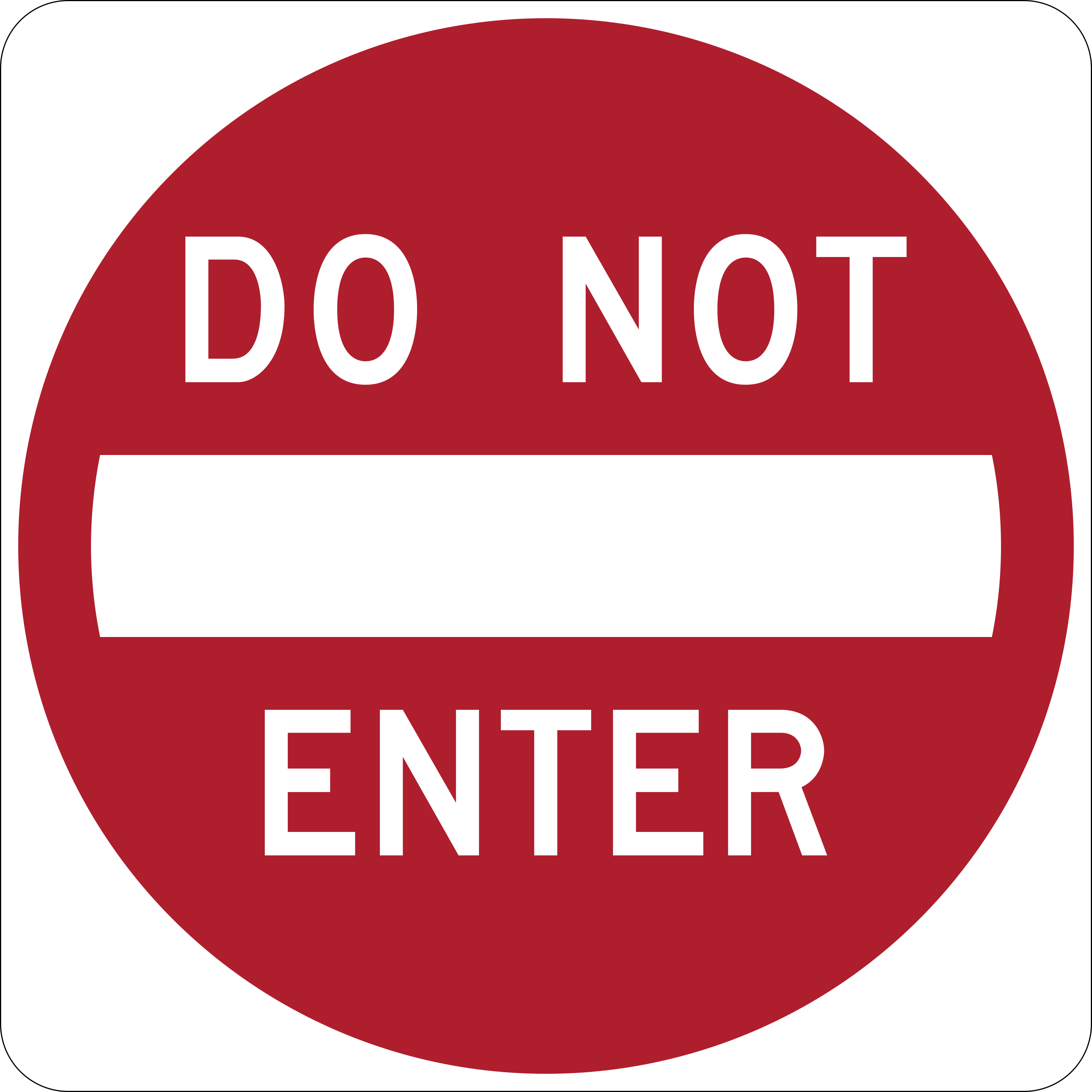
- Park along the curb during business hours
- Drive into the restricted entrance
- Follow the lane only when turning left
- Enter a railroad crossing after the gates rise
Show answer
Drive into the restricted entrance. The message on this regulatory sign bars entry from the direction facing the driver. It is not a parking restriction, a left-turn instruction, or a railroad procedure. The manual explains that rectangular signs provide regulatory information about lawful speeds and directions, which is why this sign should be obeyed as a direction control rather than treated as a suggestion. If encountered at an exit or one-way facility, stop safely, avoid entering, and find a lawful route.
20. What does the slow-moving vehicle symbol on the back of a vehicle warn you to do?

- Pass immediately because the vehicle must leave the road
- Slow down because the vehicle cannot travel faster than 25 mph
- Follow closely because the vehicle is accelerating
- Assume it can travel up to 35 mph before you pass
Show answer
Slow down because the vehicle cannot travel faster than 25 mph. The slow-moving vehicle symbol warns that the vehicle ahead cannot travel faster than 25 miles per hour. It has a legal right to use the road, so impatience is not a reason to pass without checking safety. Following closely removes reaction space, and a vehicle limited to 25 mph is not going to pull away from you. Reduce speed, remain patient, and pass only when visibility, markings, and opposing traffic make the movement lawful and safe.
Study this in the handbook: School buses and required stops
QualitySpace is expanding to Wyoming
We are a California-based independent insurance brokerage working on licensing in more states. We cannot help with Wyoming insurance yet. Leave your email and we will let you know when we can.
Every question is written from the official Wyoming Rules of the Road Driver License Manual. Need paper? Printable WY practice test with answer key.
Last verified 2026-10-05. How we check every question · Study all 200 as flashcards
Frequently asked questions
How many questions are on this Wyoming practice test?
This fixed set has 20 questions. It is test 1 of 10 from the 200 question Wyoming bank.
How does this fixed test relate to the full Wyoming bank?
Each numbered test is a fixed set of questions in a fixed order, so you can retake the same test later and compare. Every test mixes road signs and the other topics in about the same proportion as the full bank. Tests 1 to 10 together cover every question in the Wyoming bank once. The full practice page mixes the whole bank at random.
Last verified 2026-10-05. See the Wyoming DMV facts page for sourced state details.