
Test 8 of 10 · 20 questions · Free 2026
WY Permit Practice Test 8
Jump to the test ↓A fixed 20 question set from the Wyoming bank with answers and plain English explanations.
Question 1 of 20 · 0 right so far
All 20 questions in test 8
Every question below comes from the Wyoming question bank on this page. Open a question to see the correct answer and the explanation. Nothing here is hidden behind a signup.
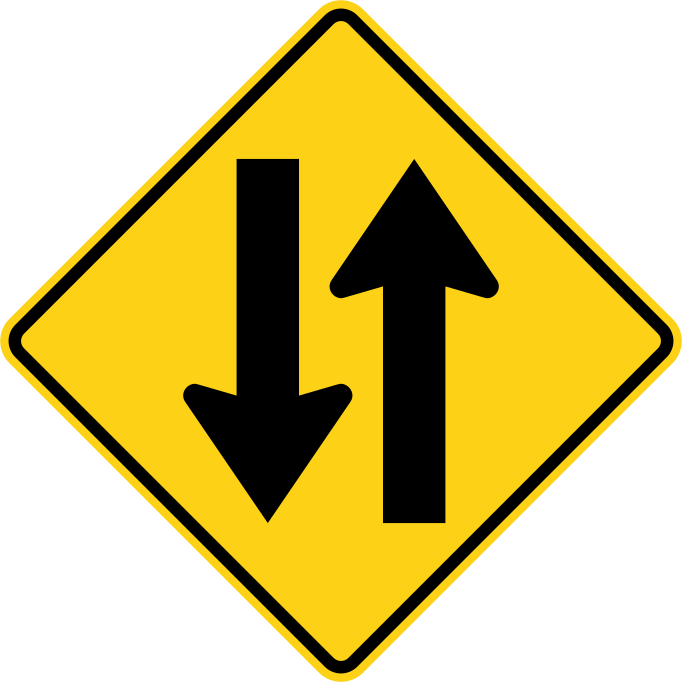
1. On the two-way roadway indicated by this sign, where should the driver travel?
- In any lane as on a multilane one-way roadway
- On the left side, because opposing vehicles must yield
- Across the center line whenever the lane ahead is open
- On the right side, leaving the left half for approaching traffic
Show answer
On the right side, leaving the left half for approaching traffic. On a two-lane road with one lane in each direction, Wyoming requires the driver to use the right side and yield the left half to oncoming traffic. That keeps opposing paths separated and preserves a predictable place for vehicles approaching from ahead. The left-side and either-side choices disregard the direction of traffic, while crossing the center line simply because space appears is unsafe. Keep a steady position within the right lane, watch the center line, and check for oncoming vehicles before any permitted maneuver.
Study this in the handbook: Pavement markings, signaling and passing
2. For the instruction-permit route to a Wyoming intermediate license, how much behind-the-wheel driving must a parent or legal guardian certify?
- 30 hours, including 5 at night
- 40 hours, including 8 at night
- 60 hours, including 15 at night
- 50 hours, including 10 at night
Show answer
50 hours, including 10 at night. For the instruction-permit route, Wyoming requires 50 hours of behind-the-wheel driving, including 10 hours at night, certified by a parent or legal guardian. The manual also lists holding a Restricted Class C license as a separate way to qualify, so the hours are tied to the instruction-permit path named here. The lower totals in the choices miss either the total practice requirement or the nighttime portion. Track both numbers before applying for the intermediate license.
Study this in the handbook: Instruction permits and intermediate licenses
3. After changing an address, how soon must a Wyoming licensee notify the department in writing?
- Within 10 days
- Within 5 days
- Within 30 days
- At the next license renewal only
Show answer
Within 10 days. The manual requires written notice within 10 days after a licensee changes an address. Five days is shorter than the stated period, while 30 days and waiting for renewal delay the notice beyond the requirement. This is an administrative update, so it does not depend on receiving a new license first. A practical cue is to handle the address change promptly and use the available department form rather than treating renewal as the notification deadline.
Study this in the handbook: Tests, renewals and restricted licenses
4. A Wyoming intermediate license holder is driving friends. Whose seat belt use is the teen responsible for?
- All occupants of the vehicle
- Only passengers under 18
- Only the teen driver's own
- Only the front seat passenger
Show answer
All occupants of the vehicle. Holders of intermediate licenses must ensure that all occupants of the vehicle are wearing seat belts, alongside the passenger limit and the 11 p.m. to 5 a.m. driving limit. The rule is not limited to the driver, to minors, or to the front seat. Wyoming's general safety belt law also requires every occupant to be belted and makes the driver responsible for compliance. Breaking any intermediate restriction brings a 30-day suspension.
Study this in the handbook: Instruction permits and intermediate licenses
5. A Wyoming driver's DWUI charge is dismissed in court, but the chemical test showed 0.09 percent. What happens to the Administrative Per Se suspension?
- It is cancelled automatically
- It still applies; dismissal does not affect it
- It is cut in half
- It turns into a warning
Show answer
It still applies; dismissal does not affect it. An Administrative Per Se suspension results when a DWUI arrest is followed by a chemical test of 0.08 percent or more, and dismissal of the DWUI in court does not affect it. The suspension is 90 days. It is an administrative action separate from the criminal case, so it is not cancelled, halved, or reduced to a warning. If the driver is later convicted of DWUI, the Administrative Per Se time served is credited toward the DWUI suspension.
Study this in the handbook: DWUI, Administrative Per Se and youthful driver suspensions
6. A Wyoming driver is convicted of a third reckless driving offense within five years. What happens?
- A 90-day suspension with limited privileges available
- A warning letter
- A one-year revocation with no limited driving privileges
- A six-month suspension
Show answer
A one-year revocation with no limited driving privileges. A third or later reckless driving offense within five years brings a one-year revocation, and no limited driving privileges are available. Reinstatement requires an SR-22, the reinstatement fee, and passing a re-examination of driving ability. A 90-day suspension is the first offense and six months the second. Wyoming lists no warning letter for reckless driving. Because it is a revocation, the driver must also go through a driver investigation before being relicensed.
Study this in the handbook: Suspensions, revocations and reinstatement
7. A Wyoming driver is convicted of furnishing beer to a 19-year-old passenger while driving. How long is the license suspension?
- A 30 day loss of license
- A one year loss of license
- A six month loss of license
- A 90 day loss of license
Show answer
A one year loss of license. The Transporting Liquor to a Minor Suspension results from a conviction for intending to furnish any alcoholic liquid or malt beverage to a person under 21 while operating or occupying a motor vehicle. The suspension is one year. Limited driving privileges may be available if the driver has not had a probationary license in the past five years. The 30 day, 90 day, and six month choices come from other Wyoming suspension rules.
Study this in the handbook: Suspensions, revocations and reinstatement
8. How many moving violations may a Wyoming driver have in 12 months before a suspension?
- One
- Up to three; a fourth conviction brings a suspension notice
- Five
- There is no limit
Show answer
Up to three; a fourth conviction brings a suspension notice. You are allowed up to three moving violations within a 12 month period. Upon receipt of a conviction for a fourth moving violation you will be notified that your driving privilege will be suspended for 90 days, and each additional moving violation within the 12 months adds another 90 day suspension. The date of the offense, not the conviction, sets the 12 month window.
Study this in the handbook: Suspensions, revocations and reinstatement
9. According to the Wyoming manual, when may a driver exceed the speed limit while passing?
- Never, even when the other vehicle is below the legal maximum
- By up to 20 mph whenever the passing lane is open
- By any amount needed to complete the pass
- By up to 10 mph when the other vehicle is below the legal maximum
Show answer
By up to 10 mph when the other vehicle is below the legal maximum. The passing guidance permits a driver to exceed the speed limit by up to 10 mph while passing a vehicle traveling below the legal maximum speed. It is a narrow passing allowance, not permission to accelerate without a limit or to use 20 extra miles per hour. The never option also misses the stated exception. Make sure passing is otherwise legal and safe, complete it promptly, and return to the right lane with adequate space. The cue is ten, not twenty or unlimited.
Study this in the handbook: Speed limits and adjusting to conditions
10. What does a solid yellow line generally prohibit?
- Turning into any public roadway
- Driving in the right lane of a two lane road
- Passing or lane changing, except for a qualifying left turn
- Passing only when the line is on the other side of traffic
Show answer
Passing or lane changing, except for a qualifying left turn. A solid yellow line separates traffic moving in opposite directions and marks a restriction on crossing it. The manual says it indicates no passing or lane changing, with an exception for making a left turn into or from an alley, private road, or driveway. It is not a ban on ordinary right lane travel. Check the marking's location and purpose before crossing, and never use the exception as a reason to pass.
Study this in the handbook: Pavement markings, signaling and passing
11. What does a solid white line tell a driver about changing lanes?
- Changing lanes is hazardous
- Changing lanes is required immediately
- Passing is encouraged if traffic is slow
- The line marks opposing traffic
Show answer
Changing lanes is hazardous. A solid white line warns that passing or changing lanes is hazardous. It does not command an immediate lane change, invite passing, or separate opposing traffic. Yellow lines serve the opposing-traffic function. Treat the solid white line as a reason to maintain position unless another lawful and clearly safe movement is available. The cue is the combination of color and pattern: white marks same-direction lanes, while solid warns against a lane change at that location.
Study this in the handbook: Pavement markings, signaling and passing
12. What should a Wyoming driver do after driving through deep water?
- Pull the parking brake hard
- Speed up to blow the water off
- Nothing, brakes are sealed
- Test the brakes and brake gently several times until they are dry
Show answer
Test the brakes and brake gently several times until they are dry. Wet brakes may pull your vehicle to one side or may not hold as well as usual, so you should always test your brakes after driving through deep water. Brake gently several times until the brakes are dry and work properly. Pulling the parking brake hard or speeding up is not the drying method the manual gives, and brakes are not described as sealed against water.
Study this in the handbook: When a crash seems imminent, and vehicle failures
13. How many motorcycles may ride side by side in one Wyoming lane?
- As many as fit
- No more than two, and only with the consent of both riders
- One only
- Three
Show answer
No more than two, and only with the consent of both riders. No more than two motorcycles may be driven abreast in the same lane, and only by consent of both motorcycle drivers. A motorcycle may not overtake and pass another vehicle within the same lane except another motorcycle, and a car must never share a lane with a motorcycle, which boxes both in with no way out. Give a motorcycle the full lane.
Study this in the handbook: Motorcycles, pedestrians, bicycles and animals
14. Within what distance behind another vehicle must a Wyoming driver dim to low beams?
- Within 1,000 feet
- Within 50 feet
- Only when the other driver flashes
- Within 300 feet from the rear of the vehicle ahead
Show answer
Within 300 feet from the rear of the vehicle ahead. If you are within 300 feet from the rear of a vehicle you are approaching, dim your lights to their lowest beam. Low beams must always be aimed to avoid glare, and high beams belong on open rural highways with no traffic ahead. A clean windshield inside and out reduces glare from oncoming vehicles, and clean headlights give more light.
Study this in the handbook: Night, weather and winter driving
15. What does the manual say about a DWUI conviction at a BAC of 0.05 percent?
- It applies only to commercial drivers
- It is impossible unless BAC reaches 0.08 percent
- It is possible with other supporting evidence
- It is allowed only when no chemical test was taken
Show answer
It is possible with other supporting evidence. The manual explains that 0.08 percent or more may result in a conviction, but a DWUI conviction can also occur at 0.05 percent when other supporting evidence exists. The lower figure is not an automatic clearance, and the statement is not limited to commercial operators. A driver should not treat the per-se threshold as permission to drive after drinking. The concrete cue is that alcohol concentration and evidence of impairment are separate parts of the warning.
Study this in the handbook: How alcohol affects you, and implied consent
16. In which language are Wyoming's written driver license tests given?
- Any language selected by the applicant
- Spanish only
- English only
- English and Spanish printed versions
Show answer
English only. The manual says all tests are given in English only. It separately permits an interpreter when a person cannot speak or write English, but that accommodation does not turn the written test into a Spanish or open-language version. The broad choice claiming any language conflicts with the stated procedure. Remember the distinction between the test language and communication help: the official testing material remains English, while an interpreter may assist as allowed.
Study this in the handbook: Tests, renewals and restricted licenses
17. At an intersection with no signs or signals, which approaching vehicle receives priority under the manual's general rule?
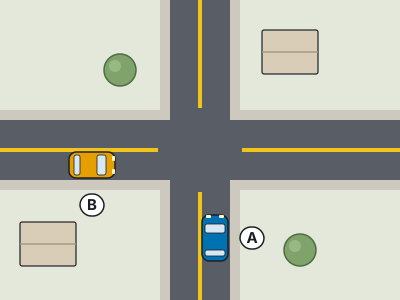
- The vehicle coming from the driver's right
- The vehicle that is larger
- The vehicle traveling faster
- The vehicle whose driver flashes headlights first
Show answer
The vehicle coming from the driver's right. At an intersection without signs or signals, the manual instructs a driver to watch for traffic coming from the right and yield regardless of who first reaches or enters the intersection. Vehicle size, speed, and a headlight flash do not create the stated priority. Slow enough to evaluate the approach, scan left and right, and be ready for a driver who fails to yield. The key memory cue is right side plus no control devices, followed by a yield.
Study this in the handbook: Right of way rules
18. What speed adjustment does the manual recommend for a wet road?
- Reduce speed by exactly half
- Increase speed by 5 mph
- Reduce speed by at least 5 to 10 mph
- Keep the dry-road speed
Show answer
Reduce speed by at least 5 to 10 mph. For wet pavement, the manual calls for reducing speed by at least 5 to 10 mph. Moisture reduces the tire grip available for steering and braking, so preserving a margin of control matters even when the road is not visibly flooded. Half speed is the guidance for packed snow, not ordinary wet pavement. The phrase at least signals that poorer visibility, standing water, traffic, or a sharper curve may justify going slower still. Watch the surface and adjust before the hazard reaches the tires.
Study this in the handbook: Speed limits and adjusting to conditions
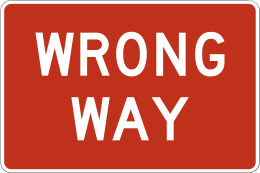
19. If this WRONG WAY sign faces you, which response is safest?
- Continue if the lane appears empty for 100 feet
- Accelerate until the next intersection to clear the sign
- Pull onto the shoulder, stop, and turn around only when no traffic is coming
- Back down the ramp without checking for approaching traffic
Show answer
Pull onto the shoulder, stop, and turn around only when no traffic is coming. A wrong-way sign means the vehicle is traveling against the intended direction, so continuing increases the risk of a head-on collision. The driver should stop or pull over when safe, then correct the route without entering more opposing traffic. An empty lane does not make wrong-way travel lawful, and accelerating or backing down the ramp without checking compounds the hazard. The manual emphasizes that signs communicate lawful directions. Treat the message as an immediate navigation and safety problem, not as a warning to ignore.
20. When traffic is joining from an entrance ramp, what should the driver in the through lane expect?
- Be alert for entering vehicles and move left when safe to help them enter
- Stop in the through lane so ramp traffic can cross in front
- Speed up to prevent any vehicle from entering the roadway
- Drive on the shoulder to create a lane for merging traffic
Show answer
Be alert for entering vehicles and move left when safe to help them enter. Wyoming's Interstate guidance says drivers already on the highway should watch for vehicles entering and, if it is safe, move left to allow them a smooth, safe entry. That is a cooperative lane choice, not a command to stop in the through lane, race the merging vehicle, or drive on the shoulder. The same list tells drivers to maintain a steady speed, avoid unnecessary lane changing, signal lane changes, and check blind spots, so move left only after confirming the adjacent lane is clear.
Study this in the handbook: Following distance and heavy trucks
QualitySpace is expanding to Wyoming
We are a California-based independent insurance brokerage working on licensing in more states. We cannot help with Wyoming insurance yet. Leave your email and we will let you know when we can.
Every question is written from the official Wyoming Rules of the Road Driver License Manual. Need paper? Printable WY practice test with answer key.
Last verified 2026-10-05. How we check every question · Study all 200 as flashcards
Frequently asked questions
How many questions are on this Wyoming practice test?
This fixed set has 20 questions. It is test 8 of 10 from the 200 question Wyoming bank.
How does this fixed test relate to the full Wyoming bank?
Each numbered test is a fixed set of questions in a fixed order, so you can retake the same test later and compare. Every test mixes road signs and the other topics in about the same proportion as the full bank. Tests 1 to 10 together cover every question in the Wyoming bank once. The full practice page mixes the whole bank at random.
Last verified 2026-10-05. See the Wyoming DMV facts page for sourced state details.