
Test 4 of 10 · 20 questions · Free 2026
WY Permit Practice Test 4
Jump to the test ↓A fixed 20 question set from the Wyoming bank with answers and plain English explanations.
Question 1 of 20 · 0 right so far

All 20 questions in test 4
Every question below comes from the Wyoming question bank on this page. Open a question to see the correct answer and the explanation. Nothing here is hidden behind a signup.
1. What does the round railroad advance warning sign tell a driver to prepare for?
- A roundabout that requires entering counterclockwise
- A highway-rail intersection ahead, where the driver should slow, look, and listen
- A bicycle route with priority over motor vehicles
- A no-passing zone that ends immediately at the sign
Show answer
A highway-rail intersection ahead, where the driver should slow, look, and listen. The round railroad warning sign marks an approaching highway-rail intersection. It gives the driver time to slow, look, listen, and be ready to stop if a train is approaching. The roundabout, bicycle, and no-passing interpretations assign unrelated meanings to the symbol. Advance warning is not permission to cross casually: never enter until there is room to clear the tracks, and expect a train at every highway-rail intersection even when no train is visible yet.
Study this in the handbook: Road sign shapes and colors
2. Without a licensed adult driver, how many unrelated passengers under 18 may an intermediate license holder carry?
- None
- Two
- One
- Three
Show answer
One. An intermediate license holder may transport no more than one passenger under 18 who is not an immediate family member unless accompanied by a licensed driver who is at least 18. The rule does not impose a total ban, so none is too restrictive, and two or three exceed the stated limit. The key distinction is unrelated minor passengers, not every passenger in the vehicle. Before starting, count that category and confirm whether the adult-supervision exception is present.
Study this in the handbook: Instruction permits and intermediate licenses
3. What speed limit does the manual list for residential areas unless otherwise posted?
- 20 mph
- 25 mph
- 30 mph
- 35 mph
Show answer
30 mph. The manual's default speed table lists residential areas at 30 mph unless a different limit is posted. The nearby 20 mph figure belongs to school zones, while 25 and 35 mph are not the residential entry in this table. A driver should still adjust below the listed maximum when road, traffic, or visibility conditions demand it. Use the location to recall the baseline, then check signs and choose a safe speed for what is actually visible ahead.
Study this in the handbook: Speed limits and adjusting to conditions
4. Which offense causes a license revocation in Wyoming?
- A first speeding ticket
- Failing to report an address change
- A first reckless driving conviction
- Leaving the scene of an injury accident
Show answer
Leaving the scene of an injury accident. Wyoming lists the offenses that cause a revocation: a third or later DWUI, a third or later reckless driving offense, leaving the scene of an injury accident, homicide by vehicle, and a felony that results directly from the manner of driving. A first reckless driving conviction brings a 90 day suspension, not a revocation. A single speeding ticket and a late address change are not on the list.
Study this in the handbook: Suspensions, revocations and reinstatement
5. What does a driver need to remember about the median on an Interstate highway?
- Use the median as a passing lane during heavy traffic
- Cross it carefully whenever the next exit is inconvenient
- Never cross it; continue to the next exit if a turn or exit is missed
- Stop on the median to check directions before continuing
Show answer
Never cross it; continue to the next exit if a turn or exit is missed. The divided-highway design separates opposing traffic, and Wyoming specifically prohibits crossing the median of an Interstate highway. Missing an exit is handled by continuing to the next exit, not by reversing or cutting across the separation. The median is neither a passing lane nor a safe place to stop for route planning. Keep the vehicle in its lane, read exit signs in advance, and accept the next legal opportunity when the intended ramp has already passed.
Study this in the handbook: Following distance and heavy trucks
6. A 20-year-old in Wyoming is convicted of driving while their license is suspended. What suspension does the manual list for a driver under 21?
- A six-month suspension
- A 90-day suspension
- A 30-day suspension
- No suspension, only a fine
Show answer
A 30-day suspension. Wyoming's list of suspensions includes Driving under Suspension, Revocation or Cancellation, which results in a 30-day suspension of driving privileges if the driver is under 21 years of age. Ninety days and six months are periods that appear in other Wyoming rules, such as the first reckless driving suspension and a second youthful driver alcohol suspension. A fine-only answer ignores the listed suspension for young drivers. Driving on a suspended license only adds to the time a young driver spends off the road.
Study this in the handbook: Suspensions, revocations and reinstatement
7. As you approach a Wyoming roundabout, which combination of actions is required before entering?
- Accelerate into the circle before traffic from the left reaches you
- Slow down, yield to pedestrians and circulating traffic, then wait for a gap on the left
- Stop inside the roundabout and let every approaching vehicle pass
- Enter immediately because circulating traffic must yield to entering vehicles
Show answer
Slow down, yield to pedestrians and circulating traffic, then wait for a gap on the left. Entry into a roundabout is controlled by yielding, not by racing for space. Reduce speed as you approach, give way to pedestrians and vehicles already circulating, look left, and merge only when a usable gap appears. Stopping inside the circle interrupts the continuous flow described by the manual. Circulating vehicles have priority, so an entering driver must select a safe opening instead of forcing other drivers to brake.
Study this in the handbook: Right of way rules
8. How early may a Wyoming licensee over 21 renew a driver's license?
- Up to one year early
- Within 30 days of expiration
- Within the 120 day period before expiration
- Only after it expires
Show answer
Within the 120 day period before expiration. Licensees over 21 may renew within the 120 day period preceding expiration, while licensees under 21 may renew within 90 days of expiration. Someone under 21 who wants an adult type license can renew only within 30 days of their 21st birthday. Renewal applications are mailed 120 days ahead to those over 21, and every renewal includes a vision screening.
Study this in the handbook: Tests, renewals and restricted licenses
9. What does an octagonal road sign tell the driver?
- The road is entering a school zone
- Yielding is optional when traffic is light
- A railroad crossing is ahead
- A complete stop is required
Show answer
A complete stop is required. The eight-sided octagon is reserved for stop signs, and the driver must come to a complete stop. This shape is intentionally distinctive so it can be recognized even when the words are hard to see. The downward triangle is the yield shape, the round sign warns of a railroad crossing, and the pentagon identifies a school zone or crossing. A light traffic condition does not make stopping optional. At a stop sign, stop before the crosswalk or stop line, then check the intersection before proceeding.
Study this in the handbook: Road sign shapes and colors
10. On an undivided highway, what must traffic in both directions do when a school bus stops with flashing red lights?
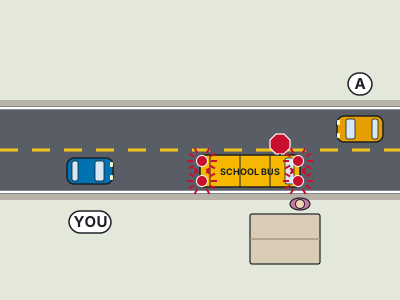
- Continue if traveling toward the front of the bus
- Stop for the bus
- Stop only when directly behind the bus
- Pass slowly if no child is visible
Show answer
Stop for the bus. On an undivided highway, Wyoming requires vehicles traveling in both directions to stop for a school bus that has stopped with flashing red lights. The driver may proceed only after the bus resumes motion or the flashing red lights are no longer activated, while still watching for pedestrians. Direction of travel on an undivided road does not create an exception. The divided-road rule is different, so first identify whether a physical barrier or separate roadway separates your vehicle from the bus.
Study this in the handbook: School buses and required stops
11. On a highway with two or more lanes in the same direction, what must you do near a stopped emergency vehicle with lights flashing?
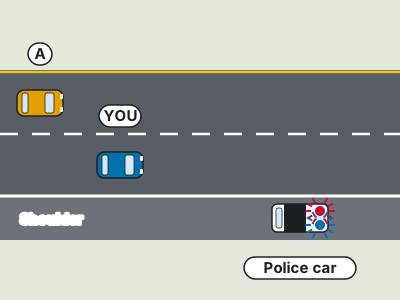
- Pass on the shoulder without changing lanes
- Remain in the adjacent lane if traffic is moving
- Stop beside the emergency vehicle in its lane
- Merge into the lane farthest from the emergency vehicle, or at least one lane away, when safe
Show answer
Merge into the lane farthest from the emergency vehicle, or at least one lane away, when safe. On a roadway with two or more lanes in the same direction, Wyoming calls for moving away from a qualifying stopped emergency or service vehicle with activated signals. The driver should merge into the farthest lane or maintain at least one lane of separation as soon as that move is safe. Staying adjacent keeps responders exposed, and stopping beside the vehicle can block traffic. Check mirrors early, signal, and follow any different direction from a police officer.
Study this in the handbook: Emergency vehicles and the Move Over law
12. On a two-lane road posted at least 45 mph, what is required near a stopped emergency vehicle on or within three feet of the roadway with activated signals?
- Slow to 20 mph below the posted speed limit
- Slow to 10 mph below the posted speed limit
- Maintain the posted limit if the emergency vehicle is off the pavement
- Stop in the opposing lane until the scene is cleared
Show answer
Slow to 20 mph below the posted speed limit. Wyoming's Move Over rule uses a specific reduction on a two-lane road when the posted speed limit is 45 mph or greater. The driver must slow to a speed 20 mph below that posted limit unless a police officer directs otherwise. The rule is not limited to vehicles sitting in a travel lane, and the shoulder or opposing lane is not a substitute for controlled passage. Identify the activated lights early, reduce speed before reaching the scene, and leave room for workers and responders.
Study this in the handbook: Emergency vehicles and the Move Over law
13. When must a Wyoming driver yield to a blind pedestrian?
- Never if the driver has a green traffic signal
- Only when the person is in a marked crosswalk at night
- Only when a crossing guard gives a hand signal
- When the person carries a visible white cane or has a guide dog
Show answer
When the person carries a visible white cane or has a guide dog. The driver must yield when a blind pedestrian carries a clearly visible white cane or is accompanied by a guide dog. The duty is not limited to nighttime, a marked crossing, or a crossing guard’s signal, and a green light does not authorize driving through the person’s path. Slow down, look carefully, and give the pedestrian room to cross before continuing, even when ordinary traffic signals appear favorable.
Study this in the handbook: Right of way rules
14. When is a Wyoming driver required to signal?
- When turning or changing lanes
- Only when turning at a red light
- Only when a vehicle is beside the car
- Only after the lane change is complete
Show answer
When turning or changing lanes. Wyoming requires drivers to signal both turns and lane changes. The duty is not limited to red lights, a nearby vehicle, or a signal sent after the maneuver has already happened. Early communication gives other road users time to understand your planned path. Check the mirrors and surrounding traffic, activate the appropriate signal before moving, and keep the vehicle’s movement smooth and deliberate.
Study this in the handbook: School buses and required stops
15. A Wyoming commercial driver gets an Administrative Per Se action for the first time. How long are commercial driving privileges disqualified?
- Disqualified for one year
- Disqualified for six months
- Disqualified for 90 days
- Disqualified for life
Show answer
Disqualified for one year. An Administrative Per Se action also brings a disqualification of commercial driving privileges. For a first major offense the disqualification is one year; for a second or later major offense it is lifetime. Ninety days is the length of the regular Administrative Per Se license suspension, not the commercial disqualification. Six months does not appear in this rule, and lifetime applies only to a repeat major offense.
Study this in the handbook: DWUI, Administrative Per Se and youthful driver suspensions
16. What ignition interlock requirement follows a fourth DWUI involving alcohol in Wyoming?
- None after the revocation ends
- One year
- Two years
- A lifetime requirement, with a petition for removal possible five years after conviction
Show answer
A lifetime requirement, with a petition for removal possible five years after conviction. A fourth or subsequent DWUI involving alcohol brings a lifetime ignition interlock requirement, though the driver may petition for removal five years after the conviction date. A second offense brings one year and a third brings two years, plus the remainder of the revocation period. A first offense with a BAC of .15 or more also requires an interlock. Each interlock period must be completed before the driver becomes eligible for any other type of driver license.
Study this in the handbook: Suspensions, revocations and reinstatement
17. An overhead lane sign shows an arrow with the word ONLY. What does that require?
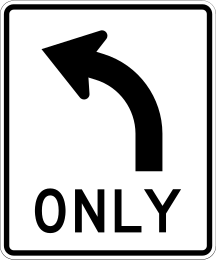
- You must go in the direction the arrow points
- You may choose any direction after slowing down
- You may use the lane for that direction only when traffic is heavy
- You must change lanes before the next signal
Show answer
You must go in the direction the arrow points. The word ONLY makes the arrow direction mandatory. It is not a suggestion and does not leave the driver free to select a different movement after slowing down. The sign also does not limit the rule to heavy traffic or automatically require a lane change. Read the arrow before entering the lane, position the vehicle early, and follow the indicated movement through the intersection.
Study this in the handbook: Pavement markings, signaling and passing
18. What does a diamond-shaped sign usually communicate?
- A warning about a road hazard
- A regulatory speed or direction rule
- A guide to a destination
- A driver service location
Show answer
A warning about a road hazard. A diamond shape is used to warn drivers about road hazards, so it calls for attention and preparation rather than simply naming a legal requirement. Rectangular signs carry regulatory information about speeds and directions, while guide and service information use other sign conventions. The tempting regulatory choice confuses shape with function. When a diamond appears, look beyond it for the curve, intersection, work area, or other condition it announces. The cue is diamond equals warning, even when the printed message is hard to read.
19. What does the Wyoming manual report about seat belt use in the state's road deaths from 2015 to 2019?
- Fewer than 10 people died each year
- An average of 100 people died each year, and more than half were not wearing seat belts
- Seat belt use was not a factor
- Nearly all victims were belted
Show answer
An average of 100 people died each year, and more than half were not wearing seat belts. An average of 100 people died on Wyoming's roads each year from 2015 to 2019, and more than 50 percent of those fatalities were not wearing their seat belts. The manual's message is simple: click it. The BUCKLE UP panel pairs that yearly average with the share of victims who were unbelted, so a claim that nearly every victim wore a belt contradicts the page.
Study this in the handbook: Seat belts and child restraints
20. White roadway lines generally divide lanes carrying traffic in what relationship?
- Traffic traveling in opposite directions
- Traffic traveling in the same direction
- The outer edge of every roadway shoulder
- Only lanes reserved for turning vehicles
Show answer
Traffic traveling in the same direction. White lines separate traffic moving in the same direction, such as lanes on a multilane roadway. Yellow lines separate opposing traffic, so the choice “Traffic traveling in opposite directions” reverses the basic color rule. A white lane line is not simply the shoulder edge, and it is not limited to turning lanes. The pattern adds another layer: broken lines may permit a lane change when clear, while a solid white line indicates that changing lanes or passing is hazardous. Use color first to understand traffic flow, then read whether the line is broken or solid before moving.
Study this in the handbook: Pavement markings, signaling and passing
QualitySpace is expanding to Wyoming
We are a California-based independent insurance brokerage working on licensing in more states. We cannot help with Wyoming insurance yet. Leave your email and we will let you know when we can.
Every question is written from the official Wyoming Rules of the Road Driver License Manual. Need paper? Printable WY practice test with answer key.
Last verified 2026-10-05. How we check every question · Study all 200 as flashcards
Frequently asked questions
How many questions are on this Wyoming practice test?
This fixed set has 20 questions. It is test 4 of 10 from the 200 question Wyoming bank.
How does this fixed test relate to the full Wyoming bank?
Each numbered test is a fixed set of questions in a fixed order, so you can retake the same test later and compare. Every test mixes road signs and the other topics in about the same proportion as the full bank. Tests 1 to 10 together cover every question in the Wyoming bank once. The full practice page mixes the whole bank at random.
Last verified 2026-10-05. See the Wyoming DMV facts page for sourced state details.