
Test 3 of 10 · 20 questions · Free 2026
WY Permit Practice Test 3
Jump to the test ↓A fixed 20 question set from the Wyoming bank with answers and plain English explanations.
Question 1 of 20 · 0 right so far
All 20 questions in test 3
Every question below comes from the Wyoming question bank on this page. Open a question to see the correct answer and the explanation. Nothing here is hidden behind a signup.
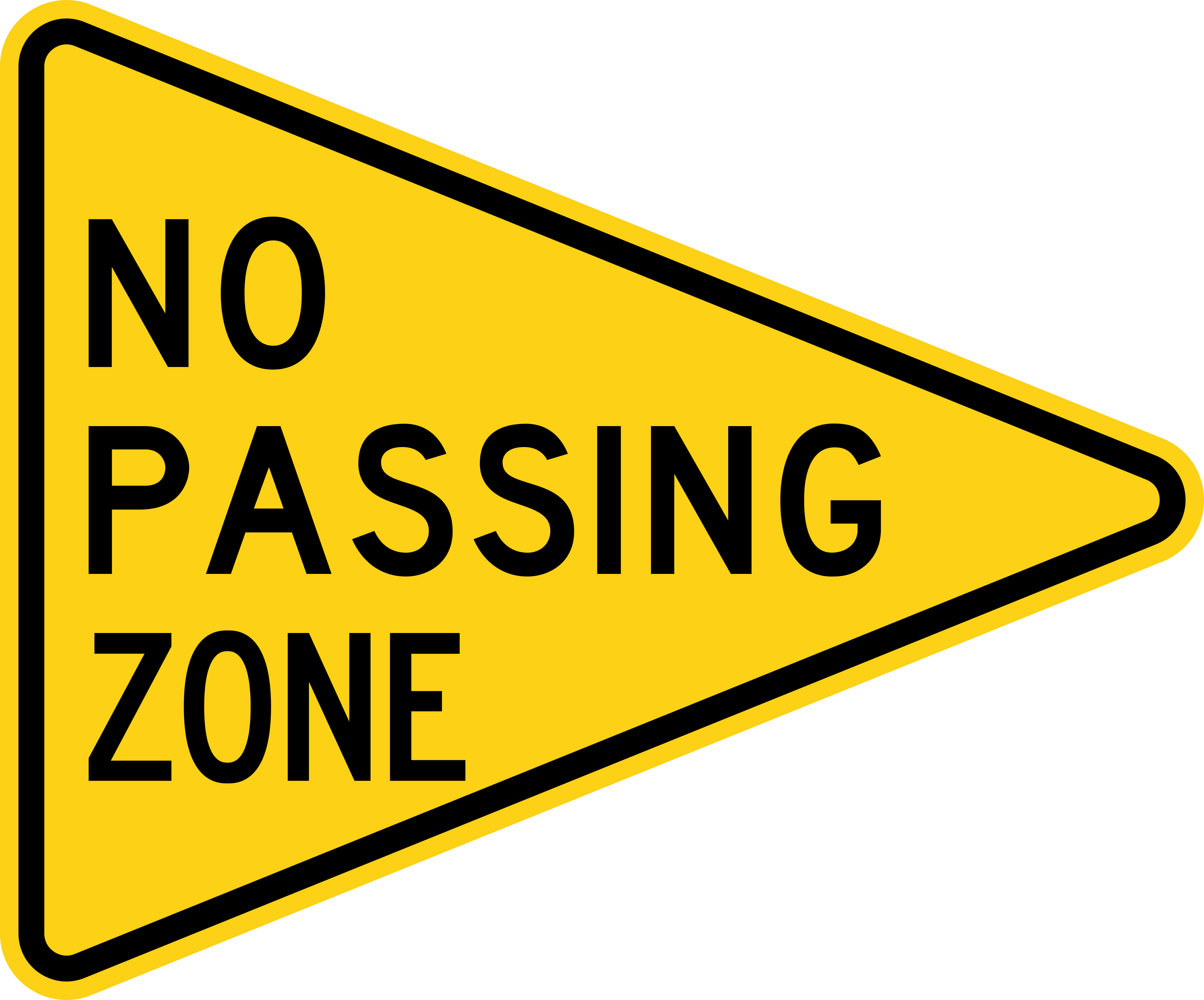
1. Where are pennant-shaped signs placed in Wyoming?
- Before a railroad crossing
- At the end of a school zone
- At the beginning of a no-passing zone
- At a required stop
Show answer
At the beginning of a no-passing zone. Pennant-shaped signs are located at the beginning of a no-passing zone. When you see one, do not pass, even if the vehicle ahead is slow, until the zone ends and the view and lane space make passing lawful and safe. The round sign warns of a railroad crossing, the pentagon marks a school zone or crossing, and the octagon requires a stop. Recognizing the pennant early lets you settle in behind the vehicle ahead instead of starting a pass you cannot finish.
Study this in the handbook: Speed limits and adjusting to conditions
2. When does a Wyoming restricted (extreme inconvenience) license expire?
- On the holder's 16th birthday
- 30 days after the holder's 16th birthday
- One year after it is issued
- 30 days after the holder's 17th birthday
Show answer
30 days after the holder's 16th birthday. A restricted license expires 30 days after the holder's 16th birthday. The 17th birthday version is a common mix-up: that is when the intermediate license expires, also 30 days after the birthday. The license does not simply end on the 16th birthday, and it is not tied to a one year term from issuance. A related 60 day restricted instruction permit exists for approved applicants without a permit.
Study this in the handbook: Tests, renewals and restricted licenses
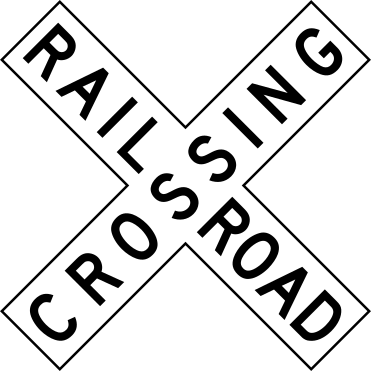
3. At the railroad crossing, how must a driver treat the crossbuck shown?
- As permission to pass another vehicle on the crossing
- As a stop sign that requires stopping even when every track is clear
- As a warning to accelerate before a train arrives
- As a yield sign, slowing, looking, listening, and stopping if a train approaches
Show answer
As a yield sign, slowing, looking, listening, and stopping if a train approaches. Wyoming identifies railroad crossbucks as yield signs. The driver slows, looks and listens, yields the right of way to trains, and stops if a train approaches. That differs from an automatic stop at every clear crossing, but it never permits racing a train or passing another vehicle on the tracks. Before entering, confirm that the vehicle can clear all tracks without stopping. Treat multiple tracks as a separate visibility check because another train may be approaching.
Study this in the handbook: Road sign shapes and colors
4. What does a round traffic sign warn a Wyoming driver about?
- The beginning of a no-passing zone
- A school zone or school crossing
- A railroad crossing ahead
- A requirement to yield to cross traffic
Show answer
A railroad crossing ahead. Wyoming reserves the round shape for a railroad crossing warning. The manual adds that a stop line or an X with the letters RR may be painted on the pavement before a crossing, and any combination of those devices may warn of an upcoming railroad crossing. The pentagon marks a school zone or crossing, the pennant marks the start of a no-passing zone, and the downward triangle is the yield shape. When a round sign appears, slow, look and listen for a train, and be ready to stop.
Study this in the handbook: Road sign shapes and colors
5. Wyoming's winter driving advice says to be prepared to stop and to increase following distance. Which landmark count does it give for checking whether you are following too closely?
- Count one thousand one through one thousand four after the vehicle ahead passes a landmark
- Count only one thousand one after the vehicle ahead clears the landmark
- Count one thousand one through one thousand three after the vehicle ahead passes the landmark
- Keep one car length of space at every speed
Show answer
Count one thousand one through one thousand four after the vehicle ahead passes a landmark. In its winter driving section, under be prepared to stop, Wyoming tells drivers to increase their following distance and check it with a landmark. Let the car ahead pass a fixed landmark, then count from one thousand one through one thousand four. If your car reaches the same landmark before you finish counting, you are following too closely. A shorter count or a fixed car length does not match this check. The manual's adverse conditions list asks for even more space on snow and ice, so treat four as a minimum.
Study this in the handbook: Night, weather and winter driving
6. What is the maximum fine for a first Wyoming child restraint violation?
- $60, waived on proof that an approved restraint was acquired after the offense
- $500
- $110
- $25
Show answer
$60, waived on proof that an approved restraint was acquired after the offense. The maximum fine for a first child restraint offense is $60, and the court shall waive it on receipt of proof of purchase, lease or other acquisition of an approved restraint after the offense. Second and subsequent offenses carry a maximum $110 fine. Non use or misuse of a restraint is a primary offense, so an officer may stop a vehicle for it alone.
Study this in the handbook: Seat belts and child restraints
7. After stopping at a flashing red signal, when may a driver proceed?
- Immediately, because flashing signals do not control traffic
- When the intersection is clear and required yielding is complete
- Only after another driver waves you through
- Whenever the vehicle behind begins to move
Show answer
When the intersection is clear and required yielding is complete. A flashing red signal is treated like a stop sign. The driver first makes a complete stop before entering, then proceeds only when the intersection is clear and any traffic or pedestrian with priority has been yielded to. The claim that flashing signals do not control traffic is false, and movement by a following driver does not establish a safe gap. A wave from another driver is not a substitute for your own observation. Stop at the proper line or crosswalk, scan both directions, and enter only after the conflict is gone.
Study this in the handbook: Traffic signals and arrows
8. What principle applies when a sharp turn or curve is ahead?
- Drive over the center line to make the turn less sharp
- Brake only after the vehicle begins to slide outward
- Use the posted maximum speed even if the road surface is poor
- Enter at a speed that preserves tire grip and vehicle control
Show answer
Enter at a speed that preserves tire grip and vehicle control. The tires are the car's only contact with the road, so grip depends on the surface under them. A curve or sharp turn should be entered at a speed that preserves that grip and keeps the vehicle within its lane. Waiting until the vehicle slides is too late, and using the posted maximum on a poor surface ignores the road-condition rule. Read the pavement, slow before the turn, and keep steering changes smooth until the vehicle straightens.
Study this in the handbook: Speed limits and adjusting to conditions
9. According to the manual, who is affected more by alcohol while driving?
- An inexperienced driver
- An experienced driver
- Both experience groups equally
- Neither experience group if driving slowly
Show answer
An inexperienced driver. The alcohol section says inexperienced drivers are affected more than experienced drivers. That comparison does not make alcohol safe for experienced drivers; it only identifies the less practiced driver as more vulnerable. Equal effect is not what the passage states, and driving slowly does not remove impairment from alcohol. Treat inexperience as an added warning sign. A new driver has fewer practiced habits to fall back on when judgment, coordination, and attention are already being weakened.
Study this in the handbook: How alcohol affects you, and implied consent
10. After a first DWUI with a BAC of 0.15 percent or greater, how long is the ignition interlock restricted license required?
- 30 days
- Three months
- One year
- Six months
Show answer
Six months. For a first DWUI within the stated period, the manual requires six months on an ignition interlock restricted driver license when the BAC at arrest was 0.15 percent or greater. Thirty days and three months are shorter than the specified period, while one year belongs to a different repeat-offense situation involving alcohol. The important pairing is first offense plus 0.15 percent or higher plus six months. That combination determines the restriction before another type of license becomes available.
Study this in the handbook: DWUI, Administrative Per Se and youthful driver suspensions
11. What is the minimum age for a regular Wyoming instruction permit?
- 14
- 16
- 15
- 17
Show answer
15. A regular instruction permit may be obtained at age 15. The age 14 option is tempting because Wyoming has a restricted instruction permit for applicants ages 14 to 15 who have been approved for a restricted license, but that is a narrower exception. The regular permit belongs to the general licensing pathway. Keep the categories separate: restricted permits address approved hardship situations, while the standard instruction permit supports supervised learning before later intermediate privileges.
Study this in the handbook: Instruction permits and intermediate licenses
12. When must a Wyoming driver yield to a pedestrian in a crosswalk?
- Only when a crossing signal is operating
- When the pedestrian is in a marked crosswalk on the driver's side
- Only when the pedestrian is walking toward the vehicle
- Never if the crosswalk has no traffic signal
Show answer
When the pedestrian is in a marked crosswalk on the driver's side. A driver must yield when a pedestrian is in a marked crosswalk on the driver’s side of the roadway, whether traffic control signals are present or not. Waiting for a signal would miss unsignalized crossings, and the person’s walking direction does not cancel the protection. Slow before the crosswalk, check both sides, and leave enough room for the pedestrian to complete the crossing without pressure from your vehicle.
Study this in the handbook: Right of way rules
13. What does a driver legally owe an approaching train at a highway-rail crossing?
- A race to clear the tracks first
- A yield of right of way
- Priority if the car reaches the crossing first
- A stop only when a police officer is present
Show answer
A yield of right of way. The crossing guidance gives the train the right of way and requires the driver to yield. Racing toward the tracks is specifically unsafe, even when the driver thinks the vehicle can beat the train. A car's arrival first does not change the train's priority, and a police officer is not needed for the rule to apply. At a crossing, slow, look, listen, and stop whenever the warning condition indicates that a train is approaching.
Study this in the handbook: Road sign shapes and colors
14. How far does a loaded heavy truck need to stop from 55 mph, and what happens when its brakes are hot?
- About 100 feet in all cases
- About 140 feet like a car
- About one mile
- About 190 to 200 feet, doubling to about 400 feet with hot brakes
Show answer
About 190 to 200 feet, doubling to about 400 feet with hot brakes. A heavy vehicle with a loaded trailer will usually take over two thirds the length of a football field, about 190 to 200 feet, to stop from 55 mph, and in heavy traffic when a truck's brakes may be hot the distance may double to 1.5 football fields, about 400 feet. A car stops in 130 to 140 feet, so a truck cannot save you if you pull in close.
Study this in the handbook: Following distance and heavy trucks
15. Up to what age does Wyoming's child restraint law apply?
- Children under 4
- Children under 12
- Children who have not reached their ninth birthday
- Children under 6
Show answer
Children who have not reached their ninth birthday. Wyoming's child restraint guide applies to any child who has not reached his or her ninth birthday, to all drivers, and to privately owned, leased or rented noncommercial passenger vehicles. The child must be secured in a seat other than the front seat, except in vehicles with one row or when all rear belts are in use, and a rear facing seat must never sit in front of an active air bag.
Study this in the handbook: Seat belts and child restraints
16. What information do rectangular regulatory traffic signs generally provide?
- Traffic regulation, including the driver's speed and direction
- A warning that a railroad crossing is immediately ahead
- A school crossing warning and the school zone shape
- The start of every no passing zone
Show answer
Traffic regulation, including the driver's speed and direction. Rectangular regulatory signs tell drivers how traffic is controlled, including speed and direction. The manual contrasts that shape with diamond warning signs, so a railroad warning, school crossing, or no-passing pennant is the wrong category. The word regulatory is important because many guide signs can also be rectangular, but this question asks about the regulatory use described in the passage. When that kind of rectangular sign gives an instruction, follow it as a lawful control for the movement ahead.
Study this in the handbook: Road sign shapes and colors
17. If the vehicle starts to skid on a slippery road, what action is recommended?
- Release the steering wheel and wait for the tires to recover
- Apply the brakes hard and keep the wheels pointed straight
- Turn sharply away from the skid while accelerating
- Stop doing what started the skid, such as easing up on the brakes or the gas, and do not apply the brakes
Show answer
Stop doing what started the skid, such as easing up on the brakes or the gas, and do not apply the brakes. Wyoming tells drivers in a skid to keep calm and not overreact. Stop doing whatever started the skid: if you slammed on the brakes, ease up on them, and if you accelerated too fast, ease up on the gas pedal. The manual adds in capital letters not to apply the brakes. Then steer to keep going straight down the road, being careful not to oversteer and ready to steer the other way as the vehicle comes out of the skid. Hard braking, sharp steering, and letting go of the wheel all make the slide worse.
Study this in the handbook: When a crash seems imminent, and vehicle failures
18. When icy roads are topped by a blowing ground blizzard, how does the Wyoming manual say steering, braking, and speed should be handled?
- Accelerate hard to cross the blowing snow before stopping
- Brake suddenly and turn rapidly toward the road edge
- Keep every movement slow and avoid doing anything quickly
- Make quick steering corrections while maintaining normal speed
Show answer
Keep every movement slow and avoid doing anything quickly. The manual calls icy roads topped by a blowing ground blizzard double trouble. It tells drivers to slow down but also keep moving, not to panic, and not to do anything quickly, and it says any steering or braking movements, as well as the speed you maintain, should be slow. Hard acceleration, sudden braking, rapid turns, and quick steering corrections all break that rule. If you lose your bearings, the manual suggests looking out the downwind side for the center stripe or road edge, and above all being patient.
Study this in the handbook: Night, weather and winter driving
19. When a green turn arrow is displayed and the path is clear, what may the driver do?
- Stop completely before following the green arrow
- Turn in the arrow's direction without stopping, while yielding to people and traffic in the intersection
- Proceed straight because a green arrow does not authorize a turn
- Turn without checking for anyone already in the intersection
Show answer
Turn in the arrow's direction without stopping, while yielding to people and traffic in the intersection. A green arrow gives permission to turn in the displayed direction without stopping, but it does not remove the duty to watch the intersection. People and other traffic already within that space retain the right of way. Stopping before following the arrow is unnecessary when the way is clear, and proceeding straight ignores the arrow's instruction. Before moving, check that the way is clear, then complete the turn carefully and continue looking for road users who may still be crossing.
Study this in the handbook: Traffic signals and arrows
20. Your vehicle starts to skid on a slippery Wyoming road. What response does the manual recommend?
- Gently turn into the skid and ease off the gas until control returns
- Apply the brakes hard and keep the steering wheel locked
- Accelerate sharply while turning away from the skid
- Hold the accelerator steady while making a quick steering correction
Show answer
Gently turn into the skid and ease off the gas until control returns. A skid calls for small, calm corrections rather than a dramatic maneuver. The manual advises turning gently into the skid while easing your foot off the accelerator, which helps the tires regain traction. Hard braking is dangerous in this situation, and accelerating can prolong the loss of control. Keep the vehicle pointed along the road and avoid an abrupt steering movement. A useful cue is to release the gas gradually and steer with the direction the vehicle is sliding until it becomes stable.
Study this in the handbook: When a crash seems imminent, and vehicle failures
QualitySpace is expanding to Wyoming
We are a California-based independent insurance brokerage working on licensing in more states. We cannot help with Wyoming insurance yet. Leave your email and we will let you know when we can.
Every question is written from the official Wyoming Rules of the Road Driver License Manual. Need paper? Printable WY practice test with answer key.
Last verified 2026-10-05. How we check every question · Study all 200 as flashcards
Frequently asked questions
How many questions are on this Wyoming practice test?
This fixed set has 20 questions. It is test 3 of 10 from the 200 question Wyoming bank.
How does this fixed test relate to the full Wyoming bank?
Each numbered test is a fixed set of questions in a fixed order, so you can retake the same test later and compare. Every test mixes road signs and the other topics in about the same proportion as the full bank. Tests 1 to 10 together cover every question in the Wyoming bank once. The full practice page mixes the whole bank at random.
Last verified 2026-10-05. See the Wyoming DMV facts page for sourced state details.