
Test 7 of 10 · 20 questions · Free 2026
WY Permit Practice Test 7
Jump to the test ↓A fixed 20 question set from the Wyoming bank with answers and plain English explanations.
Question 1 of 20 · 0 right so far
All 20 questions in test 7
Every question below comes from the Wyoming question bank on this page. Open a question to see the correct answer and the explanation. Nothing here is hidden behind a signup.
1. At an intersection with no signs or signals, you plan to turn left while an oncoming vehicle proceeds straight and another vehicle approaches from your right; to which vehicles must you yield?
- Yield to both vehicles
- Yield only to the vehicle on the right
- Yield only to the straight-moving vehicle
- Claim priority by turning first
Show answer
Yield to both vehicles. A left turn at an uncontrolled intersection creates two separate conflicts in the manual example. The left-turning car yields to the oncoming vehicle going straight and also to the vehicle approaching from the right. Yielding to only one of them leaves a crossing path unresolved. Before starting the turn, check the oncoming lane, then the right-side approach, and wait until both movements can be handled without forcing another driver to brake or swerve.
Study this in the handbook: Right of way rules
2. A Wyoming driver is convicted in court of driving without liability insurance. How long does the suspension last?
- For 30 days
- Until an SR-22 insurance form is filed with the department
- For 90 days
- For one year
Show answer
Until an SR-22 insurance form is filed with the department. The Compulsory Insurance Suspension lasts until an SR-22 insurance form has been filed with the department. There is no fixed number of days, and limited driving privileges are not available. Filing before the start date deletes the suspension from the record; filing after it also requires the reinstatement fee. Once required, proof of financial responsibility must be kept for three years.
Study this in the handbook: Suspensions, revocations and reinstatement
3. How should speed change as a road becomes wet, covered with packed snow, and then icy?
- Reduce speed by exactly 5 mph for every condition
- Keep the dry-road speed until the tires begin to slide
- Reduce speed progressively, ending at a crawl on ice
- Use the posted limit because surface conditions do not alter it
Show answer
Reduce speed progressively, ending at a crawl on ice. The Wyoming guidance becomes more cautious as traction worsens. Wet pavement calls for a reduction of at least 5 to 10 mph, packed snow calls for reducing speed by at least half, and ice requires a crawl, with further slowing when needed. A fixed 5 mph reduction ignores the different hazards, and the posted-limit choices confuse a legal maximum with a safe operating speed. Watch the surface for rapid changes near bridges, overpasses, and shaded areas, then ease off early.
Study this in the handbook: Speed limits and adjusting to conditions
4. Why does the manual say it cannot serve as an actual expression of Wyoming law?
- Its guidance becomes legally binding only after an applicant passes the test
- It uses simple terms instead of the language of Wyoming Motor Vehicle Law
- Only its printed speed limits reproduce legally authoritative text
- It explains licensing procedures but excludes the basic intent of traffic laws
Show answer
It uses simple terms instead of the language of Wyoming Motor Vehicle Law. The introduction explains that the manual uses simple language rather than the language of Wyoming Motor Vehicle Law, so it cannot be treated as the law's actual wording. Passing the test does not make the manual legally binding, its speed table is no more authoritative than the rest of the text, and the book is written to explain the basic intent of traffic laws rather than exclude it. Use the manual to learn how the rules apply in driving situations, then rely on the governing statutes for the legal text itself.
5. When must an applicant request an oral version of the Wyoming knowledge test?
- Only after failing twice
- Before taking the test
- Only after attempting the written version once
- At any time during the test
Show answer
Before taking the test. Wyoming allows an oral test, but the request has to be made before the test is taken. A failed attempt is not listed as a prerequisite, and the applicant does not need to try the written version first. Asking after the test has started also misses the timing stated in the manual. The practical step is to raise the need while arranging the knowledge test, so the examiner can provide the correct format before testing begins.
Study this in the handbook: Tests, renewals and restricted licenses
6. What does a pentagon shaped traffic sign warn a driver about?
- The beginning of a no passing zone
- A railroad crossing ahead
- A school zone ahead or a school crossing
- A required stop at an intersection
Show answer
A school zone ahead or a school crossing. The five sided pentagon has a specific school related meaning in Wyoming's manual. It warns of a school zone ahead or identifies a school crossing, so the driver should scan for children and be prepared for the 20 mph school zone limit. A round sign relates to railroad crossings, a pennant marks a no passing zone, and the octagon is reserved for stop signs. Shape recognition remains useful when weather or fading light hides the lettering.
Study this in the handbook: Speed limits and adjusting to conditions
7. A Wyoming applicant's vision is worse than 20/40 but at least 20/100. What is required?
- Denial of the license
- A daylight only restriction automatically
- Nothing beyond the written test
- A driving skills test
Show answer
A driving skills test. Wyoming's vision standard is 20/40 acuity with both eyes, with or without glasses, plus a combined horizontal field of at least 120 degrees. The manual adds that if your visual acuity is worse than 20/40 but at least 20/100, you will be required to take a driving skills test. That is the stated consequence, not an automatic denial or an automatic daylight restriction. Those who fail the vision screening must obtain a vision statement from an eye specialist, and glasses or contacts used to pass become required while driving.
Study this in the handbook: Tests, renewals and restricted licenses
8. If your vehicle stalls on a highway-rail intersection, what should you do first?
- Stay inside and try to restart it
- Get everyone out and far away from the tracks
- Push the vehicle while passengers remain inside
- Wait for the crossing gates to rise
Show answer
Get everyone out and far away from the tracks. A stalled vehicle on the tracks creates an immediate danger from a train, so everyone must leave the vehicle and move far away from the tracks. Trying to restart the car delays escape, and pushing it with passengers inside exposes them to the same impact zone. Waiting for a gate to rise is also unsafe because the vehicle may be struck before that happens. Once people are clear, call 911 and report the emergency. The key cue is escape distance, not vehicle recovery.
Study this in the handbook: Crashes, breakdowns and railroad crossings
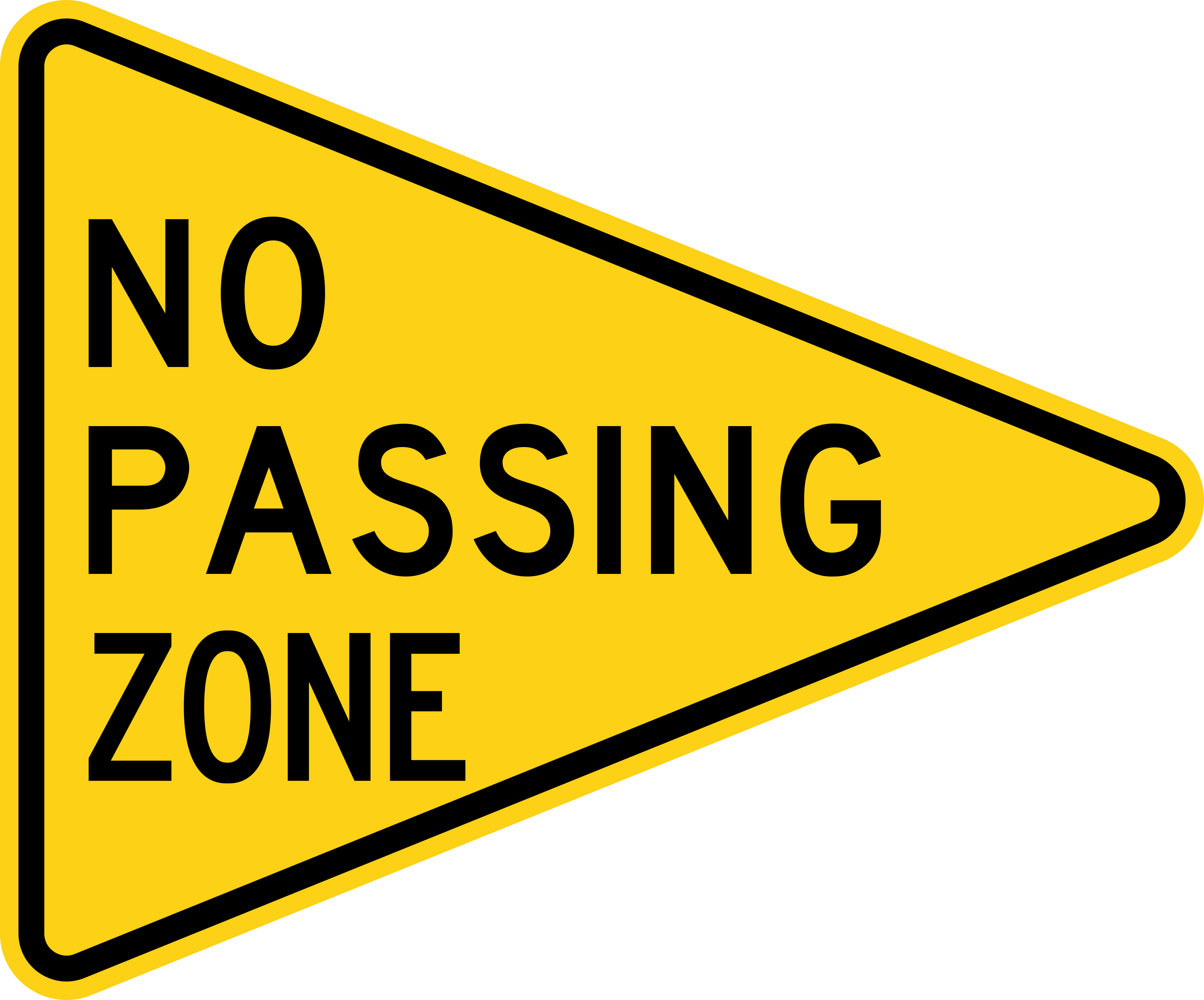
9. What should a driver do after entering a no-passing zone?
- Use the shoulder to get around a vehicle without crossing the center line
- Pass one vehicle if the driver ahead is moving slowly
- Pass quickly before reaching the next curve or hill
- Wait and do not pass where signs or pavement markings prohibit it
Show answer
Wait and do not pass where signs or pavement markings prohibit it. Wyoming's passing guidance begins with a clear restriction: do not pass when signs or pavement markings prohibit it. The same caution applies when a bridge, hill, curve, intersection, or railroad crossing is just ahead. A slow vehicle does not cancel the restriction, and racing toward the next hazard or using the shoulder creates additional risk. Stay behind the vehicle, maintain a safe following distance, and wait until the restriction ends and the complete view and lane space make passing lawful and safe.
Study this in the handbook: Speed limits and adjusting to conditions
10. What does Wyoming law prohibit a driver from doing with a cell phone or other device while operating a vehicle?
- Listening to music played from the phone
- Making a hands-free voice call
- Listening to a navigation voice prompt
- Reading or sending a text message
Show answer
Reading or sending a text message. Wyoming law specifically prohibits reading or sending a text message from a cell phone or other device while operating a vehicle. The hands-free call, navigation prompt, and music choices are device related, but they are not the conduct named in this legal prohibition. That does not make them risk free, since the manual still warns that phone use can distract drivers. If a message needs attention, pull well off the highway and stop before reading or sending it.
11. A Wyoming driver holding a restricted Class RC license is convicted of a first moving violation. How long is the suspension?
- A 30 day suspension
- A six month suspension
- A 90 day suspension
- A one year suspension
Show answer
A 90 day suspension. The Restricted Class RC/RM License Suspension is imposed for a moving violation conviction while holding a class RC or RM license. A first offense brings a 90-day suspension, and a second or later offense a one-year suspension. Thirty days is the intermediate license suspension for breaking intermediate restrictions, a different license stage. Six months does not appear in this rule, and one year is the repeat offense penalty.
Study this in the handbook: Suspensions, revocations and reinstatement
12. How far back does Wyoming look when counting prior offenses for a DWUI suspension?
- Three years
- Five years
- Ten years
- Two years
Show answer
Ten years. Wyoming's DWUI suspension schedule counts offenses within the previous 10 years: a first offense within 10 years is a 90 day suspension, a second is one year, and a third or later within 10 years is a three year revocation. Five years is the lookback for reckless driving suspensions and two years for repeat youthful driver alcohol suspensions, so those choices borrow from other rules. Three years is how long proof of financial responsibility must be kept.
Study this in the handbook: DWUI, Administrative Per Se and youthful driver suspensions
13. How should a driver respond to a flashing amber traffic signal?
- Use caution because it warns of a dangerous intersection or location
- Come to a complete stop and wait for a green light
- Proceed faster because cross traffic must stop
- Treat the road as closed in every direction
Show answer
Use caution because it warns of a dangerous intersection or location. A flashing amber signal is a caution warning, not a stop command. Wyoming says it warns of a dangerous intersection or location, so the driver should slow enough to look for cross traffic, pedestrians, and changing conditions before proceeding. A complete stop may be needed if the scene is unsafe, but it is not required by the signal itself. The green-light and closed-road choices confuse this warning with other controls. Read the signal, reduce speed, and continue only when the path is clear.
Study this in the handbook: Traffic signals and arrows
14. On packed snow, which speed change is specified in Wyoming's road-condition guidance?
- Reduce speed by at least half
- Reduce speed by 10 percent
- Reduce speed by at least 5 to 10 mph
- Use the posted limit without adjustment
Show answer
Reduce speed by at least half. Packed snow calls for a much larger reduction than wet pavement. Wyoming lists packed snow as requiring speed to be reduced by at least half, while wet roads use the smaller 5 to 10 mph reduction. The 10 percent answer is too small, and the wet-road choice borrows the wrong row of the table. Treat the half-speed figure as a minimum. If traffic, grade, curves, or visibility are poor, choose an even slower pace before braking becomes urgent.
Study this in the handbook: Speed limits and adjusting to conditions
15. In thick fog or a very heavy rain or snowstorm, what should you do if visibility is no more than 100 feet?
- Drive on the shoulder until the weather clears
- Continue at the posted limit with high beams
- Follow the vehicle ahead more closely for guidance
- Pull off the road and wait until visibility improves
Show answer
Pull off the road and wait until visibility improves. When heavy rain, snow, or thick fog limits visibility to about 100 feet, the manual says a driver cannot safely drive at any speed and should pull off the road until conditions clear. The posted limit is a maximum for favorable conditions, not a promise that travel is safe in zero-margin visibility. High beams can worsen glare, following close removes reaction space, and using the shoulder creates a conflict with stopped or disabled vehicles. Treat severely reduced sight distance as a reason to stop safely, not as a reason to press on slowly.
Study this in the handbook: Speed limits and adjusting to conditions
16. What does a diamond-shaped sign generally warn a Wyoming driver about?

- The location of a vehicle inspection station
- Lawful speeds and directions
- A required route for commercial trucks
- Road hazards or changing conditions ahead
Show answer
Road hazards or changing conditions ahead. A diamond shape is a warning that something about the roadway may require extra attention, such as a hazard or changed condition. A rectangular sign serves a different purpose by giving regulatory information about lawful speeds or directions. The other options describe service or routing information that the shape itself does not establish. When poor light hides the words, use the diamond outline as an early cue to reduce speed, scan ahead, and prepare for a road feature that may affect your path.
17. Which sequence follows Wyoming's proper lane-changing rules?
- Check mirrors, check the blind spot, check for another mover, signal, and change lanes
- Signal after moving, then check the mirror
- Look only in the rearview mirror and cross quickly
- Change lanes in an intersection before signaling
Show answer
Check mirrors, check the blind spot, check for another mover, signal, and change lanes. Wyoming's proper lane changing rules list the checks in order before the vehicle moves: check the rear view and side mirrors, look over your left or right shoulder to make sure no one is in your blind spots, check for other drivers who may also be moving into the same lane, and then signal and change lanes. Looking only in the rearview mirror skips the shoulder check, signaling after moving defeats the purpose of the signal, and the manual says not to change lanes before or while in an intersection.
Study this in the handbook: School buses and required stops
18. What do broken pavement lines indicate when the way is clear?
- Passing or lane changing is permitted
- Passing is prohibited in both directions
- Only emergency vehicles may cross the line
- The lane ends immediately at the line
Show answer
Passing or lane changing is permitted. Broken lines mark a possible movement, not an automatic command to make it. Wyoming's manual says passing or lane changing is permitted when the way is clear. The driver still has to check mirrors, blind spots, nearby traffic, and roadway conditions before crossing. A broken line does not prohibit passing in both directions or announce that a lane ends. Treat the opening as permission to evaluate a maneuver, then proceed only when safe.
Study this in the handbook: Pavement markings, signaling and passing
19. At a four-way stop, when it is unclear who stopped first, what does the Wyoming manual tell you to do?
- Insist on the right of way to keep traffic moving
- Go first if your vehicle is larger
- Yield to the driver on your right
- Wait until every other vehicle has cleared
Show answer
Yield to the driver on your right. At a four-way stop the driver who stops first normally goes first, but when that is in doubt the manual says to yield to the driver on your right. It also warns never to insist on the right of way at the risk of a crash, so vehicle size and impatience do not decide the order. Waiting for every other vehicle to clear is unnecessary once the sequence is settled. Stop fully, watch the other drivers, and proceed when the right-side rule makes your turn clear.
Study this in the handbook: Right of way rules
20. A Wyoming driver is convicted of a second DWUI within 10 years. How long is the license suspension?
- Suspended for 90 days
- Suspended for one year
- Suspended for six months
- Suspended for three years
Show answer
Suspended for one year. A second DWUI within the previous 10 years brings a one-year suspension. If the driver also served an Administrative Per Se suspension, an additional nine-month suspension is added to the record. Under Wyoming law, limited driving privileges cannot be issued for any DWUI after the first offense unless the conviction includes alcohol, in which case a one year ignition interlock license is required. Ninety days is the first offense suspension, and three years is the revocation for a third or later offense.
Study this in the handbook: DWUI, Administrative Per Se and youthful driver suspensions
QualitySpace is expanding to Wyoming
We are a California-based independent insurance brokerage working on licensing in more states. We cannot help with Wyoming insurance yet. Leave your email and we will let you know when we can.
Every question is written from the official Wyoming Rules of the Road Driver License Manual. Need paper? Printable WY practice test with answer key.
Last verified 2026-10-05. How we check every question · Study all 200 as flashcards
Frequently asked questions
How many questions are on this Wyoming practice test?
This fixed set has 20 questions. It is test 7 of 10 from the 200 question Wyoming bank.
How does this fixed test relate to the full Wyoming bank?
Each numbered test is a fixed set of questions in a fixed order, so you can retake the same test later and compare. Every test mixes road signs and the other topics in about the same proportion as the full bank. Tests 1 to 10 together cover every question in the Wyoming bank once. The full practice page mixes the whole bank at random.
Last verified 2026-10-05. See the Wyoming DMV facts page for sourced state details.