
Test 5 of 10 · 20 questions · Free 2026
WY Permit Practice Test 5
Jump to the test ↓A fixed 20 question set from the Wyoming bank with answers and plain English explanations.
Question 1 of 20 · 0 right so far
All 20 questions in test 5
Every question below comes from the Wyoming question bank on this page. Open a question to see the correct answer and the explanation. Nothing here is hidden behind a signup.
1. How long does it take to fully absorb the alcohol in a single drink, according to the Wyoming manual?
- About 5 hours
- About 2 minutes
- 30 to 40 minutes
- It is absorbed instantly
Show answer
30 to 40 minutes. The effects of alcohol increase with the passage of time because it takes 30 to 40 minutes to totally absorb the alcohol in a single drink. Food or milk in the stomach slows absorption, but two hours later it makes no difference whether you drank on a full stomach. Two people of equal weight who drink the same amount end up at about the same BAC.
Study this in the handbook: How alcohol affects you, and implied consent
2. What type of message does a yellow diamond shaped sign normally communicate?
- Guide information about destinations and distances
- Regulatory information about lawful speeds and directions
- A warning about a possible danger ahead
- A route marker identifying a numbered highway
Show answer
A warning about a possible danger ahead. Yellow diamond signs are warning signs, so they prepare drivers for a condition that may require attention or a speed adjustment. They do not function as the main regulatory shape for lawful speeds and directions, which is rectangular. The sign also cannot guarantee that no hazard exists. Scan beyond the sign, identify the potential problem, and choose a speed that leaves time to respond to the condition it announces.
Study this in the handbook: Road sign shapes and colors
3. On a divided roadway, which vehicles must stop when a school bus stops with flashing red lights?
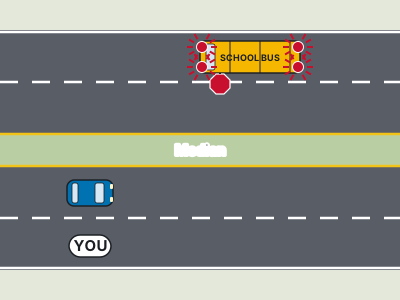
- Only vehicles on the same side of the separation as the bus
- Vehicles in every lane on both sides of the roadway
- Only vehicles directly behind the bus
- Only vehicles next to the bus after its stop arm is fully extended
Show answer
Only vehicles on the same side of the separation as the bus. On a divided roadway, the stop requirement applies to vehicles traveling on the same side of the separation as the stopped school bus. Traffic on the opposite side is treated differently from traffic on an undivided road, where both directions must stop. The bus being on a public road does not erase the duty for nearby same-side drivers. Watch the red lights, stop as required, and remain alert for children.
Study this in the handbook: School buses and required stops
4. Besides the SR-22 and reinstatement fee, what must a Wyoming driver do to be relicensed after a third DWUI?
- Nothing more once the revocation ends
- Pay a $1,000 bond only
- Undergo an alcohol or drug evaluation, complete treatment, and pass a driving re-examination
- Take only a vision test
Show answer
Undergo an alcohol or drug evaluation, complete treatment, and pass a driving re-examination. Reinstatement after a third or later DWUI requires completing all suspension and revocation actions or getting an ignition interlock license, filing an SR-22, paying the reinstatement fee, undergoing an alcohol or drug evaluation, completing an alcohol or drug treatment program, and passing a re-examination of driving ability. The license may be restricted to no alcohol or substance abuse offenses. The re-examination may be waived after an interlock period with no violations. A bond or vision test alone is not enough.
Study this in the handbook: DWUI, Administrative Per Se and youthful driver suspensions
5. What does a solid yellow line in your lane indicate about passing?
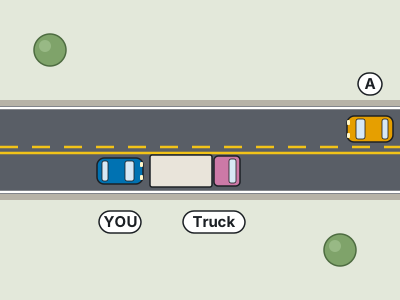
- Passing is allowed whenever the vehicle ahead is slower
- You may not pass from that lane
- The line separates lanes traveling in the same direction
- Only motorcycles may cross the line to overtake
Show answer
You may not pass from that lane. A solid yellow line in your lane means passing is prohibited from your side of the roadway. Yellow separates opposing traffic, so crossing it to overtake would place the vehicle into the path of oncoming traffic. The slower-vehicle choice ignores the marking, and a same-direction interpretation belongs to white lines. The motorcycle exception is not stated in the manual. Treat the solid yellow line as a no-passing boundary, except for the listed left-turn access situations such as entering a driveway.
Study this in the handbook: Pavement markings, signaling and passing
6. Which Wyoming office issues state driver licenses according to the customer service section?
- County clerks acting independently
- The Department of Revenue vehicle tax office
- The Wyoming Highway Patrol academy
- The Driver Services Program of the Wyoming Department of Transportation
Show answer
The Driver Services Program of the Wyoming Department of Transportation. The customer service section identifies the Driver Services Program of the Wyoming Department of Transportation as the issuer of Wyoming licenses. A county clerk, tax office, or Highway Patrol training unit is not named as the issuing program in this passage. The important distinction is between the agency that administers driver licensing and other offices that may handle related vehicle or public-safety work. When studying agency questions, match both the program name and the department.
7. Which is true of a Wyoming license revocation?
- It cancels the license, and a driver investigation is required to be relicensed
- Limited driving privileges are available during it
- It ends automatically with no further steps
- It only applies to commercial drivers
Show answer
It cancels the license, and a driver investigation is required to be relicensed. A revocation cancels the driver license, and the driver must go through a driver investigation to be relicensed once the revocation ends. Limited driving privileges are not available during a revocation, which is a key difference from many suspensions. Revocation is not automatic reinstatement, and it is not limited to commercial drivers. Offenses causing revocation include a third DWUI, a third reckless driving offense, leaving the scene of an injury accident, and homicide by vehicle.
Study this in the handbook: Suspensions, revocations and reinstatement
8. How does Wyoming classify bicyclists for traffic-law purposes on a public roadway?
- As unregulated road users
- As pedestrians with no roadway duties
- As vehicles with traffic duties but no right of way
- As vehicles with the same rights and responsibilities as motor vehicle operators
Show answer
As vehicles with the same rights and responsibilities as motor vehicle operators. Wyoming treats bicyclists on public roadways as vehicles with the same rights and responsibilities as motor vehicle operators. That means a driver should include a bicycle when applying traffic controls, yielding rules, and safe passing judgment. The choice giving duties but no right of way removes half of the manual rule, while pedestrian or unregulated status misstates the classification. When a bicycle is in traffic, expect lawful vehicle behavior and leave space for the rider to operate safely.
Study this in the handbook: Speed limits and adjusting to conditions
9. What do solid yellow lines indicate on a Wyoming roadway?
- No passing or lane changing, except for certain left turns
- Passing is permitted whenever the road looks clear
- Traffic is traveling in the same direction in both lanes
- Yellow markings identify the outer road edge only
Show answer
No passing or lane changing, except for certain left turns. Solid yellow lines mark a restriction against passing or changing lanes. The manual allows a narrow exception when a driver is making a left turn into or from an alley, private road, or driveway. A clear-looking road does not erase the marking, and yellow lines separate opposing traffic rather than traffic moving together. Treat the line as a boundary and wait for a lawful left-turn movement before crossing it.
Study this in the handbook: Pavement markings, signaling and passing
10. Which older vehicles are exempt from Wyoming's child restraint law?
- Passenger vehicles before model year 1967 and vans and trucks before model year 1972 that were built without safety belts
- All vehicles older than 10 years
- Any pickup truck
- No vehicles are exempt
Show answer
Passenger vehicles before model year 1967 and vans and trucks before model year 1972 that were built without safety belts. Vehicles that were not equipped with safety belts at the time of manufacture are exempt from the child restraint law, meaning passenger vehicles before model year 1967 and vans and trucks before model year 1972. Emergency vehicles, school buses and public transportation built without belts are also exempt. A child who fits the adult belt properly is exempt from the seat requirement too.
Study this in the handbook: Seat belts and child restraints
11. Besides the reinstatement fee, what must a Wyoming driver pay when an ignition interlock is required?
- A monthly $500 fee to the state
- Nothing beyond the reinstatement fee
- A $1,000 bond
- A $100 ignition interlock fee, plus filing an SR-22
Show answer
A $100 ignition interlock fee, plus filing an SR-22. Drivers convicted of alcohol related offenses that require an ignition interlock must file an SR-22 insurance form and pay the $50 reinstatement fee, and the manual then adds a separate $100 ignition interlock fee. They must also have the device installed on any vehicle they drive by a technician certified by the department and bring the certification of installation to their local driver exam office. A driver may instead apply for a 24/7 restricted license if a court orders the 24/7 Sobriety Program in lieu of the interlock.
Study this in the handbook: Seat belts and child restraints
12. On a highway with two or more lanes in your direction, what must you do when safely able to change lanes as you approach an authorized emergency vehicle parked with its warning lights flashing?
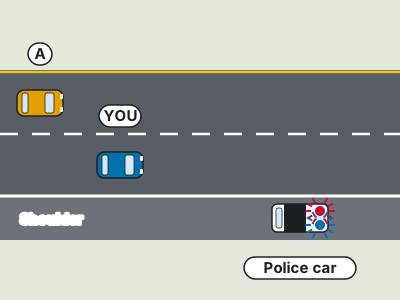
- Stop in the lane next to the vehicle
- Merge into the lane farthest from the stopped vehicle when safe
- Remain in the nearest lane and reduce speed by 20 mph even when a safe lane change is available
- Maintain the same lane and sound the horn
Show answer
Merge into the lane farthest from the stopped vehicle when safe. Wyoming's Move Over guidance says that, except when a police officer directs otherwise, a driver on a highway with two or more lanes who approaches an authorized emergency, utility, or highway construction or maintenance vehicle parked with lights flashing must merge into the lane farthest from it. Stopping beside it or merely sounding the horn does not create that separation. Slowing to at least 20 mph below the speed limit is the rule the manual gives for roads with only one lane in each direction.
Study this in the handbook: Right of way rules
13. How should following time change when Wyoming Interstate pavement is slick?
- Add only half a second no matter how slick the pavement is
- Cut the gap in half to keep traffic flowing
- Use the same interval because tires stop identically
- Double or triple the normal following time
Show answer
Double or triple the normal following time. On the Interstate, Wyoming's manual says to always leave at least two seconds of space cushion between you and the vehicle ahead, and when the weather is bad or the pavement is slick, double or triple your following time. It adds that rear-end collisions are the most frequent type of crash on the Interstate. Adding only half a second, cutting the gap, or keeping the same interval all fall short of the doubled or tripled time the manual asks for.
Study this in the handbook: Following distance and heavy trucks
14. On an overhead lane sign, what does the word ONLY require?
- You may choose any direction at the intersection
- You must travel in the direction shown by the arrow
- You must stop before following the arrow
- You may use the lane only to pass
Show answer
You must travel in the direction shown by the arrow. When an overhead lane sign uses ONLY, the driver must go in the direction indicated by its arrow and has no other option from that lane. It is a mandatory lane instruction, not a suggestion to choose among movements. The stop and passing choices add conditions that the sign does not state, while any-direction movement contradicts the word ONLY. Read the arrow before entering the lane and position early enough to obey it without a last-second merge. The cue is ONLY removes choice.
Study this in the handbook: Pavement markings, signaling and passing
15. How far does a passenger vehicle at 55 mph typically need to stop, according to the Wyoming manual?
- About 50 feet
- About 400 feet
- About 1,000 feet
- About 130 to 140 feet, half the length of a football field
Show answer
About 130 to 140 feet, half the length of a football field. A passenger vehicle traveling 55 mph can typically stop in about half the length of a football field, about 130 to 140 feet. A heavy vehicle with a loaded trailer usually takes over two thirds of a field, about 190 to 200 feet, and in heavy traffic with hot brakes a truck's stopping distance may double to 400 feet. Never cut in front of a truck and brake.
Study this in the handbook: School buses and required stops
16. What kind of information does the white SPEED LIMIT sign provide?
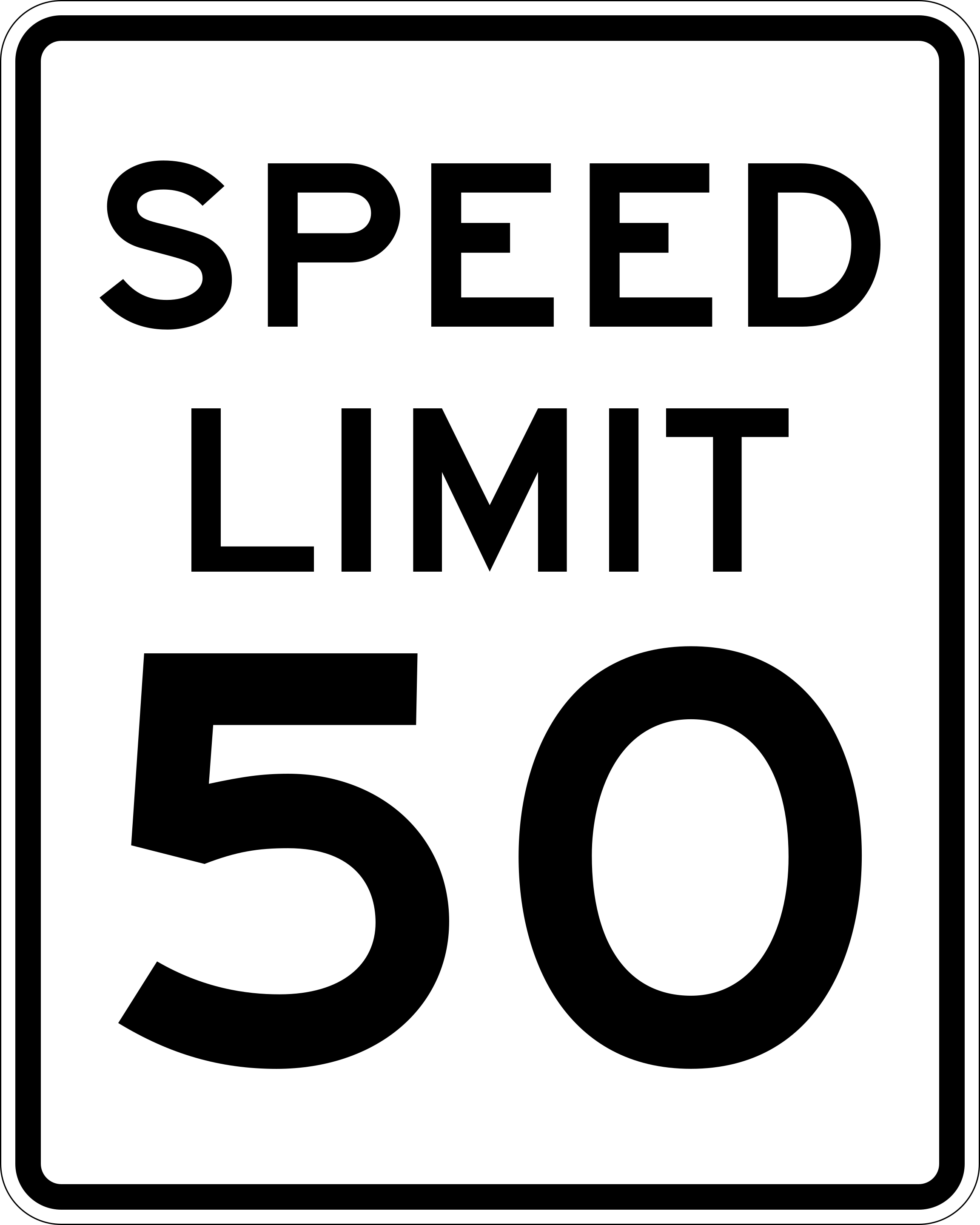
- A suggested speed that may be exceeded whenever traffic is light
- Regulatory information about a lawful speed
- A warning that applies only to trucks
- A direction to use the left lane
Show answer
Regulatory information about a lawful speed. A speed limit sign provides regulatory information about the lawful maximum for the roadway or segment. It is not merely an advisory suggestion, and it does not apply only to trucks or direct lane selection. The posted number is still not a promise that the speed is safe in rain, snow, darkness, traffic, or a curve. Adjust below the limit when conditions require it. Read the sign as a legal ceiling, then choose a speed that preserves control and stopping distance.
17. How does traffic normally move through a Wyoming roundabout?
- In either direction, depending on the chosen exit
- Clockwise, with traffic stopping at every entry
- Counterclockwise, continuing except when yielding
- Entering traffic has priority over vehicles already circulating
Show answer
Counterclockwise, continuing except when yielding. Traffic in a Wyoming roundabout moves slowly counterclockwise and normally keeps moving except when yielding to circulating traffic or pedestrians in crosswalks. Clockwise travel reverses the intended flow, and drivers cannot choose either direction based on the exit. The entry-priority choice is also wrong because entering drivers yield to traffic already in the roundabout. Slow before entry, look left for a gap, merge smoothly, and use the turn signal when leaving.
Study this in the handbook: Right of way rules
18. How should a driver respond when this slippery-road warning is relevant?

- Reduce speed and avoid sudden steering or braking changes
- Use antilock brakes as a reason to keep the usual speed
- Brake sharply while turning to test the available grip
- Follow closer to the vehicle ahead to copy its path
Show answer
Reduce speed and avoid sudden steering or braking changes. A slippery surface reduces the tires' grip and increases the distance needed to stop. Wyoming advises slowing down and avoiding sudden changes in speed or direction on snow or ice, with similar caution whenever the roadway is slick. Maintaining speed does not restore traction, and hard braking while turning can trigger a skid. Following close removes escape space if the vehicle ahead stops. Ease off the accelerator early, leave a larger cushion, and make steering and braking inputs gradual.
Study this in the handbook: Night, weather and winter driving
19. What speed limit does the manual list for secondary highways unless otherwise posted?
- 55 mph
- 70 mph
- 65 mph
- 60 mph
Show answer
70 mph. The manual lists 70 mph for secondary highways when no different limit is posted. The lower numbers in the choices are not the table entry for that road type, and the 80 mph figure belongs to the interstate category shown nearby. This listed number is a ceiling, not a command to drive that fast in poor conditions. Identify the road category, check for a posted limit, and reduce speed whenever visibility, surface, curves, or traffic make the maximum unsafe.
Study this in the handbook: Speed limits and adjusting to conditions
20. Absent an exception, during what hours may a Wyoming intermediate license holder not drive?
- 9 p.m. to 4 a.m.
- 10 p.m. to 6 a.m.
- 11 p.m. to 5 a.m.
- Midnight to 6 a.m.
Show answer
11 p.m. to 5 a.m.. The manual restricts intermediate license holders from driving between 11 p.m. and 5 a.m. unless an exception applies and the required form is carried. The other time windows shift the beginning or ending hour and therefore change the rule. Exceptions can involve medical necessity, work, school or related activities, and medical emergencies, but ordinary nighttime travel does not qualify automatically. Use 11 to 5 as the baseline interval, then check whether a documented exception is available.
Study this in the handbook: Instruction permits and intermediate licenses
QualitySpace is expanding to Wyoming
We are a California-based independent insurance brokerage working on licensing in more states. We cannot help with Wyoming insurance yet. Leave your email and we will let you know when we can.
Every question is written from the official Wyoming Rules of the Road Driver License Manual. Need paper? Printable WY practice test with answer key.
Last verified 2026-10-05. How we check every question · Study all 200 as flashcards
Frequently asked questions
How many questions are on this Wyoming practice test?
This fixed set has 20 questions. It is test 5 of 10 from the 200 question Wyoming bank.
How does this fixed test relate to the full Wyoming bank?
Each numbered test is a fixed set of questions in a fixed order, so you can retake the same test later and compare. Every test mixes road signs and the other topics in about the same proportion as the full bank. Tests 1 to 10 together cover every question in the Wyoming bank once. The full practice page mixes the whole bank at random.
Last verified 2026-10-05. See the Wyoming DMV facts page for sourced state details.