
Test 6 of 10 · 20 questions · Free 2026
WY Permit Practice Test 6
Jump to the test ↓A fixed 20 question set from the Wyoming bank with answers and plain English explanations.
Question 1 of 20 · 0 right so far
All 20 questions in test 6
Every question below comes from the Wyoming question bank on this page. Open a question to see the correct answer and the explanation. Nothing here is hidden behind a signup.
1. Which vehicles does the Wyoming manual say are more likely to tip over in a skid?
- Four-wheel-drive vehicles with high centers of gravity
- Small front-wheel-drive cars
- Vehicles with anti-lock brakes
- Low sports cars with wide tires
Show answer
Four-wheel-drive vehicles with high centers of gravity. The manual warns that four-wheel-drive vehicles with high centers of gravity are more likely to tip over in a skid. Four-wheel drive generally allows better traction, yet the manual notes these vehicles can still skid with sudden changes in power to the drive wheels. Small cars, ABS-equipped vehicles, and low sports cars are not singled out in this warning. Keep speed down on slippery roads, be prepared to stop, and increase following distance so a skid never has a chance to start.
Study this in the handbook: Night, weather and winter driving
2. When this school sign is posted near the roadway, what should a driver do?

- Keep the normal speed because the sign only identifies a school building
- Slow down and create more space when children may be near traffic
- Use the shoulder to pass any vehicle slowing for students
- Stop in the travel lane until a school employee waves traffic through
Show answer
Slow down and create more space when children may be near traffic. A school sign calls for more than simply identifying a nearby building. Wyoming describes school areas as especially dangerous because children may forget traffic risks and can run into a vehicle's path unexpectedly. Slowing down gives the driver more time to see movement and react, while a larger space cushion provides room to brake. The normal-speed option ignores the hazard, and shoulder passing creates a second danger. Scan beyond the sign for children, parked cars, crossing activity, and vehicles that may stop suddenly.
Study this in the handbook: Motorcycles, pedestrians, bicycles and animals
3. When should the driver reduce speed for the curve shown ahead?

- Before entering the curve, while the vehicle is still straight and stable
- After reaching the middle of the curve, with firm braking applied
- Only after entering the curve and feeling the vehicle drift
- After crossing the center line to improve the turning radius
Show answer
Before entering the curve, while the vehicle is still straight and stable. Wyoming's manual tells drivers to adjust speed before entering a curve, because going too fast can break the grip that tires have on the road. It explains that each tire has only an area of rubber about the size of a hand touching the road, so grip depends heavily on road conditions. Waiting until the middle of the curve, waiting for the vehicle to drift, or crossing the center line all miss the instruction to slow before the curve.
Study this in the handbook: Speed limits and adjusting to conditions
4. During a breakdown, where should you place the vehicle if you need to stop?
- With only the right-side wheels on the shoulder
- With all four wheels on the shoulder
- Partly in the travel lane so the vehicle remains visible
- On the shoulder only after stopping first in the lane
Show answer
With all four wheels on the shoulder. For a breakdown, Wyoming directs a driver to stop with all four wheels on the shoulder. That position removes the disabled vehicle from the active travel path and gives approaching traffic room to pass. Keeping only two wheels on the shoulder leaves part of the vehicle in the lane, and stopping first in the lane increases exposure. Turn on emergency flashers after securing the vehicle, and avoid getting out on the traffic side. The goal is full separation from moving traffic.
Study this in the handbook: Crashes, breakdowns and railroad crossings
5. How long must an impairment last for a permanent Wyoming disabled placard?
- At least 30 days
- Any length, if a doctor signs
- At least 5 years
- A minimum of 12 months, with temporary placards for impairments up to 6 months
Show answer
A minimum of 12 months, with temporary placards for impairments up to 6 months. Permanent disabled placards are issued to persons with physical impairments that must last a minimum of 12 months, while temporary placards may be issued for an impairment lasting up to 6 months. The application must be completed by a physician and is available at driver license exam stations and online. Disabled placards are available at no cost to the applicant.
6. In Wyoming's winter driving landmark check, which result tells you that you are following too closely?
- Your car reaches the landmark before you finish counting one thousand one through one thousand four
- Your car reaches the landmark after you finish counting through one thousand four
- You can still see the rear tires of the vehicle ahead
- The vehicle ahead is more than one car length away
Show answer
Your car reaches the landmark before you finish counting one thousand one through one thousand four. Under be prepared to stop in its winter driving section, the manual tells drivers to increase following distance and check it with a landmark. Allow the car ahead to pass a landmark, then count from one thousand one through one thousand four. If your car reaches the same landmark before you finish, you are following too closely. Car lengths and other visual rules of thumb are not the test described. The adverse conditions list later asks for even more space on snow and ice, so add room when grip worsens.
Study this in the handbook: Night, weather and winter driving
7. When turning right at a red light, what must the driver do before proceeding?
- Stop and yield to people and other vehicles
- Slow down and turn without stopping if no car is close
- Wait for a green arrow in every case
- Turn first, then yield to pedestrians in the crosswalk
Show answer
Stop and yield to people and other vehicles. Wyoming permits a right turn at a red light unless a sign prohibits it, but the maneuver is conditional. The driver must first stop, then yield to persons and other vehicles before turning. Rolling through because the intersection looks empty fails the stopping requirement, and waiting for a green arrow is not always necessary. Look for a prohibition sign, stop behind the line or crosswalk, check every conflict, and turn only after yielding.
Study this in the handbook: Traffic signals and arrows
8. When does a Wyoming suspension or revocation usually begin?
- The day of the offense
- 30 days from the date the order is mailed or given to the driver, or at the end of existing suspensions
- 90 days after the court date
- Only when the driver surrenders the license
Show answer
30 days from the date the order is mailed or given to the driver, or at the end of existing suspensions. A suspension or revocation starts 30 days from the date the department mails the order or law enforcement hands it to the driver, or at the end of any suspensions already on the record. The Administrative Per Se suspension likewise starts 30 days after the officer issues the temporary license and notice. It does not start on the offense date, 90 days after court, or only on surrender. Requests for limited privileges or a hearing must be postmarked within 20 days of the notice.
Study this in the handbook: Suspensions, revocations and reinstatement
9. Can Wyoming police stop a vehicle just because they see a young child unrestrained?
- No, only after another violation
- Only on interstate highways
- Yes, non-use or misuse of a child restraint is a primary offense
- Only if the child is under 2
Show answer
Yes, non-use or misuse of a child restraint is a primary offense. Wyoming's child restraint law is a primary offense: non-use or misuse gives reasonable suspicion to stop a vehicle to investigate. It covers children who have not reached their ninth birthday, applies to all drivers, residents and non-residents, and is not limited to interstates or to children under 2. The maximum fine is $60 for a first offense, waived with proof of acquiring an approved restraint, and $110 for later offenses.
Study this in the handbook: Seat belts and child restraints
10. When turning onto a street or highway, to whom must a driver yield?
- No vehicle if the turn signal is on
- Only vehicles already stopped
- Any vehicle close enough to be dangerous
- Only a vehicle traveling faster
Show answer
Any vehicle close enough to be dangerous. The turning rule requires yielding to vehicles close enough to be dangerous when entering a street or highway. A signal communicates the intended movement but does not cancel another road user's priority. The manual's wording also implies that the driver must judge the gap rather than rely on a fixed distance or on the other vehicle stopping. Reduce speed, scan the entry path, and wait until the turn will not interfere with nearby traffic. The safety cue is the hazard's proximity, not the presence of a turn signal.
Study this in the handbook: Right of way rules
11. When should a Wyoming driver adjust speed on a curve?
- Only when a warning sign is present
- Only after the vehicle begins to skid
- At the midpoint of the curve
- Before entering the curve
Show answer
Before entering the curve. The manual puts the speed adjustment before the curve because tire grip can be lost when a vehicle enters too fast. Waiting until a skid begins means the vehicle has already exceeded a safe approach speed, and the rule does not depend on a warning sign. The midpoint is also too late for the preventive action being taught. Look ahead, reduce speed while the vehicle is still straight, then steer through the bend with the tires maintaining contact.
Study this in the handbook: Speed limits and adjusting to conditions
12. A flashing red signal at an intersection requires which response?
- Treat it as a flashing yellow and merge carefully
- Continue without slowing if no vehicle is visible
- Stop before the crosswalk, then proceed when safe
- Wait for the signal to become a steady green before moving
Show answer
Stop before the crosswalk, then proceed when safe. A flashing red signal belongs with the manual's required stops. The driver stops before the crosswalk and may proceed only after yielding and confirming that movement is safe. Continuing through because the intersection appears empty removes the required stop. The flashing-yellow option assigns the wrong signal rule, while waiting for steady green invents a phase that may not occur. Make a complete stop, scan both directions, and then enter only when other road users have been given the necessary priority.
Study this in the handbook: School buses and required stops
13. At a stop sign, where must the vehicle stop before moving through the intersection?
- Inside the crosswalk for the best view
- At the sign post even if that blocks the crosswalk
- Before the crosswalk
- At least 100 feet before the sign in every situation
Show answer
Before the crosswalk. Wyoming requires a vehicle to stop before the crosswalk at a stop sign. That location protects people who may be crossing and keeps the vehicle from intruding into the intersection while the driver checks for other traffic. Stopping at the post when that blocks the crosswalk, or inside the crosswalk for a better view, puts the vehicle where pedestrians need to walk. The 100-foot figure belongs to turn signaling, not to a universal stopping distance. Look for the crosswalk or stop line before the vehicle reaches the crossing path.
Study this in the handbook: School buses and required stops
14. What should you do when a broken yellow line is on your side and the way ahead is clear?
- You must never cross the line
- You may pass after checking that the maneuver is safe
- You may pass only if the vehicle ahead is turning right
- You may cross only when directed by a parking attendant
Show answer
You may pass after checking that the maneuver is safe. A broken yellow line separates opposing directions, but it permits the driver on that side to pass when the way is clear. The permission still depends on visibility, adequate space, and the absence of another rule or hazard that makes passing unsafe. Never-crossing describes a solid restriction, while the right turn and parking attendant choices are unrelated. Check for vehicles, hills, curves, intersections, and other no-passing conditions before moving left. The cue is broken yellow plus a clear path, not the color alone.
15. What does the manual say alcohol does to a driver's ability to compensate for unusual driving conditions?
- It improves performance in difficult conditions
- It has no effect when the driver is experienced
- It reduces the ability to raise performance to meet the conditions
- It affects only vision and not driving decisions
Show answer
It reduces the ability to raise performance to meet the conditions. The manual explains that unusual weather, lighting, and road conditions demand more performance, while alcohol reduces the driver's ability to provide it. Experience does not erase that impairment, and the passage describes more than a vision problem. The driver cannot simply raise attention or skill enough to compensate after drinking. A practical cue is to pair any difficult condition with a sober driver: when the road asks for more judgment, alcohol supplies less of it.
Study this in the handbook: How alcohol affects you, and implied consent
16. What following distance rule does Wyoming recommend for a passenger car in normal conditions?
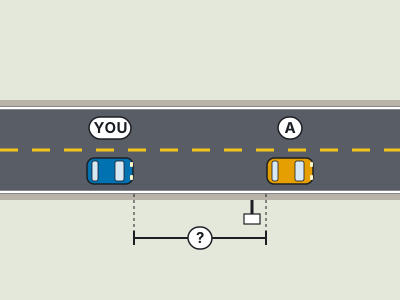
- Exactly one car length at every speed
- At least two seconds behind the vehicle ahead
- At least ten seconds in every driving situation
- No set interval if the driver can see brake lights
Show answer
At least two seconds behind the vehicle ahead. For a passenger car, leave at least two seconds between your vehicle and the one ahead. Measure it by choosing a fixed point and counting after the lead vehicle passes it. One car length is unreliable because stopping space changes with speed, while ten seconds is not the ordinary baseline. Seeing brake lights is not permission to follow closely. Add more time when roads are wet, snowy, icy, dark, or when towing a boat or trailer adds length and weight.
Study this in the handbook: Following distance and heavy trucks
17. According to the Wyoming manual, how much alcohol is in 12 ounces of beer, three to five ounces of wine, and one and a half ounces of 86 proof liquor?
- Beer has far less than the others
- Liquor has ten times as much
- About two ounces each
- About one half ounce each
Show answer
About one half ounce each. The manual explains that beer usually contains about 5 percent alcohol, wines 12 or 20 percent, and hard liquors about 40 to 50 percent. Because the serving sizes differ, 12 ounces of beer, three to five ounces of wine, and one and one half ounces of 86 proof hard liquor each have about one half ounce of alcohol. Beer therefore does not carry far less alcohol per serving, and liquor does not carry ten times as much. The liver then eliminates alcohol at a roughly constant rate.
Study this in the handbook: How alcohol affects you, and implied consent
18. What will get a Wyoming 14 or 15 year old's restricted license suspended?
- Only a DWUI conviction
- Three moving violations in a year
- Nothing short of a crash
- Being convicted of a single moving traffic violation
Show answer
Being convicted of a single moving traffic violation. The restricted license will be suspended if the holder is convicted of one moving traffic violation, or of driving outside the designated hours or the 50 mile radius. So one conviction is enough; the three violations allowance applies to regular drivers under the moving violation rule, not to restricted license holders. A DWUI or a crash is not required. The resulting RC/RM suspension is 90 days for a first offense and one year for a later one.
Study this in the handbook: Tests, renewals and restricted licenses
19. If ice covers the road, what pace does the manual tell drivers to use?
- A crawl
- The posted maximum
- The normal dry-road speed
- A pace 5 mph above traffic
Show answer
A crawl. The ice guidance is to reduce speed to a crawl, with an additional warning that a driver may need to slow further when vehicles are ahead. Ice can remove nearly all dependable traction, so an ordinary reduction is not enough. Cruise control or a higher pace cannot restore grip. The key cue is that the recommendation describes a very slow, controlled movement rather than a particular numerical speed. Leave room to stop and avoid abrupt steering, throttle, or braking inputs.
Study this in the handbook: Speed limits and adjusting to conditions
20. A Wyoming driver lets a friend use their license as identification. What suspension can follow?
- None, lending a license is legal
- A lifetime revocation
- A 30-day suspension for the borrower only
- A 90-day suspension for the person using or lending the license
Show answer
A 90-day suspension for the person using or lending the license. It is unlawful to lend your license or ID card to someone else to use as identification, to use someone else's license, or to give false information on an application. These actions may lead to cancellation of the card and a 90-day suspension for the person using or lending the license or ID card. The suspension applies to the lender as well as the user, so the borrower-only choice is wrong, and lifetime revocation is not the listed result.
Study this in the handbook: Suspensions, revocations and reinstatement
QualitySpace is expanding to Wyoming
We are a California-based independent insurance brokerage working on licensing in more states. We cannot help with Wyoming insurance yet. Leave your email and we will let you know when we can.
Every question is written from the official Wyoming Rules of the Road Driver License Manual. Need paper? Printable WY practice test with answer key.
Last verified 2026-10-05. How we check every question · Study all 200 as flashcards
Frequently asked questions
How many questions are on this Wyoming practice test?
This fixed set has 20 questions. It is test 6 of 10 from the 200 question Wyoming bank.
How does this fixed test relate to the full Wyoming bank?
Each numbered test is a fixed set of questions in a fixed order, so you can retake the same test later and compare. Every test mixes road signs and the other topics in about the same proportion as the full bank. Tests 1 to 10 together cover every question in the Wyoming bank once. The full practice page mixes the whole bank at random.
Last verified 2026-10-05. See the Wyoming DMV facts page for sourced state details.