
Test 2 of 10 · 20 questions · Free 2026
WY Permit Practice Test 2
Jump to the test ↓A fixed 20 question set from the Wyoming bank with answers and plain English explanations.
Question 1 of 20 · 0 right so far
All 20 questions in test 2
Every question below comes from the Wyoming question bank on this page. Open a question to see the correct answer and the explanation. Nothing here is hidden behind a signup.
1. Under Wyoming's Implied Consent law, when are drivers deemed to have consented to chemical tests for alcohol?
- Only when a commercial vehicle is involved
- Only after a judge signs a warrant
- Only after a crash causes an injury
- Whenever they drive on a public street or highway
Show answer
Whenever they drive on a public street or highway. Wyoming treats driving on a public street or highway as consent to the chemical testing process when an officer is investigating possible impaired driving. A warrant can become relevant if the driver refuses, but it is not the event that creates the original consent. An injury crash and commercial vehicle status are not conditions stated in this rule. A useful memory cue is the road itself: public street or highway means the implied-consent rule is in play before the test decision is made.
Study this in the handbook: How alcohol affects you, and implied consent
2. What is the proper response to a steady amber traffic light when stopping is safe?
- Accelerate to beat the red light
- Stop before entering the intersection
- Proceed at the same speed whenever the light has just changed
- Treat it as permission to turn without yielding
Show answer
Stop before entering the intersection. An amber, or yellow, light means the driver should stop before entering the intersection when a safe stop is possible. It is not an invitation to accelerate, and it does not create a special turning privilege. If stopping cannot be done safely, the manual says to proceed carefully through the intersection rather than slam on the brakes or reverse. The practical cue is to judge stopping distance as soon as yellow appears: brake smoothly when there is room, and continue cautiously only when an abrupt stop would be dangerous.
Study this in the handbook: Traffic signals and arrows
3. After a traffic crash, how long must you stay at or near the scene?
- After calling police, even before officers question anyone
- After exchanging complete information, even if police have not arrived
- Until police have arrived and questioned everyone involved
- Only until traffic behind you begins honking
Show answer
Until police have arrived and questioned everyone involved. Wyoming says that if you are involved in a crash you must stop your vehicle at or near the crash scene and stay there until the police have arrived and questioned everyone involved. Leaving after exchanging information, or after simply calling police, is too early, and pressure from traffic behind you does not end the obligation. The same list says to give aid to injured persons and send for an ambulance, warn passing traffic, record names, addresses and vehicle details, and contact police for injury, death, or property damage of $1,000 or more.
Study this in the handbook: Crashes, breakdowns and railroad crossings
4. Where should you place your vehicle during an emergency stop when possible?
- On a hill or curve where the vehicle is easiest to reach
- With only the right wheels on the shoulder and the left wheels on the pavement
- Partly in the travel lane so other drivers can see you
- With all four wheels off the pavement
Show answer
With all four wheels off the pavement. An emergency stop should remove the disabled vehicle from moving traffic as much as conditions allow. The manual says to park with all four wheels off the pavement if possible and to avoid a hill or curve where the vehicle cannot be seen easily. Leaving wheels in the lane exposes the stopped car to a collision. Once safely positioned, use the emergency flashers and make the vehicle visible without creating another roadside danger.
5. When does a Wyoming intermediate license expire, and what happens after a violation of its restrictions?
- It expires at 18, with no suspension for violations
- It expires after one year
- It expires 30 days after the holder's 17th birthday, and any violation brings a 30 day suspension
- It never expires
Show answer
It expires 30 days after the holder's 17th birthday, and any violation brings a 30 day suspension. Wyoming says an intermediate license will be suspended for 30 days for any violation of its provisions, such as the passenger limit, the seat belt requirement, or the 11 p.m. to 5 a.m. driving restriction. A separate passage says the intermediate license automatically expires 30 days after the holder's 17th birthday. It does not run until 18, last a fixed one year, or continue indefinitely. Holding it for six months along with an approved driver education course is one path to full privileges at 16 and a half.
Study this in the handbook: Instruction permits and intermediate licenses
6. What does the slow-moving vehicle symbol on the rear of a farm vehicle warn you about?

- The vehicle must yield to every passing car
- The vehicle may travel only at highway speed
- The vehicle cannot travel faster than 25 miles per hour
- The symbol means the vehicle is parked
Show answer
The vehicle cannot travel faster than 25 miles per hour. The manual says that when you see the slow-moving vehicle symbol on the back of a vehicle ahead, it is a warning to slow down, and it means the vehicle cannot travel faster than 25 miles per hour. The symbol does not mean the vehicle is parked, that it must yield to every passing car, or that it can keep up with highway speed. The manual adds that these vehicles have the legal right to be there, so do not be impatient; slow down early and pass only when it is lawful and safe.
Study this in the handbook: Emergency vehicles and the Move Over law
7. What should a driver do when another vehicle is following too closely?
- Increase the space ahead and reduce speed if needed
- Brake sharply to make the other driver back off
- Increase speed slightly to keep the same gap ahead
- Move onto the shoulder without checking traffic
Show answer
Increase the space ahead and reduce speed if needed. A tailgater reduces the space behind you, so protect the space ahead instead. Wyoming advises increasing your following distance from the vehicle in front, moving right on a multilane highway when suitable, and reducing speed to encourage the driver behind to pass. Braking sharply may cause a rear-end crash, and speeding up just preserves a smaller reaction margin. Keep signals clear, avoid sudden moves, and give yourself extra room to respond to anything ahead.
Study this in the handbook: Following distance and heavy trucks
8. What does a downward pointing triangle traffic sign require?
- Stop completely before entering every intersection
- Yield the right of way to cross traffic or merging traffic
- Increase speed to merge ahead of cross traffic
- Follow the road only in the direction of a white arrow
Show answer
Yield the right of way to cross traffic or merging traffic. The downward pointing triangle is reserved for a yield instruction. The driver must give the right of way to cross traffic or merging traffic, slowing or stopping as needed to prevent a conflict. It is not the octagonal stop sign, so a complete stop is not automatically required when the path is clear. Never accelerate to force a merge. Check the approach, identify traffic with priority, and enter only after yielding safely.
Study this in the handbook: Road sign shapes and colors
9. On an Interstate, what minimum space cushion should normally be left behind the vehicle ahead?
- At least two seconds
- One car length at every speed
- Exactly one second unless it is raining
- One and a half seconds when traffic is moving steadily
Show answer
At least two seconds. Wyoming's Interstate guidance calls for at least a two-second space cushion in normal conditions. That interval gives a driver time to notice a change, react, and brake before reaching the vehicle ahead. The one-second option is too short, and measuring only one car length ignores how speed changes stopping distance. Slick pavement or bad weather calls for doubling or tripling the following time, not abandoning the gap. Pick a fixed roadside landmark, watch the vehicle ahead pass it, and count before your own vehicle reaches the same point.
Study this in the handbook: Following distance and heavy trucks
10. For what child does a belt positioning booster provide protection, according to the Wyoming guide?
- Any infant
- A child over 40 pounds, within the booster's weight and height limits
- Only children under 20 pounds
- Children over 100 pounds
Show answer
A child over 40 pounds, within the booster's weight and height limits. Look at the weight and height limits of the belt positioning booster, which provides protection for a child over 40 pounds. If the vehicle seat has a head rest, use a low back booster with the head rest adjusted to the middle of the child's head; without a head rest use a high back booster. Wyoming's restraint law covers children who have not reached their ninth birthday.
Study this in the handbook: Seat belts and child restraints
11. At 55 mph, how much farther may a drinking driver travel before applying the brakes, according to the manual?
- About 32 feet or more
- About 16 feet
- About 8 feet
- About 100 feet exactly
Show answer
About 32 feet or more. The manual uses a 55 mph example to show that a drinking driver may travel an additional 32 feet or more before applying the brakes. The smaller figures understate the delay, and 100 feet is not the example given. This extra distance can turn a near miss into a crash because the vehicle continues moving while the driver struggles to execute the braking response. At speed, impaired reaction time is measured in roadway length, not merely in fractions of a second.
Study this in the handbook: How alcohol affects you, and implied consent
12. What is the best preparation when this lane-ending warning appears?

- Accelerate onto the shoulder to avoid entering the adjacent lane
- Stop at the lane boundary and wait until the roadway is empty
- Check mirrors and blind spots, signal, and merge when a safe gap is available
- Change lanes inside the intersection where the remaining lane begins
Show answer
Check mirrors and blind spots, signal, and merge when a safe gap is available. A lane ending requires an orderly lane change. Wyoming directs drivers to check the rearview and side mirrors, look over the shoulder for blind spots, watch for another driver moving toward the same lane, then signal and change lanes. Stopping at the boundary may create a rear-end hazard, and the shoulder is not a substitute travel lane. The manual also says not to change lanes before or while in an intersection. Start the checks early, communicate clearly, and merge only when the opening is sufficient.
Study this in the handbook: School buses and required stops
13. What happens to your right of way if you enter a Wyoming intersection while violating the speed law?
- Nothing changes unless a police officer sees you
- You keep the right of way if you arrived first
- You gain priority because you reach the intersection sooner
- You forfeit any right of way you might have had
Show answer
You forfeit any right of way you might have had. The manual states that a driver who enters an intersection while violating the speed law forfeits any right of way that driver might otherwise have had. Arriving first or reaching the intersection sooner does not restore that priority, and the rule does not depend on whether an officer is watching. The point is that right of way is something other drivers give you, and speeding removes your claim to it. Approach every intersection at a lawful speed so the ordinary rules protect you.
Study this in the handbook: Right of way rules
14. How should speed be managed on a winding section of roadway?
- Speed up between bends so each curve can be completed quickly
- Choose a slower speed that remains appropriate as road conditions change
- Use cruise control to hold the posted number through every curve
- Wait until each bend to brake firmly if the view gets shorter
Show answer
Choose a slower speed that remains appropriate as road conditions change. Wyoming explains that a car touches the road only through its tires and that the grip they provide depends heavily on the condition of the road, so motorists must drive according to road conditions. The manual also says to adjust speed before entering a curve because going too fast can break the tires' grip. On a winding section, that means choosing a slower pace before each bend rather than speeding up between curves, holding a set cruise control speed, or waiting to brake hard once the bend arrives.
Study this in the handbook: Speed limits and adjusting to conditions
15. What minimum distance before meeting an oncoming vehicle does the Wyoming manual specify for dimming high beams?
- At least 500 feet, about four to five seconds before meeting
- At least 100 feet
- Only when the other driver flashes first
- At least 1,000 feet
Show answer
At least 500 feet, about four to five seconds before meeting. The manual sets the minimum dimming point at least 500 feet before meeting an oncoming vehicle, which it describes as about four to five seconds. Dimming at 1,000 feet would satisfy the rule, but that figure is not the minimum the manual states. Waiting until 100 feet or until the other driver flashes leaves too much glare. Use low beams early enough that the approaching driver can keep a clear view of the road.
Study this in the handbook: Night, weather and winter driving
16. When a pedestrian is in a marked crosswalk on the driver's side of the roadway, what does the statute require?
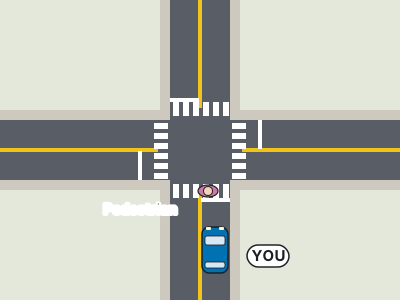
- The driver must sound the horn before proceeding
- The pedestrian must wait for all cars
- The driver may continue if no signal is present
- The driver must yield
Show answer
The driver must yield. Crosswalk duty applies whether traffic-control signals are present or absent when a person is crossing on the driver's side. The absence of a signal does not erase the duty. Honking is not a substitute for yielding, and the person walking does not have to wait for every vehicle to disappear. Slow early, stop when needed, and let the crossing area clear before continuing. The useful cue is the marked crossing and the person's location, not whether a light happens to be operating.
Study this in the handbook: Right of way rules
17. For how long must proof of financial responsibility generally remain in force when Wyoming requires it?
- Six months
- Three years
- One year
- Ten years
Show answer
Three years. The SR-22 section says proof of financial responsibility must be maintained for three years from the date it is required. That period is tied to the requirement date, not merely to the day a driver receives a notice or changes insurers. One year and six months understate the obligation, while ten years adds a condition not stated in this passage. If an insurer cancels the filing, the department must be notified, so keeping coverage active is part of the obligation.
Study this in the handbook: Suspensions, revocations and reinstatement
18. Who qualifies as an emancipated minor under Wyoming's driver license rules?
- Anyone 16 with a job
- Anyone living apart from parents
- A person at least 17 who is or was married, is in the U.S. military, or was emancipated by a district court
- Any licensed driver under 18
Show answer
A person at least 17 who is or was married, is in the U.S. military, or was emancipated by a district court. An emancipated minor is a person at least 17 years of age who is or was married, is in the military service of the United States, or has been emancipated by the district court. Emancipated minors can have that status shown on their Wyoming license, by making application to the department and paying the required fee. A job at 16, living apart from parents, or simply holding a license under 18 does not meet the definition.
19. At an intersection without signs or signals, which vehicle must yield?
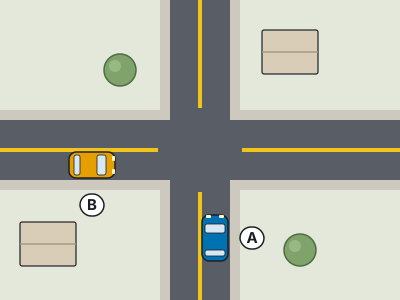
- No vehicle, because uncontrolled intersections have equal priority
- The vehicle that reaches the intersection first in every case
- The vehicle traveling on the wider roadway
- The vehicle facing traffic coming from its right
Show answer
The vehicle facing traffic coming from its right. At an intersection with no signs or signals, Wyoming requires a driver to watch for a vehicle coming from the right and yield regardless of who first reaches and enters the intersection. Arrival order therefore does not erase the right-side rule, and roadway width is not the deciding fact described here. An uncontrolled intersection still has a yield obligation. Approach slowly enough to observe both sides, confirm the other driver's movement, and yield whenever the vehicle on the right is close enough to create a conflict.
Study this in the handbook: Speed limits and adjusting to conditions
20. What general information can a driver get from the shape of a sign when visibility is poor?
- Its shape can still suggest the type of information or action involved
- Its shape becomes meaningless whenever the lettering cannot be read
- Every shape gives a regulatory speed regardless of its color
- Shape identifies the nearest emergency service rather than road conditions
Show answer
Its shape can still suggest the type of information or action involved. Wyoming explains that sign shapes remain useful when fading light, fog, rain, snow, or darkness makes the words difficult to read. A diamond shape generally warns of road hazards, while a rectangle gives regulatory information about lawful speeds and directions. The shape does not become meaningless, and it does not make every sign a speed control or an emergency-service marker. Reduce speed in poor visibility, recognize the sign form, and continue looking for the full message as conditions permit.
QualitySpace is expanding to Wyoming
We are a California-based independent insurance brokerage working on licensing in more states. We cannot help with Wyoming insurance yet. Leave your email and we will let you know when we can.
Every question is written from the official Wyoming Rules of the Road Driver License Manual. Need paper? Printable WY practice test with answer key.
Last verified 2026-10-05. How we check every question · Study all 200 as flashcards
Frequently asked questions
How many questions are on this Wyoming practice test?
This fixed set has 20 questions. It is test 2 of 10 from the 200 question Wyoming bank.
How does this fixed test relate to the full Wyoming bank?
Each numbered test is a fixed set of questions in a fixed order, so you can retake the same test later and compare. Every test mixes road signs and the other topics in about the same proportion as the full bank. Tests 1 to 10 together cover every question in the Wyoming bank once. The full practice page mixes the whole bank at random.
Last verified 2026-10-05. See the Wyoming DMV facts page for sourced state details.