
Key points
Advance warning signs tell you to look, listen, slow down and be ready to stop for trains.
Source: Handbook p. 9
“These signs warn you to look, listen, slow down and be prepared to stop for trains or any vehicles using the rails.”
Virginia Driver's Manual, Handbook p. 9Always stop when crossing lights begin to flash.
Source: Handbook p. 9
“Always stop when the light begins to flash and be alert for approaching trains.”
Virginia Driver's Manual, Handbook p. 9Never start across the tracks unless there is room for your vehicle on the other side.
Source: Handbook p. 10
“Unless you can clear the tracks completely, never start across the tracks. Make sure there is room for your vehicle on the other side of the tracks before proceeding.”
Virginia Driver's Manual, Handbook p. 10School buses must always stop at railroad crossings, even when the lights are not flashing.
Source: Handbook p. 10
“School buses must always stop at railroad crossings, even when the lights are not flashing.”
Virginia Driver's Manual, Handbook p. 10If your car stalls on the tracks, get out right away and run diagonally away from the tracks toward the oncoming train.
Source: Handbook p. 10
“Get out of the car right away and run diagonally away from the tracks in the direction of the oncoming train.”
Virginia Driver's Manual, Handbook p. 10Orange marks a work zone and means slow down and be alert.
Source: Handbook p. 10
“Remember, the color orange marks a work zone and means slow down and be alert.”
Virginia Driver's Manual, Handbook p. 10Speeding in a highway work zone can bring a fine of up to $500.
Source: Handbook p. 10
“If you are convicted of exceeding the speed limit in a highway work zone, you may be fined up to $500.”
Virginia Driver's Manual, Handbook p. 10Using a handheld communications device in a highway work zone brings a $250 fine.
Source: Handbook p. 10
“If you are convicted of using a handheld communications device in a highway work zone, you will be fined $250.”
Virginia Driver's Manual, Handbook p. 10Drive slowly over rumble strips; do not swerve around them.
Source: Handbook p. 11
“Rumble strips should be slowly driven over, not swerved around.”
Virginia Driver's Manual, Handbook p. 11
Numbers to know
| Number | What it means | Manual |
|---|---|---|
| $500 | maximum fine for speeding in a highway work zone | Handbook p. 10 |
| $250 | fine for using a handheld device in a highway work zone | Handbook p. 10 |
| 511 | number to call for road condition and construction information | Handbook p. 11 |
Recognize these signs

Railroad crossing ahead 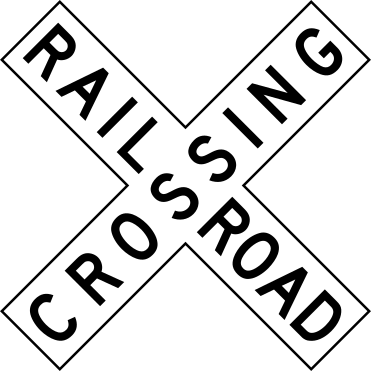
Railroad crossbuck 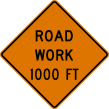
Road work ahead
3 questions from the Virginia practice test
1. Before starting across railroad tracks, what must a driver make sure of?
- The driver can shift gears while on the tracks
- A vehicle is stopped on the opposite side of the crossing
- The crossing lights are off even if traffic blocks the exit
- There is room on the other side to clear the tracks completely
Show answer
There is room on the other side to clear the tracks completely. A driver must not enter a railroad crossing unless the vehicle can clear the tracks completely and there is space beyond them. A blocked exit, even with the lights off, could leave the vehicle stranded in the path of a train. A dark crossing signal does not guarantee that the route ahead is open, and changing gears on the rails is no part of the manual instruction. Stop short when traffic is backed up, then reassess. The practical cue is to look past the rails before moving, not merely to look for a train at the crossing itself.
2. What is unusual about school buses at railroad crossings in Virginia?
- They may cross without stopping when no train is visible
- They must always stop, even when crossing lights are not flashing
- They stop only when a gate is fully lowered
- They are exempt when carrying no children
Show answer
They must always stop, even when crossing lights are not flashing. School buses must always stop at railroad crossings in Virginia, including crossings where the warning lights are not flashing. The absence of flashing lights therefore does not create an exception for a bus. A visible train is not the trigger either, and the bus does not gain an exemption because children are absent. If you are following a bus, expect the stop and leave enough space for it to complete the crossing safely.
3. What does the color orange indicate in a highway work zone?
- The road is reserved for bicycles
- Slow down and stay alert
- A higher speed is permitted through the zone
- The work area has ended
Show answer
Slow down and stay alert. Orange marks a work zone and signals drivers to slow down and remain alert. It is not a bicycle reservation, a higher speed permission, or proof that construction has ended. Workers depend on approaching drivers recognizing the changed environment and obeying the posted speed limit. Watch for lane shifts, equipment, and people close to the travel path. Continue in the assigned lane until completely clear, then resume normal decisions only after the work zone signs and activity have ended.
Practice this topic
Lock it in with safe driving questions from the free Virginia practice test. Every answer comes with a plain English explanation.
Source: the Virginia Driver's Manual, Section 2: Signals, Signs and Pavement Markings. This lesson is a plain English summary, not the law itself; where it differs, the manual and the statute govern. Last checked 2026-09-27.