
Test 4 of 10 · 20 questions · Free 2026
VA Permit Practice Test 4
Jump to the test ↓A fixed 20 question set from the Virginia bank with answers and plain English explanations. The real VA exam has a 10 question road sign section with 10 correct to pass, plus 30 knowledge questions with 24 correct to pass; take the full length version on the main practice page.
Question 1 of 20 · 0 right so far
All 20 questions in test 4
Every question below comes from the Virginia question bank on this page. Open a question to see the correct answer and the explanation. Nothing here is hidden behind a signup.
1. What does the color orange indicate in a highway work zone?
- The road is reserved for bicycles
- Slow down and stay alert
- A higher speed is permitted through the zone
- The work area has ended
Show answer
Slow down and stay alert. Orange marks a work zone and signals drivers to slow down and remain alert. It is not a bicycle reservation, a higher speed permission, or proof that construction has ended. Workers depend on approaching drivers recognizing the changed environment and obeying the posted speed limit. Watch for lane shifts, equipment, and people close to the travel path. Continue in the assigned lane until completely clear, then resume normal decisions only after the work zone signs and activity have ended.
Study this in the handbook: Railroad crossings and work zones
2. Why should you create a space cushion around your vehicle?
- It gives you distance to react and avoid a crash
- It prevents every other driver from passing you
- It lets you drive faster than the posted limit safely
- It removes the need to check mirrors and blind spots
Show answer
It gives you distance to react and avoid a crash. Open space around the vehicle gives a driver room to respond when traffic changes suddenly. Staying centered in the lane and preserving room ahead and behind helps with braking, steering, and allowing another vehicle to pass safely. The passing-prevention choice misunderstands the purpose because a cushion is not a barrier. It also cannot replace mirror checks or legal speed limits. Think of the cushion as usable reaction room, especially near large vehicles, motorcycles, bicycles, traffic, and poor weather.
Study this in the handbook: Hand position, following distance and blind spots
3. What must you do when traffic signals are out of service and displaying no lights?
- Stop and wait until a steady green appears
- Continue normally because no light means no rule
- Stop and proceed as though the intersection were an all-way stop
- Yield only to traffic approaching from the left
Show answer
Stop and proceed as though the intersection were an all-way stop. When a signal is dark because of a power outage or another problem, Virginia treats the intersection as an all-way stop. Every approach must stop and then proceed according to right-of-way rules. Stopping and treating the intersection as an all-way stop is the required action, while continuing normally assumes the absence of a light removes control. Yielding only to the left invents a one-sided yield rule. Look for an officer or portable stop signs, because those instructions replace the all-way-stop treatment when they are present.
Study this in the handbook: Traffic signals and turns on red
4. What does a flashing yellow light require a driver to do?
- Stop and remain stopped until the light changes
- Turn only in the direction of a nearby arrow
- Speed up before the light turns red
- Slow down and proceed with caution
Show answer
Slow down and proceed with caution. A flashing yellow light requires reduced speed and cautious progress. It is not the same as a flashing red signal, which calls for a complete stop before proceeding. The option requiring a continued stop confuses those two signal meanings, while accelerating works against the warning. Virginia places flashing yellow lights where hazardous conditions are higher than normal, so look carefully for cross traffic, pedestrians, and vehicles that may be difficult to see. Ease off the accelerator before the intersection, confirm that the way is clear, and continue only when the movement can be made safely.
Study this in the handbook: Traffic signals and turns on red
5. A Virginia driver who is 19 is convicted of a single demerit point violation. What does DMV require?
- Nothing until 12 points are reached
- A driver improvement clinic
- A 90-day suspension
- A new road skills test
Show answer
A driver improvement clinic. Drivers age 18 or 19 must complete a driver improvement clinic after any demerit point or safety belt or child restraint conviction for a violation committed at that age. The 12 points in 12 months threshold applies to drivers 18 and older in general, but this age group has the stricter single conviction rule. A 90-day suspension follows a second conviction only for violations under 18, and no new road test is required.
Study this in the handbook: Suspensions, revocations and demerit points
6. When will the Division of Child Support Enforcement have Virginia DMV suspend a parent's driving privilege?
- When payments are one day late
- When payments are $500 late
- Only after a jail sentence
- When payments are 90 days or $5,000 late
Show answer
When payments are 90 days or $5,000 late. DMV suspends the driving privilege when the Division of Child Support Enforcement reports child support payments late by 90 days or $5,000. Failing to appear in court or comply with a subpoena, summons or warrant in a paternity or support case also triggers it. One day or $500 late is below the threshold, and no jail sentence is required first. Restricted privileges may be available.
Study this in the handbook: Suspensions, revocations and demerit points
7. When a Lane Reduction sign shows the right lane ending, who must merge left?

- Drivers in the right lane when space opens up
- Only drivers already in the left lane
- Every driver, including those behind the sign
- No one, because the lane continues normally
Show answer
Drivers in the right lane when space opens up. A Lane Reduction warning tells the driver that the right lane ends soon. Vehicles in that lane must merge left when space opens, while drivers already in the left lane should allow the merge to happen smoothly. The left-lane-only option reverses the instruction, and no driver can assume the lane continues. Look well ahead, signal before moving, and choose a safe gap instead of waiting until the pavement narrows.
Study this in the handbook: Regulatory and warning signs
8. What does a Roundabout sign indicate, and who yields when entering?

- A four-way stop; traffic on the circle must stop first
- A circular intersection; entering traffic yields to traffic already in the circle
- A one-way ramp; entering traffic has priority
- A divided highway; vehicles must pass on the left
Show answer
A circular intersection; entering traffic yields to traffic already in the circle. A roundabout sign announces a circular intersection with a center island, sometimes called a traffic circle. Vehicles already circulating have priority, so entering traffic must yield before joining and then travel counterclockwise. It is not an automatic four-way stop, and the entering driver does not receive priority simply by reaching the entry. Slow before the circle, scan for circulating vehicles, yield, and enter only when a safe gap is available.
Study this in the handbook: Special lanes, painted curbs and parking
9. After a crash, how long does a Virginia officer with probable cause have to arrest the driver for DUI without a warrant?
- Within 30 minutes of the crash
- Within one hour, and only at the scene
- Within 24 hours of the crash
- Within three hours of the crash
Show answer
Within three hours of the crash. If a crash happens and an officer has probable cause, the driver can be arrested for DUI within three hours without a warrant and at any location. The arrest does not have to happen at the scene, so leaving does not end the officer's authority. Thirty minutes and one hour are shorter than the law allows. Twenty-four hours goes beyond it. Implied consent also means the driver has agreed to a breath test on request.
Study this in the handbook: Suspensions, revocations and demerit points
10. A Virginia permit holder aged 19 or older wants a driver's license. Which path is described in the manual?
- Hold the permit 30 days and pass a motorcycle skills test
- Hold the permit one year with no education option
- Hold the permit 60 days or present a driver education completion certificate
- Skip the permit period by submitting a vehicle registration
Show answer
Hold the permit 60 days or present a driver education completion certificate. For an applicant who is 19 or older, Virginia describes two routes before applying for the driver's license: keep the learner's permit for 60 days, or present a driver education certificate of completion. The rule is not a one year waiting period, and a vehicle registration does not replace either requirement. The motorcycle examination belongs to a different credential and does not shorten this automobile licensing step. Keep the permit dates or certificate available when preparing the application so the chosen route can be documented.
Study this in the handbook: Learner's permit, license and vehicle paperwork
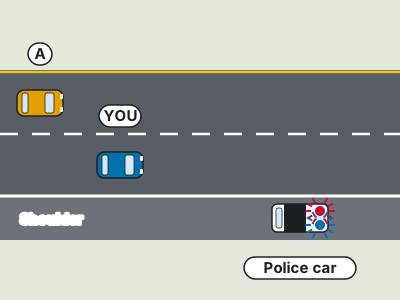
11. When approaching a stationary emergency vehicle or tow truck with flashing lights on a highway, what should a Virginia driver do if changing lanes is reasonably safe?
- Stop in the travel lane until the vehicle departs
- Change to a lane not next to it and proceed cautiously
- Speed up to pass before reaching the vehicle
- Move onto the shoulder and continue at the same speed
Show answer
Change to a lane not next to it and proceed cautiously. For a stationary emergency vehicle or tow truck with flashing lights, the preferred response is a cautious lane change into a lane not next to the vehicle when safety and traffic conditions permit. Stopping in the travel lane can create a second hazard, while accelerating or using the shoulder abandons the protective spacing the rule seeks. If the lane change cannot be made safely, reduce speed and continue with caution instead of forcing the maneuver.
Study this in the handbook: Emergency vehicles and stopped vehicles with flashing lights
12. For a second Virginia DUI offense, how long is the administrative license suspension?
- Seven days with no alternative endpoint
- One year from the date of the stop
- Only until the driver leaves the police station
- 60 days or until trial, whichever comes first
Show answer
60 days or until trial, whichever comes first. Virginia lists a second offense administrative suspension as 60 days or until the driver goes to trial, whichever comes first. The seven day period belongs to a first offense. A one year period appears in a different underage alcohol conviction context, so it should not be substituted here. Leaving the station does not end a statutory suspension. The phrase whichever comes first is important because the two possible endpoints are not added together.
Study this in the handbook: DUI suspensions, open containers and underage drinking
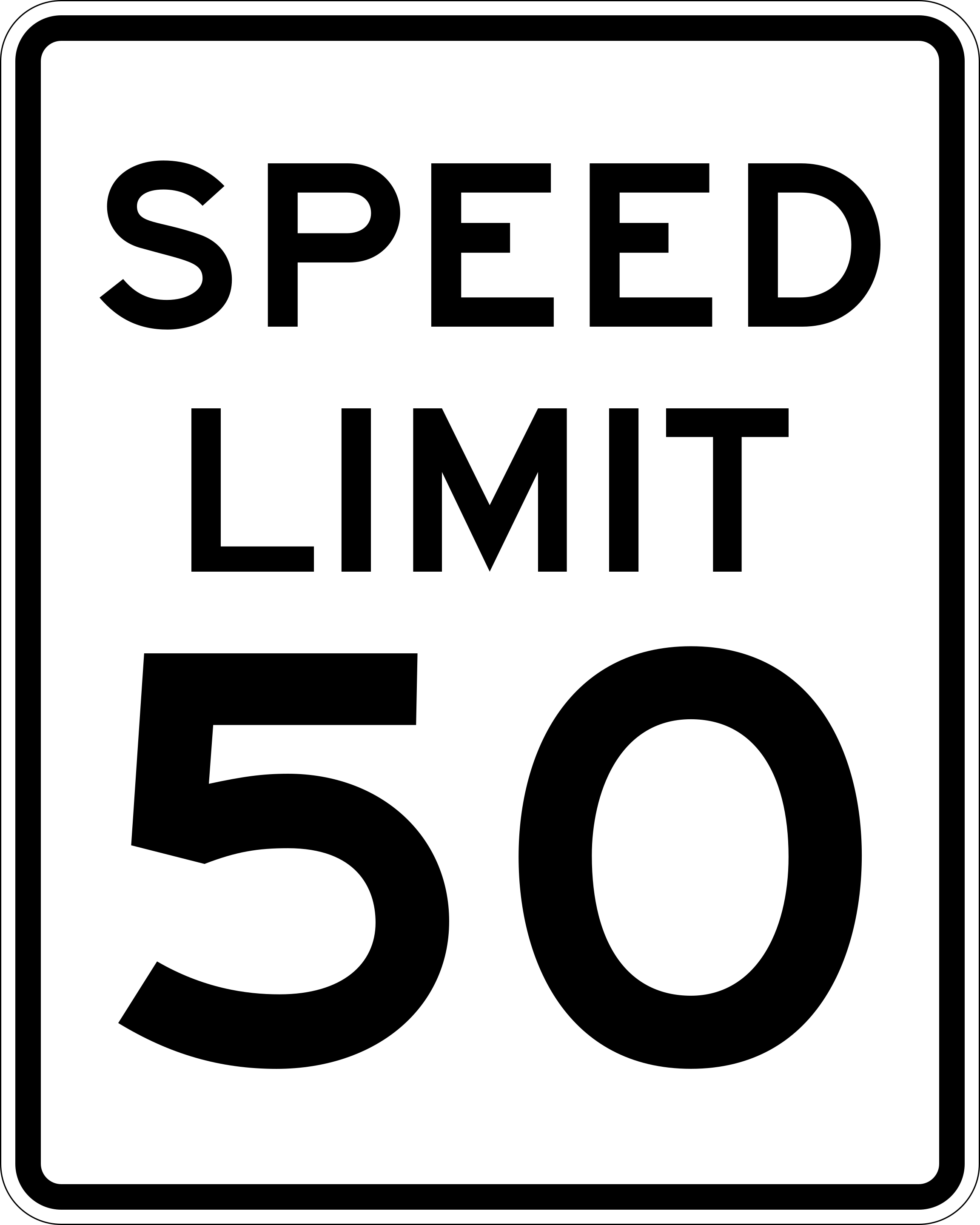
13. Under good weather conditions, what does a posted Speed Limit sign identify?
- The minimum speed for every vehicle
- A recommended speed that may always be exceeded
- The maximum legal speed on that road
- The speed allowed only while passing
Show answer
The maximum legal speed on that road. A Virginia Speed Limit sign states the maximum legal speed for that road when weather conditions are good. It is not a minimum, a casual recommendation, or a passing-only figure. Rain, snow, and ice can require a driver to go slower, and a ticket may result from driving too fast for conditions even at or below the displayed number. Use the sign as an upper boundary, then adjust downward for the surface and visibility.
Study this in the handbook: Sign colors and shapes
14. What action is required when passing a stationary vehicle with hazard flashers, a caution sign, or properly lit flares?
- Maintain speed and remain in the same lane
- Stop at least 100 feet before every such vehicle
- Make a lane change and proceed with caution
- Pass on the shoulder without reducing speed
Show answer
Make a lane change and proceed with caution. Virginia requires a lane change and cautious progress when a stationary vehicle displays hazard flashers, a caution sign, or properly lit flares or torches. Maintaining the original lane ignores the protective space the rule is designed to create. The passage does not impose a universal 100 foot stop, and using the shoulder at speed is not a safe substitute for a legal lane change. Reduce risk early by checking mirrors, signaling, and moving only when the adjacent lane is clear.
Study this in the handbook: Special lanes, painted curbs and parking
15. What does a Virginia sign reading “Speed Photo Enforced” indicate?
- Automated photo enforcement may be used for speeding in a school zone
- Officers may not issue speeding citations there
- The speed limit is advisory only
- The road has no posted maximum speed
Show answer
Automated photo enforcement may be used for speeding in a school zone. Virginia says some school zones may use automated photo enforcement, and the sign wording identifies that possibility. The sign does not make the speed limit optional, prevent officers from enforcing it, or remove the need for a posted maximum. Treat the notice as a reminder that speeding can be recorded automatically in that school zone. The word may is important: it describes possible enforcement rather than promising that a camera is active at every location. Reduce speed before entering the zone and continue following the displayed limit and traffic conditions.
Study this in the handbook: Speed limits and reckless driving
16. When entering a Virginia roundabout, to whom must the entering driver yield?
- Pedestrians and traffic already in the circle
- Only vehicles signaling a turn
- No one, because entering traffic has priority
- Only vehicles approaching from the left
Show answer
Pedestrians and traffic already in the circle. Entering traffic yields to pedestrians and to traffic already circulating in the roundabout. The rule is not limited to vehicles approaching from one side, and a turn signal does not create priority. Entering drivers should slow, read the yield sign, and wait for a safe gap. Picture the circle as already occupied: people crossing and vehicles in the circle go first, then the entering vehicle joins counter-clockwise.
Study this in the handbook: Right of way, pedestrians and roundabouts
17. When should you switch from high beams to low beams for an oncoming vehicle?
- Only when the other driver flashes headlights first
- Only after entering a city street
- Whenever the vehicle is within 50 feet
- Whenever an oncoming vehicle is within 500 feet
Show answer
Whenever an oncoming vehicle is within 500 feet. On a highway, Virginia allows high beams unless another vehicle is within 500 feet coming toward you. At that distance, switch to low beams so your light does not blind the oncoming driver. Waiting for the other driver to signal is unsafe and reverses the responsibility. The 50-foot option is too short to provide comfortable visibility and reaction time. City driving is not the controlling condition in this rule. Watch the approaching vehicle's distance, dim in advance, and keep the high beams off until the vehicles have passed.
Study this in the handbook: Headlights, night, fog, rain and snow
18. A Virginia driver ignores an officer's signal to stop, and the pursuing officer is killed as a result. What charge applies?
- A Class 4 felony
- A Class 1 misdemeanor
- A traffic infraction
- Reckless driving
Show answer
A Class 4 felony. Virginia's manual lists stopping at the direction of a police officer among the times you must always stop your vehicle. It then states that if you do not obey a law enforcement officer's signal to stop and the officer pursues you and is killed as a direct result of the pursuit, you will be guilty of a Class 4 felony. A misdemeanor, a traffic infraction, or a reckless driving charge is not the penalty the manual attaches to this fatal pursuit case.
Study this in the handbook: Speed limits and reckless driving
19. What do yellow center lines indicate about traffic on the road?
- They separate lanes traveling in the same direction
- They separate traffic traveling in opposite directions
- They mark a lane reserved for bicycles
- They show where parking is permitted
Show answer
They separate traffic traveling in opposite directions. Yellow center lines divide traffic moving in opposite directions. They help establish which side of the roadway carries opposing vehicles, while white lines generally separate lanes moving in the same direction. The same-direction choice confuses the two marking colors, and neither bicycle use nor parking is established by a yellow center line. Keep right of the center marking, watch for additional broken or solid patterns, and never cross simply because the road looks empty.
Study this in the handbook: Pavement markings
20. When making a U-turn, what must you do before proceeding?
- Accelerate immediately without signaling
- Stop only after entering the opposite lane
- Turn on your left-turn signal, stop, and yield for approaching traffic
- Use the right-turn signal and proceed without yielding
Show answer
Turn on your left-turn signal, stop, and yield for approaching traffic. Before making a U-turn, Virginia directs the driver to use the left turn signal, stop, and yield for approaching traffic. The acceleration choice removes the required stop and yield, while stopping only after entering the opposite lane waits too late to stop safely. A right turn signal communicates a different movement and does not provide the needed warning. Check for No U-Turn and No Left Turn signs first, then wait until the path is clear. The practical cue is left signal, stop, yield, and proceed only after approaching traffic no longer creates a hazard.
Study this in the handbook: When you must stop, school buses and stopping distance
QualitySpace is expanding to Virginia
We are a California-based independent insurance brokerage working on licensing in more states. We cannot help with Virginia insurance yet. Leave your email and we will let you know when we can.
Every question is written from the official Virginia Driver's Manual. Need paper? Printable VA practice test with answer key.
Last verified 2026-10-05. How we check every question · Study all 206 as flashcards
Frequently asked questions
How many questions are on this Virginia practice test?
This fixed set has 20 questions. It is test 4 of 10 from the 206 question Virginia bank. The real VA exam has a 10 question road sign section with 10 correct to pass, plus 30 knowledge questions with 24 correct to pass.
What is the passing score for the real Virginia test?
Part one: all ten road sign questions must be answered correctly; part two: you must correctly answer 24 of the 30 general knowledge questions That figure comes from the official Virginia source cited on the DMV facts page.
How does this fixed test relate to the full Virginia bank?
Each numbered test is a fixed set of questions in a fixed order, so you can retake the same test later and compare. Every test mixes road signs and the other topics in about the same proportion as the full bank. Tests 1 to 10 together cover 200 of the 206 questions in the Virginia bank, each once. The full practice page mixes the whole bank at random.
Last verified 2026-10-05. See the Virginia DMV facts page for sourced state details.
Return to the full Virginia practice test · Study road signs