
Test 7 of 10 · 20 questions · Free 2026
VA Permit Practice Test 7
Jump to the test ↓A fixed 20 question set from the Virginia bank with answers and plain English explanations. The real VA exam has a 10 question road sign section with 10 correct to pass, plus 30 knowledge questions with 24 correct to pass; take the full length version on the main practice page.
Question 1 of 20 · 0 right so far
All 20 questions in test 7
Every question below comes from the Virginia question bank on this page. Open a question to see the correct answer and the explanation. Nothing here is hidden behind a signup.
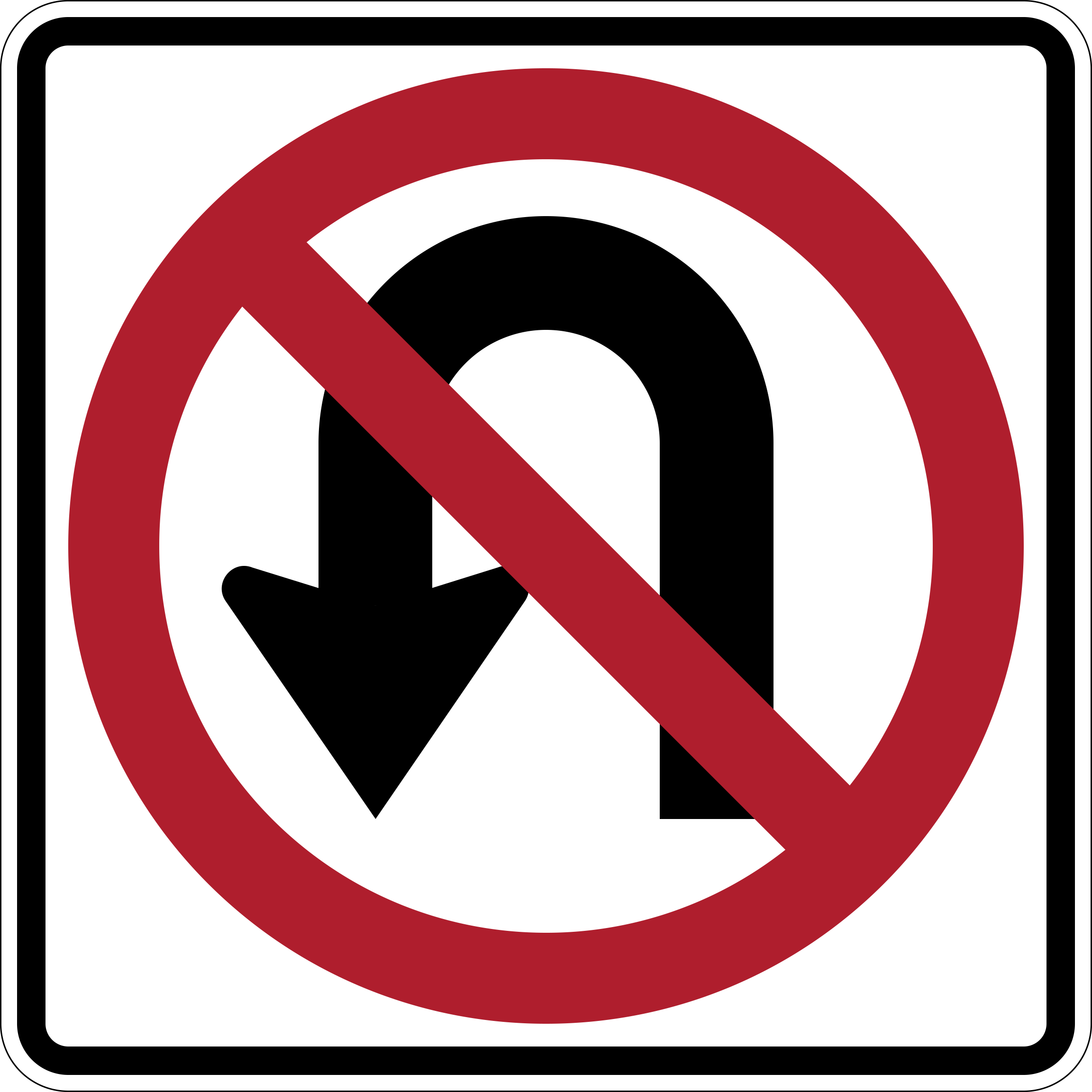
1. What action is prohibited by a No U-Turn sign?
- Making a U-turn at that location
- Turning right after a full stop
- Changing lanes before the intersection
- Turning around through a legal opening
Show answer
Making a U-turn at that location. Virginia's manual says a No U-Turn sign means U-turns are illegal, so do not make a U-turn when you see this sign. The manual also explains that on regulatory signs a red circle with a slash means NO, and the symbol inside the circle shows what is prohibited. A right turn and a lane change are different movements, and turning around later through a legal opening elsewhere is not a U-turn at the signed location.
Study this in the handbook: Sign colors and shapes
2. Which location is included in Virginia's definition of a vehicle's passenger area for open-container enforcement?
- Only the exterior roof rack
- Only the trunk of the vehicle
- An unlocked glove compartment within the driver's reach
- A separate building next to the vehicle
Show answer
An unlocked glove compartment within the driver's reach. Virginia defines the passenger area broadly for this rule. It includes the places where the driver and passengers sit plus any area within the driver's reach, including an unlocked glove compartment. The trunk is outside that described area, and a roof rack or nearby building is not part of the cabin. The key cue is reachability from inside the vehicle, not whether the container is in a seat. This definition can matter even when an item is not sitting beside a passenger, so check accessible compartments before assuming the location is excluded.
Study this in the handbook: Suspensions, revocations and demerit points
3. How does Virginia deliver a newly issued driver's license according to the manual?
- Only as a digital credential in a DMV app
- By mail, rather than issuing it at a customer service center
- Through the applicant's insurance company
- At the testing site immediately after the road test
Show answer
By mail, rather than issuing it at a customer service center. Virginia mails the new driver's license and, for security, does not issue licenses in customer service centers. The manual does not describe a phone app as the delivery method, and insurance companies play no part in delivering the license. Passing a road test does not mean the physical credential is handed over at the testing site. The postal service will not forward a license to another address, so notify DMV within 30 days of a move to make sure the card reaches you instead of returning to DMV.
Study this in the handbook: Learner's permit, license and vehicle paperwork
4. What must a Virginia driver do when meeting a military convoy?
- Pass it on the left as soon as possible
- Yield to it, and never cut through or join it
- Stop and wait for it to pass in either direction
- Follow closely behind the last vehicle
Show answer
Yield to it, and never cut through or join it. You must yield to all military convoys, and never cut through or join a military convoy. A car slipping into the line or cutting between its vehicles breaks up the group, which is exactly what the rule forbids. The same right-of-way section treats funeral processions alike: yield, and do not cut through, join or interfere with them. Passing early or trailing close behind the last vehicle are both ways of pushing into the group instead of yielding.
Study this in the handbook: Special lanes, painted curbs and parking
5. In Virginia business districts, cities, and towns, where are U-turns allowed?
- Only at intersections
- Only at railroad crossings
- Only in a marked passing lane
- Anywhere the roadway is clear
Show answer
Only at intersections. Within business districts, cities, and towns, Virginia allows U-turns only at intersections. A clear roadway by itself does not make a mid-block turn legal, and railroad crossings or passing lanes are not exceptions listed here. Before turning, check for signs that prohibit U-turns or left turns, then yield to approaching traffic. The location cue is decisive: these areas impose the intersection-only restriction.
Study this in the handbook: When you must stop, school buses and stopping distance
6. On an undivided highway, what must you do when an emergency vehicle approaches in the opposite lane?
- Continue at normal speed because it is in the other lane
- Move toward the centerline to give it more room
- Turn around before the emergency vehicle reaches you
- Pull to the edge of the road and stop
Show answer
Pull to the edge of the road and stop. On an undivided highway, an approaching emergency vehicle affects traffic in both directions. Pull to the edge of the road and stop until the emergency vehicle passes. Continuing because the vehicle is in the opposite lane ignores the manual's special requirement and leaves less room for a safe response. The centerline is not a refuge. Reduce speed early, check the shoulder, and stop where you can remain clear of the emergency vehicle's path.
Study this in the handbook: Special lanes, painted curbs and parking
7. What is the default speed limit for an unpaved road when no Virginia speed-limit sign states otherwise?
- 25 MPH
- 35 MPH
- 45 MPH
- 55 MPH
Show answer
35 MPH. Virginia lists 35 MPH as the default for unpaved roads when no sign supplies a different limit. Twenty-five MPH applies to school, business, and residential areas, while 55 MPH covers all other roads. The 45 MPH option is not one of those categories. Read the road description before choosing a number. A posted sign controls when present, and bad weather or hazards can require travel below the legal maximum.
Study this in the handbook: Speed limits and reckless driving
8. What do red reflectors placed on the pavement indicate?
- A lane reserved for emergency vehicles
- Areas that traffic must not enter or use
- A place where passing is always permitted
- The edge of a legal parking area
Show answer
Areas that traffic must not enter or use. Red pavement reflectors mark areas that traffic must not enter or use. They are positioned so that traffic moving in the wrong direction would see them, making them a serious warning rather than a parking guide. The emergency-lane choice invents a use, and the passing choice reverses the restriction. When red reflectors appear, keep the vehicle out of that marked space and follow the lane lines, signs, and direction of legal travel.
Study this in the handbook: Regulatory and warning signs
9. Before starting across railroad tracks, what must a driver make sure of?
- The driver can shift gears while on the tracks
- A vehicle is stopped on the opposite side of the crossing
- The crossing lights are off even if traffic blocks the exit
- There is room on the other side to clear the tracks completely
Show answer
There is room on the other side to clear the tracks completely. A driver must not enter a railroad crossing unless the vehicle can clear the tracks completely and there is space beyond them. A blocked exit, even with the lights off, could leave the vehicle stranded in the path of a train. A dark crossing signal does not guarantee that the route ahead is open, and changing gears on the rails is no part of the manual instruction. Stop short when traffic is backed up, then reassess. The practical cue is to look past the rails before moving, not merely to look for a train at the crossing itself.
Study this in the handbook: Railroad crossings and work zones
10. Which BAC range can result in an illegal-consumption conviction for a Virginia driver under age 21?
- At least .08 but less than .10
- At least .02 but less than .08
- At least .10 but less than .12
- At least .00 but less than .02
Show answer
At least .02 but less than .08. For a driver under 21, Virginia identifies illegal consumption when BAC is at least .02 but below .08. The .08 figure is the adult DUI threshold and misses the underage range when offered as the starting point. A range below .02 does not reach the stated minimum, while one beginning at .10 has passed the upper boundary. Remember both endpoints: .02 starts this age-based range, and .08 ends it.
Study this in the handbook: Alcohol, drugs and DUI
11. What kind of message does a black and white traffic sign usually convey?
- A warning about a curve or slippery pavement
- Directions to a historical or cultural attraction
- A legal regulation such as a speed limit or turn rule
- Information about nearby motorist services
Show answer
A legal regulation such as a speed limit or turn rule. Black paired with white signals regulatory information, meaning the sign communicates an operating rule backed by law. Speed limits and turn prohibitions are examples. A curve or slippery pavement warning describes the yellow and black combination. Historical or cultural destinations use brown and white, and motorist services use blue and white. A useful roadside cue is to treat a black and white panel as an instruction you must obey, not merely a suggestion about something you may encounter ahead.
Study this in the handbook: Traffic signals and turns on red
12. An applicant fails the Virginia road skills test at DMV three times. What must happen before a fourth attempt?
- Wait 90 days and retest at DMV
- Pay a $500 retest fee
- Complete and pass the in-vehicle part of driver education at an approved school
- Retake the knowledge exam only
Show answer
Complete and pass the in-vehicle part of driver education at an approved school. After three failed road skills tests at DMV, the applicant cannot take a fourth until completing and passing the in-vehicle part of driver education at a driver training school approved by DMV or the Department of Education. The course must be completed after the date of the third failure. No 90-day wait, $500 fee or knowledge exam retake replaces that training. The knowledge exam has a parallel rule requiring the classroom component after three failures.
Study this in the handbook: The knowledge exam, road skills test and vision screening
13. How close to a fire hydrant may you park in Virginia?
- No closer than 15 feet
- No closer than 5 feet
- No closer than 10 feet
- No closer than 25 feet
Show answer
No closer than 15 feet. Virginia bans parking within 15 feet of a fire hydrant. Five and ten feet both fall inside the 15 foot zone the list protects around a hydrant. Twenty-five feet is not the hydrant distance in the Virginia list. The same list uses 15 feet again for the entrance to a fire, ambulance or rescue squad station, 20 feet for an intersection, and 50 feet for a railroad crossing.
Study this in the handbook: Special lanes, painted curbs and parking
14. What license penalty can a Virginia court impose for a conviction of aggressive driving?
- A suspension of ten days up to six months
- A warning letter only
- A permanent revocation
- A suspension of exactly one year
Show answer
A suspension of ten days up to six months. If you are convicted of aggressive driving, your license could be suspended for as little as ten days or as long as six months. A warning letter understates the risk, and permanent revocation overstates it. A fixed one-year suspension is not the stated range. Virginia law defines aggressive driving as committing traffic offenses with the intent to harass, intimidate, injure or obstruct another person.
Study this in the handbook: Headlights, night, fog, rain and snow
15. Where does Virginia's manual say to place your hands on the steering wheel?
- At 10 and 2
- One hand at 12 o'clock
- At 12 and 6
- At the 8 o'clock and 4 o'clock positions, holding with fingers and thumbs
Show answer
At the 8 o'clock and 4 o'clock positions, holding with fingers and thumbs. Sit straight but relaxed, and if the steering wheel were a clock your hands should be at the 8 o'clock and 4 o'clock positions. Hold the wheel with your fingers and thumbs rather than gripping with your palms. The manual pairs that clock picture with a seating cue: sit straight yet relaxed, and avoid gripping the rim with your palms, so the hold stays light and controlled.
Study this in the handbook: Hand position, following distance and blind spots
16. What do double solid yellow center lines indicate?
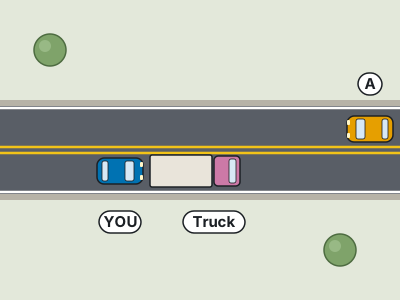
- Passing is allowed for traffic on both sides
- Only nighttime passing is prohibited
- Passing is not allowed in either direction
- The center of the road may be used as a turn lane
Show answer
Passing is not allowed in either direction. Double solid yellow lines divide opposing traffic and prohibit passing in either direction. The two-line marking is stronger than a broken yellow line, which can permit passing when the way is clear. Do not use the center area as a travel lane or assume darkness changes the restriction. Stay on your side, watch for legal turning openings and pedestrians, and obey any additional signs or pavement markings that control the road.
Study this in the handbook: Pavement markings
17. What is the first response to reduced visibility or a rain, snow, or ice covered road?
- Turn off the headlights to reduce glare
- Accelerate until the road surface improves
- Keep the same speed and shorten the gap ahead
- Reduce speed
Show answer
Reduce speed. The manual identifies slowing down as the first response when visibility falls or rain, snow, or ice covers the road. It also advises turning on headlights and doubling the normal following distance. The other choices increase risk by reducing visibility, shrinking the reaction space, or adding speed on a slippery surface. Begin the adjustment as soon as conditions change, before the vehicle reaches a hazard. A lower speed gives the tires and driver more time to respond when traction or sight distance is limited.
Study this in the handbook: Headlights, night, fog, rain and snow
18. What should you do when a yellow warning sign indicates a hazard ahead?
- Slow down, drive with caution, and be ready to stop
- Ignore the sign if the posted speed is unchanged
- Accelerate to clear the hazard before it begins
- Stop only after another driver has stopped
Show answer
Slow down, drive with caution, and be ready to stop. A yellow warning sign tells the driver that a special condition or hazard is ahead. Virginia's sign guidance is to slow down, drive with caution, and be ready to stop. Accelerating toward the hazard removes the time needed to respond, while ignoring the sign because the speed limit has not changed misses its warning function. A driver need not wait for another vehicle to stop before taking the message seriously. Use the sign as an advance cue: reduce speed early, look for the condition it names, and keep enough control to stop if the roadway requires it.
Study this in the handbook: Sign colors and shapes
19. Why is driving while sleepy especially dangerous?
- It improves concentration but increases fuel use
- It affects only passengers, not the driver
- It makes stopping distance shorter
- It can impair attention, decisions, and control, or cause you to fall asleep
Show answer
It can impair attention, decisions, and control, or cause you to fall asleep. The manual describes several consequences of drowsy driving: a sleepy driver may make careless decisions, struggle to pay attention, or actually fall asleep while driving. Those problems arise while complex information is arriving from different places, so a missed sign or an unplanned lane change can quickly become a crash. The choices about fuel, passengers, and shorter stopping distance are unrelated to the driver's impaired alertness. Treat yawning, heavy eyelids, or missing exits as a stop cue. Rest at a safe place rather than trying to push through the trip.
Study this in the handbook: Aggressive, distracted and drowsy driving
20. When pavement is wet at a Slippery When Wet sign, which action is advised?

- Reduce speed, avoid hard braking, and increase following distance
- Change direction suddenly to test traction
- Follow the vehicle ahead more closely
- Brake hard before every puddle
Show answer
Reduce speed, avoid hard braking, and increase following distance. Wet pavement reduces available traction, so Virginia advises reducing speed, avoiding hard braking or sudden direction changes, and increasing the distance behind the vehicle ahead. Hard braking and abrupt steering can make a skid more likely, while a shorter following gap leaves less time to react. The skidding-car symbol is a cue to make every input gradual and create extra space before the road becomes slick.
Study this in the handbook: Regulatory and warning signs
QualitySpace is expanding to Virginia
We are a California-based independent insurance brokerage working on licensing in more states. We cannot help with Virginia insurance yet. Leave your email and we will let you know when we can.
Every question is written from the official Virginia Driver's Manual. Need paper? Printable VA practice test with answer key.
Last verified 2026-10-05. How we check every question · Study all 206 as flashcards
Frequently asked questions
How many questions are on this Virginia practice test?
This fixed set has 20 questions. It is test 7 of 10 from the 206 question Virginia bank. The real VA exam has a 10 question road sign section with 10 correct to pass, plus 30 knowledge questions with 24 correct to pass.
What is the passing score for the real Virginia test?
Part one: all ten road sign questions must be answered correctly; part two: you must correctly answer 24 of the 30 general knowledge questions That figure comes from the official Virginia source cited on the DMV facts page.
How does this fixed test relate to the full Virginia bank?
Each numbered test is a fixed set of questions in a fixed order, so you can retake the same test later and compare. Every test mixes road signs and the other topics in about the same proportion as the full bank. Tests 1 to 10 together cover 200 of the 206 questions in the Virginia bank, each once. The full practice page mixes the whole bank at random.
Last verified 2026-10-05. See the Virginia DMV facts page for sourced state details.
Return to the full Virginia practice test · Study road signs