
Test 16 of 25 · 20 questions · Free 2026
VA Permit Practice Test 16
Jump to the test ↓A fixed 20 question set from the Virginia bank with answers and plain English explanations. The real VA exam has a 10 question road sign section with 10 correct to pass, plus 30 knowledge questions with 24 correct to pass; take the full length version on the main practice page.
Question 1 of 20 · 0 right so far
All 20 questions in test 16
Every question below comes from the Virginia question bank on this page. Open a question to see the correct answer and the explanation. Nothing here is hidden behind a signup.
1. Why does the Virginia manual say not to stop if you enter an E-ZPass-only toll lane by mistake?
- You would be fined twice for stopping
- Stopping could cause a rear-end crash
- The gate will not open for you
- Toll workers will direct you out
Show answer
Stopping could cause a rear-end crash. Some toll roads have high speed lanes reserved for vehicles with E-ZPass transponders. If you enter one by mistake without a transponder, do not stop. The manual explains that stopping is unsafe and could cause a rear-end crash, since drivers behind expect to keep moving. Cameras photograph the license plate, and the registered owner is billed for the toll. Keep going at a safe speed and handle the toll bill later.
Study this in the handbook: Special lanes, painted curbs and parking
2. Your 15-year-old friend wants to ride in the bed of your pickup, which has a camper shell over it. Is that allowed in Virginia?
- Yes, because the camper shell covers it
- Yes, if you drive below 25 mph
- Yes, for a short trip in town
- No, it is illegal for anyone under 16
Show answer
No, it is illegal for anyone under 16. It is illegal in Virginia to transport children under age 16 in the bed of a pickup truck, even if it is equipped with a camper shell. A 15-year-old falls under that rule. The law has no exception for a covered bed. Low speed and short distances are not exceptions. Have your friend ride inside the cab, buckled up. The driver must make sure every passenger under 18 is properly secured.
Study this in the handbook: Seat belts, air bags and child safety seats
3. You have a minor crash on a busy Virginia road. No one is hurt, and both cars can still be driven safely. What must you do?
- Leave the cars where they are for police
- Wait in the lane until a tow truck comes
- Drive home and call the police later
- Move the cars off the road right away
Show answer
Move the cars off the road right away. After a crash, stop at the scene or as close to it as possible without blocking traffic. Virginia law says drivers must move vehicles from the road immediately if they can be moved, no one is injured, and the driver is able to do so safely. Keep your vehicle between you and moving traffic when you get out. You still must report the crash to police and exchange information, so pull to a safe spot nearby instead of driving away.
Study this in the handbook: Alcohol, drugs and DUI
4. You want to reach a driveway about 400 feet ahead. May you drive in the two-way center left turn lane the whole way?
- No, you may use it for only 150 feet
- Yes, if your turn signal stays on
- Yes, if no one else is in the lane
- Yes, any distance before a left turn
Show answer
No, you may use it for only 150 feet. A center lane marked with a solid yellow line and a broken yellow line on each side is a two-way left turn lane. Drivers from either direction may use it to make left turns, but the manual says they may not travel further than 150 feet in it. Driving 400 feet in that lane is far beyond the limit, and drivers from the other direction may be using it too. Stay in your lane and move over near the driveway.
Study this in the handbook: Special lanes, painted curbs and parking
5. At a Virginia all-way stop, a car on your left stopped a moment before you did. Who should go first?
- The car on your left, since it got there first
- You, since you are to the right of the other car
- Whichever driver is going straight through
- The driver of the larger of the two vehicles
Show answer
The car on your left, since it got there first. When vehicles from different directions reach an intersection at different times, the one that arrives first goes first. The rule about the driver on the left yielding to the driver on the right applies only when vehicles arrive at the same time. Going straight does not give you priority, and vehicle size does not matter. Watch which vehicle stops first as you approach, then take your turn in order. If you truly tie, the car on the right goes first.
Study this in the handbook: Special lanes, painted curbs and parking
6. You reach this sign where two sets of tracks cross the road. From where could a train be coming?

- From the left, on the nearer track
- From either direction on either track
- From the direction the tracks curve
- From one direction on the far track
Show answer
From either direction on either track. The crossbuck marks a railroad crossing. Look, listen, slow down and be prepared to stop for trains or other vehicles using the rails. The manual warns that trains may approach from either direction, and where there is more than one track, they may approach from either direction on either track. After one train passes, another can be hidden behind it on the next track. Look both ways down every track before you cross, and never assume one train is the only one.
Study this in the handbook: Railroad crossings and work zones
7. At a Virginia intersection with a painted bicycle box, your light is red and you want to turn right. What should you do?
- Stop inside the box, then turn when clear
- Stop behind the box, then turn if clear
- Wait for the green light before turning
- Turn right after yielding to bikes in the box
Show answer
Wait for the green light before turning. Bicycle boxes are painted at some intersections, often green with a white bicycle symbol. Drivers stop behind the box at a red light, and bicyclists move into the box in front of the cars. Right turns on red are not allowed at these intersections, so a driver who wants to turn right must wait for the green light. When turning right on green, signal and yield to bicycles on your right. Never stop inside the box itself.
Study this in the handbook: Special lanes, painted curbs and parking
8. A small plate under a Virginia stop sign reads 4 Way. Who has to stop at this intersection?
- Only drivers facing the sign with the plate
- Every vehicle on every road coming into it
- Only vehicles that plan to turn left there
- Only drivers who arrive while others wait
Show answer
Every vehicle on every road coming into it. An All Way or 4 Way plate under a stop sign tells you that traffic on all roads leading into the intersection must stop, not just your direction. Every driver stops, so watch the other approaches to see who arrived first. After stopping, the vehicle that arrived first goes first, and if two arrive together the driver on the left yields to the driver on the right. Watch the other approaches and take your turn.
Study this in the handbook: Traffic signals and turns on red
9. You must stop and park along a Virginia road that has a wide shoulder and no curb. Where should you leave your car?
- Half on the shoulder, half in the lane
- As far onto the shoulder as possible
- On the pavement, right at the edge line
- On the shoulder, close to the lane edge
Show answer
As far onto the shoulder as possible. When you park on a public road, the rule is to move as far from traffic as possible. If you park on a shoulder, pull over as far onto the shoulder as you can. Leaving part of the car in the travel lane, or stopping just beside the edge line, puts it where passing vehicles may hit it. Turn on your flashers if you are stopping because of trouble, and look for traffic before opening your door.
Study this in the handbook: Special lanes, painted curbs and parking
10. Before driving after a snowfall, what does the Virginia manual say you should clear?
- The windshield and the driver's window
- The windows; the roof can wait
- Snow and ice from the whole car, roof included
- Just the headlights and the windshield
Show answer
Snow and ice from the whole car, roof included. The manual tells drivers to remove snow and ice from the entire car, including the roof, hood and rear, before starting out. Snow left on the car can fly off while you are moving and create a hazard for drivers behind you. Clear all windows, mirrors, and front and rear lights too, so you can see and other drivers can see your signals. Clearing only a small patch of windshield leaves you with blind spots.
Study this in the handbook: Headlights, night, fog, rain and snow
11. Adults over 21 may legally possess marijuana in Virginia. Is driving under its influence legal?
- No, driving high is still illegal
- Yes, for adults over age 21
- Yes, if it was bought legally
- Yes, as long as no alcohol is also used
Show answer
No, driving high is still illegal. The manual separates two things. Possession of marijuana and marijuana products by people over 21 is legal, but driving under the influence of marijuana is still illegal. Smoking or consuming cannabis affects how you drive, and impaired driving from any drug can bring the same penalties as an alcohol DUI. Where the product came from, or whether alcohol was also involved, does not change that. Wait until the effects are fully gone before driving.
Study this in the handbook: Alcohol, drugs and DUI
12. Your light is a solid green with no arrow, and you want to turn left. An oncoming car is coming straight through. What should you do?
- Turn now, since green gives you priority
- Speed up to turn before the car arrives
- Signal and expect the car to wait
- Yield to the oncoming car, then turn
Show answer
Yield to the oncoming car, then turn. A solid green light lets you go if the way is clear, but drivers turning left on green do not have the right-of-way. The manual explains this with the Left Turn Yield on Green sign: left-turning traffic at a green light must yield to traffic coming from the other direction. Pull forward, keep your wheels straight, let the oncoming car pass, and also yield to pedestrians in the intersection. Turn when there is a safe gap.
Study this in the handbook: Sign colors and shapes
13. A car is tailgating you on a two-lane Virginia road, and there is no other lane to move into. What should you do?
- Brake hard so the driver backs off
- Speed up to get away from the car
- Gently tap your brakes and slow down
- Stop on the road to let it pass
Show answer
Gently tap your brakes and slow down. If someone is following you too closely, do not brake suddenly. The manual says to move over to another lane if possible, or gently tap your brakes to flash your brake lights and slow down. That should encourage the tailgater to pass you or slow down. Here there is no other lane, so tapping the brakes and easing off is the best option. Speeding up only invites the tailgater to keep pressing, and stopping in the road is dangerous.
Study this in the handbook: Hand position, following distance and blind spots
14. Your 11-year-old cousin wants to ride in the front seat of your car, which has air bags. What does the Virginia manual advise?
- Front is fine once a child turns ten
- Front is fine with the seat pushed back
- Front is fine for short trips in town
- The back seat is safer at 12 and under
Show answer
The back seat is safer at 12 and under. In the section on air bags, the manual says children ages 12 and under are safer buckled up in the back seat. The advice appears in the manual's air bag section. An 11-year-old falls in that age range, so the back seat is the better choice no matter how short the trip. Make sure the child is properly secured in a safety belt or booster seat, since the driver is responsible for passengers under 18.
Study this in the handbook: Seat belts, air bags and child safety seats
15. You realize you have been riding in another driver's blind spot on a Virginia highway. What should you do?
- Stay there and hold a steady speed
- Sound your horn so the driver notices you
- Move closer so the driver can see you
- Speed up or drop back out of that spot
Show answer
Speed up or drop back out of that spot. Driving in someone else's blind spot can be just as dangerous as not checking your own, because the other driver may change lanes right into you. The manual's advice is to speed up or drop back, but not to stay in the other driver's blind spot. Holding your position keeps you hidden, and moving closer makes a sideswipe more likely. A horn does not solve the problem. Adjust your speed within the limit until the driver can see you in a mirror.
Study this in the handbook: Right of way, pedestrians and roundabouts
16. Your Virginia traffic light is red, no sign forbids turning, and you want to turn right. What does the law allow?
- Turn right without stopping if no cross traffic is coming
- Wait for the green light, since red turns are not allowed
- Turn right after a full stop, yielding to people and traffic
- Turn right only when a green arrow shows next to the red light
Show answer
Turn right after a full stop, yielding to people and traffic. Virginia permits a right turn while the signal shows a steady red, but the vehicle must first come to a complete stop. After stopping, look both ways and yield to pedestrians and other traffic, and check for motorcycles, bicycles and mopeds that are easy to miss. Rolling through the turn without stopping breaks the rule even when the cross street looks empty. No green arrow is needed. The turn is off limits only where a No Turn on Red sign is posted or a red arrow points right.
Study this in the handbook: Traffic signals and turns on red
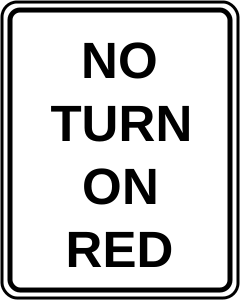
17. You are on a one-way street about to cross another one-way street, the light is red, and this white rectangular sign with black words NO TURN ON RED is posted. Which turns are off limits until the light turns green?
- Both the right turn and the left turn
- Only the right turn onto the cross street
- Only the left turn onto the cross street
- Neither turn, as long as you stop first
Show answer
Both the right turn and the left turn. Virginia normally allows a right turn on red, and a left turn on red from one one-way street onto another, after a complete stop. A No Turn on Red sign cancels both of those permissions. Many new drivers think the sign only blocks right turns, but the manual applies it to the left turn on red as well. A full stop does not make either turn legal while this sign is posted. Wait for the green signal before turning in either direction.
Study this in the handbook: Traffic signals and turns on red
18. You pass a city bus, pull back in close in front of it, and then slow down for a turn. Why is this so dangerous?
- Buses must pass any car that slows down
- The bus needs nearly twice the room to stop
- The bus driver will lose sight of the road
- Buses are not allowed to brake suddenly
Show answer
The bus needs nearly twice the room to stop. Trucks, buses and RVs need nearly twice the time and room to stop as cars. The manual warns that you could be rear-ended if you cut in front too soon after passing, or cut in front and then suddenly slow down, because the driver would be forced to slam on the brakes. After passing, look for the entire front of the vehicle in your rearview mirror before pulling in, and then keep your speed steady. Plan turns so you do not slow right in front of it.
Study this in the handbook: Bicycles, motorcycles, trucks and other road users
19. You are making a right turn onto a Virginia street that has two lanes going your way. Which lane should you turn into?
- The lane closest to the curb
- The lane farthest from the curb
- Whichever lane has less traffic
- The left lane, then move right
Show answer
The lane closest to the curb. For a right turn, start in the lane furthest to the right and signal three or four seconds, about 100 feet, before the turn. Brake smoothly before and during the turn and complete it into the lane closest to the curb, unless pavement markings lead you elsewhere. If you need another lane, change lanes after the turn using your signal and mirrors. Swinging wide into the far lane can hit a driver turning left from the other direction.
Study this in the handbook: When you must stop, school buses and stopping distance
20. You want to pass a bicyclist in Virginia, but your lane is too narrow to leave three feet of clearance. What must you do?
- Pass anyway at a slow, steady speed
- Sound the horn so the cyclist moves over
- Change lanes to pass the cyclist safely
- Squeeze by with at least two feet of room
Show answer
Change lanes to pass the cyclist safely. State law requires drivers to pass cyclists with at least three feet of clearance. When the lane is not wide enough for that, the driver must change lanes to pass safely. Passing slowly with less space still breaks the rule, and the two foot figure belongs to the trash truck rule, not to bicycles. Using a marked bike lane to pass is also prohibited. If you cannot change lanes yet, stay behind the cyclist until you can.
Study this in the handbook: Right of way, pedestrians and roundabouts
Every question is written from the official Virginia Driver's Manual. Need paper? Printable VA practice test with answer key.
Last verified 2026-10-05. How we check every question · Study all 500 as flashcards
Frequently asked questions
How many questions are on this Virginia practice test?
This fixed set has 20 questions. It is test 16 of 25 from the 500 question Virginia bank. The real VA exam has a 10 question road sign section with 10 correct to pass, plus 30 knowledge questions with 24 correct to pass.
What is the passing score for the real Virginia test?
Part one: all ten road sign questions must be answered correctly; part two: you must correctly answer 24 of the 30 general knowledge questions That figure comes from the official Virginia source cited on the DMV facts page.
How does this fixed test relate to the full Virginia bank?
Each numbered test is a fixed set of questions in a fixed order, so you can retake the same test later and compare. Every test mixes road signs and the other topics in about the same proportion as the full bank. Tests 1 to 25 together cover every question in the Virginia bank once. The full practice page mixes the whole bank at random.
Last verified 2026-10-05. See the Virginia DMV facts page for sourced state details.
Return to the full Virginia practice test · Study road signs