
Test 11 of 25 · 20 questions · Free 2026
VA Permit Practice Test 11
Jump to the test ↓A fixed 20 question set from the Virginia bank with answers and plain English explanations. The real VA exam has a 10 question road sign section with 10 correct to pass, plus 30 knowledge questions with 24 correct to pass; take the full length version on the main practice page.
Question 1 of 20 · 0 right so far
All 20 questions in test 11
Every question below comes from the Virginia question bank on this page. Open a question to see the correct answer and the explanation. Nothing here is hidden behind a signup.
1. In a Virginia school zone, a crossing guard steps into the street and holds up a stop paddle while your light is green. What must you do?
- Stop and follow the guard's signal
- Go on, since your light is green
- Slow down but keep moving past
- Honk so the guard steps back
Show answer
Stop and follow the guard's signal. At school zones and school crossings, drivers must obey the speed limit and the signals from crossing guards. When a guard signals you to stop, you stop, even if your light is green, because children may be crossing. Watch for children crossing the street or playing nearby, and be ready to slow down or stop throughout the zone. Wait until the guard signals you to go and the crosswalk is clear before moving on.
Study this in the handbook: Regulatory and warning signs
2. On which kind of road must you pull over and stop for an emergency vehicle coming toward you in the opposite lane?
- A divided highway with a median
- A one-way street in town
- An interstate with a barrier
- An undivided highway
Show answer
An undivided highway. When an emergency vehicle approaches in the opposite lane on an undivided highway, you must pull over to the edge of the road and stop until it passes. On an undivided road nothing separates you from its path. A median or barrier gives separation, and a one-way street has no opposite lane. Emergency vehicles coming from behind always require you to pull right and stop.
Study this in the handbook: Special lanes, painted curbs and parking
3. A flashing yellow light hangs over a sharp curve on a Virginia country road. What should you do?
- Stop fully before the curve
- Speed up to clear the curve
- Ignore it unless cars are near
- Slow down and go with caution
Show answer
Slow down and go with caution. This signal tells you to slow down and proceed with caution. These lights are placed at locations with higher-than-normal hazards. You do not need to stop as you would for a flashing red, but you should reduce your speed and be ready for whatever the light is warning about. Speeding up or ignoring it defeats its purpose. A flashing red light, by contrast, means come to a complete stop and yield.
Study this in the handbook: Traffic signals and turns on red
4. An oncoming car at night has its high beams on. Where does the Virginia manual tell you to look?
- Glance toward the side of the road
- Look straight into its lights to judge distance
- Close one eye until the car passes
- Look down at your dashboard gauges
Show answer
Glance toward the side of the road. Bright oncoming high beams can blind you for a moment. The manual says to avoid looking directly at the lights. Instead, glance toward the side of the road, then look quickly ahead to check the other vehicle's position, and keep repeating this until you have passed it. Staring into the glare or looking down at the dashboard takes your eyes off your lane. Slow down a little if the glare makes it hard to see.
Study this in the handbook: Headlights, night, fog, rain and snow
5. You park facing downhill next to a curb on a steep Virginia street. Which way should your front wheels point?
- To the left, away from the curb
- Straight ahead, parallel to the curb
- To the right, toward the curb
- Toward the street, to be seen
Show answer
To the right, toward the curb. Facing downhill with a curb, turn the front wheels right, toward the curb. With a curb, turning the wheels this way helps keep the car from rolling into the street. Uphill with a curb is the opposite: turn the wheels left, away from the curb. Without a curb, turn the wheels so that a rolling car would move away from traffic. Always set the parking brake as well.
Study this in the handbook: Special lanes, painted curbs and parking
6. According to the Virginia manual, what can ponded water on the road cause a vehicle to do?
- Hydroplane or lose control
- Overheat its engine quickly
- Lose its power steering
- Blow out a front tire
Show answer
Hydroplane or lose control. Ponded water is standing water on the road surface. The manual tells drivers to use caution when driving through it and to avoid it if possible, because it can cause vehicles to hydroplane or otherwise lose control. Water standing on the road is most dangerous at higher speeds. If you must go through, slow down before you reach the water and keep the steering wheel steady.
Study this in the handbook: Headlights, night, fog, rain and snow
7. You and an oncoming driver are both signaling to turn left at the same Virginia intersection. How should the two turns be made?
- Turn behind each other, driver sides together
- Turn in front of each other, passenger sides together
- One driver waits until the other has finished
- Whoever signaled first turns while the other waits
Show answer
Turn in front of each other, passenger sides together. When two vehicles approach each other and both signal a left turn, the manual says both should turn in front of each other so that the passenger sides of the vehicles pass beside each other. This keeps each driver's path clear of the other and lets both turns happen at once. Turning behind each other makes the paths cross. Waiting for the other driver, or deciding by who signaled first, is not how the manual describes it. Still yield to pedestrians.
Study this in the handbook: When you must stop, school buses and stopping distance
8. In a Virginia town's business district, you want to make a U-turn in the middle of a block. Is that allowed?
- Yes, if no traffic is coming
- Yes, if you use your left signal
- Yes, if the street is wide
- No, only at intersections
Show answer
No, only at intersections. In business districts, cities and towns, U-turns are allowed only at intersections. Never make a U-turn on a highway either. Light traffic, a turn signal or a wide street does not change the rule. Before turning at an intersection, check for No U-Turn or No Left Turn signs, signal left, stop and yield, then turn into the outside lane going the other way.
Study this in the handbook: When you must stop, school buses and stopping distance
9. Dense fog suddenly rolls across the Virginia highway you are driving on. What should your first response be?
- Reduce your speed
- Switch to high beams
- Stop in your lane
- Speed up to get through it
Show answer
Reduce your speed. Driving becomes hazardous when visibility is reduced or the road is covered with rain, snow or ice. The manual says reducing your speed should be your first response to decreased visibility and dangerous road conditions. After slowing, double your following distance and turn on your headlights, using low beams in fog. High beams reflect off fog and make it harder to see, and stopping in a travel lane invites a rear end crash. Look for road edge markings to guide you.
Study this in the handbook: Headlights, night, fog, rain and snow
10. At 30 mph on a dry road, the car ahead passes a sign, and you reach the same sign after counting only one second. What does that tell you?
- You are following too closely
- Your gap is just right for this speed
- You are too far behind the car
- You should speed up to match it
Show answer
You are following too closely. To check following distance, glance at the vehicle ahead as it passes a fixed object, then count the seconds until you reach the same place. Under 35 MPH on a dry road you need at least two seconds. The manual says if you reach the mark before counting off two, three or four seconds, depending on speed, you are following too closely. Slow down and increase your following distance, and add more seconds in bad weather or heavy traffic.
Study this in the handbook: Hand position, following distance and blind spots
11. You are about to turn onto a highway ramp, and a red circle sign with a white horizontal bar faces you at its entrance. What should you do?
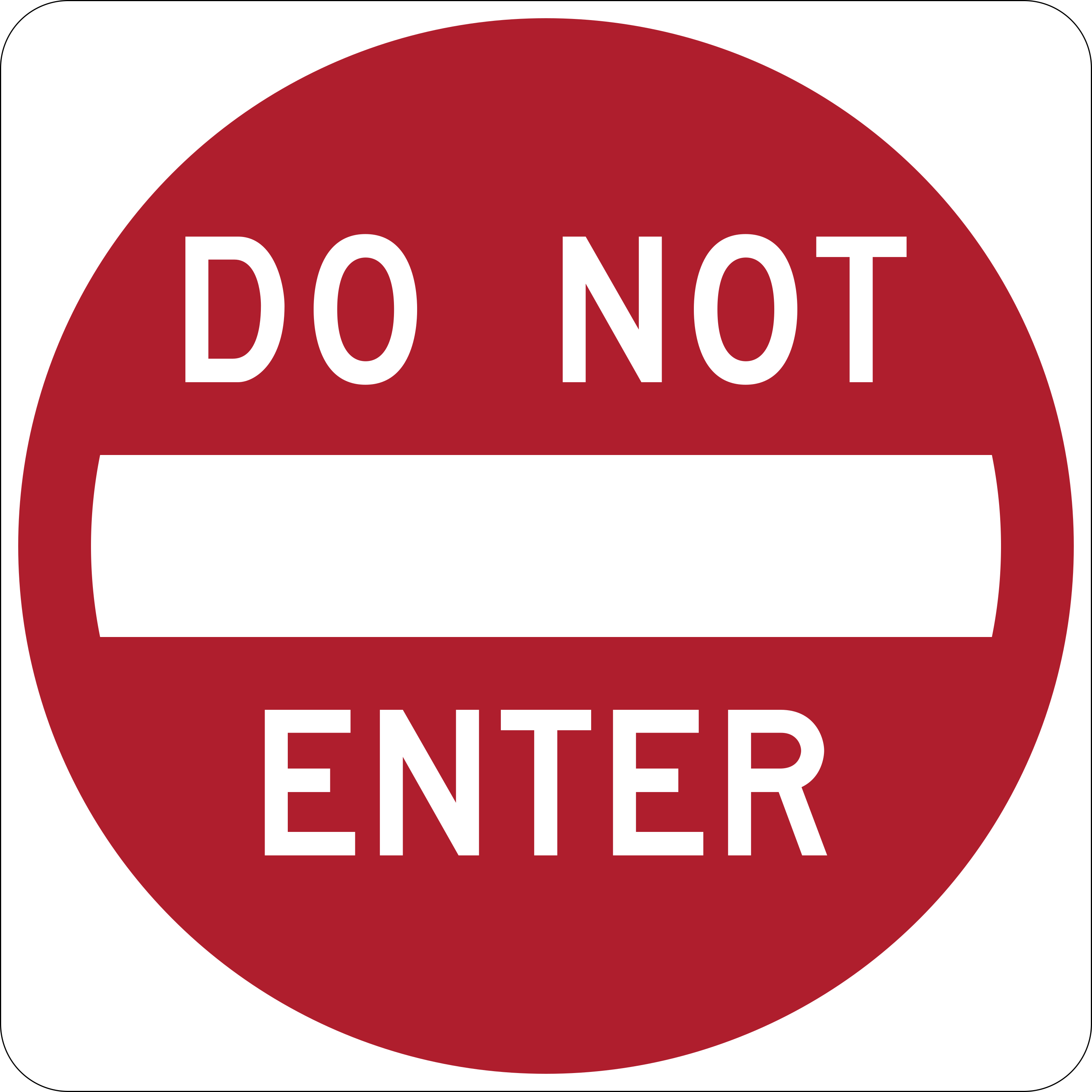
- Enter slowly with your flashers on
- Enter only if no traffic is coming
- Do not enter; find another way
- Enter but stay on the right shoulder
Show answer
Do not enter; find another way. This red and white sign means you cannot drive in that direction. A ramp marked this way carries traffic toward you, so turning onto it would put you head-on with vehicles headed your way. Going slowly, using flashers or hugging the shoulder does not make it safe or legal. Continue past the ramp and look for the correct entrance. If you ever realize you have passed one of these signs, slow down, pull over and turn around carefully.
Study this in the handbook: Sign colors and shapes
12. What shape does Virginia use for signs that warn of special conditions or hazards ahead?
- Octagon
- Diamond
- Pentagon
- Circle
Show answer
Diamond. Diamond shaped signs warn you of special conditions or hazards ahead, such as curves, hills, merging lanes or slippery pavement. When you see one, slow down, drive with caution and be ready to stop. The octagon is reserved for stop signs, the pentagon marks school zones and school crossings, and a round sign is used ahead of railroad crossings. Most diamond warning signs are yellow with black symbols, and orange diamonds are used in work zones.
Study this in the handbook: Sign colors and shapes
13. The sun has just set, but the sky is still fairly bright. Must your headlights be on in Virginia?
- No, not until it is fully dark
- No, only once street lights come on
- Yes, from sunset to sunrise
- No, unless it is raining too
Show answer
Yes, from sunset to sunrise. Headlights are required in Virginia from sunset until sunrise. The manual also advises turning them on at sunset, as soon as light begins to fade, so others can see your vehicle. Waiting until it is fully dark or until street lights come on is too late. Rain adds a separate requirement whenever wipers are needed. Turn your headlights on as the sun goes down.
Study this in the handbook: Headlights, night, fog, rain and snow
14. What should you watch for after passing this yellow diamond warning sign with a black plus-shaped symbol?

- A hospital entrance just ahead
- A railroad crossing just ahead
- Vehicles entering at an intersection ahead
- A four-lane highway beginning
Show answer
Vehicles entering at an intersection ahead. The plus shaped symbol on a yellow diamond is the Intersections warning sign. It tells you an intersection is ahead and that you should be alert for vehicles entering the road you are traveling on. Be ready to slow or stop for vehicles that pull out. Hospitals use blue guide signs, and railroad crossings have their own round warning sign and crossbuck. Ease off the gas and scan both sides as you approach.
Study this in the handbook: Railroad crossings and work zones
15. During heavy rain, which vehicles does the Virginia manual say are especially hard to see?
- Large trucks directly ahead of you
- Those behind you and in your blind spots
- Cars that have their headlights on
- Vehicles stopped at red lights ahead
Show answer
Those behind you and in your blind spots. The manual says driving in heavy rain can be as hazardous as driving in fog, especially if the wind is blowing. Vehicles to the rear and in blind spot areas are especially difficult to see when it is raining. Take extra time before changing lanes, check mirrors carefully and glance over your shoulder. Use low beam headlights so others can see you, and slow down to match the visibility.
Study this in the handbook: Headlights, night, fog, rain and snow
16. An 18-year-old Virginia driver is stopped and has a BAC of .03. What can the driver be convicted of?
- Nothing, since the limit is .08
- Nothing, unless it reaches .05
- Illegal consumption of alcohol
- Only an equipment violation
Show answer
Illegal consumption of alcohol. Drivers under 21 face a much lower threshold. If you are under 21, you can be convicted of illegal consumption of alcohol if your BAC is at least .02 but less than .08. A .03 reading falls inside that range. The .08 figure is the adult DUI level, and an underage driver at .08 or higher can face a DUI. Virginia has a zero tolerance law against underage drinking, so any drinking before driving is a serious risk.
Study this in the handbook: Aggressive, distracted and drowsy driving
17. Where does the Virginia manual say is the safest place to install a child safety seat?
- Behind the driver, by the left door
- In the center of the back seat
- In the front passenger seat
- Next to one of the rear doors
Show answer
In the center of the back seat. When traveling with children, the manual says the safest place to install a child safety seat is in the center of the back seat. Children 12 and under are safer in the back seat. The front passenger seat is used for a rear facing seat only when there is no back seat and no active passenger air bag. Free child safety seat checks are held across Virginia if you want help confirming the seat is installed correctly.
Study this in the handbook: Seat belts, air bags and child safety seats
18. In a Virginia work zone, a large flashing arrow board points to the left. What is it telling you?
- Turn left at the next cross street ahead
- Use the left lane to pass slow vehicles
- Workers will cross the road from the left
- Part of the road ahead is closed; change lanes
Show answer
Part of the road ahead is closed; change lanes. Large flashing arrow boards and flashing message signs are used in work zones to send drivers into different traffic lanes. They also tell you that part of the road ahead is closed. When the arrow points left, the lane you are in is ending, so check your mirrors, signal and merge left early instead of waiting until the last moment. The arrow does not mean to turn at a cross street or to pass other traffic. Slow down and follow the posted work zone speed.
Study this in the handbook: Railroad crossings and work zones
19. A Virginia road has double solid yellow center lines, and you need to turn left into a driveway across them. May you cross the lines?
- No, you must drive on to a gap in the lines
- No, double yellow lines can never be crossed
- Yes, but you must use hazard flashers first
- Yes, you may cross them to make a left turn
Show answer
Yes, you may cross them to make a left turn. Double solid yellow lines mark the center of the road and ban passing in either direction. The manual still lists a few times you may cross them, and making a left turn is one. You may also cross to pass pedestrians, bicyclists, and scooter or skateboard riders when the opposite lane is clear. Hazard flashers are not part of the rule. Signal your turn, yield to oncoming traffic, and cross the lines only when the way is clear.
Study this in the handbook: Regulatory and warning signs
20. You are driving in a Virginia city and scanning 20 to 30 seconds ahead. About how far ahead is that on city streets?
- About half a block
- About one block
- About three blocks
- About one mile
Show answer
About one block. Expert drivers try to keep their eyes focused 20 to 30 seconds ahead. At city speeds, the manual says that distance is about one block. Looking that far ahead lets you spot risks early, such as a signal changing, a car pulling out or a pedestrian stepping off the curb, and gives you more time to react. Avoid staring at the middle of the road just in front of the hood. Scan from side to side as you look ahead.
Study this in the handbook: Hand position, following distance and blind spots
Every question is written from the official Virginia Driver's Manual. Need paper? Printable VA practice test with answer key.
Last verified 2026-10-05. How we check every question · Study all 500 as flashcards
Frequently asked questions
How many questions are on this Virginia practice test?
This fixed set has 20 questions. It is test 11 of 25 from the 500 question Virginia bank. The real VA exam has a 10 question road sign section with 10 correct to pass, plus 30 knowledge questions with 24 correct to pass.
What is the passing score for the real Virginia test?
Part one: all ten road sign questions must be answered correctly; part two: you must correctly answer 24 of the 30 general knowledge questions That figure comes from the official Virginia source cited on the DMV facts page.
How does this fixed test relate to the full Virginia bank?
Each numbered test is a fixed set of questions in a fixed order, so you can retake the same test later and compare. Every test mixes road signs and the other topics in about the same proportion as the full bank. Tests 1 to 25 together cover every question in the Virginia bank once. The full practice page mixes the whole bank at random.
Last verified 2026-10-05. See the Virginia DMV facts page for sourced state details.
Return to the full Virginia practice test · Study road signs