
Test 9 of 10 · 20 questions · Free 2026
VA Permit Practice Test 9
Jump to the test ↓A fixed 20 question set from the Virginia bank with answers and plain English explanations. The real VA exam has a 10 question road sign section with 10 correct to pass, plus 30 knowledge questions with 24 correct to pass; take the full length version on the main practice page.
Question 1 of 20 · 0 right so far
All 20 questions in test 9
Every question below comes from the Virginia question bank on this page. Open a question to see the correct answer and the explanation. Nothing here is hidden behind a signup.
1. A Virginia driver under 18 is convicted of a second demerit point violation. What does DMV do?
- Sends a warning letter only
- Suspends the driving privilege for 90 days
- Revokes the license until age 21
- Requires only a second online course
Show answer
Suspends the driving privilege for 90 days. For violations committed under 18, the first demerit point conviction sends the driver to a driver improvement clinic, and the second brings a 90-day suspension. A third conviction brings revocation for one year or until age 18, whichever is longer, not revocation until 21. A warning letter or another course alone understates the second step. Safety belt and child restraint violations count toward this sequence for young drivers.
Study this in the handbook: Suspensions, revocations and demerit points
2. A 20-year-old Virginia driver is convicted of driving after illegally drinking, with a BAC of .09. Which penalties can apply?
- Only the underage .02 penalties
- No penalty, because the driver is not yet 21
- Only a written warning to the parents
- The same penalties as an adult
Show answer
The same penalties as an adult. An underage driver whose BAC was .08 percent or higher may face the same penalties as an adult DUI offender. The one-year suspension and $500 or 50-hour package is for the band from .02 up to but not including .08, so it does not cap the penalty at .09. Being under 21 makes the law stricter, not more lenient, and a warning to parents is not a listed outcome. Virginia describes this as a zero tolerance approach to underage drinking.
Study this in the handbook: DUI suspensions, open containers and underage drinking
3. A Virginia officer asks you to sign a traffic citation. What does the manual say about signing?
- Signing counts as pleading guilty
- You may refuse to sign with no consequence
- Only a lawyer may sign for you
- Signing is not an admission of guilt, and refusing may lead to arrest
Show answer
Signing is not an admission of guilt, and refusing may lead to arrest. The manual tells drivers to sign the citation because signing is not an admission of guilt. Refusing to sign may result in arrest, or the driver may have to go to the police station. Refusing is not free of consequences, and no lawyer is needed at the roadside. If you disagree with the officer, the manual says not to argue your view at that time, because you will have your chance to make your case in court.
Study this in the handbook: Seat belts, air bags and child safety seats
4. What roadway condition is shown by a Winding Road warning sign?

- A series of turns or curves ahead
- A straight road with a single lane closure
- A railroad crossing with several tracks
- A hill where stopping is prohibited
Show answer
A series of turns or curves ahead. The winding-road symbol forecasts a series of turns or curves rather than one isolated bend. Virginia recommends slowing on all curves for better control, so a driver should select a steady, manageable pace before the sequence begins. The sign does not identify tracks, a lane closure, or a no-stopping hill. Use the repeated-arrow cue to look through the entire section, maintain a safe lane position, and avoid sudden inputs.
Study this in the handbook: Railroad crossings and work zones
5. You are towing a light to medium trailer in Virginia and it starts to sway. What should you do?
- Slow down
- Speed up to straighten the trailer
- Brake hard and stop in the lane
- Steer sharply in the opposite direction
Show answer
Slow down. The manual's instruction for a swaying trailer is simple: slow down. Towing a trailer adds stress to the vehicle, and it takes twice as long to pass, stop, accelerate and turn, so allow for the added length when you change lanes. Before each trip, check the hitch pin, coupler, safety chains, electrical plug and trailer lights, and practice in an empty parking lot before towing on public roads.
Study this in the handbook: Bicycles, motorcycles, trucks and other road users
6. At a green light with no green arrow, whom must a driver who is turning yield the right-of-way to?
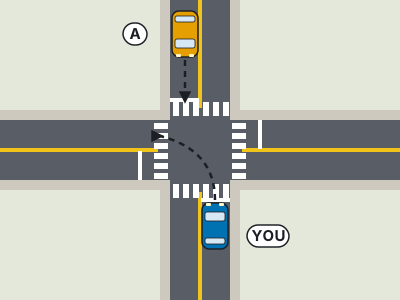
- Only vehicles behind you
- No one, because a green circle guarantees a clear turn
- Vehicles coming from the other direction and pedestrians in the intersection
- Only a vehicle displaying hazard flashers
Show answer
Vehicles coming from the other direction and pedestrians in the intersection. A turn on a green light without a green arrow does not automatically have priority. Virginia requires the turning driver to yield the right-of-way to vehicles coming from the other direction and to pedestrians in the intersection. The green signal permits movement only when the way is clear, so the answer that no one must be yielded to treats the light as an unconditional release. Traffic behind the turning vehicle and a car using hazard flashers do not decide this conflict. Check for less visible vehicles such as motorcycles, bicycles and mopeds, and wait until the opposing lane and crosswalk are open.
Study this in the handbook: Traffic signals and turns on red
7. A traffic signal is not working. How should Virginia drivers handle the intersection?
- Traffic on the larger road proceeds without stopping
- Everyone stops, and the driver on the left yields to the driver on the right
- Only vehicles turning left must stop
- The first vehicle to reach the intersection may continue
Show answer
Everyone stops, and the driver on the left yields to the driver on the right. When traffic lights are not working, all vehicles coming to the intersection must stop. If two drivers then need to decide who goes first, the driver on the left yields to the driver on the right. A larger road does not receive automatic priority, and the first vehicle cannot simply continue without the required stop. Treat the dark signal as a stop-controlled intersection, then apply the right-side priority rule.
Study this in the handbook: Special lanes, painted curbs and parking
8. What headlights should a Virginia driver use in heavy fog?
- High beams only
- Low beam headlights
- No headlights if the road has edge lines
- Hazard flashers instead of headlights
Show answer
Low beam headlights. Heavy fog reflects light back toward the driver, so Virginia directs drivers to use low beam headlights and use the road edge markings as a guide. High beams can worsen the glare and make distance judgments harder. Edge lines are helpful but do not replace the required lighting, and hazard flashers are not a substitute for headlights while the vehicle is moving. Slow down as visibility shrinks, keep the vehicle positioned by the roadway markings, and avoid staring into reflected light.
Study this in the handbook: Headlights, night, fog, rain and snow
9. After failing Virginia’s knowledge exam, how long must an applicant under age 18 wait before retaking it?
- A full 15 days
- Seven days
- Two days
- Until turning 18
Show answer
A full 15 days. An applicant under 18 must wait a full 15 days after failing the knowledge exam before trying again. Two days is associated with a different testing rule in the manual, and seven days is not the stated retest interval. The applicant does not have to wait until age 18. Count the full waiting period from the failed attempt, then schedule the next test after the required interval has elapsed.
Study this in the handbook: The knowledge exam, road skills test and vision screening
10. How close may a driver park to fire trucks or equipment stopped while answering an alarm?
- No closer than 500 feet
- No closer than 50 feet
- No closer than 100 feet
- There is no distance rule if hazard lights are on
Show answer
No closer than 500 feet. The manual prohibits parking within 500 feet of fire trucks or equipment stopped while answering an alarm. Fifty feet is the separate distance listed for a railroad crossing, so it is an easy number to borrow incorrectly. One hundred feet is not the fire scene buffer in this passage, and flashing lights do not create a parking exemption. Choose a legal location well outside the response area so emergency crews retain room to work and move equipment.
Study this in the handbook: Special lanes, painted curbs and parking
11. What fine does Virginia set for a first conviction of violating the child restraint law?
- $25
- $100
- $50
- $500
Show answer
$50. The driver is responsible for making sure children are properly secured. A conviction for violating the child restraint law brings a $50 fine. A second or later offense could mean a $500 penalty, so that larger amount is not the first offense fine. All children under 8 must ride in a child safety seat or booster seat in vehicles made after January 1, 1968, unless a physician grants a written waiver.
Study this in the handbook: Seat belts, air bags and child safety seats
12. What movement is permitted on a One Way street?
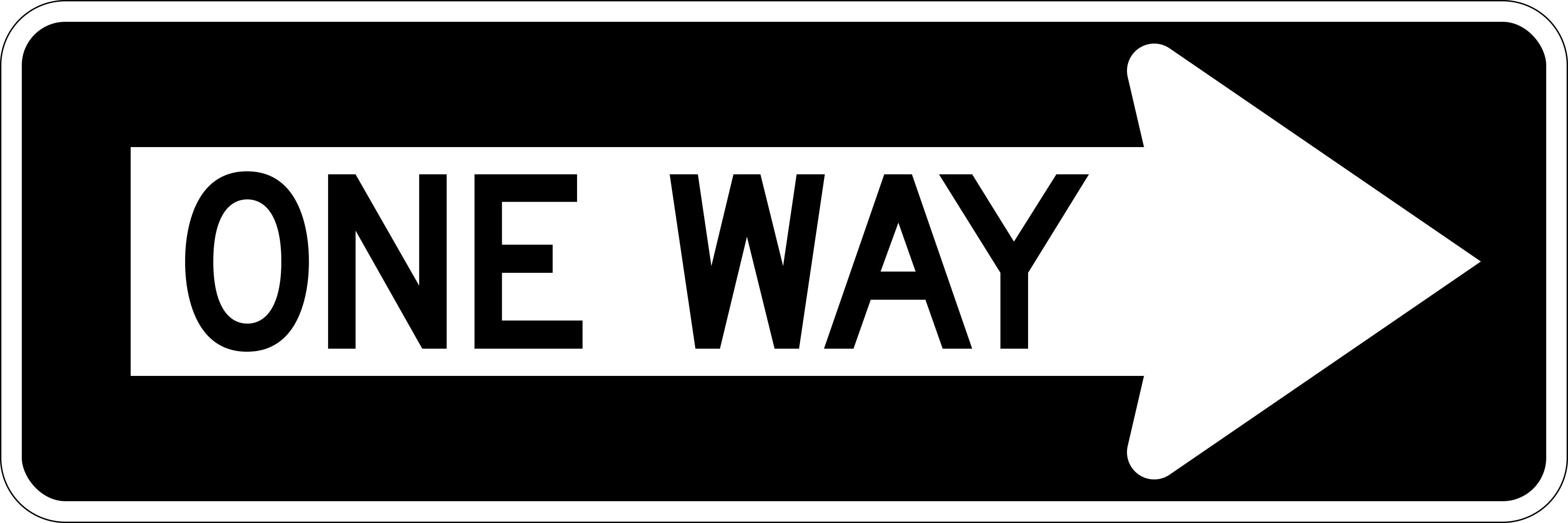
- Traffic may travel only in the arrow's direction
- Traffic must use the shoulder in the arrow's direction
- Traffic may choose either direction after yielding
- Traffic must turn at the next block
Show answer
Traffic may travel only in the arrow's direction. A One Way sign controls the flow of traffic, not merely the preferred lane. Vehicles may travel only in the direction shown by its arrow. Yielding does not authorize movement against that flow, and the sign does not require a turn at the next block. When entering or crossing a one-way roadway, use the arrow as the directional cue and stay alert for the possibility that all lanes carry the same way.
Study this in the handbook: Sign colors and shapes
13. At a Virginia intersection with a painted bicycle box, where must a driver stop for a red signal?
- Inside the bicycle box, ahead of the bike lane
- Anywhere in the box as long as no bicyclist is waiting
- Past the box, at the edge of the crosswalk
- Behind the bicycle box, not inside it
Show answer
Behind the bicycle box, not inside it. Bicycle boxes are painted areas at intersections that hold a white bicycle symbol, and the box and its approach lanes may be painted green. Drivers stopping for a red signal must stay behind the whole box. The space belongs to bicyclists, who move into it in front of drivers waiting at the intersection. Stopping inside the box or beyond it takes that space away. The same intersections also ban right turns on red.
Study this in the handbook: Special lanes, painted curbs and parking
14. What should a driver remember when using antilock brakes?
- Use the parking brake instead of the foot brake
- Pump the brake pedal rapidly at every stop
- Turn off the ignition before braking
- Never pump antilock brakes
Show answer
Never pump antilock brakes. If a vehicle has antilock brakes, the Virginia manual tells the driver to understand how they work and gives a direct warning: never pump antilock brakes. Turning off the ignition or substituting the parking brake removes useful control and is not an approved response. Check the vehicle owner's manual and practice braking before going out on the road, so the pedal feel is familiar before an emergency. The cue is simple: antilock brakes change pedal technique, not the need to brake decisively when danger requires it.
Study this in the handbook: Speed limits and reckless driving
15. You enter a Virginia toll lane reserved for E-ZPass transponders by mistake and you have no transponder. What should you do?
- Stop at the toll point and wait for help
- Back up to the lane entrance
- Keep going without stopping; the owner will be billed
- Pull onto the shoulder and wait for an officer
Show answer
Keep going without stopping; the owner will be billed. Some toll roads have high speed lanes only for vehicles with E-ZPass transponders, and you should not enter them without one. If you do enter one by mistake, do not stop, because stopping is unsafe and could cause a rear-end crash. Cameras photograph the license plate and the registered owner is billed for the toll. The plate camera handles the toll, so the right move is simply to keep driving.
Study this in the handbook: Special lanes, painted curbs and parking
16. When may a vehicle on the solid yellow line side cross the line?
- To pass only after sunset when traffic is lighter
- To pass any slower vehicle whenever the opposite lane looks open
- To change lanes whenever a driver behind signals
- To pass pedestrians, bicyclists, or listed small-wheeled riders when the opposite lane is clear and passing is safe
Show answer
To pass pedestrians, bicyclists, or listed small-wheeled riders when the opposite lane is clear and passing is safe. Virginia gives the solid-line side a narrow exception rather than general passing permission. That vehicle may cross the line only to pass pedestrians, bicyclists, and riders of scooters or skateboards, and only when the opposite lane is clear and the maneuver can be completed safely. A slower car does not qualify, and a following driver’s signal cannot authorize crossing. Darkness also has no role in the rule. Before moving over, identify the road user you are passing, check the opposite lane, and leave enough room to return without creating a conflict.
Study this in the handbook: Passing, turning, U turns and signals
17. On a Virginia road with fewer than four lanes, how must you pass a stationary vehicle collecting trash?
- Pass at the posted speed with at least one foot of room
- Stop and wait until the truck moves
- Slow to 10 mph below the limit and pass at least two feet to the left
- Slow to 25 mph and pass at least five feet to the left
Show answer
Slow to 10 mph below the limit and pass at least two feet to the left. On a highway of at least four lanes, change to a lane not next to the trash truck when it is safe. With fewer than four lanes, or if you cannot change lanes, slow down to 10 mph below the posted limit and pass at least two feet to the left of the vehicle. Keeping the posted speed ignores the slowdown, and a full stop is not required. Twenty-five mph and five feet are not the stated figures.
Study this in the handbook: Special lanes, painted curbs and parking
18. What extra fine applies in Virginia for driving 81 to 85 mph in a 65 mph zone?
- An additional $500 fine
- No extra fine below 86 mph
- An additional $100 fine
- An automatic suspension
Show answer
An additional $100 fine. You are subject to an additional $100 fine if convicted of driving between 81 and 85 mph in a 65 mph zone, on top of the ordinary speeding penalty. Driving over 85 mph, or 20 or more mph above the limit, can be charged as reckless driving, a misdemeanor criminal offense, so a $500 add on or a rule of no extra fine below 86 mph misstates the law. The added fine is not an automatic suspension. Speed limits are set for ideal conditions, so slow further when conditions demand it.
Study this in the handbook: Speed limits and reckless driving
19. After entering a roundabout, in which direction must traffic travel?
- Clockwise
- Counter-clockwise
- Straight across the center island
- In either direction depending on the exit
Show answer
Counter-clockwise. After entering a Virginia roundabout, traffic travels counter-clockwise around the central island. Clockwise movement reverses the intended flow and can create a conflict with vehicles entering or circulating from the other approach. Driving straight across the center island is not a permitted path, and choosing either direction would remove the predictable pattern needed by every driver. Slow before entry, yield as required, select the lane that matches the intended exit, and keep the vehicle moving in the marked circular direction. The center island is the visual cue that helps confirm this one-way circulation.
Study this in the handbook: Special lanes, painted curbs and parking
20. How close to the entrance of a fire, ambulance or rescue squad station may you park in Virginia?
- No closer than 5 feet
- No closer than 15 feet
- No closer than 50 feet
- No closer than 500 feet
Show answer
No closer than 15 feet. Virginia prohibits parking within 15 feet of the entrance to a fire, ambulance or rescue squad station. Five feet sits well inside that 15 foot zone, so it cannot be the limit. Fifty feet is the railroad crossing rule, and 500 feet applies where fire trucks or equipment are stopped answering an alarm, which is a different situation from a station entrance. Hydrants use the same 15 foot figure.
Study this in the handbook: Special lanes, painted curbs and parking
QualitySpace is expanding to Virginia
We are a California-based independent insurance brokerage working on licensing in more states. We cannot help with Virginia insurance yet. Leave your email and we will let you know when we can.
Every question is written from the official Virginia Driver's Manual. Need paper? Printable VA practice test with answer key.
Last verified 2026-10-05. How we check every question · Study all 206 as flashcards
Frequently asked questions
How many questions are on this Virginia practice test?
This fixed set has 20 questions. It is test 9 of 10 from the 206 question Virginia bank. The real VA exam has a 10 question road sign section with 10 correct to pass, plus 30 knowledge questions with 24 correct to pass.
What is the passing score for the real Virginia test?
Part one: all ten road sign questions must be answered correctly; part two: you must correctly answer 24 of the 30 general knowledge questions That figure comes from the official Virginia source cited on the DMV facts page.
How does this fixed test relate to the full Virginia bank?
Each numbered test is a fixed set of questions in a fixed order, so you can retake the same test later and compare. Every test mixes road signs and the other topics in about the same proportion as the full bank. Tests 1 to 10 together cover 200 of the 206 questions in the Virginia bank, each once. The full practice page mixes the whole bank at random.
Last verified 2026-10-05. See the Virginia DMV facts page for sourced state details.
Return to the full Virginia practice test · Study road signs