
Test 20 of 25 · 20 questions · Free 2026
VA Permit Practice Test 20
Jump to the test ↓A fixed 20 question set from the Virginia bank with answers and plain English explanations. The real VA exam has a 10 question road sign section with 10 correct to pass, plus 30 knowledge questions with 24 correct to pass; take the full length version on the main practice page.
Question 1 of 20 · 0 right so far
All 20 questions in test 20
Every question below comes from the Virginia question bank on this page. Open a question to see the correct answer and the explanation. Nothing here is hidden behind a signup.
1. A 16-year-old passenger in your back seat refuses to buckle up. Under Virginia law, who is responsible for making sure that passenger is secured?
- The passenger alone
- The passenger's parents
- You, the driver
- No one, since it is the back seat
Show answer
You, the driver. A driver transporting anyone younger than 18 must make sure that passenger is properly secured in a safety belt, booster seat or child safety seat, no matter where the passenger is seated. A 16-year-old in the back seat falls under that rule, so the duty is yours as the driver. Do not start driving until everyone under 18 is buckled. The law also requires all adult passengers, front and rear, to wear belts.
Study this in the handbook: Seat belts, air bags and child safety seats
2. Which color combination does Virginia use for regulatory signs such as speed limits and no-turn rules?
- Black and white
- Yellow and black
- Green and white
- Orange and black
Show answer
Black and white. Sign colors tell you the purpose of a sign. Black used with white conveys regulatory information, meaning the operation is regulated by law. Speed limit, do not pass and no turn signs are examples. Yellow and black signs give warnings, green and white signs give destination information, and orange and black signs are used in construction areas. When you see a black and white sign, treat it as a rule you must obey, not just advice.
Study this in the handbook: Traffic signals and turns on red
3. Your lane has a white curved arrow painted on it with the word ONLY. What must you do?
- Go straight or turn, as you prefer
- Turn in the direction of the arrow
- Change lanes before the intersection
- Turn only if the signal shows an arrow
Show answer
Turn in the direction of the arrow. White lane arrows are curved or straight. If you are in a lane marked with a curved arrow, or a curved arrow and the word ONLY, you must turn in the direction of the arrow. A lane marked with both a curved and a straight arrow is the one that lets you turn or go straight. If you end up in an ONLY lane by mistake, make the turn and find another route rather than cutting over at the last second.
Study this in the handbook: Special lanes, painted curbs and parking
4. A black and white One Way sign with an arrow is posted at the corner of a cross street you want to turn onto. What must you check before turning?
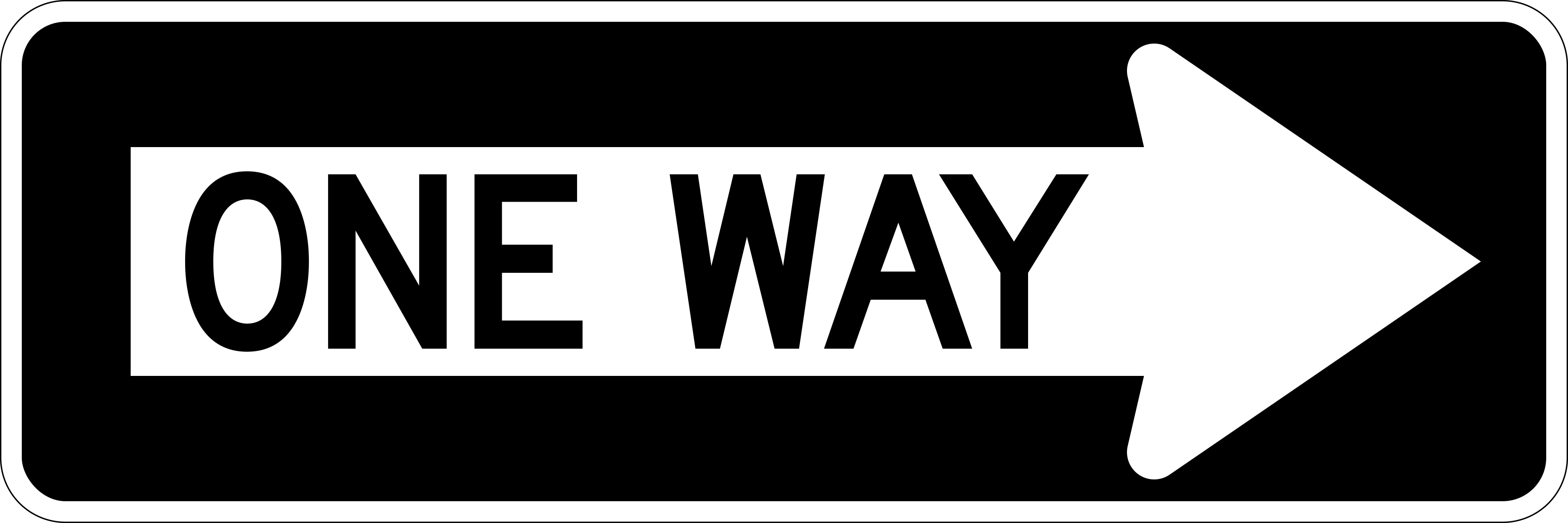
- That you turn the way the arrow points
- That the street has two lanes
- That no bus is coming the other way
- That you signal opposite the arrow
Show answer
That you turn the way the arrow points. A One Way sign means traffic flows only in the direction of the arrow. Before turning onto a street with this sign, make sure your turn sends you the same way the arrow points. Turning the other way would put you against all of that street's traffic. The number of lanes does not matter, and on a true one-way street no vehicles should be coming toward you. Signal in the direction you are actually turning.
Study this in the handbook: Sign colors and shapes
5. On a two-lane Virginia road, you are behind a slow car as you near a railroad crossing. The oncoming lane is empty. May you pass before the tracks?
- Yes, if you finish before the tracks
- Yes, if the crossing lights are off
- Yes, if the car ahead waves you on
- No, passing at a railroad crossing is unlawful
Show answer
No, passing at a railroad crossing is unlawful. The manual lists places where passing is unlawful and unsafe, and railroad crossings are one of them, along with hills, curves and intersections. The only exception is a road with two or more lanes of traffic moving in the same direction. On a two-lane road, stay behind the slow car until you are well past the crossing. Lights that are off or a wave from the other driver do not change the rule. Watch for trains as you cross.
Study this in the handbook: Passing, turning, U turns and signals
6. You are driving slower than the traffic around you on a multi-lane Virginia highway. Which lane should you use?
- The left lane, where traffic is lighter
- The right lane, out of faster traffic
- Any lane, if you are within the limit
- The lane with the fewest trucks in it
Show answer
The right lane, out of faster traffic. On a multi-lane highway, drivers moving slower than the surrounding traffic should stay in the right lane. The left lane is for passing only, not for cruising. The manual repeats that the left lane is for passing, not cruising. Being under the speed limit does not make any lane acceptable. Move left only to pass, signal and check your blind spot, then return to the right when it is safe.
Study this in the handbook: Passing, turning, U turns and signals
7. According to the Virginia manual, how can wet pavement change your braking distance?
- It adds about one car length
- It changes little if tires are good
- It can make it three times as long
- It can make it twice as long
Show answer
It can make it twice as long. Braking distance is how far the car travels after you apply the brakes. Besides speed, it depends on the condition of your brakes and tires and on the pavement. The manual gives a clear example: wet pavement can double your braking distance. Good tires help, but they do not cancel the effect of water on the road. When it rains, slow down and leave more room ahead so the longer stop still fits in the space you have.
Study this in the handbook: Speed limits and reckless driving
8. You turn off a paved highway onto a gravel country road in Virginia. No speed limit sign is posted. What is the most you may drive?
- 25 mph
- 35 mph
- 45 mph
- 55 mph
Show answer
35 mph. Leaving pavement changes the default limit. When no sign states otherwise, Virginia's maximum for passenger vehicles and motorcycles is 35 MPH on unpaved roads. The 55 MPH default you had on the paved highway no longer applies once you are on gravel. 25 MPH is the default for school, business and residential areas. You must also drive slower whenever conditions make the limit unsafe.
Study this in the handbook: Speed limits and reckless driving
9. A car ahead keeps drifting across lanes as if the driver is falling asleep. What does the Virginia manual suggest?
- Pull alongside the car and honk to wake them
- Follow close and flash your lights
- Pass quickly and put it out of mind
- Have a passenger call law enforcement
Show answer
Have a passenger call law enforcement. The manual treats drowsy driving as a form of impaired driving that endangers everyone on the road. If you see a drowsy driver, the manual says to find a safe place to stop or ask a passenger to call law enforcement, and to be ready to describe the location, the vehicle and what you saw. Pulling alongside or following closely puts you near a car that may swerve. Keep your distance and let officers handle it.
Study this in the handbook: Aggressive, distracted and drowsy driving
10. On a four-lane Virginia highway, a trash truck is stopped collecting garbage in the right lane, and the next lane over is open. What should you do?
- Slow to 10 mph under the limit and stay in lane
- Pass within two feet at your current speed
- Change to a lane not next to the truck
- Stop and wait until the truck moves on
Show answer
Change to a lane not next to the truck. When passing stationary trash collection vehicles on a highway of at least four lanes, change to a lane not next to the vehicle if you can change lanes safely. The slow down to 10 MPH below the limit and two feet of clearance rule is for roads with fewer than four lanes or when you cannot change lanes. Here the next lane is open, so move over. Check your mirrors and blind spot before moving over.
Study this in the handbook: Special lanes, painted curbs and parking
11. You are at a spot where a U-turn is legal. Which signal should you turn on before you stop and yield?
- Your left turn signal
- Your right turn signal
- Your hazard flashers
- No signal is needed
Show answer
Your left turn signal. When making a U-turn, turn on your left-turn signal, stop, and yield for approaching traffic. When the way is clear, proceed into the outside or right-hand lane traveling in the opposite direction. A right signal would tell other drivers the wrong thing, and flashers do not show a direction. Signals are required by law for turns. Check first for No U-Turn or No Left Turn signs, and never make a U-turn on a highway.
Study this in the handbook: When you must stop, school buses and stopping distance
12. In a car with antilock brakes, you must stop quickly on a wet road. How should you use the brake pedal?
- Do not pump the brakes
- Pump them quickly to stop sliding
- Tap lightly several times
- Pull the parking brake instead
Show answer
Do not pump the brakes. If your vehicle has antilock brakes, learn how they work by checking the owner's manual and practicing before you drive on the road. The manual's key reminder is never to pump antilock brakes. Pumping or tapping the pedal is exactly what the manual warns against. The parking brake is not designed for emergency stops while moving. Press the brake and keep steering around the hazard if you need to.
Study this in the handbook: Speed limits and reckless driving
13. A motorcycle is riding near one side of your lane, leaving space beside it. May you drive next to it in the same lane?
- Yes, if there is room in the lane
- Yes, if you stay under 25 mph
- Yes, when traffic has stopped
- No, never share a lane with one
Show answer
No, never share a lane with one. A motorcycle is narrower than the lane, but the rider may use the entire lane as traffic and road conditions change. Small debris or a change in the road surface can force a sudden move to the side. The manual tells drivers to expect sudden moves within the lane and never to drive beside a motorcycle in the same lane. Low speed or stopped traffic does not change this. Give the rider the full lane and follow at a safe distance.
Study this in the handbook: Right of way, pedestrians and roundabouts
14. In Virginia, which of these places has a 15-foot no-parking zone at its entrance?
- A fire, ambulance or rescue squad station
- A railroad crossing on a city street
- A public school's main front door
- A hospital emergency room driveway
Show answer
A fire, ambulance or rescue squad station. You may not park within 15 feet of the entrance to a fire, ambulance or rescue squad station. The rule covers fire stations, ambulance stations and rescue squad stations alike. Railroad crossings carry a larger 50 foot no-parking distance. The manual does not set a specific entrance distance for schools or hospitals, though local signs may. Fire hydrants share the same 15 foot figure as station entrances.
Study this in the handbook: Special lanes, painted curbs and parking
15. While you drive on a Virginia highway with overhead lane signals, a yellow X lights up above your lane. What should you do?
- Stop at once because the lane has closed
- Stay in the lane and turn at the next exit
- Move out of that lane as soon as it is safe
- Keep going, since the X applies only to trucks
Show answer
Move out of that lane as soon as it is safe. A yellow X, or a yellow arrow pointing diagonally downward, tells you to leave the lane as soon as you safely can. It gives you time to leave before the lane changes use. Stopping suddenly in a moving lane could cause a rear end crash, and the signal does not let you stay put until an exit. It applies to every vehicle, not only large trucks. Check mirrors and your blind spot, signal, and change lanes when there is a safe gap.
Study this in the handbook: Traffic signals and turns on red
16. A Virginia lane use control sign above your lane shows only a curved arrow. What must you do?
- Go straight or turn, whichever you choose
- Turn in the direction that the arrow shows
- Merge out of that lane before the corner
- Turn only when a green arrow is lit for you
Show answer
Turn in the direction that the arrow shows. Lane use control signs are posted where turns are required or where special turning moves are permitted for certain lanes. When the sign over your lane shows a curved arrow, traffic in that lane must turn in the direction of the arrow. Continuing straight from that lane would cut across drivers who are turning beside you. A lane marked with both a curved and a straight arrow is the one that gives you a choice. Pick your lane early so you are not forced into a turn.
Study this in the handbook: Sign colors and shapes
17. You are about to turn on an empty Virginia road with no other traffic in sight. Should you still signal?
- No, signals are for other drivers only
- Not unless a pedestrian is nearby
- Yes, signal even when no one is around
- Not unless the intersection has lights
Show answer
Yes, signal even when no one is around. Using your turn signal is required by law and tells drivers around you what you plan to do. The manual urges drivers to develop a good habit and use turn signals or hand signals even if no other traffic is on the road. A driver or cyclist you have not noticed may be close by, and a steady habit means you will not forget to signal when it matters. Signal three or four seconds, about 100 feet, before the turn.
Study this in the handbook: When you must stop, school buses and stopping distance
18. According to the Virginia manual, how should a pregnant woman wear her seat belt?
- Across the middle of the belly
- With the shoulder belt only
- With the lap belt removed for comfort
- As low on the pelvis as possible
Show answer
As low on the pelvis as possible. Pregnant women are much safer when buckled up, and the manual says to wear the belt as low on the pelvis as possible. Wear the lap belt low, against your thighs. The shoulder belt still goes over the shoulder and across the chest. Skipping the lap belt or placing it across the middle of the belly is not safe. Keep both belts snug on every trip.
Study this in the handbook: Seat belts, air bags and child safety seats
19. A friend plans to rely on an energy drink and loud music to stay alert on a late drive. What does the Virginia manual say about that?
- Those methods work when used together
- These do not reliably keep you awake
- Caffeine works, but music does not
- They work for up to two hours
Show answer
These do not reliably keep you awake. The manual says that rolling down a window, chewing gum, turning up the radio, or consuming caffeine, energy drinks or other stimulants do not prevent drowsy driving and are not reliable ways to stay awake. Drowsy driving is a type of impaired driving that puts everyone on the road at risk. What does help is rest: stop at a safe place for a nap, switch drivers with a well-rested companion, or plan the trip for daytime hours.
Study this in the handbook: Aggressive, distracted and drowsy driving
20. What usually happens when alcohol is combined with other drugs, such as cold medicine?
- The drug cancels out the alcohol
- Only the alcohol affects your driving
- The effects of both are multiplied
- The effects wear off more quickly
Show answer
The effects of both are multiplied. Combining alcohol with other drugs usually multiplies the effects of both and can have a disastrous effect on your ability to drive. The manual warns that one drink taken with another drug, even aspirin or allergy or cold medicine, could affect your driving as much as several drinks. Mixing them does not cancel either one out or make them wear off faster. Read medicine labels for warnings, and do not drink at all when you are taking medication.
Study this in the handbook: Alcohol, drugs and DUI
Every question is written from the official Virginia Driver's Manual. Need paper? Printable VA practice test with answer key.
Last verified 2026-10-05. How we check every question · Study all 500 as flashcards
Frequently asked questions
How many questions are on this Virginia practice test?
This fixed set has 20 questions. It is test 20 of 25 from the 500 question Virginia bank. The real VA exam has a 10 question road sign section with 10 correct to pass, plus 30 knowledge questions with 24 correct to pass.
What is the passing score for the real Virginia test?
Part one: all ten road sign questions must be answered correctly; part two: you must correctly answer 24 of the 30 general knowledge questions That figure comes from the official Virginia source cited on the DMV facts page.
How does this fixed test relate to the full Virginia bank?
Each numbered test is a fixed set of questions in a fixed order, so you can retake the same test later and compare. Every test mixes road signs and the other topics in about the same proportion as the full bank. Tests 1 to 25 together cover every question in the Virginia bank once. The full practice page mixes the whole bank at random.
Last verified 2026-10-05. See the Virginia DMV facts page for sourced state details.
Return to the full Virginia practice test · Study road signs