
Test 19 of 25 · 20 questions · Free 2026
VA Permit Practice Test 19
Jump to the test ↓A fixed 20 question set from the Virginia bank with answers and plain English explanations. The real VA exam has a 10 question road sign section with 10 correct to pass, plus 30 knowledge questions with 24 correct to pass; take the full length version on the main practice page.
Question 1 of 20 · 0 right so far
All 20 questions in test 19
Every question below comes from the Virginia question bank on this page. Open a question to see the correct answer and the explanation. Nothing here is hidden behind a signup.
1. What do Virginia's Road Construction Ahead and Detour signs tell you?
- The traffic pattern or route ahead changes
- The road ahead is now closed to all vehicles
- Work is finished and normal speed resumes
- A toll plaza is coming up on the route
Show answer
The traffic pattern or route ahead changes. Road Construction Ahead and Detour signs tell you there is a change in the traffic pattern or route ahead. The manual says to slow down, because unusual or potentially dangerous conditions are ahead. A detour may send you onto a different road, and construction may shift lanes or narrow them. These signs do not always mean the road is fully closed. Watch for flaggers, cones and new lane markings, and follow the posted route.
Study this in the handbook: Railroad crossings and work zones
2. When does the Virginia manual say to be especially alert for deer and other large animals?
- Around midday in the summer heat
- Late at night in the spring
- At dusk and dawn, especially in fall
- During heavy winter rain late at night
Show answer
At dusk and dawn, especially in fall. Tens of thousands of crashes with deer, elk and bears happen in Virginia each year, causing deaths, injuries and costly damage. The manual tells drivers to be alert at dusk and dawn, especially in the fall. Large animals frequently travel in groups, so others are likely nearby. Slow down where deer crossing signs are posted, scan the road edges, and be ready to stop.
Study this in the handbook: Alcohol, drugs and DUI
3. Someone is hurt inside a wrecked car after a Virginia crash. When should you try to move the person out?
- Right away, so the person can lie flat
- Only if you are trained or a fire threatens
- After calling the insurance company
- As soon as another driver can help lift
Show answer
Only if you are trained or a fire threatens. The manual tells drivers to give any help they can if someone is injured, but not to move an injured person from a wrecked vehicle unless they have the necessary medical training or there is an immediate danger, such as fire. Call for help, stay with the person, and report the crash to the police as quickly as possible. Wait for trained responders unless a real danger forces a move.
Study this in the handbook: Alcohol, drugs and DUI
4. A large electronic message board over a Virginia highway tells drivers to move to the left lane ahead. What should you do?
- Ignore it unless police are present
- Follow the direction it posts
- Treat it as a suggestion to consider
- Follow it if the weather is bad
Show answer
Follow the direction it posts. Portable and permanent message boards give information about traffic, road, weather or other hazardous conditions. The manual says to always obey any directions posted on these message boards. When a board tells you to change lanes, move over early and smoothly after checking mirrors and your blind spot. The directions apply whether or not police are present and in any weather. You can also check road conditions before a trip by calling 511.
Study this in the handbook: Regulatory and warning signs
5. You are entering a two-lane Virginia roundabout and plan to turn left. How should you position your car as you enter?
- Stay to the left as you enter
- Stay to the right as you enter
- Use whichever lane is emptier
- Enter on the right, then cross over
Show answer
Stay to the left as you enter. Slow down as you approach a roundabout and use your turn signal to show where you are going. If you plan to turn left, stay to the left as you enter. If you plan to turn right, stay to the right. Picking a lane by how empty it looks can leave you in the wrong lane for your exit, and crossing lanes inside the circle risks hitting someone beside you. Read the lane signs before the entrance so you choose correctly.
Study this in the handbook: Special lanes, painted curbs and parking
6. A large X with the letters RR is painted across your lane on a Virginia road. What is ahead?
- A right-turn-only lane
- A reduced speed zone
- A roundabout entrance
- A railroad crossing
Show answer
A railroad crossing. Some Virginia rail crossings have an X and the letters RR painted on the pavement on the approach. The marking gives one more warning that tracks are ahead, in addition to the advance warning sign and the crossbuck. When you see it, be alert, because trains may come at any time and from either direction. It does not mark a turn lane, a speed change or a roundabout. Slow down, look and listen, and be ready to stop before the tracks.
Study this in the handbook: Railroad crossings and work zones
7. In Virginia, what does a curb painted red generally mean?
- Stop briefly to pick up or drop off riders
- Do not stop, stand or park there
- Stop long enough to load or unload goods
- Park there if you hold a commercial permit
Show answer
Do not stop, stand or park there. A painted curb means special parking rules apply, and the exact meaning can vary by locality. In general, a red curb means do not stop, stand or park. A white curb allows stopping only long enough to pick up or drop off passengers, and a yellow curb allows stopping only long enough to load or unload while staying with the car. Some communities use red curbs to mark no parking zones. Check local signs if you are unsure.
Study this in the handbook: Special lanes, painted curbs and parking
8. In a Virginia funeral procession with no police escort, which vehicle must obey all traffic signs and signals?
- Every vehicle in the procession
- The last vehicle in the procession
- None, since processions have priority
- The lead vehicle in the procession
Show answer
The lead vehicle in the procession. Unless a police escort leads it, the first vehicle in a funeral procession must obey all traffic signs and signals. The other drivers in the procession may follow carefully without stopping and may use hazard lights to show they are part of it. Other motorists must yield to the procession and must not cut through, join or interfere with it. Expect a line of cars with flashers moving through a signal together, and wait until the whole group has passed.
Study this in the handbook: Special lanes, painted curbs and parking
9. In the Virginia manual, what is reaction distance?
- How far you travel after you press the brake
- How far you travel from seeing a problem to braking
- How long it takes you to recognize a hazard
- The gap you keep behind the vehicle ahead
Show answer
How far you travel from seeing a problem to braking. Stopping distance has three parts. Perception time is the time needed to recognize a hazard. Reaction distance is the distance your vehicle covers between the moment you recognize the problem and the moment you apply the brakes. Braking distance is how far the car goes after the brakes are on. At highway speed a car covers a lot of ground before the brakes even start working, which is one reason a distracted or tired driver needs much more room to stop.
Study this in the handbook: Speed limits and reckless driving
10. You are in an HOV lane separated from other lanes by double solid white lines, and your exit is coming up. Where may you cross over to leave?
- Anywhere, once you signal
- Wherever traffic beside you is light
- Right across the lines at the exit
- Only where signs and markings allow
Show answer
Only where signs and markings allow. Double solid white lines separate lanes of traffic going the same direction and are often used to set off special use lanes, such as HOV lanes. Crossing these lines is not allowed. You may enter or leave the special use lane only where signs and markings allow, usually at a gap where the lines become broken. Plan ahead and move out at the marked opening before your exit, even if it means leaving the lane earlier than you would like.
Study this in the handbook: Special lanes, painted curbs and parking
11. Your car is lawfully parked in a lot, and you want to hold your phone to make a call. Does Virginia's handheld phone law allow it?
- No, the ban applies whenever the engine runs
- No, a parked driver must use hands-free
- Yes, holding it is allowed while lawfully parked
- Yes, but just for calls under one minute
Show answer
Yes, holding it is allowed while lawfully parked. Virginia law prohibits drivers from holding a cell phone or other wireless device while driving, except in a driver emergency or when the vehicle is lawfully parked or stopped. A car lawfully parked in a lot falls within that exception, so holding the phone to make a call is allowed there. The ban is about driving, not about whether the engine is running. Pull over to a safe, legal spot before picking up the phone.
Study this in the handbook: Aggressive, distracted and drowsy driving
12. You missed your street and want to turn around at a Virginia intersection posted with this sign: a black left arrow inside a red circle with a slash. May you make a U-turn there?
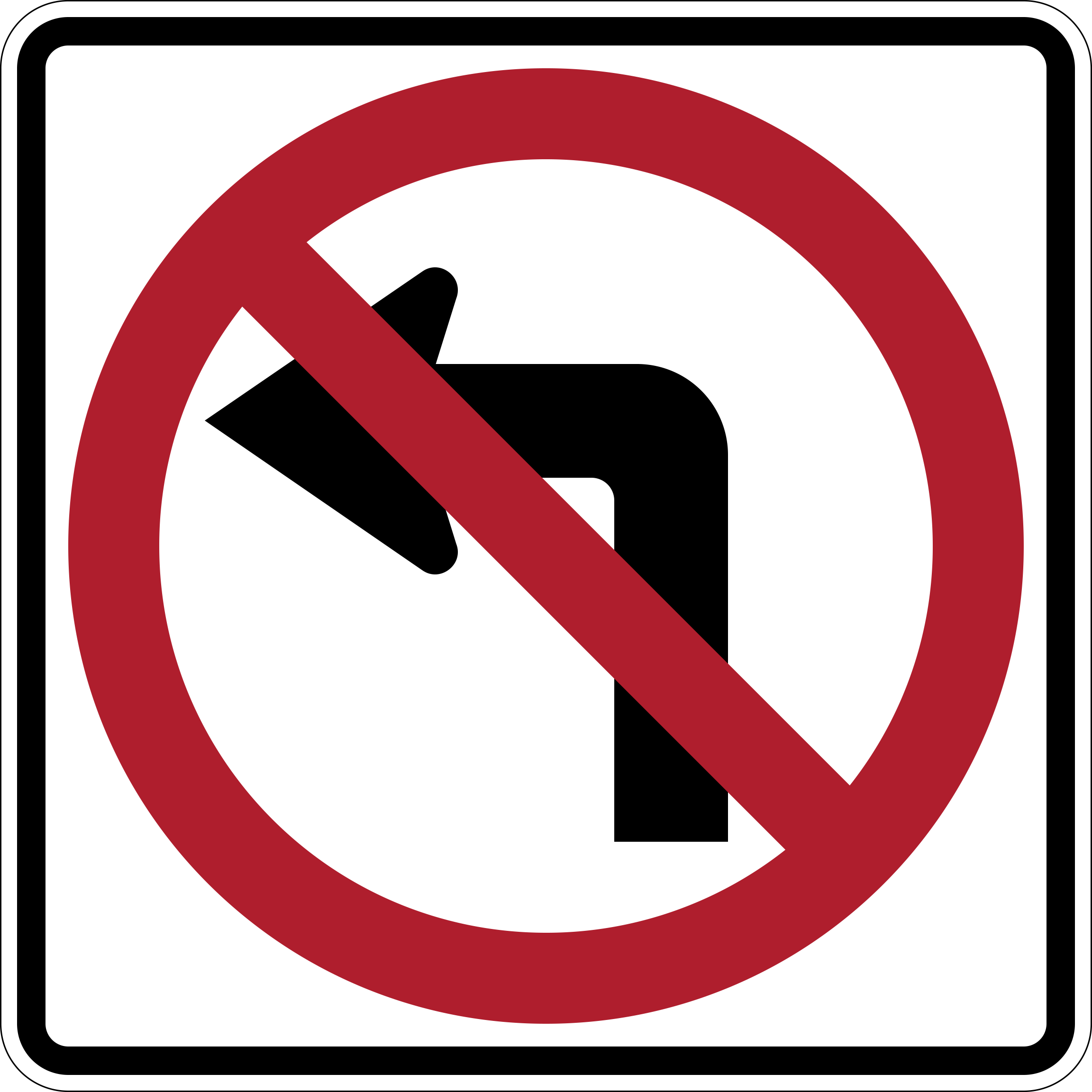
- Yes, U-turns are separate from left turns
- Yes, if you stop first and yield
- No, a U-turn counts as two left turns
- Yes, if the intersection is in town
Show answer
No, a U-turn counts as two left turns. This sign means left turns are against the law at that spot. In Virginia, a U-turn is considered two left turns, so it is also illegal where a No Left Turn sign is posted. Stopping and yielding first does not make it legal, and being in a town does not help. Drive on to another intersection where neither a No Left Turn nor a No U-Turn sign is posted, or turn right and find a safe way back.
Study this in the handbook: Sign colors and shapes
13. In Virginia, which sign shape always means stop?
- An octagon with eight sides
- A triangle pointing down
- A pentagon with five sides
- A diamond standing on a point
Show answer
An octagon with eight sides. Sign shapes carry meaning even before you can read them. The eight-sided octagon always means stop, and you must come to a complete stop at the sign, stop line, pedestrian crosswalk or curb. A downward triangle is the yield sign, the five-sided pentagon marks school zones and crossings, and the diamond is used for warnings. Because shapes can be seen in fog or from far away, knowing that an octagon means stop helps you react early.
Study this in the handbook: Traffic signals and turns on red
14. On a slippery road, when does the Virginia manual say you have the most traction and control?
- When the front tires are rolling
- When the front wheels are locked
- When the rear tires are spinning
- When you brake hard and steer
Show answer
When the front tires are rolling. On ice and packed snow, how you brake matters most. The manual says you have the most traction and control when the front tires are rolling, and that a slow, steady speed rather than hard braking lets you control the vehicle. Locked wheels slide, and spinning tires have lost their grip. Braking hard while steering on ice is a common way to lose control. Ease off the gas early and brake gently so the tires keep turning.
Study this in the handbook: Headlights, night, fog, rain and snow
15. When no speed limit sign is posted, in which kinds of Virginia areas is 25 mph the maximum for cars?
- Unpaved gravel and dirt roads
- Two-lane rural highways
- School, business and residential areas
- Interstate entrance and exit ramps
Show answer
School, business and residential areas. Virginia sets default limits for passenger vehicles and motorcycles that apply when no sign gives a different number. The limit is 25 MPH in school, business and residential areas, 35 MPH on unpaved roads, and 55 MPH on all other roads. Unpaved roads therefore get 35, not 25, and rural highways fall under the 55 MPH default. A posted sign with a different number always takes the place of these defaults.
Study this in the handbook: Speed limits and reckless driving
16. A friend says a single shot of liquor is much stronger than a beer. According to the Virginia manual, a shot equals about how much beer?
- Twelve ounces of beer
- Six ounces of beer
- Twenty-four ounces of beer
- Thirty-six ounces of beer
Show answer
Twelve ounces of beer. The manual says twelve ounces of beer is the same as a shot of liquor or a five-ounce glass of wine. A shot is not stronger than a regular beer; each counts as one drink. Six ounces would be half a beer, and twenty-four or thirty-six ounces would be two or three beers. Count every drink the same way, remember that even one drink affects vision, judgment and coordination, and know that only time can lower intoxication.
Study this in the handbook: Aggressive, distracted and drowsy driving
17. You are circling inside a Virginia roundabout and your exit is the next one. Which signal should you use?
- Turn on your left turn signal
- Turn on your hazard flashers
- No signal, since the circle is one-way
- Turn on your right turn signal
Show answer
Turn on your right turn signal. While inside a roundabout, stay in your lane until you are ready to leave. Then use your right turn signal to let drivers around you know you are exiting. A left signal would suggest you are staying in the circle or moving toward the center. Hazard flashers are for warning of a stopped or disabled vehicle, not for exits. Before you leave, check for vehicles continuing through the roundabout beside or behind you, and glance over your shoulder for your blind spot.
Study this in the handbook: Passing, turning, U turns and signals
18. You need to read a long message on your phone while driving in Virginia. What does the manual say to do first?
- Read it at the next red light
- Hold the phone low and glance down
- Pull over and stop in a safe place
- Slow down below the speed limit
Show answer
Pull over and stop in a safe place. Driving requires your full attention, and using a phone is one of the distractions the manual lists. Before engaging in distracting behavior, it says to pull over and stop the vehicle in a safe location. A red light can change at any moment, and holding the phone while driving is prohibited in Virginia except in an emergency or when lawfully parked or stopped. Slowing down does not give you back the seconds your eyes are off the road.
Study this in the handbook: Aggressive, distracted and drowsy driving
19. A parent asks whether to turn their 18-month-old's car seat to face forward. What does the Virginia manual say?
- Turn it now; one year is enough
- Keep it rear facing to age 2 or the seat limit
- Turn it once the child can walk
- Face it forward if the seat is in the back
Show answer
Keep it rear facing to age 2 or the seat limit. The manual says children should ride rear facing from birth to 2 years, or as long as the safety seat manufacturer allows. At 18 months, a child is still under that age, so the seat should stay rear facing. Walking or the seat being in the back does not change the guidance. After that, children ride forward facing in a child seat or booster until at least age 8. Check the seat's label for its rear facing height and weight limits.
Study this in the handbook: Seat belts, air bags and child safety seats
20. Traffic is backed up just past a railroad crossing, and there is no room beyond the tracks for your car. The lights are not flashing. What should you do?
- Pull onto the tracks and wait
- Cross and stop with your rear on the rail
- Wait before the tracks until there is room
- Go around the line on the shoulder
Show answer
Wait before the tracks until there is room. Unless you can clear the tracks completely, never start across. The manual says to make sure there is room for your vehicle on the other side of the tracks before proceeding. If traffic stops while you are on the crossing, you could be trapped when a train comes. Wait behind the crossing until the line moves far enough for your whole vehicle to fit, even if the lights are not flashing. Never use the shoulder to get around the line.
Study this in the handbook: Railroad crossings and work zones
Every question is written from the official Virginia Driver's Manual. Need paper? Printable VA practice test with answer key.
Last verified 2026-10-05. How we check every question · Study all 500 as flashcards
Frequently asked questions
How many questions are on this Virginia practice test?
This fixed set has 20 questions. It is test 19 of 25 from the 500 question Virginia bank. The real VA exam has a 10 question road sign section with 10 correct to pass, plus 30 knowledge questions with 24 correct to pass.
What is the passing score for the real Virginia test?
Part one: all ten road sign questions must be answered correctly; part two: you must correctly answer 24 of the 30 general knowledge questions That figure comes from the official Virginia source cited on the DMV facts page.
How does this fixed test relate to the full Virginia bank?
Each numbered test is a fixed set of questions in a fixed order, so you can retake the same test later and compare. Every test mixes road signs and the other topics in about the same proportion as the full bank. Tests 1 to 25 together cover every question in the Virginia bank once. The full practice page mixes the whole bank at random.
Last verified 2026-10-05. See the Virginia DMV facts page for sourced state details.
Return to the full Virginia practice test · Study road signs