
Test 5 of 10 · 20 questions · Free 2026
VA Permit Practice Test 5
Jump to the test ↓A fixed 20 question set from the Virginia bank with answers and plain English explanations. The real VA exam has a 10 question road sign section with 10 correct to pass, plus 30 knowledge questions with 24 correct to pass; take the full length version on the main practice page.
Question 1 of 20 · 0 right so far
All 20 questions in test 5
Every question below comes from the Virginia question bank on this page. Open a question to see the correct answer and the explanation. Nothing here is hidden behind a signup.
1. What does yellow used with black convey on a traffic sign?
- A regulatory instruction such as a speed limit
- Directions to a motorist service
- A warning about a curve, stop ahead, or slippery pavement
- A historical or cultural destination
Show answer
A warning about a curve, stop ahead, or slippery pavement. Yellow used with black marks a warning sign. The manual gives curves ahead, stop ahead, overhead clearances, and slippery pavement as examples. A regulatory instruction uses black with white, motorist services use blue and white, and historical or cultural interests use brown and white. Read the warning as a prompt to slow down, search for the condition, and be ready to stop. The color does not tell you the exact hazard by itself, so use the symbol or words to choose the proper response.
Study this in the handbook: Traffic signals and turns on red
2. When a green arrow points left, what movement does it permit if the way is clear?
- Turn right across the intersection
- Proceed straight only, not left
- Travel in the direction of the arrow
- Treat the signal as a stop sign
Show answer
Travel in the direction of the arrow. A green arrow permits movement in the arrow's direction when the way is clear, so a left-pointing arrow authorizes the left movement. It does not direct the driver right or straight, and it is not a stop indication. A driver making a turn without a green arrow must yield to opposing vehicles and pedestrians; the arrow instead marks a movement the signal has opened for you. Still scan the intersection for people or hazards before moving. The arrow gives the permitted direction, while the clear-path condition tells you when it is safe to use it.
Study this in the handbook: Traffic signals and turns on red
3. What does braking distance describe?
- The time needed to notice a hazard
- The distance the car travels after the brakes are applied
- The distance traveled before the driver reacts
- The width of the lane during a stop
Show answer
The distance the car travels after the brakes are applied. Braking distance begins after the driver applies the brakes and continues until the vehicle stops. Perception time comes earlier, when the driver recognizes a hazard, and reaction distance covers the travel before the pedal is applied. The lane width is unrelated. Wet pavement can lengthen the braking portion substantially, so maintain a larger cushion and reduce speed before a slick area. Separating these three parts of stopping distance helps explain why a late response can still produce a collision even when the brakes work properly.
Study this in the handbook: When you must stop, school buses and stopping distance
4. After moving to a new address within Virginia, how soon must you notify DMV?
- Within 10 days
- Within 60 days
- Only at your next renewal
- Within 30 days
Show answer
Within 30 days. Virginia requires drivers to notify DMV within 30 days of a move. The postal service will not forward a driver's license, so a card mailed to an old address goes back to DMV. Sixty days is the deadline for a new resident to get a Virginia license, a different rule. Ten days is too short, and waiting until renewal leaves DMV with the wrong address for mailings.
Study this in the handbook: Learner's permit, license and vehicle paperwork
5. A Virginia driver without an E-ZPass transponder approaches a toll plaza. What should they do?
- Look for and follow the signs for cash only lanes, slowing down as they approach
- Use any lane and pay later
- Use the E-ZPass express lane
- Stop before the plaza and wait for an attendant
Show answer
Look for and follow the signs for cash only lanes, slowing down as they approach. If you do not have a transponder, look for and follow the signs for cash only lanes as you approach a toll plaza, and slow down as you approach it. Be extra cautious approaching, entering and leaving the plaza because other drivers may be changing lanes and toll employees may be crossing the lanes. Some toll roads have high speed lanes reserved for vehicles with E-ZPass transponders, so do not enter those lanes unless you have one.
Study this in the handbook: Special lanes, painted curbs and parking
6. How often may the Virginia knowledge exam be taken?
- Twice during every business day
- Only once per business day
- Any number of times on the same day
- Once per calendar month
Show answer
Only once per business day. Virginia allows the knowledge exam only once per business day. That means a failed attempt cannot be followed by another sitting later the same day, even if an appointment slot opens. Twice daily and unlimited same day choices ignore the stated scheduling limit, while a calendar month imposes a delay much longer than the manual describes. Plan the next attempt for a later business day and use the interval to review signs, laws, and safe driving material instead of expecting repeated same day tries.
Study this in the handbook: The knowledge exam, road skills test and vision screening
7. Where do the Virginia requirements for yielding to vehicles with flashing lights not apply?
- Highway work zones
- Divided highways
- Residential streets
- Roads with posted speed limits
Show answer
Highway work zones. The manual expressly says these requirements do not apply in highway work zones. That is a specific exception, not a general exemption for residential streets, divided highways, or roads with posted limits. Drivers should still follow signs, flaggers, and work zone controls because the exception does not make the area consequence free. When a work zone is present, reduce speed, watch for workers and traffic shifts, and obey the instructions governing that zone.
Study this in the handbook: Special lanes, painted curbs and parking
8. On a highway with at least four lanes, how should a driver pass a stationary trash collection vehicle when it is safe to change lanes?
- Pass in the adjacent lane at the posted speed
- Stop in the lane directly behind the collection vehicle
- Change to a lane that is not next to the vehicle
- Use the shoulder to get around it
Show answer
Change to a lane that is not next to the vehicle. On a highway with at least four lanes, Virginia directs a driver passing stationary trash-collection vehicles to move into a lane that is not next to the vehicle when a lane change is possible. Passing in the adjacent lane leaves the vehicle immediately beside the work area, so it misses the required separation. The guidance does not call for stopping behind the truck or using the shoulder. Look ahead for collection activity, signal early, check the open lane, and move over smoothly while preserving a safe speed and following distance.
Study this in the handbook: Special lanes, painted curbs and parking
9. When may you cross train tracks on a roadway?
- When the vehicle ahead begins to move, even if the exit is blocked
- Whenever the crossing lights are not flashing
- After stopping on the tracks to check both directions
- Only when you have enough room to cross without stopping and clear the tracks safely
Show answer
Only when you have enough room to cross without stopping and clear the tracks safely. Cross train tracks only when there is enough room beyond them to complete the crossing without stopping. A dark signal does not prove that the route is safe, and stopping on the rails leaves the vehicle in the train’s path. Following a moving vehicle is also unsafe if traffic has filled the far side. Look both ways, obey the signs and signals, and confirm the entire exit is open before entering. If space is uncertain, wait before the tracks until the vehicle ahead has cleared the crossing area.
Study this in the handbook: Bicycles, motorcycles, trucks and other road users
10. Which rule helps a Virginia driver judge whether there is enough following distance?
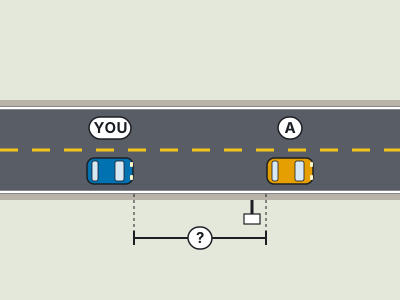
- Keep one second at every speed
- Stay exactly one car length behind
- Use the two-, three- and four-second rule
- Follow closely until the vehicle ahead brakes
Show answer
Use the two-, three- and four-second rule. The manual uses a two-, three-, and four-second rule to help judge whether the gap behind the vehicle ahead is sufficient. One car length does not account for changing speed, and one second at every speed gives too little room as speed rises. Following closely until braking begins defeats the purpose of a space cushion. Increase the interval for poor weather, heavy traffic, large vehicles, motorcycles, bicycles, or a tailgater.
Study this in the handbook: Hand position, following distance and blind spots
11. Under Virginia DMV's current insurance requirements, what must an owner do to purchase license plates or decals for a vehicle?
- Pay a $500 uninsured motor vehicle fee instead of buying insurance
- Certify that the vehicle is covered by the minimum insurance requirements
- Show a clean driving record in place of insurance
- Nothing beyond paying the registration fee
Show answer
Certify that the vehicle is covered by the minimum insurance requirements. Virginia DMV says that to purchase license plates or decals, you must certify that the vehicle is covered by the minimum insurance requirements, and the insurance carrier must be authorized to do business in Virginia. The printed driver manual still describes paying a $500 uninsured motor vehicle fee instead, but that handbook passage is outdated: 2023 Acts of Assembly chapter 538 repealed the fee option effective July 1, 2024. A clean driving record or a registration payment is no substitute for insurance, and a driver caught uninsured must pay a $600 noncompliance fee to get driving privileges back.
12. What do double solid white lines between lanes going the same direction mean in Virginia?
- You may not cross them, and may enter the special use lane only where signs and markings allow
- You may cross them to pass if the way is clear
- They mark a lane where traffic flows in the opposite direction
- They show a shared center lane for left turns
Show answer
You may not cross them, and may enter the special use lane only where signs and markings allow. Double solid white lines separate lanes of traffic going in the same direction. They are most often used to set a special use lane apart from regular lanes, such as a High Occupancy Vehicle lane on an expressway. You may not cross these lines. You may enter the special use lane only where signs and markings allow it. Yellow lines, not white lines, separate traffic moving in opposite directions.
Study this in the handbook: Special lanes, painted curbs and parking
13. Between 10 PM and 2 AM, how many drivers do researchers estimate are drunk, according to the Virginia manual?
- Three out of every ten
- Half
- One out of every fifty
- One out of every hundred
Show answer
Three out of every ten. Researchers estimate that between the hours of 10 PM and 2 AM three out of every ten drivers are drunk, and more than one third of them have been drinking at someone else's home. Nearly half of drivers arrested for DUI are social to moderate drinkers. The manual's point is that the danger is not limited to problem drinkers, and late night driving means sharing the road with impaired drivers.
Study this in the handbook: Alcohol, drugs and DUI
14. Depending on the locality, what can a Virginia driver convicted of DUI be charged for the emergency response to the crash?
- Nothing, because the response is taxpayer funded
- Up to $1,000 for the cost of the response
- Up to $100 for the police report only
- The full cost with no limit
Show answer
Up to $1,000 for the cost of the response. Some Virginia cities and counties make a DUI driver pay restitution, up to $1,000, for the police, emergency medical services, firefighters and rescue crews who respond to a crash or incident caused by the violation. The response is not always free to the driver. The charge is not limited to a $100 report fee, and it is capped rather than unlimited. This cost is on top of the fines and suspensions for the DUI itself.
Study this in the handbook: Suspensions, revocations and demerit points
15. About what share of Virginia traffic crashes does driver distraction account for each year?
- Roughly 17 percent
- Roughly 2 percent
- Roughly 50 percent
- Roughly 90 percent
Show answer
Roughly 17 percent. Annually, driver distraction accounts for roughly 17 percent of all traffic crashes in Virginia. While the driver is distracted the vehicle may drift into a high risk situation, and the driver loses precious seconds before recognizing it and making an emergency maneuver. Hands free navigation is allowed only when the driver is not entering information or holding the device, and Virginia law bars holding a phone or other wireless device while driving except in an emergency or when lawfully parked or stopped.
Study this in the handbook: Aggressive, distracted and drowsy driving
16. In Virginia, what additional movement is illegal when a No Left Turn sign is posted?
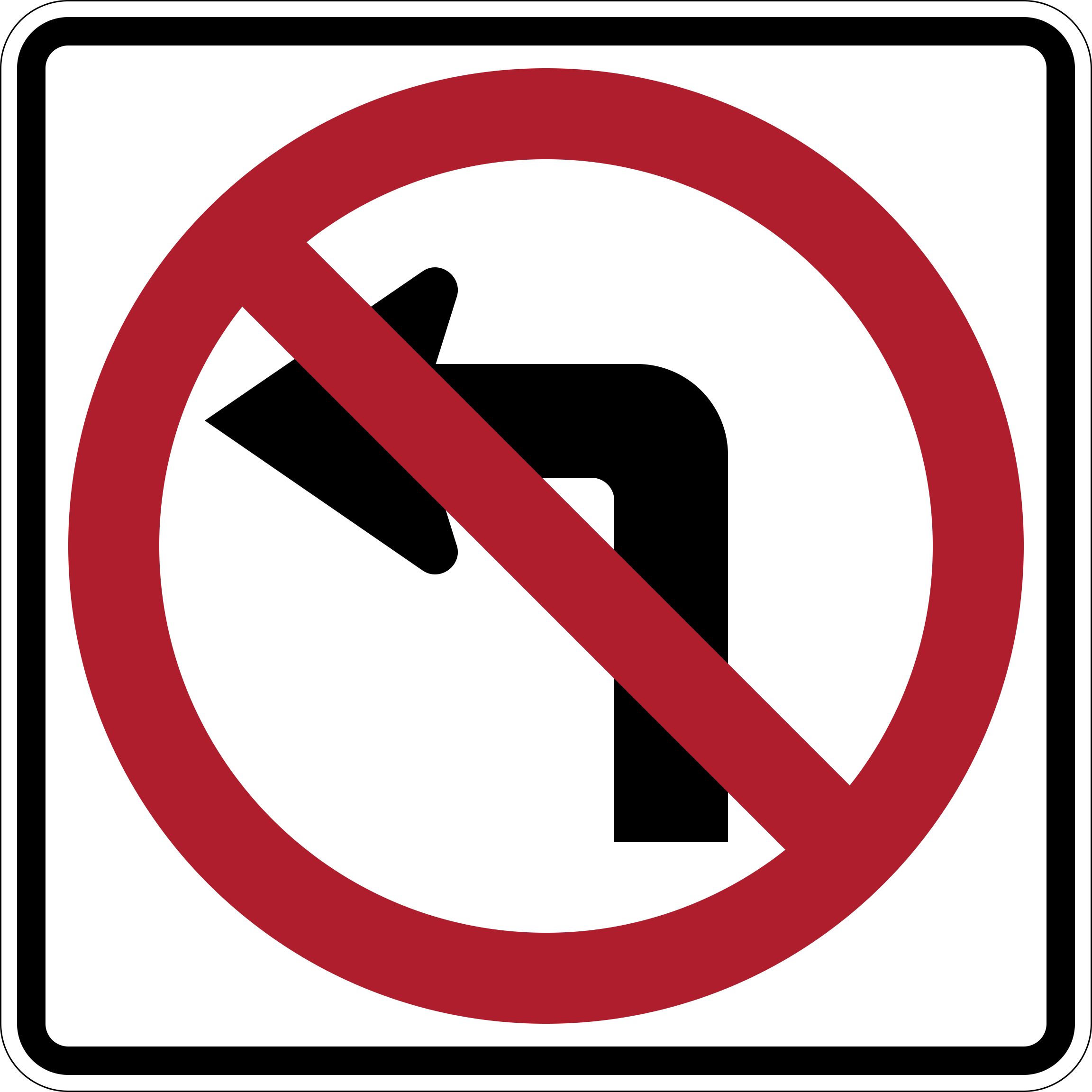
- A right turn from the outside lane
- A lane change after checking the mirror
- A left turn after yielding at a green arrow
- A U-turn, because Virginia treats it as two left turns
Show answer
A U-turn, because Virginia treats it as two left turns. Virginia gives the No Left Turn sign an important added consequence: a U-turn is treated as two left turns. Therefore, the sign bars both the obvious left turn and the attempt to reverse direction by making a U-turn. A right turn or a properly checked lane change is not the movement named by this sign. Remember the two-left-turn rule whenever the crossed-out left arrow appears, including on a quiet roadway.
Study this in the handbook: Regulatory and warning signs
17. What does Virginia’s implied-consent law mean when a person operates a motor vehicle on public roads?
- The driver may refuse every test without consequence
- The driver agrees only after signing a separate form
- The driver must submit only after a court conviction
- The driver agrees to take a breath test upon request
Show answer
The driver agrees to take a breath test upon request. Operating a motor vehicle on Virginia public roads carries agreement to take a breath test upon request under implied-consent laws. No separate signed form or prior conviction is required for the agreement described in the manual. Refusal is not presented as consequence-free. The practical cue is automatic consent attached to driving on public roads, while administrative suspension and other penalties can follow a refusal or qualifying BAC result.
Study this in the handbook: Suspensions, revocations and demerit points
18. What kind of information does a diamond-shaped traffic sign provide?

- A command to park in a marked space
- A route number and destination only
- A warning about special conditions or hazards ahead
- A guarantee that the road is clear
Show answer
A warning about special conditions or hazards ahead. The diamond shape is a warning shape. It alerts the driver to special conditions or hazards ahead and calls for slower, more cautious driving. It does not by itself grant a route destination, parking permission, or assurance that no conflict exists. Use the warning as advance notice to scan farther down the roadway, reduce speed as needed, and stay prepared to stop if the condition requires it.
Study this in the handbook: Sign colors and shapes
19. In Virginia, what does orange on a roadway sign or marker identify?
- A hospital or other emergency medical destination
- A historic site or cultural point of interest
- A route providing ordinary highway directions
- A construction area where drivers should slow down and stay alert
Show answer
A construction area where drivers should slow down and stay alert. Orange identifies construction activity, so expect workers, altered lane patterns, barriers, or other temporary controls. Reduce speed and watch carefully for the instructions paired with the orange warning. The hospital choice confuses a service destination with a work area. Historic and cultural attractions use brown information signs, not orange. Ordinary directions are shown by green guide signs. A useful road cue is to connect orange with an active work zone and to anticipate that the normal path, speed, or lane arrangement may change before you reach the workers.
Study this in the handbook: Traffic signals and turns on red
20. How soon must a new Virginia resident title and register a vehicle?
- Within 60 days
- Within 30 days of moving to Virginia
- Within 10 days
- Within one year
Show answer
Within 30 days of moving to Virginia. Title and register your vehicle and obtain Virginia license plates within 30 days of moving to Virginia, and get a Virginia driver's license within 60 days. Plates go on the front and rear, with month and year decals in the designated areas. The vehicle must pass an annual safety inspection, and in certain localities an emissions inspection as well. You must also keep the registration card with you while operating the vehicle.
Study this in the handbook: Learner's permit, license and vehicle paperwork
QualitySpace is expanding to Virginia
We are a California-based independent insurance brokerage working on licensing in more states. We cannot help with Virginia insurance yet. Leave your email and we will let you know when we can.
Every question is written from the official Virginia Driver's Manual. Need paper? Printable VA practice test with answer key.
Last verified 2026-10-05. How we check every question · Study all 206 as flashcards
Frequently asked questions
How many questions are on this Virginia practice test?
This fixed set has 20 questions. It is test 5 of 10 from the 206 question Virginia bank. The real VA exam has a 10 question road sign section with 10 correct to pass, plus 30 knowledge questions with 24 correct to pass.
What is the passing score for the real Virginia test?
Part one: all ten road sign questions must be answered correctly; part two: you must correctly answer 24 of the 30 general knowledge questions That figure comes from the official Virginia source cited on the DMV facts page.
How does this fixed test relate to the full Virginia bank?
Each numbered test is a fixed set of questions in a fixed order, so you can retake the same test later and compare. Every test mixes road signs and the other topics in about the same proportion as the full bank. Tests 1 to 10 together cover 200 of the 206 questions in the Virginia bank, each once. The full practice page mixes the whole bank at random.
Last verified 2026-10-05. See the Virginia DMV facts page for sourced state details.
Return to the full Virginia practice test · Study road signs