
Test 8 of 10 · 20 questions · Free 2026
VA Permit Practice Test 8
Jump to the test ↓A fixed 20 question set from the Virginia bank with answers and plain English explanations. The real VA exam has a 10 question road sign section with 10 correct to pass, plus 30 knowledge questions with 24 correct to pass; take the full length version on the main practice page.
Question 1 of 20 · 0 right so far
All 20 questions in test 8
Every question below comes from the Virginia question bank on this page. Open a question to see the correct answer and the explanation. Nothing here is hidden behind a signup.
1. How far from an intersection must a Virginia driver park?
- At least 10 feet
- At least 15 feet
- At least 50 feet
- At least 20 feet
Show answer
At least 20 feet. Virginia's parking list says you may not park within 20 feet of an intersection. Fifteen feet is the rule for a fire hydrant and for the entrance to a fire, ambulance or rescue squad station, so it belongs to other items. Fifty feet is the railroad crossing distance, and ten feet would still put the car inside the 20 foot intersection zone. The same list also bars parking in a bike lane and in front of driveways.
Study this in the handbook: Special lanes, painted curbs and parking
2. A Virginia driver whose license is suspended for an alcohol-related offense is caught driving. What happens to the vehicle right away?
- It is impounded for 30 days
- It is impounded for 3 days
- It is towed only if it is blocking traffic
- It is impounded for one year
Show answer
It is impounded for 30 days. The vehicle is impounded immediately for 30 days when someone drives after a suspension for an alcohol-related offense. After a conviction, the court can impound it for 90 more days. Three days is the cap in a different rule, for driving without a license after a prior conviction for doing so. Towing only when the car blocks traffic misses the point that impoundment is automatic, and one year is not the stated period.
Study this in the handbook: Suspensions, revocations and demerit points
3. What does red used with white convey on a Virginia traffic sign?
- Motorist services only
- A destination or route distance
- Stop, yield, do not, and no
- A historical or cultural interest
Show answer
Stop, yield, do not, and no. Red used with white conveys stop, yield, do not, and no on Virginia traffic signs. That color combination is a quick warning that the sign carries a restriction or required response, such as stopping, yielding, or avoiding a movement. Green, blue, and brown have different information roles, including destinations, motorist services, and historical or cultural interests. The choice naming a route distance confuses sign colors with guide information. When red and white appear together, read the symbol and wording carefully, slow as needed, and follow the instruction before entering the controlled area.
Study this in the handbook: Sign colors and shapes
4. How often must a Virginia vehicle pass a safety inspection?
- Every two years, only when the vehicle is sold
- Once when the vehicle is first registered in Virginia
- Monthly, before every long trip
- Annually, with a valid inspection sticker displayed
Show answer
Annually, with a valid inspection sticker displayed. Virginia requires an annual vehicle safety inspection and a valid inspection sticker displayed on the vehicle. A sale or initial registration does not replace the recurring inspection obligation. The monthly interval belongs to checking tires for wear and damage, not to obtaining a safety inspection. Watch the sticker and arrange the yearly inspection before it expires, especially before a road skills test or a long trip where an invalid inspection could create a separate problem.
Study this in the handbook: Learner's permit, license and vehicle paperwork
5. How long can a truck and trailer be in Virginia, and how much clear road may passing it require?
- As long as 65 feet, needing more than half a mile of clear road to pass
- About 100 feet, needing one mile
- About 30 feet, needing 500 feet to pass
- There is no length limit
Show answer
As long as 65 feet, needing more than half a mile of clear road to pass. A truck and its trailer may be as long as 65 feet, and it may take you more than half a mile of clear road to pass. Large vehicles need nearly twice the time and room to stop as cars, so never cut in and brake in front of one. When passing, look for the entire front of the truck in your rearview mirror before pulling in, then maintain your speed.
Study this in the handbook: Bicycles, motorcycles, trucks and other road users
6. Your Virginia lane is marked with both a curved arrow and a straight arrow. What may you do from this lane?
- Only turn in the direction of the curved arrow
- Only go straight
- Turn only after a full stop
- Turn or go straight
Show answer
Turn or go straight. White lane arrows tell you which movements are allowed from a lane. When a lane shows only a curved arrow, or a curved arrow with the word ONLY, you must turn the way the arrow points. When the lane shows both a curved arrow and a straight arrow, you may either turn or continue straight. Choose your lane early, because solid white lines near intersections discourage lane changes at the last moment.
Study this in the handbook: Special lanes, painted curbs and parking
7. What should you do when a sharp right turn warning appears?

- Maintain highway speed until the turn begins
- Stop on the center line before turning
- Pass the turn by using the shoulder
- Slow down and prepare for the sharp turn ahead
Show answer
Slow down and prepare for the sharp turn ahead. The sharp-right-turn warning indicates that the roadway will turn sharply and calls for lower speed before the maneuver. Maintaining speed delays the adjustment, and stopping on the center line or using the shoulder introduces conflicts with other road users. The sign is advance information, not a command to halt in the lane. Brake smoothly in advance, remain within the marked roadway, and steer through the turn under control.
Study this in the handbook: Railroad crossings and work zones
8. What must happen before a Virginia applicant can take the knowledge exam a fourth time after three failures?
- The applicant must wait one year
- The applicant must take only the road skills test
- The applicant must complete and pass the classroom component of driver education
- The applicant may retest immediately
Show answer
The applicant must complete and pass the classroom component of driver education. Three failed knowledge exams trigger a prerequisite before a fourth attempt: the applicant must complete and pass the classroom component of driver education. A one-year delay is not the stated condition, and passing the road skills test does not substitute for classroom completion. Immediate retesting is unavailable. When a question mentions three failures, look for the added education requirement rather than another ordinary scheduling interval.
Study this in the handbook: The knowledge exam, road skills test and vision screening
9. Unless a sign says otherwise, what is the maximum speed for passenger vehicles and motorcycles in Virginia school, business, and residential areas?
- 35 MPH
- 45 MPH
- 55 MPH
- 25 MPH
Show answer
25 MPH. The default maximum for passenger vehicles and motorcycles in school, business, and residential areas is 25 MPH. The 35 MPH choice belongs to unpaved roads, and 55 MPH is the default for all other roads. Forty-five MPH is not the listed statewide default for these areas. A posted limit can change the applicable maximum. Even at that limit, drivers must slow for weather, construction, or another condition that makes the speed unsafe.
Study this in the handbook: Speed limits and reckless driving
10. In Virginia, what can result from failing to stop for a lawfully crossing pedestrian and causing serious injury or death?
- A parking ticket
- A Class 1 misdemeanor
- A $50 fine
- No penalty if the driver had a green light
Show answer
A Class 1 misdemeanor. Drivers are required to come to a full stop for pedestrians who are lawfully crossing a roadway, and failing to stop and causing serious bodily damage or death can result in a Class 1 misdemeanor. A parking ticket or a $50 fine understates that consequence. Stop and remain stopped until pedestrians have passed the lane in which your vehicle is stopped. Be especially careful around schools, playgrounds and residential areas where people may be playing or crossing the street.
Study this in the handbook: Right of way, pedestrians and roundabouts
11. What does the five-sided sign identify?

- A hospital entrance
- A school zone or school crossing
- A temporary construction detour
- A railroad track with two lanes
Show answer
A school zone or school crossing. The pentagon is reserved for school-related warnings. It marks a school zone or warns about a school crossing, so drivers should watch for children and follow the posted speed limit and crossing-guard signals. It is not a hospital, railroad, or construction symbol. When this shape appears, reduce distractions, expect children near the roadway, and be ready to slow or stop around the school area.
Study this in the handbook: Sign colors and shapes
12. At a railroad crossing with flashing signals, what must you do?
- Slow down and cross if the gates are raised
- Stop only when a train horn can be heard
- Come to a complete stop, even if no train is visible
- Proceed without stopping when the crossing looks clear
Show answer
Come to a complete stop, even if no train is visible. Virginia requires a complete stop at a railroad crossing when the signals are flashing, whether or not a train can be seen. Raised gates or a quiet track do not cancel the signal. The choice to slow down and continue treats a warning as optional, while waiting for a horn relies on an unreliable cue. Stop before the crossing, check for a safe route, and move only when the signals permit passage. This habit protects against a train hidden by darkness, weather, or another obstruction.
Study this in the handbook: Traffic signals and turns on red
13. What must a Virginia driver do when an emergency vehicle approaches from behind using a siren or flashing lights?
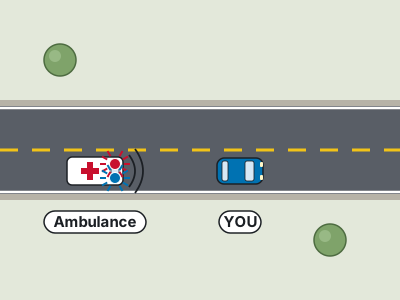
- Follow it closely through the intersection
- Yield, pull safely to the right edge, and stop until it passes
- Stop in the middle of the lane immediately
- Race ahead so it cannot pass
Show answer
Yield, pull safely to the right edge, and stop until it passes. Virginia's manual says that when police, fire and rescue vehicles or ambulances approach from behind using a siren, flashing lights or both, you must immediately yield the right-of-way. Safely pull over to the right edge of the road and stop until the emergency vehicle has passed. The manual also says never to follow an emergency vehicle closer than 500 feet when its lights are flashing, so following it closely is wrong, and stopping in the lane or racing ahead does not yield the way.
Study this in the handbook: Emergency vehicles and stopped vehicles with flashing lights
14. After a crash with no injuries, when may the drivers move the vehicles?
- When the vehicles can be moved safely and the drivers can do so without blocking traffic
- Never, because crash vehicles must remain in place
- Immediately, even if someone is injured
- Only after a tow truck arrives
Show answer
When the vehicles can be moved safely and the drivers can do so without blocking traffic. Virginia's manual directs drivers to move vehicles from the road immediately when they are able to be moved, nobody is injured, and the driver is capable of doing it safely. This protects people from traffic and reduces the chance of a secondary collision. Waiting for a tow truck is unnecessary, and leaving movable vehicles in the travel lane creates another hazard. Injury changes the condition, so moving a vehicle immediately without checking for injured people is also wrong. Be careful when exiting, and keep your vehicle between you and moving traffic if possible.
Study this in the handbook: Crashes, deer and traffic stops
15. A Virginia driver is caught driving without insurance and did not pay the uninsured motor vehicle fee. What noncompliance fee must be paid to end the suspension?
- $600, or an approved payment plan, plus a three year insurance certificate filing
- $1,500
- $100
- No fee, only a warning
Show answer
$600, or an approved payment plan, plus a three year insurance certificate filing. A driver found without the required insurance must pay a $600 noncompliance fee or be approved for a payment plan, and have the insurance company file a certificate showing a policy with the required limits. That certificate of insurance must stay on file for three years from the date driving privileges are regained. Return the plates and cancel the registration before letting a policy lapse.
16. When is passing unlawful and unsafe under the Virginia manual’s listed examples?
- Whenever the road has two lanes moving in the same direction
- Only when a driver is traveling below the speed limit
- On hills, curves, intersections, or railroad crossings, subject to the stated exception
- Whenever the vehicle ahead is smaller than yours
Show answer
On hills, curves, intersections, or railroad crossings, subject to the stated exception. The manual lists hills, curves, intersections, and railroad crossings among places where passing is unlawful and unsafe, except on roads with two or more lanes moving in the same direction. The two-lane same-direction answer reverses that exception by treating every such road as prohibited. A low speed does not create a general passing ban, and the size of the vehicle ahead is not the deciding condition. Before passing, scan for the road feature and lane arrangement, obey the marking, and wait until the maneuver is lawful and visible to other traffic.
Study this in the handbook: Passing, turning, U turns and signals
17. When a school bus displays flashing red lights and an extended stop sign, who must stop?
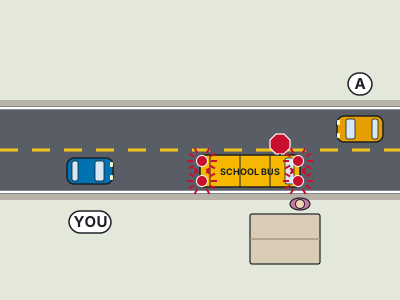
- Vehicles approaching from any direction on the highway, private road, or school driveway
- Only vehicles approaching from behind the bus
- Only vehicles traveling in the bus's lane
- No one if the bus is on a private road
Show answer
Vehicles approaching from any direction on the highway, private road, or school driveway. A stopped school bus with flashing red lights and an extended stop sign requires traffic approaching from any direction to stop on a highway, private road, or school driveway. The rule is broader than stopping only behind the bus or only in its lane. A private road does not remove the stopping requirement. Remain stopped until all people are clear of the roadway and the bus moves again. Look for children who may cross unexpectedly after leaving the bus.
Study this in the handbook: When you must stop, school buses and stopping distance
18. When should you add extra seconds to your following distance?
- Only when driving below 25 MPH
- Only when following a motorcycle on a clear road
- Never, because the listed intervals cover every condition
- When weather, traffic, pavement, or vehicle condition makes stopping harder
Show answer
When weather, traffic, pavement, or vehicle condition makes stopping harder. The manual says to add seconds when conditions reduce the time or traction available for a safe response. Bad weather, heavy traffic, poor pavement, and a vehicle in poor condition all call for a larger cushion. The rule is not limited to low speed or a single type of road user. The listed intervals describe dry surfaces, so the answer that more space is never needed overlooks the effect of rain, congestion, or equipment problems. Increase the gap before conditions become urgent rather than braking late.
Study this in the handbook: Hand position, following distance and blind spots
19. May children ride in the bed of a pickup truck in Virginia?
- Yes, if the truck stays under 35 mph
- No, transporting children under 16 in a pickup bed is illegal even with a camper shell
- Yes, if a camper shell is installed
- Yes, on private roads and highways alike
Show answer
No, transporting children under 16 in a pickup bed is illegal even with a camper shell. It is illegal to transport children under age 16 in the bed of a pickup truck, even if it is equipped with a camper shell, so neither a shell, a low speed nor the type of road makes it legal. The same section says never to allow children to ride in the luggage area of hatchbacks, station wagons or vans, and never to leave a hatchback open with a child in the back seat. Children belong properly secured in a seat inside the vehicle.
Study this in the handbook: Seat belts, air bags and child safety seats
20. What is unusual about school buses at railroad crossings in Virginia?
- They may cross without stopping when no train is visible
- They must always stop, even when crossing lights are not flashing
- They stop only when a gate is fully lowered
- They are exempt when carrying no children
Show answer
They must always stop, even when crossing lights are not flashing. School buses must always stop at railroad crossings in Virginia, including crossings where the warning lights are not flashing. The absence of flashing lights therefore does not create an exception for a bus. A visible train is not the trigger either, and the bus does not gain an exemption because children are absent. If you are following a bus, expect the stop and leave enough space for it to complete the crossing safely.
Study this in the handbook: Railroad crossings and work zones
QualitySpace is expanding to Virginia
We are a California-based independent insurance brokerage working on licensing in more states. We cannot help with Virginia insurance yet. Leave your email and we will let you know when we can.
Every question is written from the official Virginia Driver's Manual. Need paper? Printable VA practice test with answer key.
Last verified 2026-10-05. How we check every question · Study all 206 as flashcards
Frequently asked questions
How many questions are on this Virginia practice test?
This fixed set has 20 questions. It is test 8 of 10 from the 206 question Virginia bank. The real VA exam has a 10 question road sign section with 10 correct to pass, plus 30 knowledge questions with 24 correct to pass.
What is the passing score for the real Virginia test?
Part one: all ten road sign questions must be answered correctly; part two: you must correctly answer 24 of the 30 general knowledge questions That figure comes from the official Virginia source cited on the DMV facts page.
How does this fixed test relate to the full Virginia bank?
Each numbered test is a fixed set of questions in a fixed order, so you can retake the same test later and compare. Every test mixes road signs and the other topics in about the same proportion as the full bank. Tests 1 to 10 together cover 200 of the 206 questions in the Virginia bank, each once. The full practice page mixes the whole bank at random.
Last verified 2026-10-05. See the Virginia DMV facts page for sourced state details.
Return to the full Virginia practice test · Study road signs