
Test 13 of 25 · 20 questions · Free 2026
VA Permit Practice Test 13
Jump to the test ↓A fixed 20 question set from the Virginia bank with answers and plain English explanations. The real VA exam has a 10 question road sign section with 10 correct to pass, plus 30 knowledge questions with 24 correct to pass; take the full length version on the main practice page.
Question 1 of 20 · 0 right so far
All 20 questions in test 13
Every question below comes from the Virginia question bank on this page. Open a question to see the correct answer and the explanation. Nothing here is hidden behind a signup.
1. Which of these is a place where Virginia law says you may not park?
- Along a curb with no paint or signs
- On the right side of a two-way street
- In front of someone's driveway
- In a marked space with no restrictions
Show answer
In front of someone's driveway. The manual lists places where parking is not allowed, including beside another parked vehicle, which is double parking, on crosswalks or sidewalks, and in front of driveways. Blocking a driveway traps the owner and forces them to back out blind or wait. An unmarked curb, the right side of a two-way street and an unrestricted marked space are ordinary legal places to park, as long as no other rule such as a hydrant or intersection distance applies.
Study this in the handbook: Special lanes, painted curbs and parking
2. A funeral procession is moving through an intersection ahead of you in Virginia, and you are running late. What may you do?
- Slip into a gap between two cars
- Join the end to get through the light
- Wait and let the whole procession pass
- Cut through once your light is green
Show answer
Wait and let the whole procession pass. Virginia drivers must yield to funeral processions and must not cut through, join or interfere with one. Cars in the procession may follow the lead vehicle through a signal without stopping and may use hazard lights to show they are part of it. Slipping into a gap or tacking onto the end both break the rule, even if your own light turns green. Being late is not an exception. Wait until the last car of the procession has passed.
Study this in the handbook: Special lanes, painted curbs and parking
3. As you reach a Virginia roundabout, a pedestrian is in the crosswalk at the entry and a car is already circling toward you. What should you do?
- Yield to both before you enter
- Yield to the person, then enter ahead of the car
- Enter first, since you are at the entry
- Wave the person across and go around the car
Show answer
Yield to both before you enter. Entering traffic at a roundabout must yield the right-of-way to pedestrians and to traffic already in the circle. In this case both the person in the crosswalk and the circling car come before you. Wait at the yield line until the crosswalk is clear and there is a safe gap in the circle, then enter and travel counter-clockwise. Each road into a roundabout is marked with a yield sign.
Study this in the handbook: Special lanes, painted curbs and parking
4. This yellow diamond railroad warning sign shows a long, low vehicle on top of a raised set of tracks. What hazard does it describe?

- The crossing often floods after rain
- A second train may follow the first
- Low vehicles may drag on the tracks
- The crossing has no gates or lights
Show answer
Low vehicles may drag on the tracks. This is the Low Ground Railroad Crossing sign. It warns that a steep slope where the tracks cross the road may cause the bottom of low vehicles to get caught or drag on the tracks. A vehicle stuck on the rails is in serious danger from approaching trains. Drivers of low trailers, long vehicles or cars with little ground clearance should find another crossing. If a vehicle ever stalls on the tracks, get out right away and move away from the rails.
Study this in the handbook: Railroad crossings and work zones
5. A white diamond shape is painted in the center of a Virginia highway lane. What kind of lane is it?
- A high occupancy vehicle lane
- A lane that ends just ahead
- A climbing lane for slow trucks
- A lane for emergency stopping
Show answer
A high occupancy vehicle lane. High occupancy vehicle lanes are marked on highways by a diamond shape in the center of the lane. They may also be set apart by a barrier or by solid double white lines. During heavy traffic periods these lanes are reserved for buses, vanpools, carpools, motorcycles and certain clean fuel vehicles. Road signs show how many people a vehicle must carry and the hours the rule is in effect. Stay out of the lane when your vehicle does not qualify.
Study this in the handbook: Special lanes, painted curbs and parking
6. On a rural Virginia road, you pass a yellow diamond warning sign showing a farm tractor. What does the manual tell you to do in this area?
- Speed up to get past tractors early
- Honk so farm workers know you are near
- Use the shoulder to get around tractors
- Be ready to slow or stop; pass only when clear
Show answer
Be ready to slow or stop; pass only when clear. The Tractors and Farm Equipment sign means these vehicles regularly travel in the area. The manual says to be ready to slow down or stop, and to pass only when the way is clear. Farm equipment traveling 25 MPH or less must display the orange slow moving vehicle emblem. Driving on the shoulder to get around is not a legal way to pass, and speeding up only shortens your time to react when you come upon one.
Study this in the handbook: Regulatory and warning signs
7. A row of white triangles is painted across your lane as you near a Virginia roundabout. What does it show?
- Where a speed hump begins
- Where you must yield, or stop if needed
- The end of a no passing zone
- Where bicycles merge with cars
Show answer
Where you must yield, or stop if needed. A yield line is a row of triangles across the road. It may be used with a yield sign to show the point where you must yield, or stop if necessary. Yield lines are often found at the entrance to a roundabout, where drivers must yield to traffic already in the circle and to pedestrians. They do not mark speed humps, passing zones or bicycle merges. Slow as you approach the triangles and be ready to wait behind them for a safe gap.
Study this in the handbook: Special lanes, painted curbs and parking
8. A bicyclist ahead of you on a Virginia street moves to the center of the lane before turning left. Is that allowed?
- No, a cyclist has to keep near the right edge
- No, the cyclist has to walk the bike across
- Yes, but only on streets with a bike lane
- Yes, cyclists may use the lane center when needed
Show answer
Yes, cyclists may use the lane center when needed. A bicyclist on the roadway generally has the same right-of-way as a driver. Cyclists may ride in the center of the lane when necessary, such as when they are about to turn left or when the lane is too narrow to share side by side with a car. Expect this and do not crowd or honk at the rider. Slow down, stay behind until there is room, and pass only with at least three feet of clearance once the cyclist has turned.
Study this in the handbook: Right of way, pedestrians and roundabouts
9. You are towing a small trailer behind your car and want to pass a slower vehicle. How should you plan the pass?
- Allow about twice the usual time and room
- Pass the same way you would without it
- Pass faster than normal to save time
- Pass on the shoulder to save space
Show answer
Allow about twice the usual time and room. Towing a trailer places additional stress on the vehicle, and the manual says it takes the vehicle twice as long to pass, stop, accelerate and turn. Plan for a much longer clear stretch than you would need without the trailer, and allow for its added length when you return to the lane. Speeding is never allowed while passing, and the shoulder is not a passing lane. If the trailer starts to sway, slow down.
Study this in the handbook: Bicycles, motorcycles, trucks and other road users
10. Your car stalls on the tracks and a train is coming from your right. Which way should you run after you get out?
- Away from the tracks, angled toward the train
- Along the tracks, away from the train
- Straight back the way you came
- Back to the car to try the engine
Show answer
Away from the tracks, angled toward the train. If your car stalls on the tracks, do not hesitate. Get out right away and run diagonally away from the tracks in the direction of the oncoming train. With the train on your right, that means moving away from the rails at an angle toward the right. Running along the tracks, or straight back without angling toward the train, is not what the manual describes. Never return to the car once a train is coming.
Study this in the handbook: Railroad crossings and work zones
11. Your light is red, but a police officer standing in the intersection waves you through. What should you do?
- Stay stopped until the light turns green
- Wait and ask the officer to repeat it
- Go only after turning on your flashers
- Follow the officer and go when waved on
Show answer
Follow the officer and go when waved on. Traffic signals, signs and markings must be obeyed unless a police officer is directing traffic. The manual says to always follow the officer's direction. Officers often take over intersections during crashes, events or signal problems, and they may wave you through a red or stop you on a green. Waiting for the light defeats the officer's control of traffic. Check that the way is clear, then move as directed.
Study this in the handbook: Traffic signals and turns on red
12. A Virginia speed limit sign shows 55. Under what conditions is 55 meant as the maximum legal speed?
- Day or night, in any kind of weather
- During daylight hours
- When traffic is light
- When weather conditions are good
Show answer
When weather conditions are good. Speed limit signs tell you the maximum legal speed for the road when weather conditions are good. In rain, snow or ice you can be ticketed for driving too fast for the conditions even at or below the posted number, so the sign is not a promise that 55 is safe at all times. The limit applies day or night and whether traffic is light or heavy. Adjust down whenever conditions are less than ideal.
Study this in the handbook: Sign colors and shapes
13. You signal to move into the center lane of a three-lane Virginia highway. What else does the manual tell you to check for?
- The vehicle ahead of you in your lane
- Drivers who may move into that same lane
- Whether the next exit is on the right side
- Drivers waiting at the next on-ramp
Show answer
Drivers who may move into that same lane. Before changing lanes, check your side and rearview mirrors for traffic coming from behind, then signal. The manual adds that you should check for other drivers who may also be moving into the same lane. On a three-lane road, a driver in the far lane can aim for the center lane at the same moment you do. Just before moving, glance over your shoulder for your blind spot. Move over smoothly once the lane is clear.
Study this in the handbook: Passing, turning, U turns and signals
14. A Virginia warning sign shows the road curving right with a short road joining from the left inside the curve. What does it warn about?
- The road splits into two branches
- A side road joins from the left in the curve
- The left lane ends inside the curve
- A sharp right turn followed by a left
Show answer
A side road joins from the left in the curve. This is the Right Curve with Side Road sign. It means the road ahead curves right and a side road joins from the left within the curve. Watch the left side of the curve for drivers coming out. Slow down for the curve and be alert for vehicles entering your road. A split in the road is shown by a Y sign, and a lane ending has its own lane reduction sign.
Study this in the handbook: Railroad crossings and work zones
15. You plan to slow down soon for a driveway on a Virginia road. How can you warn the driver behind you ahead of time?
- Turn on your hazard flashers
- Flash your headlights a few times
- Sound your horn as you slow
- Tap your brakes before slowing
Show answer
Tap your brakes before slowing. The manual tells drivers to help the person behind them by keeping a safe following distance and a steady speed, and to tap the brakes to warn the driver behind when they plan to slow down or stop. A light tap flashes the brake lights without a sharp drop in speed, giving the other driver time to react. Hazard flashers are for a stopped or disabled vehicle, headlights face forward, and the horn does not tell anyone you are slowing.
Study this in the handbook: Hand position, following distance and blind spots
16. A 30-year-old Virginia driver is tested and has a BAC of exactly .08. What does that mean under the law?
- The driver is just under the legal limit
- The driver is driving under the influence
- It counts only if the driving is impaired
- It is legal for drivers age 21 and over
Show answer
The driver is driving under the influence. For drivers age 21 or older, Virginia considers you to be driving under the influence if your BAC is .08 percent or higher. The words or higher mean that exactly .08 is already over the line, not just under it. Proof of bad driving is not needed at that level. A driver can also be convicted with a BAC below .08 if driving is impaired. The safest plan is not to drive at all after drinking.
Study this in the handbook: Aggressive, distracted and drowsy driving
17. Another car is passing you on a two-lane Virginia road. What should you do?
- Speed up so the pass ends sooner
- Keep a steady speed or slow down
- Pull onto the shoulder and stop
- Flash your high beams as a warning
Show answer
Keep a steady speed or slow down. When you are being passed, do not speed up. Keep a steady speed or slow down so the other driver can get back into the lane quickly. Speeding up stretches out the time the passing car spends in the opposite lane, which can lead to a head-on crash. Pulling onto the shoulder is unnecessary and can be dangerous, and flashing lights may distract or blind the other driver. Easing off slightly is the safest help you can give.
Study this in the handbook: Passing, turning, U turns and signals
18. On a dry road at speeds below 35 mph, what following distance does Virginia's chart call for?
- Two seconds
- One second
- Three seconds
- Four seconds
Show answer
Two seconds. Virginia uses a two, three and four second rule for following distance on dry surfaces. Below 35 MPH the chart calls for two seconds. From 35 to 45 MPH it is three seconds, and from 46 to 70 MPH it is four seconds. To check, note when the vehicle ahead passes a fixed object, then count until you reach it. If you get there before you finish counting, you are too close. Add extra seconds in bad weather or heavy traffic.
Study this in the handbook: Hand position, following distance and blind spots
19. How far may a Virginia driver travel in a two-way center left turn lane?
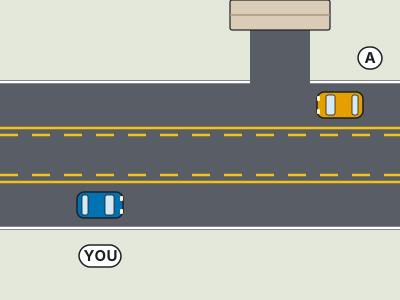
- As far as needed to reach the turn
- Up to one half mile
- No more than 150 feet
- No more than 500 feet
Show answer
No more than 150 feet. A center lane bordered by a solid yellow line and a broken yellow line on each side may be used by drivers traveling in either direction for making left turns, but they may not travel further than 150 feet in this lane. It is a turning lane, not a passing or merging lane. Enter it just before the turn and watch for opposing drivers using the same lane.
Study this in the handbook: Special lanes, painted curbs and parking
20. The plate under this curve sign shows 35 mph, and the posted limit is 55 mph. How fast should you take the curve?
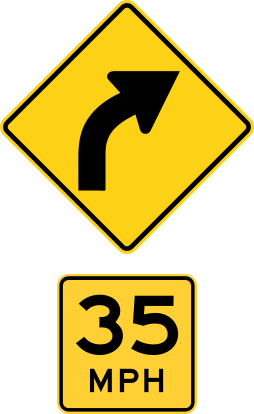
- Keep to 55, the legal limit
- Slow to 45, about halfway
- Slow to the 35 mph shown
- Speed up to hold traction
Show answer
Slow to the 35 mph shown. The Right Curve with Safe Speed Indicator sign means the road ahead curves right and you should slow down to the safe speed indicated. Here that is 35 MPH, even though the posted limit for the road is 55. The legal limit is set for the road in general, while the plate shows a safe speed for that curve. Slow down before you enter the curve, not in the middle of it, and keep a steady speed through the turn.
Study this in the handbook: Railroad crossings and work zones
Every question is written from the official Virginia Driver's Manual. Need paper? Printable VA practice test with answer key.
Last verified 2026-10-05. How we check every question · Study all 500 as flashcards
Frequently asked questions
How many questions are on this Virginia practice test?
This fixed set has 20 questions. It is test 13 of 25 from the 500 question Virginia bank. The real VA exam has a 10 question road sign section with 10 correct to pass, plus 30 knowledge questions with 24 correct to pass.
What is the passing score for the real Virginia test?
Part one: all ten road sign questions must be answered correctly; part two: you must correctly answer 24 of the 30 general knowledge questions That figure comes from the official Virginia source cited on the DMV facts page.
How does this fixed test relate to the full Virginia bank?
Each numbered test is a fixed set of questions in a fixed order, so you can retake the same test later and compare. Every test mixes road signs and the other topics in about the same proportion as the full bank. Tests 1 to 25 together cover every question in the Virginia bank once. The full practice page mixes the whole bank at random.
Last verified 2026-10-05. See the Virginia DMV facts page for sourced state details.
Return to the full Virginia practice test · Study road signs