
Test 12 of 25 · 20 questions · Free 2026
VA Permit Practice Test 12
Jump to the test ↓A fixed 20 question set from the Virginia bank with answers and plain English explanations. The real VA exam has a 10 question road sign section with 10 correct to pass, plus 30 knowledge questions with 24 correct to pass; take the full length version on the main practice page.
Question 1 of 20 · 0 right so far
All 20 questions in test 12
Every question below comes from the Virginia question bank on this page. Open a question to see the correct answer and the explanation. Nothing here is hidden behind a signup.
1. At a pedestrian hybrid beacon, which light pattern tells drivers they may go with caution if the crosswalk is clear?
- Both red lights glowing steadily
- The yellow light glowing steadily
- The two red lights flashing back and forth
- A single red light flashing alone
Show answer
The two red lights flashing back and forth. A pedestrian hybrid beacon goes through stages. A flashing yellow at the bottom shows a pedestrian has activated it, and a solid yellow tells drivers to prepare to stop. When both red lights turn solid, drivers must stop while the walk signal shows. Finally, while the walk signal counts down, the two red lights alternate flashing, which tells drivers they may proceed with caution if the crosswalk is now clear. Always check for anyone still crossing.
Study this in the handbook: Traffic signals and turns on red
2. An exit ramp sign shows an advisory speed of 25 mph. What does that number mean?
- The lowest speed allowed on the ramp
- The maximum safe speed for the exit
- The limit on the main road ahead
- The speed at which tolls are charged
Show answer
The maximum safe speed for the exit. An Advisory Speed sign indicates the maximum safe speed for a highway exit. Exit ramps often curve tightly, so the safe speed can be much lower than the speed you were going on the highway. Slow down on the deceleration lane and enter the ramp at or below the speed shown. It is not a minimum speed and does not describe the road ahead after the ramp. Watch for traffic backing up near the end of the ramp.
Study this in the handbook: Regulatory and warning signs
3. On a Virginia road with signals hung over each lane, a red X is lit above the lane you are in. What does it mean?
- Never drive in the lane under that signal
- The lane closes soon, so plan to merge later
- The lane is open only for drivers turning left
- The lane is for buses during rush hour only
Show answer
Never drive in the lane under that signal. Lane use signals show which lanes you may use at different hours of the day. A red X means you must never drive in that lane. Lane use signals can change during the day, so check them each time you drive the road. A yellow X is the signal that tells you to move out of a lane as soon as it is safe, and a green arrow means the lane is open. A lane marked only for left turns uses an arrow signal, not an X.
Study this in the handbook: Traffic signals and turns on red
4. What does the Virginia manual call the most common mistake drivers make when backing up?
- Failing to look both ways behind them
- Backing up too slowly for traffic
- Setting the parking brake before backing
- Using the turn signal while backing
Show answer
Failing to look both ways behind them. The manual names failing to look both ways behind the vehicle as the most common backing mistake. Mirrors do not give you a full view, so a child, a cyclist or a car crossing behind you can be missed. Turn your body and head to the right and look out through the rear window, back up slowly, and glance quickly to either side for pedestrians and approaching traffic. Backing slowly is the advice, not a mistake.
Study this in the handbook: Special lanes, painted curbs and parking
5. While waiting in a Virginia intersection to turn left, why should you keep your front wheels pointed straight ahead?
- It lets you turn faster once a gap opens
- It keeps your turn signal from canceling
- It shows others you might go straight
- A rear-end hit won't push you into oncoming lanes
Show answer
A rear-end hit won't push you into oncoming lanes. When you wait to turn left, keep the front wheels straight until you actually begin the turn. If a vehicle hits you from behind while your wheels are already turned, the impact can push you into oncoming traffic. With straight wheels, a rear impact moves you forward instead. The position has nothing to do with turning faster or with the signal. Signal early, look for pedestrians and oncoming traffic, and turn the wheel only when the way is clear.
Study this in the handbook: When you must stop, school buses and stopping distance
6. You are driving beside a tractor-trailer in Virginia. How can you tell you may be in the truck driver's blind spot?
- You can read the name on the trailer
- You can see the truck's turn signals
- You are well ahead of the truck's cab
- You can't see the driver's face in his mirror
Show answer
You can't see the driver's face in his mirror. Trucks, tractor-trailers, buses and RVs have big No-Zones on both sides that are much larger than a car's blind spots. The manual gives a simple test: if you cannot see the driver's face in the side view mirror, the driver cannot see you. Reading the trailer or seeing its signals does not mean the driver sees you. Do not linger beside a large vehicle. Pass steadily or drop back until the driver's face shows in the mirror.
Study this in the handbook: Bicycles, motorcycles, trucks and other road users
7. After you signal, stop and yield for a legal U-turn in Virginia, which lane should you turn into once the way is clear?
- The outside lane going the other way
- The inside lane, next to the center line
- Any open lane going the other way
- The left-turn lane on the far side
Show answer
The outside lane going the other way. U-turns are allowed only where signs do not forbid them, and in business districts, cities and towns only at intersections. To make one, turn on your left-turn signal, stop, and yield for approaching traffic. When the way is clear, proceed into the outside, or right-hand, lane traveling in the opposite direction. Before turning, check for No U-Turn or No Left Turn signs. Never make a U-turn on a highway.
Study this in the handbook: When you must stop, school buses and stopping distance
8. What does Virginia law say about alcohol for people under age 21?
- They may hold it if it stays sealed
- They may drink it at home with family
- They may have it if a parent agrees
- They may not buy, possess or drink it
Show answer
They may not buy, possess or drink it. Virginia has a zero tolerance law against underage drinking. The manual states that if you are under age 21, you cannot purchase, possess or consume alcohol. Holding a closed container still counts as possession. A driver under 21 with a BAC of at least .02 can be convicted of illegal consumption, and a BAC of .08 or higher can bring adult DUI penalties. A parent's permission or a home setting is not an exception listed in the manual.
Study this in the handbook: Suspensions, revocations and demerit points
9. A deer jumps out so close that you cannot avoid it. Should you swerve into the next lane to miss it?
- Yes, swerving is always the safest move
- Yes, if no car is visible in that lane
- No; brake firmly and stay in your lane
- No; speed up so it bounces off quickly
Show answer
No; brake firmly and stay in your lane. If a collision with a deer or other animal is unavoidable, the manual says do not swerve. Brake firmly, stay in your lane, and come to a controlled stop. Swerving is exactly what the manual tells you not to do. Speeding up increases the force of the impact. If you do hit a large animal, report it to law enforcement. Be most alert at dusk and dawn, especially in the fall.
Study this in the handbook: Alcohol, drugs and DUI
10. The main signal is red, but a green arrow pointing right lights up beside it. The way is clear. What may you do?
- Wait for the main light to turn green
- Go straight through on the green arrow
- Turn right in the direction of the arrow
- Turn left, since a green signal is showing
Show answer
Turn right in the direction of the arrow. At a green arrow, you may go in the direction of the arrow if the way is clear. A right green arrow lets you turn right even while the main light shows red. It does not permit going straight or turning left; those moves follow the main signal. Check for pedestrians and less visible vehicles such as bicycles and mopeds before turning, and complete the turn into the proper lane.
Study this in the handbook: Traffic signals and turns on red
11. In a Virginia work zone, a highway worker in an orange vest holds a red flag out over your lane. What does that mean?
- Stop and wait until the flagger lets you go
- Slow down and keep moving past the worker
- Change lanes and pass the worker carefully
- Tap your horn so the worker knows you are near
Show answer
Stop and wait until the flagger lets you go. Flaggers are highway workers who usually wear orange or yellow vests, or yellow-green shirts or jackets. They use STOP/SLOW paddles or red flags to stop or direct traffic through the work zone and to let workers or construction vehicles cross the road. A red flag held over your lane means stop. Stay stopped until the flagger signals you to move. Driving past or around a flagger can put workers and oncoming traffic in danger.
Study this in the handbook: Railroad crossings and work zones
12. A train has just cleared a Virginia crossing, but the crossing lights are still flashing. When may you drive across?
- Once the tracks are clear and the lights stop
- As soon as the last train car passes you
- When the driver beside you starts to go
- After waiting about thirty seconds
Show answer
Once the tracks are clear and the lights stop. At a crossing with flashing lights, stop when the lights begin to flash. Do not go until all trains or other rail vehicles have passed, the tracks are clear, and the lights are no longer flashing. Lights that keep flashing after one train goes by can mean a second train is coming, possibly from the opposite direction on another track. Following another driver or counting a set number of seconds is not the rule. Wait for the lights to go dark.
Study this in the handbook: Railroad crossings and work zones
13. At a triangular sign, how should you approach the intersection?
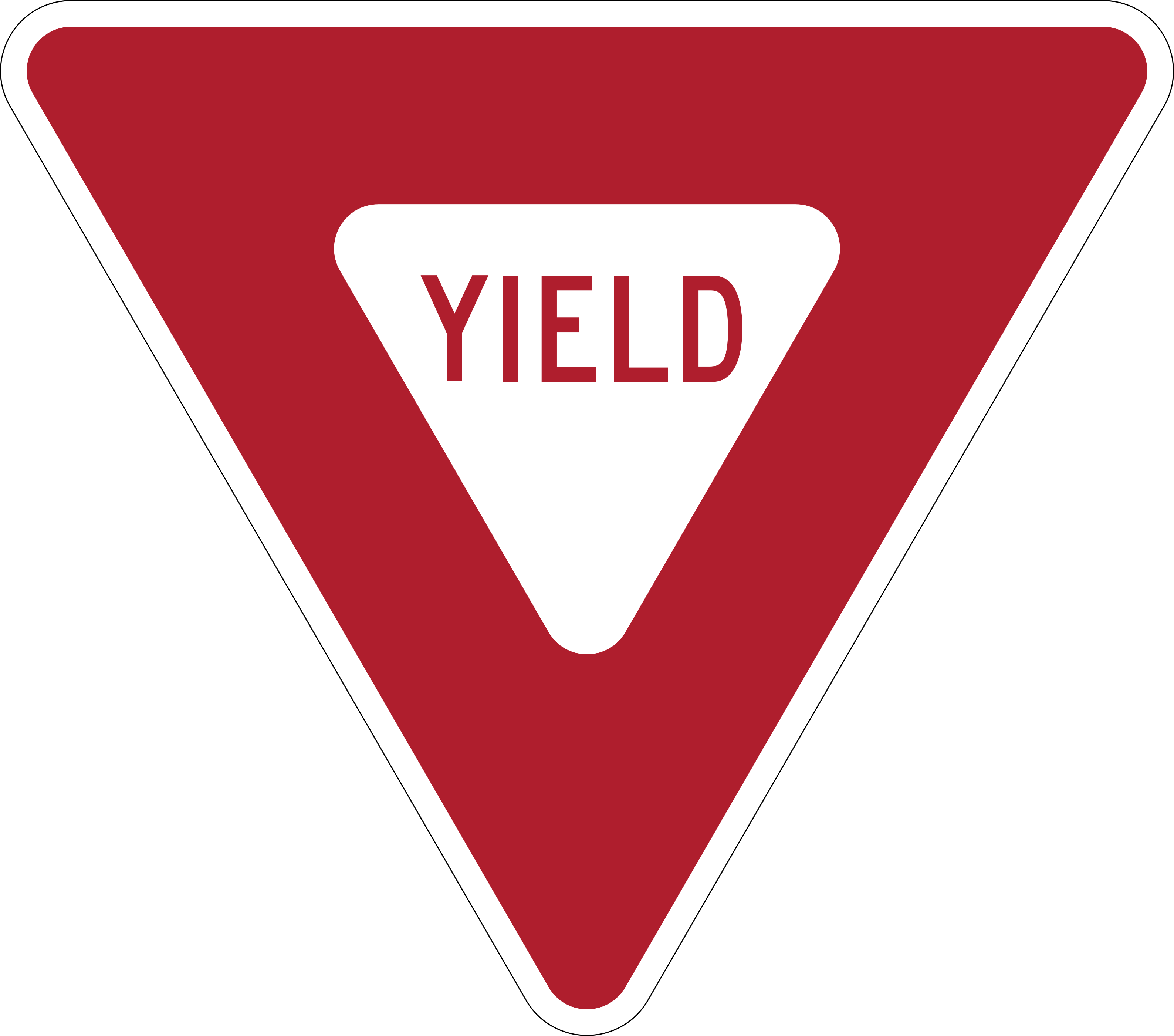
- Accelerate to claim the intersection first
- Slow down, prepare to stop, and let traffic, pedestrians, or bicyclists pass
- Stop in every case before reaching the sign
- Proceed without checking if your lane is clear
Show answer
Slow down, prepare to stop, and let traffic, pedestrians, or bicyclists pass. The inverted triangle identifies a yield instruction. Virginia expects a driver to reduce speed on approach, remain ready to stop, and allow vehicles, pedestrians, or bicyclists to pass safely before proceeding. A complete stop is not automatically required when the way is open, which makes the always-stop option too broad. Treat the triangle as a request for caution and a right-of-way check, not as permission to roll through without looking.
Study this in the handbook: Sign colors and shapes
14. You have stopped for a pedestrian lawfully crossing in front of your car on a Virginia street. When may you start moving again?
- As soon as the person clears your bumper
- After the pedestrian has passed your lane
- When a driver behind you starts honking
- Once the person reaches the center line
Show answer
After the pedestrian has passed your lane. Drivers must come to a full stop for pedestrians lawfully crossing a roadway, and the manual says to stop and remain stopped until pedestrians have passed the lane in which your vehicle is stopped. Moving while the person is still in your lane, or just because a driver behind you is impatient, can cause a serious injury. People on foot are especially likely to be badly hurt if struck. Failing to stop and causing serious injury or death can be a Class 1 misdemeanor.
Study this in the handbook: Right of way, pedestrians and roundabouts
15. At an unmarked corner, a person with a guide dog steps to the curb to cross in front of your car. What must you do?
- Slow down and drive around them
- Tap the horn so they know you are there
- Come to a full stop for the person
- Wave them across but keep rolling
Show answer
Come to a full stop for the person. Virginia requires drivers to come to a full stop for a pedestrian using a cane or guide dog, because it shows the person is blind or has a vision impairment. The rule does not depend on a marked crosswalk; drivers must also yield to pedestrians at unmarked intersections. Remember that people with disabilities may move slowly. Stay stopped until the person has fully crossed your lane, and do not use the horn to hurry them.
Study this in the handbook: Right of way, pedestrians and roundabouts
16. An aggressive driver is weaving and shouting near you on a Virginia highway. What should you do?
- Speed up to get away from the driver
- Brake to slow the driver down behind you
- Gesture back so the other driver knows you saw
- Stay out of the way and avoid eye contact
Show answer
Stay out of the way and avoid eye contact. The manual's advice is to protect yourself. If you see an aggressive driver, stay out of the way. Do not challenge the driver by speeding up or trying to out-maneuver him, and avoid eye contact while ignoring gestures and shouting. Racing away, braking in front of the driver or responding with gestures can turn a tense moment into a crash or a confrontation. Let the driver go by, and keep a safe distance.
Study this in the handbook: Headlights, night, fog, rain and snow
17. What does a curb painted yellow generally mean in Virginia?
- Stop only to pick up or drop off passengers
- Stop only long enough to load or unload, and stay with your car
- Do not stop, stand or park at any time
- Parking is allowed for up to two hours
Show answer
Stop only long enough to load or unload, and stay with your car. A painted curb means special parking rules apply, and the manual tells drivers to check with the locality for exact meanings. Generally, yellow means you may stop only long enough to load or unload, and you must stay with your car. White is the color for stopping briefly to pick up or drop off passengers. Red means do not stop, stand or park. The manual also lists curbs painted yellow among places where parking is prohibited.
Study this in the handbook: Special lanes, painted curbs and parking
18. You are in the through lane when you pass this yellow diamond Merge sign, and traffic from the side lane will join yours. Who is responsible for merging safely?

- Only the drivers in the joining lane
- Only the drivers in your through lane
- Drivers in both lanes
- Whichever driver is going faster
Show answer
Drivers in both lanes. The Merge sign means two lanes of traffic moving in the same direction are about to become one. The manual says drivers in both lanes are responsible for merging safely. If you are in the through lane, watch the merging traffic, keep a steady speed or adjust slightly so others can fit in, and avoid speeding up to block them. Merging drivers must also find a safe gap. Shared care keeps both lanes moving without sudden braking.
Study this in the handbook: Regulatory and warning signs
19. Why is driving past a Do Not Enter or Wrong Way sign so dangerous?
- You will leave the area covered by GPS
- You could crash head-on with oncoming cars
- You will end up on a toll road with no exit
- You may block a lane used by buses
Show answer
You could crash head-on with oncoming cars. Do Not Enter and Wrong Way signs mean you cannot drive in that direction. The manual warns that if you drive past them, you are going the wrong way and could get into a head-on crash with vehicles headed your way. Wrong-way arrows on the pavement carry the same warning. If you find yourself past one of these signs, immediately slow down, pull over and cautiously turn around.
Study this in the handbook: Sign colors and shapes
20. Your light is red. There is no stop line, but a crosswalk is painted across your lane. Where should you stop?
- In the crosswalk, at its far edge
- Past the crosswalk, at the corner
- Even with the traffic signal pole
- Before you reach the crosswalk
Show answer
Before you reach the crosswalk. At a red light, come to a complete stop at the stop line. If there is no stop line, stop before entering the intersection or before reaching the crosswalk. Stopping in the crosswalk blocks people who are crossing on their walk signal, and pulling past it puts your car in their path and closer to cross traffic. The signal pole is not the guide. Remain stopped as long as the signal is red, unless a turn on red is allowed.
Study this in the handbook: Traffic signals and turns on red
Every question is written from the official Virginia Driver's Manual. Need paper? Printable VA practice test with answer key.
Last verified 2026-10-05. How we check every question · Study all 500 as flashcards
Frequently asked questions
How many questions are on this Virginia practice test?
This fixed set has 20 questions. It is test 12 of 25 from the 500 question Virginia bank. The real VA exam has a 10 question road sign section with 10 correct to pass, plus 30 knowledge questions with 24 correct to pass.
What is the passing score for the real Virginia test?
Part one: all ten road sign questions must be answered correctly; part two: you must correctly answer 24 of the 30 general knowledge questions That figure comes from the official Virginia source cited on the DMV facts page.
How does this fixed test relate to the full Virginia bank?
Each numbered test is a fixed set of questions in a fixed order, so you can retake the same test later and compare. Every test mixes road signs and the other topics in about the same proportion as the full bank. Tests 1 to 25 together cover every question in the Virginia bank once. The full practice page mixes the whole bank at random.
Last verified 2026-10-05. See the Virginia DMV facts page for sourced state details.
Return to the full Virginia practice test · Study road signs