
Test 6 of 10 · 20 questions · Free 2026
VA Permit Practice Test 6
Jump to the test ↓A fixed 20 question set from the Virginia bank with answers and plain English explanations. The real VA exam has a 10 question road sign section with 10 correct to pass, plus 30 knowledge questions with 24 correct to pass; take the full length version on the main practice page.
Question 1 of 20 · 0 right so far
All 20 questions in test 6
Every question below comes from the Virginia question bank on this page. Open a question to see the correct answer and the explanation. Nothing here is hidden behind a signup.
1. After the first impoundment, how much longer can a Virginia court impound the car of a driver convicted of driving on an alcohol-related suspension?
- An additional 10 days
- An additional 30 days
- An additional two years
- An additional 90 days
Show answer
An additional 90 days. The first 30 days of impoundment are immediate, and the court can add another 90 days if the driver is convicted. Thirty days is the immediate period, so repeating it as the court's addition confuses the two steps. Ten days and two years are not listed for this offense. The total exposure is therefore up to 120 days without the vehicle, counting the immediate period and the court's addition together.
Study this in the handbook: Suspensions, revocations and demerit points
2. An applicant fails the Virginia road skills test at DMV. How long must the person wait to take it again?
- One day
- Two days
- 15 days
- 30 days
Show answer
Two days. After failing the road skills test, the applicant must wait two days before trying again. The 15 day wait applies to applicants under 18 who fail the knowledge exam, a different test. One day falls short of the stated two day wait, and the road test may be taken only once per business day as well. Thirty days is not the retest wait the manual gives for the road skills test. After three road test failures at DMV, the applicant must complete the in-vehicle part of driver education first.
Study this in the handbook: The knowledge exam, road skills test and vision screening
3. How many demerit points can Virginia DMV assign to a single conviction?
- One, two or three
- Five, ten or fifteen
- Three, four or six
- Two, eight or twelve
Show answer
Three, four or six. Virginia assigns three, four or six demerit points per conviction, and tracks them over rolling 12 month and 24 month periods. The one to three, five to fifteen and two to twelve sets are not Virginia values. Knowing the values helps with the thresholds: 12 points in 12 months or 18 in 24 months triggers a driver improvement clinic for drivers 18 and older, and higher totals bring stronger action.
Study this in the handbook: Suspensions, revocations and demerit points
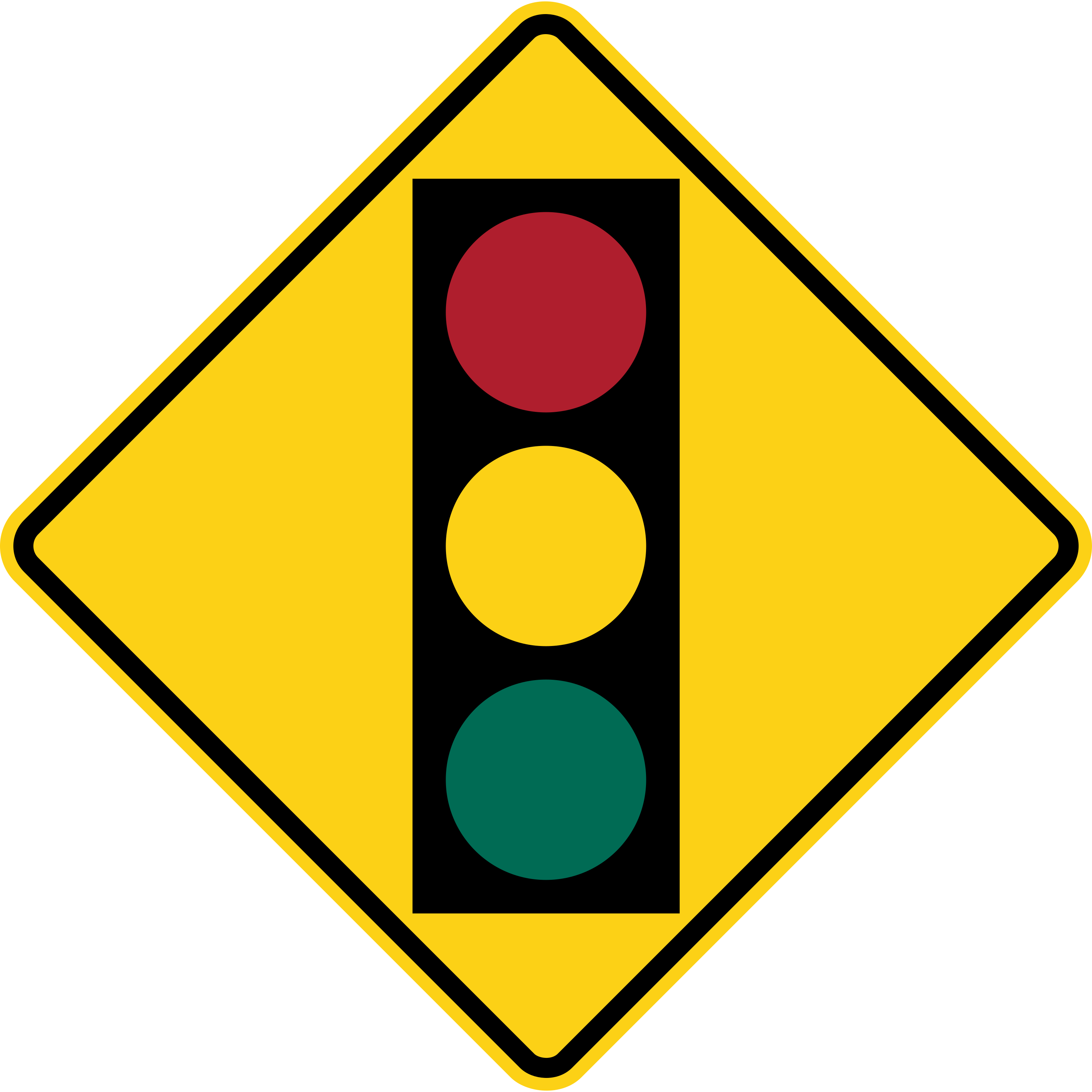
4. What does a Signal Ahead warning sign indicate?
- A signal is behind you and can be ignored
- The next signal is permanently out of service
- Only emergency vehicles may enter the intersection
- Traffic signals are ahead, so slow and be ready to stop
Show answer
Traffic signals are ahead, so slow and be ready to stop. Signal Ahead is advance notice that traffic lights are coming. The manual pairs that notice with slowing down and readiness to stop, which helps a driver manage an intersection that may be hidden by distance, a curve, or changing traffic. It does not say the signal is broken or restricted to emergency vehicles. Let the sign change your approach early, then obey the actual light when it comes into view.
Study this in the handbook: Regulatory and warning signs
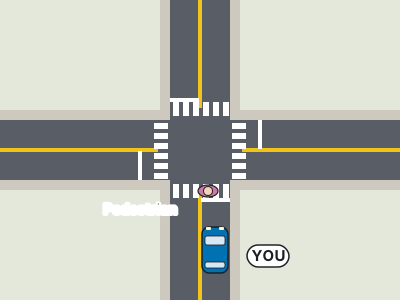
5. What must a driver do for a pedestrian lawfully crossing a roadway?
- Slow slightly and pass before the pedestrian reaches the lane
- Honk so the pedestrian moves faster
- Come to a full stop and remain stopped until the pedestrian has cleared the lane
- Stop only if the pedestrian is using a cane
Show answer
Come to a full stop and remain stopped until the pedestrian has cleared the lane. A driver must come to a full stop for pedestrians who are lawfully crossing a roadway. The vehicle stays stopped until the pedestrian has passed the lane in which the vehicle is stopped. Slowing without stopping leaves the person exposed, and a horn does not replace the required protection. The cane choice is too narrow because the full stop rule applies to lawful roadway crossings generally. Scan ahead before turning or proceeding, and wait until the pedestrian has safely cleared your lane before moving again.
Study this in the handbook: Right of way, pedestrians and roundabouts
6. What must a Virginia driver carry whenever operating a vehicle?
- A valid driver's license or learner's permit
- A current passport instead of a license
- A vehicle title and insurance card only
- A copy of the most recent inspection receipt
Show answer
A valid driver's license or learner's permit. Virginia requires the driver to carry a valid driver's license or learner's permit whenever driving. A title proves ownership, and an insurance card documents coverage, but neither document grants driving authority by itself. A passport is not a substitute for the license or permit the manual requires behind the wheel. The inspection receipt concerns the vehicle's condition rather than the operator's permission to drive. The manual adds that any misuse of a driver's license or learner's permit is illegal and can bring a fine, jail or a license suspension.
Study this in the handbook: Learner's permit, license and vehicle paperwork
7. In which vehicles must Virginia children under 8 ride in a child safety seat or booster?
- Vehicles manufactured after January 1, 1968
- Only vehicles with rear seats
- Only vehicles built after 2000
- All vehicles including antiques
Show answer
Vehicles manufactured after January 1, 1968. All children under age 8 must be properly secured in a child safety seat or booster seat when riding in vehicles manufactured after January 1, 1968. Children should ride rear facing from birth to age 2 or as long as the seat maker allows, and a rear facing seat may go in front only if there is no back seat and no active passenger air bag. A first violation costs $50, and a later one up to $500.
Study this in the handbook: Seat belts, air bags and child safety seats
8. What is the fine for using a handheld communications device in a Virginia highway work zone?
- $50
- $250
- $1,000
- A warning only
Show answer
$250. If you are convicted of using a handheld communications device in a highway work zone, you will be fined $250. Work zone speeding can bring a fine up to $500, and orange marks a work zone and means slow down and stay alert. Workers, lane shifts and barricades leave little margin for a driver looking at a phone instead of the road.
Study this in the handbook: Railroad crossings and work zones
9. Where does the Virginia manual say children ages 12 and under are safest?
- Buckled up in the back seat
- On a parent's lap
- In the front seat with the belt behind them
- In the front seat with the air bag on
Show answer
Buckled up in the back seat. Children ages 12 and under are safer buckled up in the back seat. That advice sits in the manual's air bag list, next to buckling up every occupant, moving your seat back at least ten inches from the steering wheel, and tilting an adjustable wheel downward so the bag points toward your chest. Information about air bag on off switches is available from the National Highway Traffic Safety Administration.
Study this in the handbook: Seat belts, air bags and child safety seats
10. If a collision with a deer is unavoidable, what does the manual advise?
- Swerve into oncoming traffic to miss the animal
- Brake firmly, stay in your lane, and make a controlled stop
- Accelerate so the animal has less time in the roadway
- Leave your lane and drive onto the shoulder immediately
Show answer
Brake firmly, stay in your lane, and make a controlled stop. When an animal cannot be avoided, the safest response is firm braking while keeping the vehicle in its lane and bringing it to a controlled stop. The swerving choices can create a more serious collision with oncoming traffic, a ditch, or another vehicle. Drivers should also slow down when they see a large animal because deer often travel in groups. At dusk and dawn, scan the roadside, use the horn when appropriate, and expect another animal nearby.
Study this in the handbook: Alcohol, drugs and DUI
11. When may a Virginia driver travel below the posted speed limit?
- Never, because the posted number is mandatory minimum speed
- Only when following a police vehicle
- Only on unpaved roads
- When doing so does not impede the normal movement of traffic
Show answer
When doing so does not impede the normal movement of traffic. Virginia permits a driver to go slower than the speed limit as long as the slower pace does not impede normal traffic movement. The posted number is a maximum, not a required minimum. This does not create a special exception only for police-following or unpaved roads. Slow for rain, congestion, curves, or another hazard, while remaining attentive to traffic behind you and avoiding an unnecessary obstruction.
Study this in the handbook: Speed limits and reckless driving
12. When must you stop for a school bus even if its warning signals are not on?
- Only when children are crossing in front of the bus
- Only when the bus has an extended stop sign
- When the bus is loading or unloading passengers
- Never, unless the red lights are flashing
Show answer
When the bus is loading or unloading passengers. Virginia also requires a stop when a school bus is loading or unloading passengers, even if its warning signals are not operating. Waiting for flashing red lights misses the separate condition stated in the manual. The presence of visible children is not the threshold, because passengers may be entering or leaving outside your immediate view. Treat a bus serving passengers as a stop situation, watch for people near the roadway, and remain stopped until the movement around the bus is safe.
Study this in the handbook: Speed limits and reckless driving
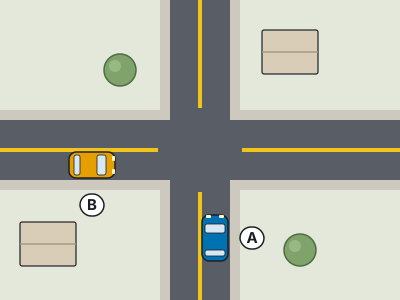
13. Two vehicles arrive at an uncontrolled intersection at the same time. Who should go first?
- The vehicle traveling faster
- The driver on the left
- The vehicle on the wider road
- The driver on the right
Show answer
The driver on the right. At an intersection without signs or signals, simultaneous arrival creates a right-of-way rule rather than a race. The driver on the left must allow the driver on the right to go first. The wider-road choice is not the rule, and speed does not create priority. Slow before entering, look for vehicles, pedestrians, and bicyclists, and be ready for a driver who may not recognize the same order. Yielding here prevents two vehicles from entering the conflict point together.
Study this in the handbook: Special lanes, painted curbs and parking
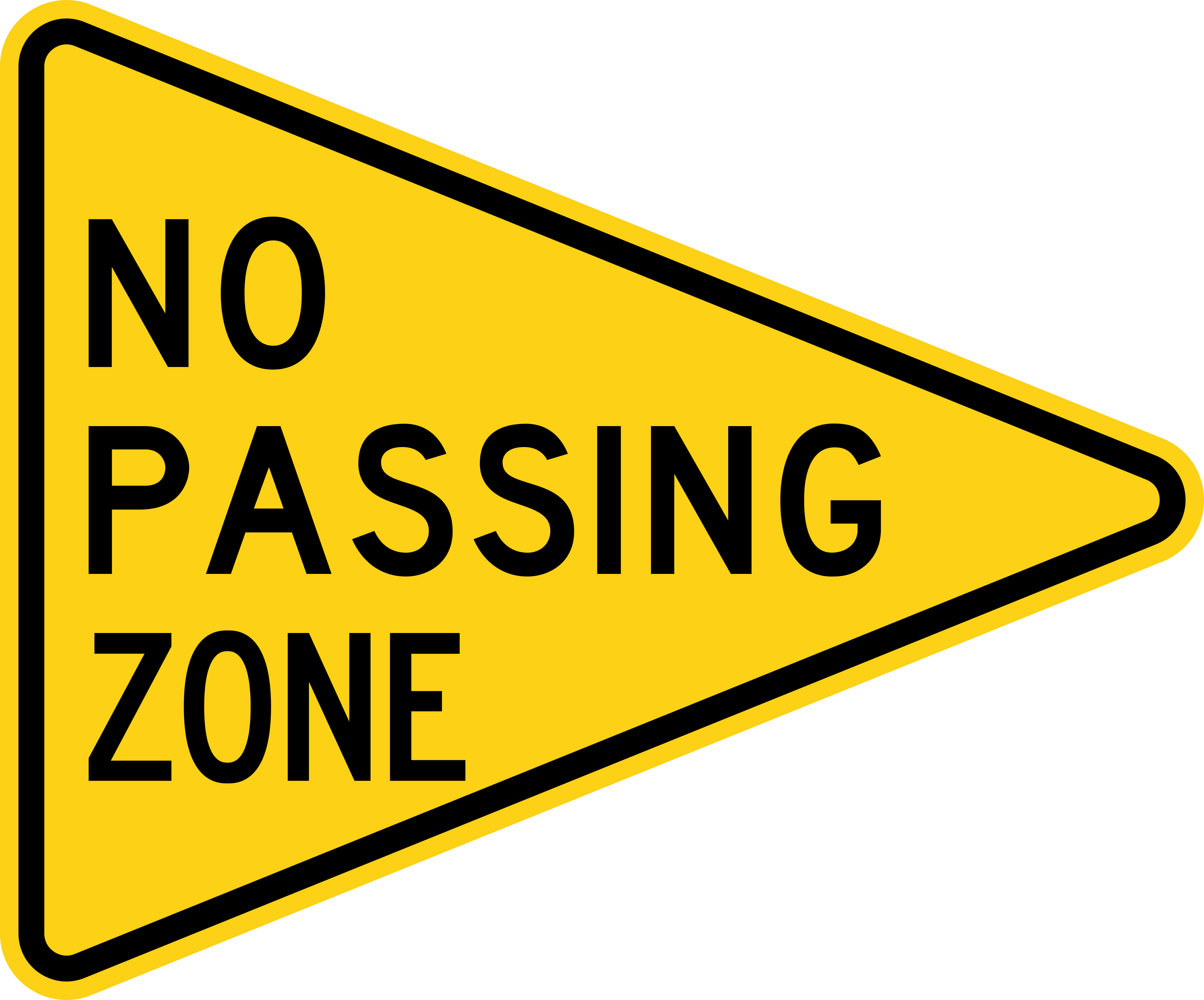
14. What does the pennant-shaped No Passing Zone sign identify?
- A place where passing is required
- The beginning of a no passing zone
- The end of every roadway restriction
- A lane reserved for emergency vehicles
Show answer
The beginning of a no passing zone. The yellow pennant is the No Passing Zone warning sign, and it marks the beginning of a no passing zone. A driver may not pass cars ahead in the same lane there, even when the way is clear. The answer that passing is required reverses the rule: the sign never orders a driver to pass. Calling it the end of every restriction wrongly treats the sign as an ending marker, while the emergency lane answer invents a special lane use. Treat the pennant as a cue that you must stay behind slower traffic in your lane.
Study this in the handbook: Regulatory and warning signs
15. What minimum following distance does the Virginia manual give for an emergency vehicle with flashing lights?
- 500 feet
- 200 feet
- 1,000 feet
- 100 feet
Show answer
500 feet. When an emergency vehicle's lights are flashing, Virginia says never to follow it closer than 500 feet. The 200 foot figure appears elsewhere in the manual for low beam use behind another vehicle, not for pursuing an emergency response. One hundred feet leaves too little separation, while 1,000 feet doubles the stated minimum without being required. Leave a substantial cushion and remember that the rule applies to following in the same direction, not just to passing a stopped vehicle.
Study this in the handbook: Special lanes, painted curbs and parking
16. What is the general purpose of a green and white Virginia traffic sign?
- Helpful destination information for people traveling the road
- A motorist service location such as fuel or lodging
- A construction zone requiring a temporary lane shift
- A warning about a curve or slippery pavement
Show answer
Helpful destination information for people traveling the road. Green and white signs provide helpful destination information, such as where a route or place can be found. The motorist service choice belongs with blue and white signs, which identify services rather than destinations. A temporary lane shift is a work-zone matter, and a curve or slippery pavement is a hazard warning. Do not use the color alone to decide your turn: read the destination wording and confirm the route, exit, or distance shown. A practical cue is to associate green with getting somewhere, while the other color categories handle services, construction, or changing road conditions.
Study this in the handbook: Traffic signals and turns on red
17. For a driver age 21 or older operating a noncommercial vehicle in Virginia, what is the lowest BAC covered by the general alcohol per se threshold?
- 0.02 percent or higher
- 0.05 percent or higher
- 0.10 percent or higher
- 0.08 percent or higher
Show answer
0.08 percent or higher. Virginia treats a driver who is at least 21 as driving under the influence when BAC reaches .08 percent. A reading of .02 percent belongs to the separate under-21 alcohol rule, while .05 percent is not the adult threshold stated here. A .10 percent reading is above the threshold, but it is not the minimum that triggers the rule. Focus on age first, then match the adult BAC figure. Actual impairment can also support a DUI conviction at a lower BAC.
Study this in the handbook: Alcohol, drugs and DUI
18. When a broken yellow line is beside a solid yellow line, from which side is passing allowed?
- From the side with the solid line
- From the side with the broken line
- From both sides at all times
- From neither side, even for a left turn
Show answer
From the side with the broken line. The paired center marking assigns different passing rules to the two directions. Passing is allowed from the side next to the broken yellow line, while the side next to the solid yellow line may not pass. This is not a blanket permission: the driver still needs a clear opposite lane and a safe opportunity. The solid-line driver cannot borrow the broken-line rule simply because the other direction is permitted to pass. Look down at the line nearest your lane before deciding, then check traffic, visibility, and distance before moving left.
Study this in the handbook: Pavement markings
19. What does a steady yellow traffic light warn a driver about?
- The intersection is closed to all traffic
- The signal grants an unrestricted right of way
- The light is about to change
- The driver must accelerate before red appears
Show answer
The light is about to change. A steady yellow light or arrow is a caution warning that the signal is about to change. If you have not entered the intersection, stop when it is safe; if stopping would be unsafe, proceed through cautiously. A driver already in the intersection should clear it carefully. Accelerating to beat the light is specifically contrary to the manual's advice and can turn a changing signal into a conflict. The yellow display is therefore a transition cue: check your stopping distance, avoid sudden unsafe braking, and never use extra speed to extend the green phase.
Study this in the handbook: Traffic signals and turns on red
20. What should you do when a winding road warning shows a series of curves ahead?
- Accelerate before each curve
- Keep the same speed until the last curve
- Use the posted speed only after the winding section
- Slow down for better control
Show answer
Slow down for better control. A winding road warning identifies a series of turns or curves ahead, so Virginia advises slowing down for better control on all curves. Holding speed through the entire sequence can make steering and lane position harder to manage, while acceleration reduces the time available to react to the next bend. The sign is a cue to anticipate repeated changes, not an instruction to wait until the final curve. Scan beyond the first turn, ease off the accelerator before entering, and keep a steady path that leaves room for unexpected traffic or roadway conditions.
Study this in the handbook: Railroad crossings and work zones
QualitySpace is expanding to Virginia
We are a California-based independent insurance brokerage working on licensing in more states. We cannot help with Virginia insurance yet. Leave your email and we will let you know when we can.
Every question is written from the official Virginia Driver's Manual. Need paper? Printable VA practice test with answer key.
Last verified 2026-10-05. How we check every question · Study all 206 as flashcards
Frequently asked questions
How many questions are on this Virginia practice test?
This fixed set has 20 questions. It is test 6 of 10 from the 206 question Virginia bank. The real VA exam has a 10 question road sign section with 10 correct to pass, plus 30 knowledge questions with 24 correct to pass.
What is the passing score for the real Virginia test?
Part one: all ten road sign questions must be answered correctly; part two: you must correctly answer 24 of the 30 general knowledge questions That figure comes from the official Virginia source cited on the DMV facts page.
How does this fixed test relate to the full Virginia bank?
Each numbered test is a fixed set of questions in a fixed order, so you can retake the same test later and compare. Every test mixes road signs and the other topics in about the same proportion as the full bank. Tests 1 to 10 together cover 200 of the 206 questions in the Virginia bank, each once. The full practice page mixes the whole bank at random.
Last verified 2026-10-05. See the Virginia DMV facts page for sourced state details.
Return to the full Virginia practice test · Study road signs