
Test 3 of 10 · 20 questions · Free 2026
VA Permit Practice Test 3
Jump to the test ↓A fixed 20 question set from the Virginia bank with answers and plain English explanations. The real VA exam has a 10 question road sign section with 10 correct to pass, plus 30 knowledge questions with 24 correct to pass; take the full length version on the main practice page.
Question 1 of 20 · 0 right so far
All 20 questions in test 3
Every question below comes from the Virginia question bank on this page. Open a question to see the correct answer and the explanation. Nothing here is hidden behind a signup.
1. What vision does Virginia require for an unrestricted driver's license?
- 20/40 or better in one or both eyes, with 110 degrees or better horizontal vision
- 20/20 in both eyes
- 20/70 with 70 degrees of horizontal vision
- Any vision with glasses
Show answer
20/40 or better in one or both eyes, with 110 degrees or better horizontal vision. Virginia's unrestricted license standard is 20/40 or better vision in one or both eyes and 110 degrees or better horizontal vision in one or both eyes, or a comparable measurement showing a field of vision within that range. A driver who can reach only 20/70 with 70 degrees may be restricted to daylight hours. If you need glasses or contacts to pass the screening, you must wear them when you drive.
Study this in the handbook: The knowledge exam, road skills test and vision screening
2. At least how far above the posted speed limit may support a Virginia reckless-driving charge based on speed?
- 10 MPH
- 15 MPH
- 20 MPH
- 5 MPH
Show answer
20 MPH. Virginia identifies 20 miles per hour above the posted limit as one speed based threshold for a possible reckless-driving charge. The phrase at least includes an excess of exactly 20 MPH, not just amounts greater than 20. A 10, 15, or 5 MPH increase falls below that particular threshold, although unsafe driving can still create other legal problems. Compare the vehicle speed with the limit shown for that road, especially where a lower temporary limit applies. A useful check is to subtract the posted number from the speedometer reading before deciding whether the gap has reached 20.
Study this in the handbook: Speed limits and reckless driving
3. What is prohibited when a funeral procession is traveling through Virginia?
- Yielding to the procession at an intersection
- Waiting until the procession has passed
- Allowing the lead vehicle to obey traffic signals
- Cutting through, joining, or interfering with the procession
Show answer
Cutting through, joining, or interfering with the procession. Virginia requires drivers to yield to funeral processions and separately prohibits cutting through them, joining them, or interfering with their movement. Yielding, waiting for the group to clear, and recognizing the lead vehicle’s duty to obey signs and signals are compatible with the rule. Joining may seem harmless when the procession travels in your direction, but it is expressly included among the prohibited actions. Stay outside the line of vehicles, avoid attempting to cross between them, and continue only after the procession has passed or a safe route is available.
Study this in the handbook: Special lanes, painted curbs and parking
4. What response is appropriate at a Pedestrian Crossing warning sign?

- Maintain speed because pedestrians must wait
- Honk so people leave the crosswalk
- Slow down and be prepared to stop
- Move onto the shoulder to pass walkers
Show answer
Slow down and be prepared to stop. A pedestrian crossing warning means people may be entering a crosswalk or crossing the vehicle’s path. Virginia directs drivers to slow down and be prepared to stop, with an additional arrow sign possibly marking the precise location. Pedestrians do not lose the hazard simply because they are expected to wait, and the shoulder is not a passing lane. Use the walking-person symbol to begin scanning for people, bicycles, and other devices.
Study this in the handbook: Regulatory and warning signs
5. What should you do when a Keep Right sign marks an obstruction ahead?
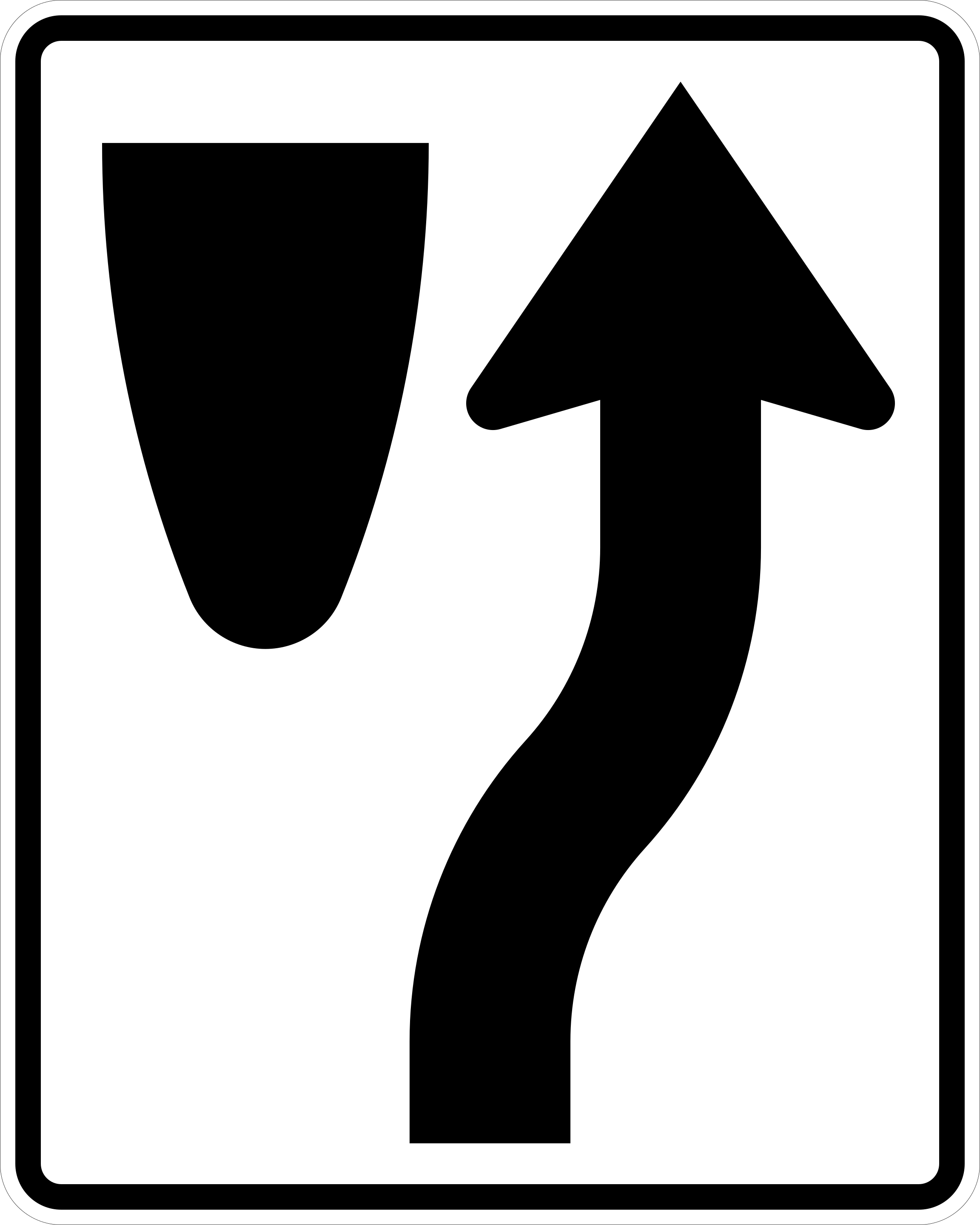
- Stop and wait for the obstruction to move
- Pass on the side shown by the arrow
- Drive left of the barrier if no traffic is visible
- Treat the arrow as a suggested passing lane
Show answer
Pass on the side shown by the arrow. Keep Right is used where a traffic island, median, or barrier lies ahead. The arrow identifies the side on which the driver must continue, so passing left merely because the roadway looks open is unsafe and contrary to the sign. The instruction is not a suggestion to use a preferred passing lane. Spot the obstruction early, position the vehicle on the indicated side, and maintain control through the narrowed path.
Study this in the handbook: Sign colors and shapes
6. Until what age does the Virginia manual say children should ride rear facing?
- Until age 1
- Until age 4
- Until age 8
- From birth to 2 years, or as long as the seat maker allows
Show answer
From birth to 2 years, or as long as the seat maker allows. Children should ride rear facing from birth to 2 years, or as long as the safety seat manufacturer allows. After that they ride facing forward in a child safety seat or booster seat until at least age 8, or until a seat belt fits properly. Age 8 is the booster threshold, not the rear facing one. A rear facing seat may go in the front only if there is no back seat and the passenger air bag is absent or turned off.
Study this in the handbook: Seat belts, air bags and child safety seats
7. A Virginia driver with a prior conviction for driving without a license is caught driving unlicensed again. How long does the vehicle stay impounded?
- For 30 days no matter what
- Until the driver gets a license or for three days, whichever is less
- Until the driver pays a $500 fee
- For 90 days after conviction
Show answer
Until the driver gets a license or for three days, whichever is less. When someone drives without a license after a prior conviction for the same thing, police impound the vehicle until the person gets a license or for three days, whichever is less. Thirty days and the added 90 days belong to driving on an alcohol-related suspension, a different offense. A $500 fee is not how this impoundment ends. Getting licensed within the three days releases the vehicle sooner.
Study this in the handbook: Suspensions, revocations and demerit points
8. At a flashing yellow arrow, when may you turn in the arrow's direction?
- When the way is clear after yielding to opposing traffic and pedestrians
- Only after waiting for a steady green arrow
- Only if no vehicle is behind you
- Immediately, because the arrow gives absolute priority
Show answer
When the way is clear after yielding to opposing traffic and pedestrians. A flashing yellow arrow permits a turn in its direction only when the way is clear. The turning driver must yield to vehicles coming from the other direction and to pedestrians in the intersection. The arrow does not grant absolute priority, require a steady green, or depend on whether another vehicle follows behind. Before moving, scan for motorcycles, bicycles, mopeds, and people in the crosswalk. Let a pedestrian finish crossing before turning, even if the signal has changed.
Study this in the handbook: Traffic signals and turns on red
9. If your vehicle veers off the road, what should you do to regain the roadway safely?
- Brake hard and turn sharply back onto the road
- Accelerate onto the shoulder until the vehicle straightens
- Turn toward the ditch to keep the tires from sliding
- Gradually reduce speed, look where you want to go, and steer slowly back
Show answer
Gradually reduce speed, look where you want to go, and steer slowly back. A driver who leaves the roadway should stay calm, ease the vehicle down in speed, focus on the intended path, and make a gentle steering correction. The choice calling for hard braking and a sharp turn is risky because an abrupt movement can create another loss of control. The manual connects over-correction with a rear-wheel slide and emphasizes gradual steering. A useful cue is to reduce speed first, then guide the vehicle back when the tires and traffic conditions allow it.
Study this in the handbook: When you must stop, school buses and stopping distance
10. At a Merge warning sign, what traffic pattern should you expect?

- Opposing traffic will cross your lane immediately
- Your lane is reserved for buses
- Two lanes moving in the same direction will become one
- The road will divide into two one-way roadways
Show answer
Two lanes moving in the same direction will become one. The Merge warning means two lanes traveling in the same direction are about to become one. Drivers in both lanes share responsibility for merging safely, so neither lane has an automatic right to force the other out. Opposing traffic and a divided-highway split describe different roadway patterns. Begin checking mirrors and gaps when the sign appears, communicate with a signal, and make room for a smooth, controlled merge.
Study this in the handbook: Regulatory and warning signs
11. What is the safest response when another driver is tailgating you?
- Brake suddenly to force the driver to stop
- Speed up well above the posted limit
- Move onto the shoulder without checking traffic
- Avoid sudden braking, and move to another lane or gently tap the brakes and slow down
Show answer
Avoid sudden braking, and move to another lane or gently tap the brakes and slow down. Tailgating is when one driver follows another too closely. Virginia says not to brake suddenly in that situation, because a sudden stop turns the close following distance into an immediate crash risk. If possible, move over to another lane, or gently tap your brakes to flash your brake lights and slow down, which should encourage the tailgater to pass you or slow down. Speeding above the limit does not solve the problem, and moving onto the shoulder without checking creates a new hazard. The manual also lists being tailgated as a time to increase your own following distance ahead.
Study this in the handbook: Hand position, following distance and blind spots
12. A licensed driver moves to Virginia from another state. How soon must the person get a Virginia driver's license?
- Within 60 days
- Within 10 days
- Within 30 days
- Within one year
Show answer
Within 60 days. A new Virginia resident who drives must obtain a Virginia driver's license within 60 days of moving. Thirty days is the separate deadline to title and register a vehicle and get Virginia plates, and it is also the deadline for reporting an address change. Ten days and one year are not the stated periods. Planning both steps early keeps the driver and the vehicle legal.
Study this in the handbook: Learner's permit, license and vehicle paperwork
13. How many demerit points can lead to a 90-day suspension or the Intelligent Speed Assistance Program in Virginia?
- 18 points within 12 months or 24 points within 24 months
- 12 points within 12 months
- 30 points within 36 months
- 6 points in any period
Show answer
18 points within 12 months or 24 points within 24 months. If you receive 18 demerit points within 12 months or 24 points within 24 months, DMV must offer a choice of a 90-day suspension or nine months in the Intelligent Speed Assistance Program; either path also requires satisfactory completion of a driver improvement clinic. A lower threshold, 12 points in 12 months or 18 in 24, requires the clinic without the suspension. DMV monitors every driver's record over rolling 12 and 24 month windows.
Study this in the handbook: Suspensions, revocations and demerit points
14. According to the Virginia manual, how far behind a truck, bus or RV can its blind spot stretch?
- About 20 feet
- About 200 feet
- About 50 feet
- About 500 feet
Show answer
About 200 feet. Large vehicles cannot see cars directly behind or beside them. Their blind spots may stretch up to 20 feet in front of the cab and about 200 feet behind the vehicle. Twenty feet is the front blind spot, not the rear one. Fifty and 500 feet are not the figures given. A driver who follows a truck closely sits in that rear zone, where the truck driver cannot see the car at all.
Study this in the handbook: Bicycles, motorcycles, trucks and other road users
15. During what period must headlights be used at night?
- From one hour after sunset to one hour before sunrise
- From sunset to sunrise
- Only between midnight and dawn
- Only when driving on an unlit highway
Show answer
From sunset to sunrise. Virginia requires headlights from sunset to sunrise. Waiting until an hour after sunset misses the period when light is already fading, and the rule does not begin at midnight. An unlit highway is not the only place covered. Turning the lights on at sunset makes the vehicle more visible to others as daylight decreases. Keep them on through sunrise, and use low beams when meeting oncoming traffic or following another vehicle within the manual’s stated distance.
Study this in the handbook: Headlights, night, fog, rain and snow
16. A Virginia 19-year-old uses a fake ID to try to buy alcohol. How long is the mandatory license suspension?
- At least six months but not more than one year
- Exactly 30 days
- At least two years
- No suspension, only a fine
Show answer
At least six months but not more than one year. Misrepresenting age with a fake ID to drink or buy alcohol brings a license suspension of at least six months and no more than one year. The same offense also carries a fine of at least $500, at least 50 hours of community service, and up to 12 months in jail. A flat 30 days is too short, two years exceeds the maximum, and the idea of a fine alone ignores the mandatory suspension.
Study this in the handbook: DUI suspensions, open containers and underage drinking
17. What can result from violating Virginia's requirements for passing a stationary emergency vehicle or tow truck with flashing lights?
- Automatic cancellation of the vehicle's registration with no other action
- A warning only, with no effect on the driving record
- Court suspension of the driver's license and demerit points
- Mandatory impoundment of every vehicle involved
Show answer
Court suspension of the driver's license and demerit points. The manual warns that violations can result in a court suspension of the driver's license and demerit points on the driving record. It does not promise a warning, automatic registration cancellation, or mandatory impoundment in every case. The consequence language is tied to the safe passing requirements around the stationary flashing vehicle, so the driver should treat the lane change or speed reduction as a legal duty. Protect the roadside scene and protect the driving record by creating space early.
Study this in the handbook: Special lanes, painted curbs and parking
18. At a flashing red signal, what must happen before you continue?
- Slow down and continue without stopping
- Stop completely, yield, and proceed when the way is clear
- Treat it as a green light
- Stop only if a pedestrian is present
Show answer
Stop completely, yield, and proceed when the way is clear. A flashing red light calls for a complete stop followed by yielding to oncoming vehicles and pedestrians. Movement may resume only when the way is clear. Simply slowing treats the signal like a flashing yellow and fails to satisfy the red-light instruction. A flashing red does not become green because the intersection looks empty, and the stop is not dependent on seeing a pedestrian. At a railroad crossing, the manual adds that you must stop even if no train is visible. Use the signal color and flashing pattern as the immediate decision cue.
Study this in the handbook: Traffic signals and turns on red
19. When may a driver in Virginia turn left on a red light?
- From any two-way street onto a one-way street without stopping
- Only after waiting for a green arrow, even between one-way streets
- From a one-way street onto a two-way street whenever traffic is light
- From a one-way street onto another one-way street, after stopping and yielding
Show answer
From a one-way street onto another one-way street, after stopping and yielding. Virginia permits a left turn on red only when the driver is on a one-way street and turning left onto another one-way street. The vehicle must first stop completely, look both ways, and yield to pedestrians and traffic. A two-way origin or destination does not satisfy the street pattern, and light traffic does not waive the stop. A green arrow is not required for this permitted turn unless another sign or red arrow prohibits it.
Study this in the handbook: Traffic signals and turns on red
20. For a first offense involving refusal or a BAC of .08 percent or higher, how long is Virginia’s administrative suspension?
- 60 days
- 30 days
- Seven days
- Until the criminal trial
Show answer
Seven days. Virginia’s administrative license suspension lasts seven days for a first offense when the driver refuses a breath test or has BAC of .08 percent or higher and is charged with DUI. Sixty days applies to a second offense, and waiting until trial describes a third offense. Thirty days is not the first-offense period stated. Administrative suspension is separate from later court and DMV consequences after a conviction.
Study this in the handbook: DUI suspensions, open containers and underage drinking
QualitySpace is expanding to Virginia
We are a California-based independent insurance brokerage working on licensing in more states. We cannot help with Virginia insurance yet. Leave your email and we will let you know when we can.
Every question is written from the official Virginia Driver's Manual. Need paper? Printable VA practice test with answer key.
Last verified 2026-10-05. How we check every question · Study all 206 as flashcards
Frequently asked questions
How many questions are on this Virginia practice test?
This fixed set has 20 questions. It is test 3 of 10 from the 206 question Virginia bank. The real VA exam has a 10 question road sign section with 10 correct to pass, plus 30 knowledge questions with 24 correct to pass.
What is the passing score for the real Virginia test?
Part one: all ten road sign questions must be answered correctly; part two: you must correctly answer 24 of the 30 general knowledge questions That figure comes from the official Virginia source cited on the DMV facts page.
How does this fixed test relate to the full Virginia bank?
Each numbered test is a fixed set of questions in a fixed order, so you can retake the same test later and compare. Every test mixes road signs and the other topics in about the same proportion as the full bank. Tests 1 to 10 together cover 200 of the 206 questions in the Virginia bank, each once. The full practice page mixes the whole bank at random.
Last verified 2026-10-05. See the Virginia DMV facts page for sourced state details.
Return to the full Virginia practice test · Study road signs