
Test 21 of 25 · 20 questions · Free 2026
VA Permit Practice Test 21
Jump to the test ↓A fixed 20 question set from the Virginia bank with answers and plain English explanations. The real VA exam has a 10 question road sign section with 10 correct to pass, plus 30 knowledge questions with 24 correct to pass; take the full length version on the main practice page.
Question 1 of 20 · 0 right so far
All 20 questions in test 21
Every question below comes from the Virginia question bank on this page. Open a question to see the correct answer and the explanation. Nothing here is hidden behind a signup.
1. Near Virginia's warning sign for horse-drawn buggies, which action does the manual tell you to avoid?
- Slowing down well below the limit
- Leaving three feet when you pass
- Using your low beam headlights
- Sounding your horn near the buggy
Show answer
Sounding your horn near the buggy. The horse-drawn buggy sign means these vehicles regularly travel in the area. The manual tells drivers to slow down and not to use the horn near them. State law also requires at least three feet of clearance when you pass a buggy and the way is clear, so leaving that space is required, not something to avoid. Slowing down is exactly what the sign asks for. Pass only when the road ahead is clear.
Study this in the handbook: Regulatory and warning signs
2. To see as much as possible while backing up, what does the Virginia manual tell you to do?
- Rely on both outside side mirrors
- Look back over your left shoulder
- Open your door and lean out to look
- Turn and look out through the rear window
Show answer
Turn and look out through the rear window. Mirrors do not give a full view when you back up. To see as much as possible, the manual says to turn your body and head to the right and look out through the rear window. Back up slowly and glance quickly to either side for pedestrians and approaching traffic. Looking over the left shoulder leaves most of the area behind the car hidden, and leaning out an open door shows only one side.
Study this in the handbook: Special lanes, painted curbs and parking
3. A 25-year-old Virginia driver has a BAC of .06 but is clearly driving poorly. Can the driver be convicted of DUI?
- Yes, if the driving is impaired
- No, the legal limit is .08
- Not unless the BAC reaches .10 or more
- Not unless a test is refused
Show answer
Yes, if the driving is impaired. For drivers age 21 or older, a BAC of .08 percent or higher counts as driving under the influence. The manual adds that if your driving is impaired, you can be convicted of DUI with a BAC lower than .08 percent. The .08 figure is not a safe level to drive up to. Just one drink can affect vision, judgment and coordination. The only way to avoid the risk is to decide before drinking that you will not drive.
Study this in the handbook: Aggressive, distracted and drowsy driving
4. On an undivided two-lane Virginia road, a school bus stopped in the opposite lane shows flashing red lights and its stop sign. What must you do?
- Stop, even though it faces the other way
- Slow down and pass with care
- Keep going, since it is not in your lane
- Honk to warn children, then pass
Show answer
Stop, even though it faces the other way. You must stop for a stopped school bus with flashing red lights and an extended stop sign when you approach from any direction on a highway, private road or school driveway. On an undivided road, that includes drivers going the opposite way. The only exception is a road divided by a median or barrier with the bus on the other side. Stay stopped until everyone is clear and the bus moves.
Study this in the handbook: Speed limits and reckless driving
5. An ambulance with flashing lights passes you and you end up driving behind it. How close may you follow it?
- No closer than 100 feet
- No closer than 200 feet
- No closer than 500 feet
- No closer than 300 feet
Show answer
No closer than 500 feet. Virginia says never to follow an emergency vehicle closer than 500 feet when its lights are flashing. When it approaches from behind, you must pull to the right edge and stop until it passes. Following closely to get through traffic faster is dangerous and illegal. Drop back to at least 500 feet. The same 500 foot figure applies to parking near fire trucks answering an alarm, so it is easy to remember for both rules.
Study this in the handbook: Special lanes, painted curbs and parking
6. A narrow Virginia road has no center line markings. A slow tractor is ahead, no signs prohibit passing, and the road ahead is clear. May you pass?
- Yes, on the left when the way is clear
- No, unmarked roads have no passing
- Yes, on the right shoulder
- No, not unless the tractor pulls over
Show answer
Yes, on the left when the way is clear. Many two-lane roads in Virginia do not have lane markings. On an unmarked two-lane road, you may pass a slow moving vehicle on the left side if there are no signs prohibiting passing, and you must make sure the way is clear. Passing on the shoulder is not allowed, and the tractor does not have to pull over first. Watch for hidden driveways and hills, and finish the pass well before any oncoming vehicle.
Study this in the handbook: Regulatory and warning signs
7. How does the Virginia manual tell you to adjust your following distance behind a motorcycle in good weather?
- Add an extra second to the usual rule
- Use the same gap you would for a car
- Follow closer so the rider can see you
- Double the usual gap in all weather
Show answer
Add an extra second to the usual rule. Never tailgate a motorcycle or any other vehicle. The manual tells drivers to allow plenty of braking distance by adding an extra second to the following distance rule when behind a motorcycle. In inclement weather, that distance should be doubled. A motorcycle can stop quickly, and a small piece of debris can make the rider brake or swerve without warning. Following closer to be seen only reduces your time to react if the rider slows suddenly.
Study this in the handbook: Right of way, pedestrians and roundabouts
8. During Virginia HOV hours, which vehicle is excluded from the minimum number of passengers shown on the HOV sign?
- A pickup truck with one rider
- A motorcycle with one rider
- A taxi carrying no passengers
- A rental car driven by a visitor
Show answer
A motorcycle with one rider. HOV signs show the minimum number of people a vehicle must carry to use the lane, and the hours the rule applies. Motorcycles and clean fuel vehicles are excluded from that passenger count, so a motorcycle may use the lane during HOV hours with only its rider. A pickup, a taxi without passengers or a rental car must still meet the posted number. Check the sign each time, because the required number of people can differ from one HOV lane to another.
Study this in the handbook: Special lanes, painted curbs and parking
9. In Virginia, what does a rectangular sign standing taller than it is wide generally do?
- Warns of a curve or other hazard
- Marks a school zone or crossing
- Gives directions to nearby places
- Gives instructions or states the law
Show answer
Gives instructions or states the law. Rectangles are used for both regulatory and guide signs, and the direction of the rectangle hints at which kind you are seeing. A vertical rectangle, taller than it is wide, generally gives instructions or tells you the law, as a speed limit sign does. A horizontal rectangle may give directions or other information. Hazard warnings are diamond shaped, and the five sided pentagon marks school zones and crossings. Reading the shape first helps you know how to respond before you read the words.
Study this in the handbook: Sign colors and shapes
10. Which hand signal does Virginia use to show other drivers that you are slowing or stopping?
- Left hand and arm pointing upward
- Left hand and arm pointing straight out
- Right hand and arm pointing downward
- Left hand and arm pointing downward
Show answer
Left hand and arm pointing downward. To signal that you are slowing down or stopping, extend your left hand and arm out the window pointing downward. Pointing upward means a right turn, and holding the arm straight out means a left turn. Every Virginia hand signal is given with the left hand and arm. This exact signal appears on the sample knowledge exam in the manual, so learn all three positions before test day.
Study this in the handbook: When you must stop, school buses and stopping distance
11. Snow is falling and you are driving exactly at the posted Virginia speed limit. Could you still get a ticket for your speed?
- No, driving at the posted limit is always legal
- Yes, for driving too fast for the conditions
- Not unless you are 20 mph or more over the limit
- Not unless you are driving on an interstate
Show answer
Yes, for driving too fast for the conditions. A posted speed limit shows the top legal speed when weather conditions are good. During rain, snow and ice, an officer can ticket you for driving too fast for the conditions even if you are at or below the number on the sign. The 20 mph figure relates to reckless driving, which is a separate and more serious charge. The rule applies on every road, not just interstates. On a slick road, slow down well below the limit and leave extra space ahead.
Study this in the handbook: Sign colors and shapes
12. You are driving out of a store parking lot in Virginia, and you must cross a sidewalk to reach the street. What must you do?
- Slow down and roll out if no cars are near
- Stop only if people are on the sidewalk
- Stop, then yield to walkers and traffic
- Honk and pull out quickly into the street
Show answer
Stop, then yield to walkers and traffic. The manual lists places where you must always stop, and one is when entering a street or crossing over a sidewalk from a driveway, alley, building or parking lot. Pedestrians on the sidewalk may be hidden by parked cars or walls, so a full stop gives you time to see them. After stopping, yield to people on the sidewalk and to traffic on the street, then pull out when the way is clear. Rolling out slowly or honking does not meet the rule.
Study this in the handbook: Speed limits and reckless driving
13. You are driving 40 mph on a dry Virginia road behind another car. How many seconds of following distance should you keep?
- 3 seconds
- 2 seconds
- 4 seconds
- 5 seconds
Show answer
3 seconds. The following distance chart sets the gap by speed on dry pavement: two seconds under 35 MPH, three seconds from 35 to 45 MPH, and four seconds from 46 to 70 MPH. At 40 MPH you fall in the middle band, so keep at least three seconds. The manual also warns that these cushions do not work if you are speeding over 70. When the road is wet or traffic is heavy, add more seconds on top of the chart figure.
Study this in the handbook: Hand position, following distance and blind spots
14. Your pickup truck has no back seat. When may a rear-facing child seat go in the front passenger seat?
- Any time the seat is buckled in tightly
- When the truck has no passenger air bag
- When the child is at least one year old
- Never, for any reason, in any vehicle
Show answer
When the truck has no passenger air bag. Children should ride rear facing from birth to 2 years, or as long as the seat maker allows, and children 12 and under are safest in the back seat. When a vehicle has no back seat, the manual allows a rear facing child seat in the front passenger seat if the vehicle is not equipped with a passenger side air bag or that air bag is turned off. The center of the back seat is the safest place for a child seat whenever there is one.
Study this in the handbook: Seat belts, air bags and child safety seats
15. On a cold Virginia morning, which part of the road is likely to freeze before the rest?
- Busy intersections in town
- Sunny, open straight stretches
- Bridges and shady areas
- Freshly paved sections
Show answer
Bridges and shady areas. The manual tells drivers to watch for ice on bridges and in shady areas, and states that bridges freeze before other road surfaces. A road that feels fine in the open can still be icy on the next bridge or in a shaded stretch. Slow down before you reach a bridge and avoid sudden braking or steering while you cross.
Study this in the handbook: Headlights, night, fog, rain and snow
16. You have just finished a lane change on a Virginia highway. What does the manual tell you to check?
- That your hazard lights are switched on
- That your high beams are turned off
- That the car behind flashed its lights
- That your turn signal has stopped flashing
Show answer
That your turn signal has stopped flashing. After you complete a turn or lane change, the manual says to make sure the turn signal stops flashing. Signals tell other drivers what you plan to do next. A blinker left on tells other drivers you are about to move again, and someone may pull out or change lanes in front of you because of it. Make checking the signal part of every lane change and turn.
Study this in the handbook: When you must stop, school buses and stopping distance
17. What are Virginia's minimum liability limits for policies effective on or after January 1, 2025?
- $25,000, $50,000 and $20,000
- $30,000 per person, $60,000 per accident for injury, and $20,000 property damage
- $50,000, $100,000 and $25,000
- $15,000, $30,000 and $10,000
Show answer
$50,000, $100,000 and $25,000. For policies effective on or after January 1, 2025, Virginia requires at least $50,000 for injury or death of one person, $100,000 for two or more people, and $25,000 for property damage. The 30/60/20 limits applied to policies effective from January 1, 2022 through December 31, 2024. The 25/50/20 set appears in the driver's manual for policies that took effect before January 1, 2022, and no source lists 15/30/10 for Virginia. Check the policy effective date before matching it to a row of the table.
18. You find an open curb space whose front edge is about 10 feet from a fire hydrant. May you park there in Virginia?
- Yes, 10 feet is enough room
- No, stay at least 15 feet away
- Yes, if you stay in the car
- Yes, if the curb is not painted
Show answer
No, stay at least 15 feet away. Virginia does not allow parking within 15 feet of a fire hydrant. A car 10 feet away is inside that zone, even if you stay in the car or the curb has no paint. The distance is measured from the hydrant itself. Look for another space, and remember the related distances: 20 feet from an intersection, 15 feet from a fire or rescue station entrance, and 50 feet from a railroad crossing.
Study this in the handbook: Special lanes, painted curbs and parking
19. Your car's brakes feel weak, but the road is dry and you are going 40 mph. What does the manual say to do with your following distance?
- Keep the normal three seconds
- Add extra seconds beyond the chart
- Cut it to two seconds to stay close
- Follow closer and brake earlier
Show answer
Add extra seconds beyond the chart. The following distance chart assumes a dry road and a vehicle in good condition: three seconds at 35 to 45 MPH. The manual says that for bad weather, heavy traffic, poor pavement, or if your vehicle is in poor condition, add extra seconds to increase your following distance. Weak brakes mean a longer stop, so the normal three seconds is not enough. Get the brakes repaired as soon as possible, and avoid following closely in the meantime.
Study this in the handbook: Hand position, following distance and blind spots
20. A raised median island begins ahead, and a white rectangular sign showing a black arrow beside a raised island symbol stands on its nose. Which side of the island should you drive on?
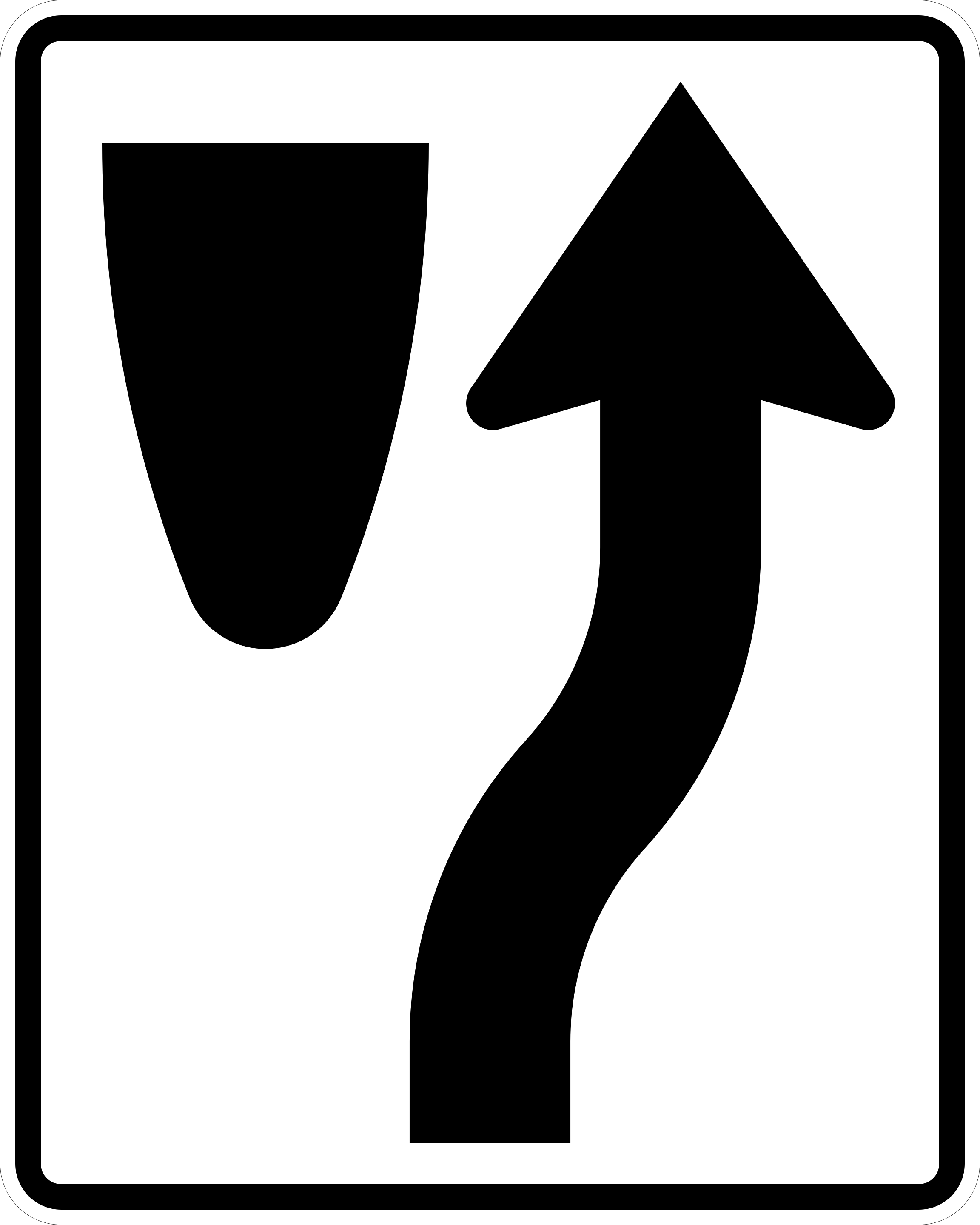
- Either side, whichever is clearer
- The left side, to pass the island
- The right side, as the arrow shows
- Straddle the island's painted edge
Show answer
The right side, as the arrow shows. The Keep Right sign means a traffic island, median or barrier is ahead, and you must keep to the side shown by the arrow. On a divided road that is the right side, which keeps you with traffic moving your way. Driving left of the island would put you in the lanes used by oncoming traffic. Neither side is a free choice. Steer early and smoothly to the right.
Study this in the handbook: Sign colors and shapes
Every question is written from the official Virginia Driver's Manual. Need paper? Printable VA practice test with answer key.
Last verified 2026-10-05. How we check every question · Study all 500 as flashcards
Frequently asked questions
How many questions are on this Virginia practice test?
This fixed set has 20 questions. It is test 21 of 25 from the 500 question Virginia bank. The real VA exam has a 10 question road sign section with 10 correct to pass, plus 30 knowledge questions with 24 correct to pass.
What is the passing score for the real Virginia test?
Part one: all ten road sign questions must be answered correctly; part two: you must correctly answer 24 of the 30 general knowledge questions That figure comes from the official Virginia source cited on the DMV facts page.
How does this fixed test relate to the full Virginia bank?
Each numbered test is a fixed set of questions in a fixed order, so you can retake the same test later and compare. Every test mixes road signs and the other topics in about the same proportion as the full bank. Tests 1 to 25 together cover every question in the Virginia bank once. The full practice page mixes the whole bank at random.
Last verified 2026-10-05. See the Virginia DMV facts page for sourced state details.
Return to the full Virginia practice test · Study road signs