
Test 23 of 25 · 20 questions · Free 2026
VA Permit Practice Test 23
Jump to the test ↓A fixed 20 question set from the Virginia bank with answers and plain English explanations. The real VA exam has a 10 question road sign section with 10 correct to pass, plus 30 knowledge questions with 24 correct to pass; take the full length version on the main practice page.
Question 1 of 20 · 0 right so far
All 20 questions in test 23
Every question below comes from the Virginia question bank on this page. Open a question to see the correct answer and the explanation. Nothing here is hidden behind a signup.
1. You pass a Photo Speed Enforcement sign as you enter a Virginia work zone. What does it tell you?
- Cameras may record speeding in this work zone
- Workers will hold up signs showing your speed
- The speed limit does not apply right now
- Photos are taken of drivers using phones
Show answer
Cameras may record speeding in this work zone. In a work zone, a Photo Speed Enforcement sign means automated photo enforcement is in place for speeding there. The manual's message is simple: always obey the posted speed limit in a work zone. Speeding in a highway work zone can bring a fine of up to $500, and workers' lives depend on drivers slowing down and avoiding distractions. The sign does not suspend the limit, and it is about speed, not phone use. Slow down before you reach the cones.
Study this in the handbook: Railroad crossings and work zones
2. A steady red right arrow is lit at a Virginia intersection, and no sign allows a turn on the red arrow. May you turn right after stopping?
- Yes, as with any red light
- Yes, if no cars are coming
- Yes, after yielding to walkers
- No, wait until the arrow changes
Show answer
No, wait until the arrow changes. A red arrow means you must stop if you intend to move in the direction of the arrow, and you may not proceed that way as long as it is displayed. Virginia law prohibits right and left turns at red arrow lights unless a sign at the intersection reads Right on Red Arrow After Stop or Left on Red Arrow After Stop. A steady red ball allows a right turn after stopping, but a red arrow does not. Wait for a green signal.
Study this in the handbook: Traffic signals and turns on red
3. A police car with flashing lights is stopped on the shoulder, but heavy traffic beside you makes changing lanes unsafe. What should you do?
- Force your way into the next lane
- Slow down and pass with caution
- Keep your speed and stay in lane
- Stop in your lane until traffic clears
Show answer
Slow down and pass with caution. The preferred step is to change to a lane not next to a stopped emergency vehicle, but only if it can be done safely. The manual says that if you are unable to safely change lanes, reduce your speed and proceed with caution. Forcing your way over can cause a crash, and passing at full speed puts the officer at risk. Stopping in a travel lane creates a new hazard. Slow down, watch the officer and give as much room as your lane allows.
Study this in the handbook: Special lanes, painted curbs and parking
4. A disabled car with its hazard flashers on is stopped on the shoulder of a multi-lane Virginia highway. What does the law require as you pass?
- Nothing, since it is not an emergency car
- Honk so the driver knows you are near
- Keep your lane and hold your speed
- Change lanes and proceed with caution
Show answer
Change lanes and proceed with caution. Virginia's move over rules are not limited to emergency vehicles. When passing stationary vehicles that have their hazard warning flashers on, have displayed caution signs, or are marked with properly lit flares or torches, you are required to make a lane change and proceed with caution. Honking does not meet the requirement. Move over when it is safe, and slow down.
Study this in the handbook: Special lanes, painted curbs and parking
5. Light rain has you running your windshield wipers steadily during the day, though you can still see well. Must your headlights be on?
- No, not during daylight hours
- No, unless fog is also present
- No, unless you can see under 100 feet
- Yes, wipers for weather mean lights on
Show answer
Yes, wipers for weather mean lights on. Virginia law requires headlights in rain, fog, snow or sleet when visibility drops to 500 feet, and the manual adds that you must use your headlights whenever you use your windshield wipers because of bad weather. Daylight does not change the rule, and visibility does not have to be poor. Headlights in the rain mainly help other drivers see you, since vehicles to the rear and in blind spots are hard to see in wet weather.
Study this in the handbook: Special lanes, painted curbs and parking
6. You are not sure whether a new allergy medicine will affect your driving. What does the Virginia manual say to do?
- Drive anyway, since it was sold legally
- Read the label and ask a pharmacist or doctor
- Take half the dose and drive slowly
- Drink coffee to stay alert after taking it
Show answer
Read the label and ask a pharmacist or doctor. Almost any drug can reduce your ability to drive safely, including medicines for allergies, colds and headaches. The manual says to read the label before taking any drug or medicine and look for warnings about side effects. If you are uncertain about its effects, ask your pharmacist or doctor for advice. A legal purchase does not mean it is safe to drive, and coffee does not undo drowsiness. Remember that, while effects vary among users, no drug is harmless.
Study this in the handbook: Alcohol, drugs and DUI
7. The fog on your Virginia road is only light. What does the manual still advise?
- Use high beams to see through it
- Keep your speed, since it is thin
- Follow close behind the car ahead
- Slow down, since distances are hard to judge
Show answer
Slow down, since distances are hard to judge. Fog reflects light and can bounce your own headlights back into your eyes, which is why low beams are used in heavy fog. The manual adds that even light fog reduces visibility and your ability to judge distances, so you should slow down. High beams make fog glare worse. Following closely to use another car's lights leaves no room to stop if it brakes. Watch the road edge markings and increase your following distance.
Study this in the handbook: Headlights, night, fog, rain and snow
8. The center line next to your lane is solid yellow, with a broken yellow line beside it on the far side. May you pass?
- Yes, on the left if the way is clear
- No, passing is allowed from the broken side
- Yes, if the vehicle ahead is slow
- Yes, if you return within ten seconds
Show answer
No, passing is allowed from the broken side. A broken yellow line alongside a solid yellow line means passing is allowed from the side of the broken line, but not from the side of the solid line. With the solid line on your side, you may not pass. Drivers going the other way, who have the broken line, may pass when the way is clear. The only time you may cross from the solid side is to pass pedestrians, bicyclists, or scooter and skateboard riders when it is safe.
Study this in the handbook: Regulatory and warning signs
9. You are behind a slow tractor when you see this yellow pennant-shaped sign with black lettering on the left side of the road. The lane ahead looks clear. May you pass?
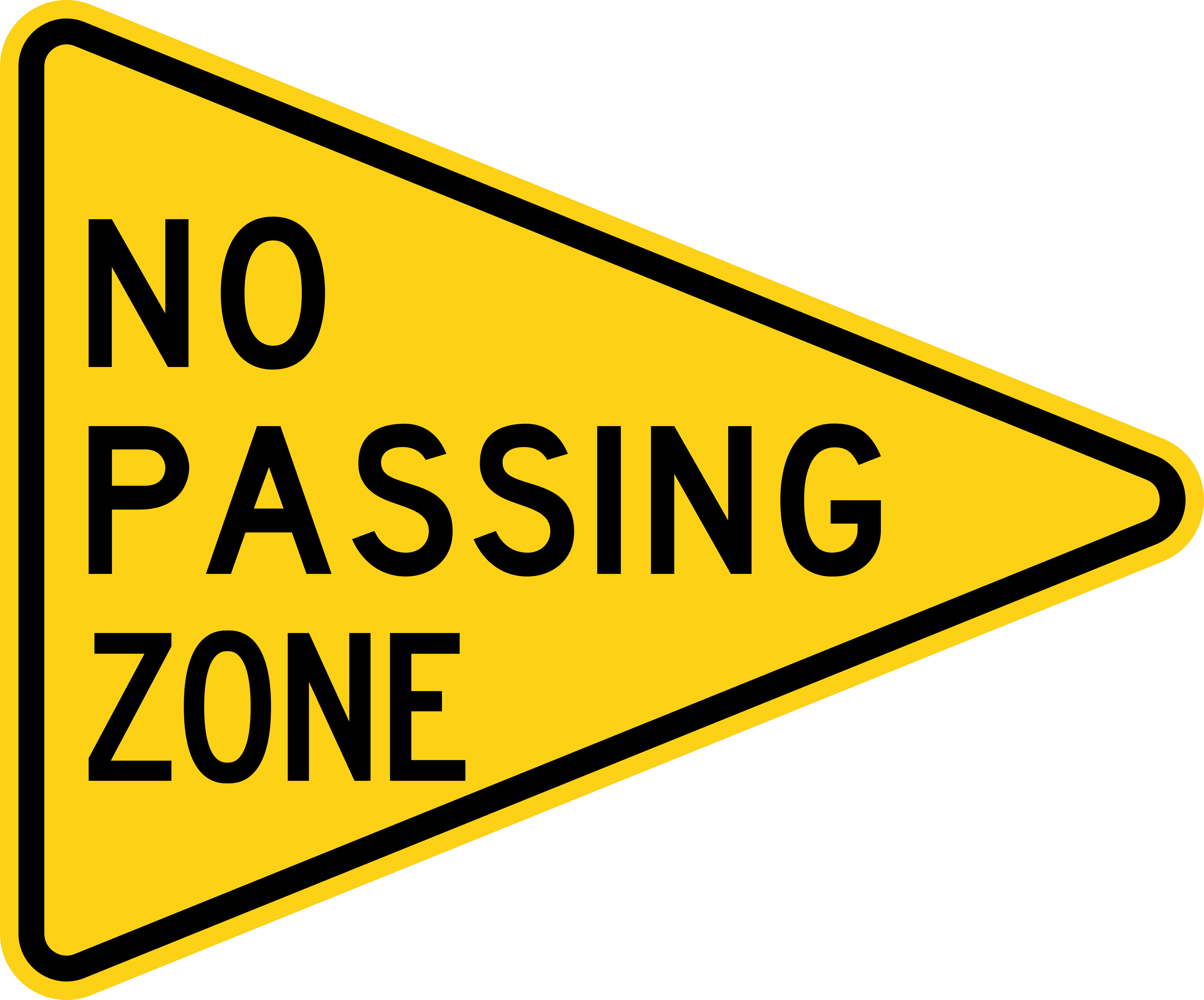
- Yes, if you can see far ahead
- Yes, if the tractor waves you on
- No, not even if the way is clear
- Yes, if you pass in under ten seconds
Show answer
No, not even if the way is clear. The pennant shaped No Passing Zone sign marks the beginning of a no passing zone. You may not pass cars ahead of you in your lane, even if the way is clear. Passing on hills and curves is also listed as unlawful and unsafe. A wave from the tractor driver or a quick pass does not change the rule. Stay behind the slow vehicle until the zone ends and passing becomes legal and safe.
Study this in the handbook: Regulatory and warning signs
10. You park about 30 feet from a railroad crossing in Virginia to wait for a friend. Is that legal?
- Yes, 30 feet is more than enough
- Yes, if you stay behind the wheel
- No, you must be at least 50 feet away
- Yes, if the crossing has gates
Show answer
No, you must be at least 50 feet away. Virginia does not allow parking within 50 feet of a railroad crossing. A car 30 feet away is inside that zone, on any street. Staying in the car does not change the rule, and gates at the crossing do not either. Move back to at least 50 feet. Compare this with 15 feet for a hydrant and 20 feet for an intersection.
Study this in the handbook: Special lanes, painted curbs and parking
11. You are passing a slow car on a two-lane Virginia road. May you go over the speed limit to finish the pass?
- No, exceeding the limit to pass is illegal
- Yes, by up to 10 mph while you pass
- Yes, if the pass is taking too long
- Yes, if no oncoming car is in sight
Show answer
No, exceeding the limit to pass is illegal. The manual lists steps for passing: check traffic ahead, behind and in your blind spot, signal, accelerate, and return to the right lane when you can see the front of the passed vehicle in your rearview mirror. It also states that it is against the law to exceed the speed limit as you pass. There is no 10 mph allowance. If you cannot complete the pass at or below the limit, the gap is too short and you should not start the pass.
Study this in the handbook: Passing, turning, U turns and signals
12. Which U-turn does the Virginia manual tell drivers never to make?
- A U-turn at a town intersection
- A U-turn on a quiet side street
- A U-turn on a highway
- A U-turn where no sign forbids it
Show answer
A U-turn on a highway. U-turns are not legal everywhere. Before making one, check for No U-Turn or No Left Turn signs, since Virginia treats a U-turn as two left turns. In business districts, cities and towns, U-turns are allowed only at intersections, so an intersection in town can be a legal spot. The manual is direct about highways: never make a U-turn on a highway. Elsewhere, check for No U-Turn or No Left Turn signs, signal left, stop and yield before turning.
Study this in the handbook: When you must stop, school buses and stopping distance
13. A Virginia sign marks a high occupancy vehicle lane. Who may use that lane while the restriction is in effect?
- Any vehicle keeping up with the speed limit
- Only taxis, delivery vans and trucks
- Drivers who need to pass slower traffic
- Buses and cars with the posted number of riders
Show answer
Buses and cars with the posted number of riders. High occupancy vehicle signs mark lanes reserved for buses and for vehicles carrying a driver plus one or more passengers, with the exact number listed on the sign. A driver alone does not qualify just by moving fast or by needing to pass. Commercial vans and trucks are not given the lane because of their type. Read the sign for the number of people required and the hours, and stay out of the lane if your vehicle does not meet the requirement.
Study this in the handbook: Sign colors and shapes
14. At a pedestrian hybrid beacon over a Virginia crosswalk, both top red lights are glowing steadily and a walk signal is showing. What must you do?
- Go ahead if the crosswalk looks empty to you
- Stop and stay stopped while the lights are solid
- Slow down and get ready to stop soon
- Yield only to people already in your lane
Show answer
Stop and stay stopped while the lights are solid. A pedestrian hybrid beacon runs through several stages. A flashing yellow light at the bottom means someone has pressed the button, and a solid yellow means prepare to stop. When the two red lights at the top turn solid, the walk signal is on and drivers must stop. Only later, when the two red lights flash back and forth while the walk signal counts down, may you go with caution if the crosswalk is clear. Solid red is a full stop for every lane.
Study this in the handbook: Traffic signals and turns on red
15. A pedestrian using a white cane is about to cross the street in front of you in Virginia. What are you required to do?
- Come to a full stop for the person
- Slow down and steer around the person
- Tap the horn once so they know you are there
- Stop if they step into a marked crosswalk
Show answer
Come to a full stop for the person. Virginia requires drivers to come to a full stop for a pedestrian using a cane or a guide dog, because the cane or dog shows the person is blind or has a vision impairment. That person may not see your car or judge your speed, so a horn or a near miss is frightening and unsafe. The duty applies whether or not the crossing is marked. Remember that elderly people and people with disabilities may move slowly, so wait until they are fully across.
Study this in the handbook: Right of way, pedestrians and roundabouts
16. In Virginia, what is the best way to see a car in your blind spot before you change lanes?
- Look once more in your inside mirror
- Trust your side mirror if it is set right
- Quickly turn your head and look over your shoulder
- Slow down and wait to hear a horn
Show answer
Quickly turn your head and look over your shoulder. Mirrors leave gaps beside and behind your car. The manual says the best way to see a car in your blind spot is to quickly turn your head and glance over your shoulder to make sure the way is clear before changing lanes or passing. Even well adjusted mirrors can miss a car or motorcycle riding just behind your door. Keep the glance quick so your eyes return to the road ahead, then signal and move over smoothly.
Study this in the handbook: Right of way, pedestrians and roundabouts
17. How should a shoulder belt be worn, according to the Virginia manual?
- Behind your back for comfort
- Under your arm, across the waist
- Over the shoulder and across the chest
- Loosely, so you can lean forward freely
Show answer
Over the shoulder and across the chest. Wear the shoulder belt over your shoulder and across your chest, and the lap belt low on your lap against your thighs. The manual says never to wear the shoulder belt behind your back or under your arm. Both belts should be snug. Pregnant women should wear the belt as low on the pelvis as possible. Adjust the seat and belt height before you drive so it fits correctly.
Study this in the handbook: Seat belts, air bags and child safety seats
18. Before you drive, how does the Virginia manual say to set your two side mirrors?
- So you can barely see the sides of your car
- So half of each mirror shows your car's side
- Tilted down so you can see your rear tires
- So they match the view in the inside mirror
Show answer
So you can barely see the sides of your car. Blind spots are areas around your car where other vehicles are hard to see. Adjusting mirrors before you drive shrinks them. The manual says the inside mirror should frame the entire back window, and both side mirrors should be set so you can barely see the sides of your vehicle. Showing a large part of your own car wastes mirror space and enlarges the blind spot beside you. Even with good settings, glance over your shoulder before changing lanes.
Study this in the handbook: Right of way, pedestrians and roundabouts
19. Do Virginia traffic signals apply to people riding bicycles on the road?
- No, they follow walk signals instead
- Yes, signals apply to bicyclists too
- Only when they ride in a bike lane
- Only on roads posted over 35 mph
Show answer
Yes, signals apply to bicyclists too. Traffic signals are not only for car drivers. The manual says they apply to drivers, motorcycle riders, bicyclists, moped riders and pedestrians. A bicyclist on the road must stop at a red light and follow the same signals as other traffic, whether or not a bike lane is present. Drivers should still watch for riders who do not follow the rules. Expect bicyclists to share the intersection with you and check for them before turning.
Study this in the handbook: Traffic signals and turns on red
20. How does towing a light to medium trailer affect the time your vehicle needs to pass, stop, accelerate and turn?
- It takes twice as long
- It takes the same time
- It takes half again as long
- It takes three times as long
Show answer
It takes twice as long. Light to medium trailers are attached to mid-sized cars and trucks with safety chains and a trailer hitch. Towing one places extra stress on the vehicle, and the manual says it takes the vehicle twice as long to pass, stop, accelerate and turn. Plan for much longer gaps before passing or pulling into traffic, and leave more room to stop. Remember the No-Zones around large vehicles, because a trailer creates similar blind areas behind and beside you.
Study this in the handbook: Bicycles, motorcycles, trucks and other road users
Every question is written from the official Virginia Driver's Manual. Need paper? Printable VA practice test with answer key.
Last verified 2026-10-05. How we check every question · Study all 500 as flashcards
Frequently asked questions
How many questions are on this Virginia practice test?
This fixed set has 20 questions. It is test 23 of 25 from the 500 question Virginia bank. The real VA exam has a 10 question road sign section with 10 correct to pass, plus 30 knowledge questions with 24 correct to pass.
What is the passing score for the real Virginia test?
Part one: all ten road sign questions must be answered correctly; part two: you must correctly answer 24 of the 30 general knowledge questions That figure comes from the official Virginia source cited on the DMV facts page.
How does this fixed test relate to the full Virginia bank?
Each numbered test is a fixed set of questions in a fixed order, so you can retake the same test later and compare. Every test mixes road signs and the other topics in about the same proportion as the full bank. Tests 1 to 25 together cover every question in the Virginia bank once. The full practice page mixes the whole bank at random.
Last verified 2026-10-05. See the Virginia DMV facts page for sourced state details.
Return to the full Virginia practice test · Study road signs