
Test 18 of 25 · 20 questions · Free 2026
VA Permit Practice Test 18
Jump to the test ↓A fixed 20 question set from the Virginia bank with answers and plain English explanations. The real VA exam has a 10 question road sign section with 10 correct to pass, plus 30 knowledge questions with 24 correct to pass; take the full length version on the main practice page.
Question 1 of 20 · 0 right so far
All 20 questions in test 18
Every question below comes from the Virginia question bank on this page. Open a question to see the correct answer and the explanation. Nothing here is hidden behind a signup.
1. A bicycle symbol with a double chevron above it is painted in your Virginia travel lane. What does it mean for you as a driver?
- Cars may not use the lane at all
- Bicycles must ride on the shoulder
- A bike lane starts that cars must avoid
- Expect bicyclists riding in this lane
Show answer
Expect bicyclists riding in this lane. This marking is a shared lane marking, often called a sharrow. It is used on travel lanes too narrow for a car and a bicycle to ride side by side. Sharrows show where bicyclists are encouraged to ride in the lane and remind drivers to expect bicyclists on the road. The lane is still open to cars, and cyclists are not sent to the shoulder. Slow down behind a cyclist and pass only with at least three feet of clearance.
Study this in the handbook: Special lanes, painted curbs and parking
2. On a straight Virginia road, your right wheels drift off the pavement onto the shoulder. What should you do?
- Jerk the wheel hard to the left at once
- Ease off the speed and steer back gently
- Brake hard while turning back onto the road
- Speed up to climb back onto the pavement
Show answer
Ease off the speed and steer back gently. If you veer off the road, curved or straight, the manual says not to panic. Gradually reduce your speed, look in the direction you want to go, and slowly steer back onto the roadway. Jerking the wheel can cause over-correcting, where the rear wheels slide toward the outside of the turn and you lose control. Hard braking while turning or speeding up makes that loss of control more likely. Stay alert so you drift less often in the first place.
Study this in the handbook: When you must stop, school buses and stopping distance
3. In Virginia, what does this yellow diamond warning sign, showing a truck on a downward slope, tell drivers to do?

- Watch for trucks entering from a side road
- Expect a slow truck lane to begin soon
- Check your brakes for a steep grade ahead
- Look for falling rocks along the shoulder
Show answer
Check your brakes for a steep grade ahead. The truck on a slope marks the Hill warning sign. It tells you a steep grade is ahead and advises you to check your brakes. On a long downhill, speed builds quickly, so slow down before the grade starts rather than braking hard halfway down. The sign does not announce a truck crossing, a climbing lane or a rock slide; those use different signs. Leave extra following distance, because vehicles ahead may slow sharply on the slope.
Study this in the handbook: Regulatory and warning signs
4. What does a blue and white sign along a Virginia road tell you about?
- Services available to motorists
- Historic or cultural sites nearby
- Destinations and route directions
- Rules such as speed or turn limits
Show answer
Services available to motorists. Green, blue and brown signs with white all give helpful information, but each color has its own job. Blue signs inform drivers about motorist services. Green signs give destination information, such as which way to go for a city. Brown signs point out historical or cultural interests in the area. Black and white signs are regulatory, meaning they state a law such as a speed limit. Recognizing the blue color early helps you plan a stop without slowing traffic suddenly.
Study this in the handbook: Traffic signals and turns on red
5. You are on a one-way Virginia street at a red light and want to turn left onto another one-way street. No sign forbids it. What may you do?
- Wait for the green; left on red is never legal
- Turn after a full stop, yielding to traffic
- Turn without stopping if no one is coming
- Turn only if a green arrow lights up
Show answer
Turn after a full stop, yielding to traffic. Virginia allows a left turn at a red light when you are on a one-way street turning left onto another one-way street. You must first come to a complete stop, look both ways and yield to pedestrians and other traffic, checking for motorcycles, bicycles and mopeds. The turn is not allowed if a No Turn on Red sign is posted or a red arrow pointing left is displayed. A green arrow is not required.
Study this in the handbook: Traffic signals and turns on red
6. A Virginia regulatory sign shows a symbol inside a red circle with a red slash across it. What does that tell you?
- The action shown is allowed after a stop
- The road ahead is closed to all traffic
- The action shown inside is not allowed
- A hazard ahead calls for extra caution
Show answer
The action shown inside is not allowed. Regulatory signs tell you the law, and you must obey them. On these signs a red circle with a slash means no. The picture inside the circle shows what is prohibited, such as a left arrow on a no left turn sign or a U shaped arrow on a no U-turn sign. The slash does not mean the move is allowed after stopping, and it does not close the whole road. Hazard warnings use yellow diamond signs instead. Read the symbol to know which action is banned.
Study this in the handbook: Sign colors and shapes
7. On which side may you park on a one-way road in Virginia?
- Either side of the road
- The right side, as on two-way roads
- The left side, facing the traffic
- The side with the widest shoulder
Show answer
Either side of the road. Virginia's parking rule depends on the type of street. On a two-way street you must park on the right side of the road, in the direction you are traveling. On a one-way road, all traffic moves the same way, so you may park on either side. Wherever you park, pull as close to the curb as you can, no more than one foot away, and move as far from traffic as possible. Check signs and curb paint for other limits.
Study this in the handbook: Special lanes, painted curbs and parking
8. You have parked on a busy Virginia street and are ready to get out. What should you do before opening your door?
- Turn on your hazard flashers first
- Open it slowly so others notice it
- Look for cars, cyclists and pedestrians
- Sound the horn to warn the traffic behind you
Show answer
Look for cars, cyclists and pedestrians. The manual reminds drivers to be aware of other traffic when getting out of a vehicle and to look for other cars, bicyclists and pedestrians before opening the door. A door swung into a bike lane or traffic lane can cause a serious crash, especially with a cyclist who has no time to stop. Opening slowly or honking does not replace actually looking. Check your mirror and glance back over your shoulder, then open the door only when the way is clear.
Study this in the handbook: Special lanes, painted curbs and parking
9. This sign, a black U-shaped arrow inside a red circle with a slash, is posted at an intersection in a Virginia town. May you make a U-turn there?
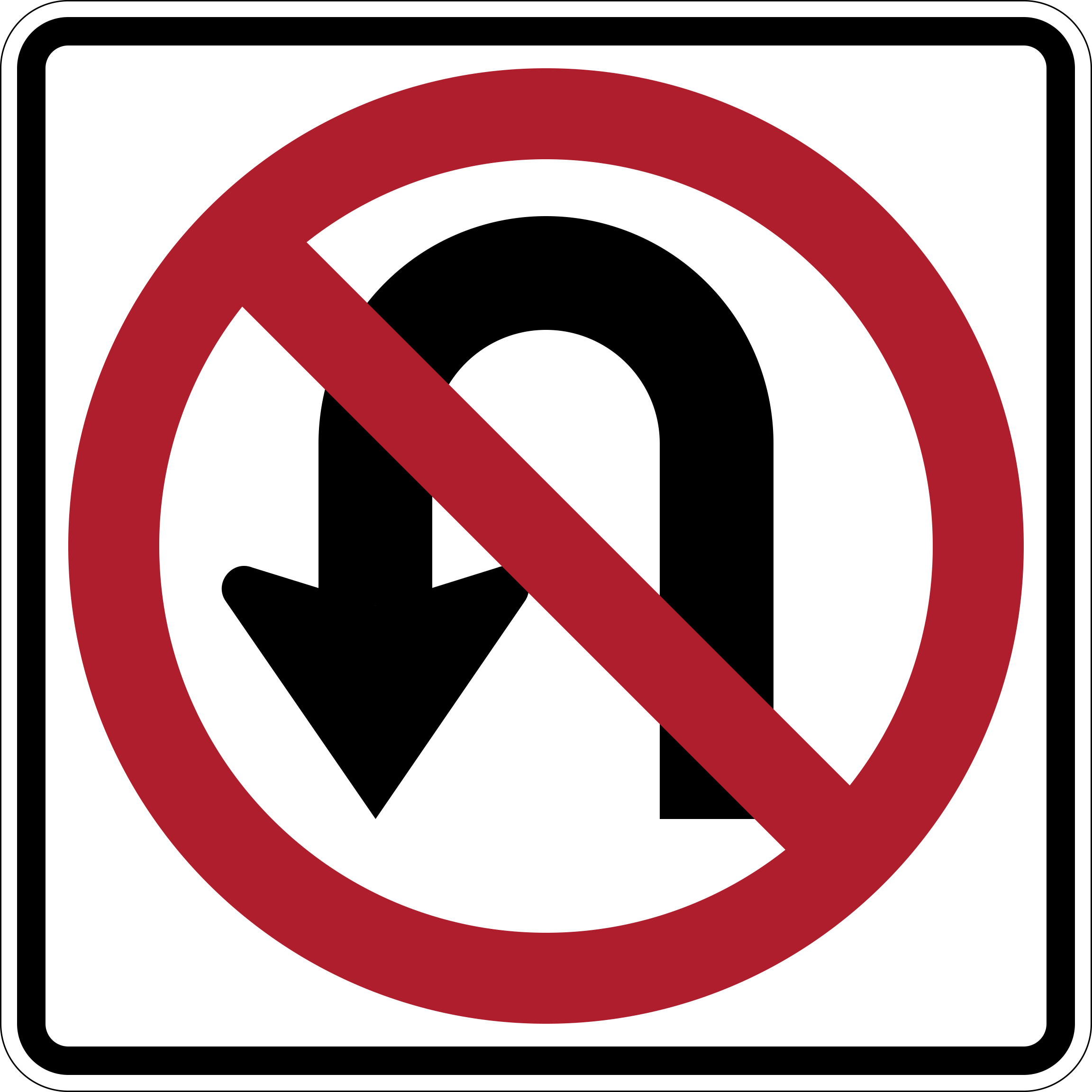
- Yes, town intersections allow U-turns
- No, the sign makes U-turns illegal here
- Yes, if you signal left and yield first
- Yes, if no traffic is approaching
Show answer
No, the sign makes U-turns illegal here. In business districts, cities and towns, U-turns are generally allowed only at intersections, but a No U-Turn sign overrides that. The manual says U-turns are illegal when you see this sign. Signaling, stopping and yielding do not make the turn legal, and empty roads do not either. Continue to another intersection where no No U-Turn or No Left Turn sign is posted, since Virginia treats a U-turn as two left turns.
Study this in the handbook: Sign colors and shapes
10. Orange barrels and orange signs appear along the road ahead. What does the color orange tell you?
- A school zone; watch for children
- A crash scene; prepare to stop
- A detour for trucks only
- A work zone; slow down and be alert
Show answer
A work zone; slow down and be alert. The manual reminds drivers that the color orange marks a work zone and means slow down and be alert. In a work zone, the lives of highway workers depend on drivers obeying posted speed limits and avoiding distractions. Speeding in a highway work zone can bring a fine of up to $500. School zones use a strong yellow-green color, and incident areas such as crash scenes use pink signs. Keep to the middle of your lane near the devices.
Study this in the handbook: Railroad crossings and work zones
11. You are on a dark Virginia highway with your high beams on when headlights appear coming toward you about 400 feet away. What should you do?
- Switch to low beams now
- Keep high beams until 200 feet
- Flash your high beams twice
- Keep high beams on to see far
Show answer
Switch to low beams now. Use high-beam headlights on highways unless another vehicle is coming toward you within 500 feet. At about 400 feet, the oncoming car is already inside that distance, so switch to low beams now to avoid blinding the other driver. The 200 foot figure is the distance for following a vehicle in your own lane. Flashing your lights can blind the oncoming driver. Return to high beams after the car has passed if the road is dark.
Study this in the handbook: Headlights, night, fog, rain and snow
12. Which three factors does the Virginia manual say determine the distance it takes to stop your vehicle?
- Vehicle speed, vehicle weight and tire condition
- Reaction distance, braking distance and road slope
- Perception time, reaction distance and braking distance
- Following distance, braking distance and road grip
Show answer
Perception time, reaction distance and braking distance. The manual breaks stopping into three parts. Perception time is how long it takes to recognize a hazard. Reaction distance is how far the vehicle travels between recognizing the problem and applying the brakes. Braking distance is how far the car travels after the brakes are applied. Speed, tires, brakes and pavement affect braking distance, but they are not the three named factors. Weather, visibility and your mental and physical condition affect all three parts of the total.
Study this in the handbook: Speed limits and reckless driving
13. You are leaving a Virginia work zone and want to move into the next lane. When may you change lanes?
- As soon as you pass the last flagger
- Right away, to get ahead of slow trucks
- When the next speed limit sign appears
- After you are completely clear of the zone
Show answer
After you are completely clear of the zone. Lane changes are risky while lanes are narrow and devices are still close to traffic. As you leave the work zone, stay in your lane and keep your speed, and do not change lanes until you are completely clear of the zone. Passing the last worker or seeing a new sign does not mean the cones and barriers are behind you. Remember that the color orange marks a work zone and means slow down and be alert. Wait until the road is fully open.
Study this in the handbook: Railroad crossings and work zones
14. On which Virginia roads are bicyclists generally not legally allowed to ride?
- Roads with limits above 35 mph
- Interstates and most freeways
- Two-lane roads without shoulders
- Any road near a bike path
Show answer
Interstates and most freeways. Bicyclists are legally allowed on all public roads except interstates and most freeways, which are limited access highways. That means you can meet cyclists on fast rural roads, narrow two-lane roads and busy city streets, even where a bike path is nearby. Drivers should also watch for bicyclists riding in either direction on sidewalks, shared-use paths and two-way separated bike lanes. Slow down when you approach a cyclist and pass with at least three feet of clearance.
Study this in the handbook: Right of way, pedestrians and roundabouts
15. May a Virginia driver use a phone for GPS navigation while driving?
- No, phones are banned for any use
- Yes, if not holding it or typing in it
- Yes, holding it up at the wheel is fine
- Yes, but just at speeds under 25 mph
Show answer
Yes, if not holding it or typing in it. Virginia law prohibits drivers from holding a phone or other wireless device while driving, except in a driver emergency or when the vehicle is lawfully parked or stopped. A phone or similar device may still be used for navigation, as long as the driver is not entering information or holding it while driving. Set your destination before you start, place the phone in a mount, and pull over safely if you need to change the route.
Study this in the handbook: Aggressive, distracted and drowsy driving
16. When does the Virginia manual say to set your mirrors, music and other vehicle controls?
- As soon as you get in, before driving
- At the first red light you come to
- On a straight road with light traffic
- Whenever the car ahead is far away
Show answer
As soon as you get in, before driving. Driving needs your full attention, and adjusting controls is one of the common distractions the manual lists. Its precautions include setting or adjusting the controls on the vehicle and other devices as soon as you get in the car and before you begin driving. A red light or an empty stretch of road can change in a second, and your eyes are off the road while you fiddle. If something needs changing later, pull over and stop in a safe place.
Study this in the handbook: Aggressive, distracted and drowsy driving
17. A Virginia driver takes an over-the-counter cold medicine before a trip. What does the manual warn such medicine can do?
- Cause drowsiness and dizziness
- Nothing, since no prescription is needed
- Lower the driver's blood alcohol level
- Make the driver more alert for hours
Show answer
Cause drowsiness and dizziness. Almost any drug can reduce your ability to drive safely, and the manual makes clear the problem is not just illegal drugs. Many over-the-counter and prescription medicines for headaches, hay fever, colds, allergies or nervous conditions can cause drowsiness and dizziness, slowing reaction time. This includes syrups, drops, sprays, pills and tablets. Read the label for side effects before taking anything, and ask a pharmacist or doctor if you are unsure whether it is safe to drive.
Study this in the handbook: Alcohol, drugs and DUI
18. You are waiting to turn right when your light changes from red to green, but a pedestrian is still crossing the street you are turning into. What should you do?
- Turn now, because the green light gives you priority
- Tap the horn so the pedestrian moves along faster
- Swing around behind the pedestrian as you turn
- Let the pedestrian finish crossing, then turn
Show answer
Let the pedestrian finish crossing, then turn. A change to green does not erase the duty to a person already in the street. The Virginia manual says that if the light turns from red to green while a pedestrian is in the street, you must allow that person to cross before you turn. Steering around them or honking still pressures someone who is lawfully crossing. Pedestrians are especially prone to serious injury when struck. Wait with your wheels straight until the crosswalk in your path is clear, then complete the turn.
Study this in the handbook: Traffic signals and turns on red
19. On a long highway trip you catch yourself nodding off, so you stop at a safe rest area. What does the manual say even a short nap can do?
- Nothing; only a full night of sleep helps
- Help only if you also drink coffee
- Make things worse by leaving you groggy
- Even 10 to 20 minutes can help a lot
Show answer
Even 10 to 20 minutes can help a lot. Head nodding and heavy eyelids are signs of drowsy driving. The manual's advice is to stop at a safe place and take a nap, noting that as little as 10 to 20 minutes of sleep can make a big difference. Coffee, energy drinks, loud music and open windows are not reliable ways to stay awake. Also stop at least every two hours on long drives, and switch to a well-rested driver if you have a companion.
Study this in the handbook: Aggressive, distracted and drowsy driving
20. A school bus is stopped and children are getting off, but its red lights are not flashing. What must you do?
- Pass slowly, since no lights are on
- Honk and wait for a gap to pass
- Stop anyway while it is unloading
- Pass on the left if the lane is clear
Show answer
Stop anyway while it is unloading. Flashing red lights are not the only trigger. The manual says you must also stop if the bus is loading or unloading passengers and the signals are not on. A driver who relies only on the lights could miss this rule. Stop and wait until the children are clear and the bus moves again. Passing a bus that is loading or unloading is listed as unlawful and unsafe.
Study this in the handbook: Speed limits and reckless driving
Every question is written from the official Virginia Driver's Manual. Need paper? Printable VA practice test with answer key.
Last verified 2026-10-05. How we check every question · Study all 500 as flashcards
Frequently asked questions
How many questions are on this Virginia practice test?
This fixed set has 20 questions. It is test 18 of 25 from the 500 question Virginia bank. The real VA exam has a 10 question road sign section with 10 correct to pass, plus 30 knowledge questions with 24 correct to pass.
What is the passing score for the real Virginia test?
Part one: all ten road sign questions must be answered correctly; part two: you must correctly answer 24 of the 30 general knowledge questions That figure comes from the official Virginia source cited on the DMV facts page.
How does this fixed test relate to the full Virginia bank?
Each numbered test is a fixed set of questions in a fixed order, so you can retake the same test later and compare. Every test mixes road signs and the other topics in about the same proportion as the full bank. Tests 1 to 25 together cover every question in the Virginia bank once. The full practice page mixes the whole bank at random.
Last verified 2026-10-05. See the Virginia DMV facts page for sourced state details.
Return to the full Virginia practice test · Study road signs