
Test 10 of 10 · 20 questions · Free 2026
VA Permit Practice Test 10
Jump to the test ↓A fixed 20 question set from the Virginia bank with answers and plain English explanations. The real VA exam has a 10 question road sign section with 10 correct to pass, plus 30 knowledge questions with 24 correct to pass; take the full length version on the main practice page.
Question 1 of 20 · 0 right so far
All 20 questions in test 10
Every question below comes from the Virginia question bank on this page. Open a question to see the correct answer and the explanation. Nothing here is hidden behind a signup.
1. Regardless of the posted limit, what speed can expose a Virginia driver to a reckless-driving charge?
- Over 85 MPH
- Over 65 MPH
- Exactly 80 MPH
- Exactly 75 MPH
Show answer
Over 85 MPH. Virginia identifies driving over 85 MPH as an independent reckless-driving basis, regardless of the posted limit. Exactly 85 is not what this wording says, and 65 or 75 do not substitute for the stated number. Keep this rule separate from the 20-MPH-over-limit rule because either condition can support a charge. A posted sign does not erase the flat-speed boundary. Treat the figure as a legal limit, not as a recommended travel speed.
Study this in the handbook: Speed limits and reckless driving
2. How many traffic-sign questions must an applicant answer correctly before moving to part two of Virginia’s knowledge exam?
- At least eight
- All ten
- At least five
- All thirty
Show answer
All ten. Part one contains ten traffic-sign questions, and the applicant must answer all ten correctly before taking part two. The 80 percent figure applies to the general-knowledge portion, not the sign section. Five correct answers would leave half the sign items wrong, while thirty refers to neither the required sign count nor the sign threshold. Separate the two exam parts in your memory: perfect performance on signs comes before the general questions.
Study this in the handbook: The knowledge exam, road skills test and vision screening
3. Where must Virginia drivers yield to pedestrians or bicyclists under this crosswalk rule?
- Only after the person reaches the driver’s lane
- Only at a signalized crosswalk
- At a clearly marked crosswalk or an unmarked intersection
- Only when a crossing guard is present
Show answer
At a clearly marked crosswalk or an unmarked intersection. The Virginia rule covers a person crossing within a clearly marked crosswalk and a person crossing at an intersection even when the pavement has no marked crosswalk. A traffic signal is not required by this wording, and waiting until someone reaches your lane would delay the required yielding. A crossing guard is also not listed as a condition. Slow before the crossing, check around stopped or turning vehicles, and leave enough room for the pedestrian or bicyclist to reach the other side safely. The practical cue is to scan every intersection for people, not only painted stripes.
Study this in the handbook: Special lanes, painted curbs and parking
4. What vision standard allows a Virginia license restricted to daylight driving only?
- 20/40 with 110 degrees
- 20/70 or better in one or both eyes, with 70 degrees or better horizontal vision
- 20/100 with 50 degrees
- No minimum for daylight driving
Show answer
20/70 or better in one or both eyes, with 70 degrees or better horizontal vision. A license restricted to daylight hours only requires 20/70 or better vision in one or both eyes and 70 degrees or better horizontal vision. The unrestricted standard is 20/40 and 110 degrees. A driver with vision in only one eye needs at least 30 degrees toward the nose and 40 degrees toward the temple. Bioptic telescopic lens wearers follow a separate DMV publication.
Study this in the handbook: The knowledge exam, road skills test and vision screening
5. What share of drivers arrested for DUI in Virginia are social to moderate drinkers?
- About 5 percent
- About 90 percent
- Almost none
- Nearly 50 percent
Show answer
Nearly 50 percent. Nearly 50 percent of the drivers arrested for DUI are social to moderate drinkers, and the manual adds that in your lifetime there is a 50-50 chance you will be involved in an alcohol related crash. It also warns that one drink taken alongside another drug, even an aspirin or a cold medicine, could hit driving ability like several alcoholic beverages. The only sure way to avoid the risk is to decide before you start drinking that you will not drive.
Study this in the handbook: Aggressive, distracted and drowsy driving
6. When is passing at a crosswalk prohibited?
- Only when the crosswalk has a traffic signal
- Only after a pedestrian has already crossed
- Whenever the road has two lanes in your direction
- When approaching a crosswalk and a vehicle ahead or beside you is stopped
Show answer
When approaching a crosswalk and a vehicle ahead or beside you is stopped. Passing is unlawful when approaching a crosswalk and the vehicle ahead of you or the lane next to you is stopped. The stopped vehicle may be hiding a pedestrian, so moving around it can create a serious blind side collision. A signal is not required for the prohibition, and multiple lanes do not automatically make the maneuver safe. Do not pass simply because the crosswalk looks empty. Slow and remain behind the stopped vehicle until you can see that the crossing and adjacent travel path are clear.
Study this in the handbook: Right of way, pedestrians and roundabouts
7. What must drivers obey in a school zone or school crossing area?
- Only the regular highway speed limit
- A horn signal from every approaching vehicle
- The speed limit and signals from crossing guards
- Only the school bus's flashing lights
Show answer
The speed limit and signals from crossing guards. In a school zone or school crossing area, drivers must obey the applicable speed limit and signals from crossing guards while watching for children. The regular-limit-only choice omits the guard's directions, and a horn is not a substitute for controlled speed. A bus's flashing lights are not the only source of authority in the area. Slow before the warning point, scan sidewalks and crosswalks, and be prepared to stop for a child who enters the roadway.
Study this in the handbook: Regulatory and warning signs
8. Where must you stop at a red traffic light when there is no stop line?
- Before entering the intersection or reaching the crosswalk
- Only beside the nearest parked vehicle
- At least one full block before the signal
- After entering the intersection to improve visibility
Show answer
Before entering the intersection or reaching the crosswalk. At a red light, make a complete stop at the stop line. If there is no line, stop before entering the intersection or before reaching the crosswalk. Rolling beyond that point places the vehicle in the crossing path and defeats the protection provided by the signal. The manual does not call for a block long stopping distance or a position beside a parked vehicle. Approach under control, identify the line or crosswalk early, and remain stopped while the signal is red unless a permitted turn applies.
Study this in the handbook: Traffic signals and turns on red
9. When must Virginia motorists use headlights because of reduced visibility or bad weather?
- When visibility is reduced to 500 feet or when wipers are required by bad weather
- Only when visibility falls below 100 feet
- Whenever the road is wet, even if visibility is clear
- Only after sunset, regardless of weather
Show answer
When visibility is reduced to 500 feet or when wipers are required by bad weather. Virginia requires headlights during inclement weather when visibility is reduced to 500 feet, and also whenever windshield wipers are being used because of bad weather. The sunset-only choice omits a daytime weather requirement. The 100-foot threshold waits too long, while turning lights on for every wet road overstates the rule unless visibility or wiper use triggers it. Headlights help other road users see the vehicle, so respond promptly as rain, fog, snow, or sleet worsens.
Study this in the handbook: Headlights, night, fog, rain and snow
10. When you plan to change lanes, turn, or enter or exit a highway, what should you do first?
- Sound the horn twice and continue
- Brake hard without signaling
- Give the proper turn signal
- Move immediately before checking traffic
Show answer
Give the proper turn signal. Virginia places the turn signal before the maneuver when a driver plans to change lanes, turn, or enter or exit a highway. Signaling communicates the intended movement to nearby drivers, but it does not give permission to move into an occupied space. Braking hard without signaling can surprise traffic behind you, and sounding the horn is not a substitute for the required signal. Moving immediately before checking traffic skips the safety check. Signal first, then inspect mirrors and blind spots, and complete the movement only when the lane or turn path is clear.
Study this in the handbook: Passing, turning, U turns and signals
11. How much sleep does the Virginia manual say can make a big difference for a drowsy driver?
- At least 8 hours
- Sleep does not help once you are tired
- At least 2 hours
- As little as 10 to 20 minutes
Show answer
As little as 10 to 20 minutes. Stop at a safe place and take a nap; as little as 10 to 20 minutes of sleep can make a big difference. Other tips are to limit long distance driving, stop at least every two hours for rest, drive with a companion and switch drivers, and avoid driving from 10 p.m. to 6 a.m. Rolling down the window, gum, radio or caffeine do not substitute for sleep.
Study this in the handbook: Aggressive, distracted and drowsy driving
12. At what point must an adult Virginia driver complete a driver improvement clinic because of demerit points?
- After 6 points in 12 months
- After 12 demerit points within 12 months or 18 points within 24 months
- After 30 points in 24 months
- Only after a suspension
Show answer
After 12 demerit points within 12 months or 18 points within 24 months. Drivers 18 or older must complete a driver improvement clinic when they accumulate 12 demerit points within 12 months or 18 points within 24 months, and if the clinic is not completed within 90 days DMV suspends the driving privilege. Reaching 18 points in 12 months or 24 in 24 brings a 90 day suspension plus the clinic. Under 18, a single demerit conviction requires the clinic.
Study this in the handbook: Suspensions, revocations and demerit points
13. How should you respond to a Stop Ahead or Yield Ahead sign?

- Speed up so you reach the sign before other traffic
- Stop immediately in the travel lane regardless of traffic
- Ignore it unless the pavement is wet
- Slow down and be ready to stop
Show answer
Slow down and be ready to stop. Stop Ahead and Yield Ahead are advance warnings that a stop or yield sign is farther ahead. The driver should reduce speed and prepare for the upcoming control, not wait until the last moment. Stopping immediately wherever the warning appears may create a new hazard because the sign is not necessarily the intersection itself. Keep a clear view, ease off the accelerator, and expect to apply the appropriate rule at the next sign.
Study this in the handbook: Regulatory and warning signs
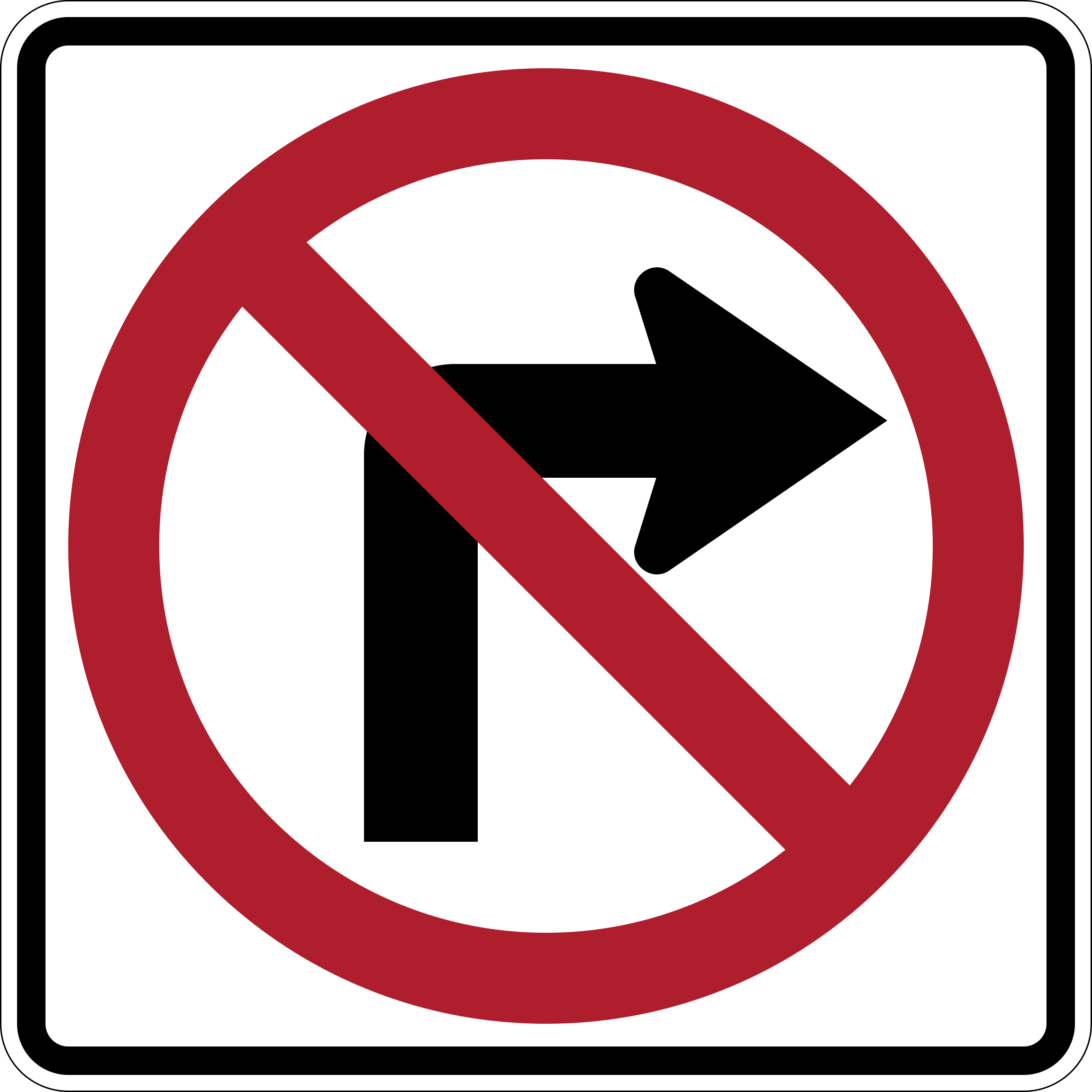
14. What must you do when you see a No Right Turn sign?
- Use the shoulder to complete the turn
- Make the right turn only after yielding
- Turn right if the light is green
- Do not make a right turn
Show answer
Do not make a right turn. The No Right Turn sign makes right turns illegal at that location. A green signal does not erase the posted restriction, and yielding cannot convert the prohibited maneuver into an allowed one. Using the shoulder would still be an attempt to make the banned turn. Scan the sign before beginning a turn, then continue straight or follow another permitted route until a legal turning point is available.
Study this in the handbook: Sign colors and shapes
15. After a crash involving property damage, personal injury, or death, what must be reported to the police?
- Only the vehicle color
- The motor vehicle crash
- Only the weather conditions
- Nothing unless another driver asks
Show answer
The motor vehicle crash. Virginia requires a motor vehicle crash involving property damage, personal injury, or death to be reported to the police. This duty concerns the crash itself and does not depend on a request from another driver. Vehicle color and weather may be useful details, but neither replaces the report. If the crash causes an injury, give reasonable help without moving an injured person unless you have medical training or an immediate danger such as fire exists. Contact police promptly, protect the scene from further danger, and exchange identifying information with the people involved.
Study this in the handbook: Crashes, deer and traffic stops
16. What must drivers do when approaching a Virginia roundabout?
- Ignore signs once the entry lane is clear
- Follow only the vehicle ahead without checking signs
- Pay attention and obey the roundabout signs
- Use the shoulder if the signs require a yield
Show answer
Pay attention and obey the roundabout signs. Roundabouts use signs and pavement markings to organize entry and movement, so drivers must pay attention and obey them. Ignoring a yield sign can place an entering vehicle in the path of traffic already in the circle. Simply following the vehicle ahead does not reveal whether the entry is controlled, and using the shoulder is never a substitute for obeying a sign. Slow down, identify the instruction before the entry point, yield when directed, and travel counter-clockwise after entering.
Study this in the handbook: Special lanes, painted curbs and parking
17. On a two-way street in Virginia, on which side of the road must you park?
- The right side of the road
- Either side of the road
- The left side, facing oncoming traffic
- Whichever side has the wider shoulder
Show answer
The right side of the road. Virginia's parking rules say to park on the right side of the road on a two-way street. Only a one-way road lets you park on either side. When you park next to a curb you must pull close and stay within one foot of it, and on a shoulder you pull over as far as possible. The width of the shoulder does not change which side of a two-way street you use.
Study this in the handbook: Special lanes, painted curbs and parking
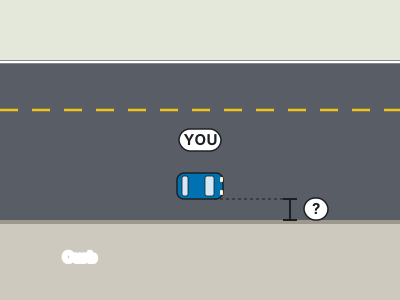
18. When parking next to a curb on a public road, how close must your vehicle be?
- No more than three feet from the curb
- At least five feet from the curb
- No more than one foot from the curb
- Any distance if the hazard lights are on
Show answer
No more than one foot from the curb. When parking next to a curb, Virginia requires the vehicle to be pulled close and no more than one foot away. Three feet leaves unnecessary space for moving traffic and does not meet the stated limit. Parking five feet away is even farther from the curb, and hazard lights do not make an excessive distance lawful. After pulling over, check that the vehicle is not blocking a lane, driveway, or required access area. The easy measurement cue is approximately one foot, not the width of a parking lane.
Study this in the handbook: Special lanes, painted curbs and parking
19. If a Virginia vehicle has air bags, how far should the driver sit from the steering wheel?
- At least ten inches
- At least two inches
- At least four inches
- At least 24 inches
Show answer
At least ten inches. With air bags, drivers should move the seat back so they are at least ten inches from the steering wheel, and tilt an adjustable wheel downward so the bag points at the chest rather than the head and neck. Two or four inches would leave the driver far closer than the ten inch distance the manual sets. Twenty-four inches is not the figure the manual gives.
Study this in the handbook: Seat belts, air bags and child safety seats
20. Which occupants must wear safety belts under Virginia law?
- Only the driver and front seat passenger
- The driver and all passengers, front and rear
- Only passengers under 18
- Only occupants on interstate highways
Show answer
The driver and all passengers, front and rear. Virginia law requires the driver and all passengers, in both front and rear seats, to wear safety belts. The front seat only answer leaves out rear passengers who are covered. The driver has a separate duty to make sure anyone under 18 is secured in a belt, booster or child seat wherever the child sits, so the under 18 rule adds to the belt law rather than replacing it. The law is not limited to interstates.
Study this in the handbook: Seat belts, air bags and child safety seats
QualitySpace is expanding to Virginia
We are a California-based independent insurance brokerage working on licensing in more states. We cannot help with Virginia insurance yet. Leave your email and we will let you know when we can.
Every question is written from the official Virginia Driver's Manual. Need paper? Printable VA practice test with answer key.
Last verified 2026-10-05. How we check every question · Study all 206 as flashcards
Frequently asked questions
How many questions are on this Virginia practice test?
This fixed set has 20 questions. It is test 10 of 10 from the 206 question Virginia bank. The real VA exam has a 10 question road sign section with 10 correct to pass, plus 30 knowledge questions with 24 correct to pass.
What is the passing score for the real Virginia test?
Part one: all ten road sign questions must be answered correctly; part two: you must correctly answer 24 of the 30 general knowledge questions That figure comes from the official Virginia source cited on the DMV facts page.
How does this fixed test relate to the full Virginia bank?
Each numbered test is a fixed set of questions in a fixed order, so you can retake the same test later and compare. Every test mixes road signs and the other topics in about the same proportion as the full bank. Tests 1 to 10 together cover 200 of the 206 questions in the Virginia bank, each once. The full practice page mixes the whole bank at random.
Last verified 2026-10-05. See the Virginia DMV facts page for sourced state details.
Return to the full Virginia practice test · Study road signs