
Test 2 of 10 · 20 questions · Free 2026
VA Permit Practice Test 2
Jump to the test ↓A fixed 20 question set from the Virginia bank with answers and plain English explanations. The real VA exam has a 10 question road sign section with 10 correct to pass, plus 30 knowledge questions with 24 correct to pass; take the full length version on the main practice page.
Question 1 of 20 · 0 right so far

All 20 questions in test 2
Every question below comes from the Virginia question bank on this page. Open a question to see the correct answer and the explanation. Nothing here is hidden behind a signup.
1. What roadway arrangement does a Divided Highway Begins sign announce?
- A two-way road with no median ahead
- A highway split into two separate one-way roadways
- A mandatory U-turn at the next opening
- A lane reserved for bicycles only
Show answer
A highway split into two separate one-way roadways. Divided Highway Begins announces that a median or divider will separate the highway into two roadways, each carrying one-way traffic. The driver should keep right on the roadway being entered. This is different from a two-way road without a median, and it does not direct a U-turn or identify a bicycle lane. Notice the split ahead, stay on the proper side of the divider, and avoid crossing it.
Study this in the handbook: Regulatory and warning signs
2. Who under age 21 may supervise a Virginia learner's permit holder?
- Any licensed friend age 18 or older
- Any licensed driver age 16 or older
- A licensed legal guardian or sibling age 18, 19 or 20
- No one under 21 may ever supervise
Show answer
A licensed legal guardian or sibling age 18, 19 or 20. A permit holder normally drives with a licensed driver at least 21 years old in the front passenger seat. The supervisor may be 18, 19 or 20 only if that person is the learner's legal guardian, brother, sister, half brother, half sister, stepbrother or stepsister. A friend of 18 does not qualify, and a 16-year-old never does. Saying no one under 21 may ever supervise ignores the family exception.
Study this in the handbook: DUI suspensions, open containers and underage drinking
3. When may a Virginia driver hold a cell phone while the vehicle is in use?
- Whenever the call is under one minute
- While using it for navigation and typing an address
- In a driver emergency or when the vehicle is lawfully parked or stopped
- At any red light
Show answer
In a driver emergency or when the vehicle is lawfully parked or stopped. Virginia law prohibits holding a cell phone or other wireless device while driving, except in a driver emergency or when the vehicle is lawfully parked or stopped. A phone may be used for navigation only if the driver is not entering information or holding it. Typing an address while moving breaks that rule. Short calls get no exception, and a red light is not the same as being lawfully parked or stopped.
Study this in the handbook: Aggressive, distracted and drowsy driving
4. What should you do at a flashing red arrow?
- Slow down and turn without stopping
- Proceed straight because the arrow does not control your lane
- Wait for a green arrow even after the road is clear
- Stop completely, yield, and proceed in the arrow's direction when clear
Show answer
Stop completely, yield, and proceed in the arrow's direction when clear. A flashing red arrow combines a required stop with a controlled turn. Stop completely, yield to vehicles coming from the other direction and pedestrians in the intersection, then move in the arrow's direction when the way is clear. The no-stop choice is wrong because the red signal still requires a full stop. Do not confuse this signal with a steady red arrow, which prohibits movement in that direction while displayed.
Study this in the handbook: Traffic signals and turns on red
5. How early should you signal before making a turn in Virginia?
- Three or four seconds and 100 feet before the turn
- Only after entering the intersection
- Exactly 200 feet before every turn
- One second and 10 feet before the turn
Show answer
Three or four seconds and 100 feet before the turn. Virginia’s turning guidance says to signal at least three or four seconds, or 100 feet, ahead of the turn. The purpose is to give nearby drivers and pedestrians time to understand your intended path. Waiting until the intersection is already occupied gives others too little notice. The one second and 10 foot option is far shorter, while 200 feet is not the manual’s stated turning distance. Signal, check in all directions, and then brake smoothly so the signal communicates a planned movement rather than a last second reaction.
Study this in the handbook: When you must stop, school buses and stopping distance
6. What does an advisory speed sign tell a driver?
- The minimum legal speed on every nearby road
- The distance to the next service area
- The speed required for all vehicles in Virginia
- The maximum safe speed for a highway exit
Show answer
The maximum safe speed for a highway exit. An advisory speed sign identifies the maximum safe speed for a highway exit. It helps a driver choose a speed for the geometry and conditions of that exit, but it is not a universal minimum or a statewide speed rule. It also does not measure distance to services. Reduce speed before entering the exit rather than braking late within the curve. Continue to account for rain, traffic, visibility, and the vehicle's handling because a posted advisory assumes a need for caution, not permission to exceed it.
Study this in the handbook: Regulatory and warning signs
7. When passing a person riding a bicycle, how much clearance must a Virginia driver provide?
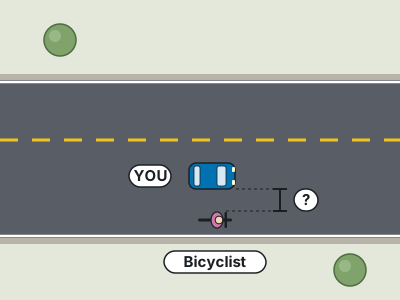
- At least three feet to the left
- Exactly six inches from the bicycle
- At least one foot to the right
- No clearance if the driver signals first
Show answer
At least three feet to the left. Virginia requires a driver approaching or passing a person on a bicycle, moped, or similar device to reduce speed and pass at least three feet to the left. One foot is too little room for a wobble, wind, or a pavement hazard. Six inches is plainly unsafe, and a turn signal does not replace the required lateral space. Wait for a safe opening, check the full passing path, and return only when clear. The concrete cue is to picture a three foot buffer between the vehicle and the rider.
Study this in the handbook: Bicycles, motorcycles, trucks and other road users
8. When entering an interstate from an entrance ramp in Virginia, which traffic has priority?
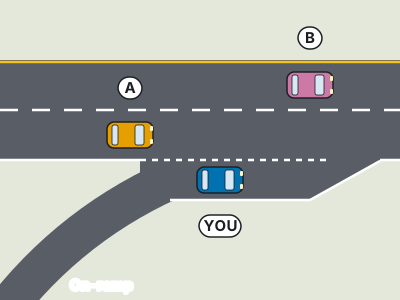
- The vehicle coming from the ramp
- Traffic already on the highway
- The vehicle traveling faster
- The vehicle with the longer ramp
Show answer
Traffic already on the highway. A driver using an entrance ramp must yield to traffic already on the highway. The ramp vehicle does not gain priority because it is merging, moving faster, or traveling on a long acceleration lane. Search for an opening, adjust speed, and enter only when the movement is safe. The test cue is the direction of travel: entering traffic yields, while the established highway flow has the right-of-way.
Study this in the handbook: Special lanes, painted curbs and parking
9. If no sign gives a different limit, what default speed applies to all other Virginia roads for passenger vehicles and motorcycles?
- 25 MPH
- 35 MPH
- 55 MPH
- 65 MPH
Show answer
55 MPH. The manual assigns 55 MPH to all other roads in its default-speed list for passenger vehicles and motorcycles. Twenty-five MPH is for school, business, and residential areas, while 35 MPH is the unpaved-road figure. Sixty-five MPH is not the general default described here. First check whether the road fits a named category. If not, and no posted sign changes the limit, the remaining category uses 55 MPH. Conditions can still require a lower speed.
Study this in the handbook: Speed limits and reckless driving
10. When a Virginia DUI conviction involves a passenger age 17 or younger, what additional mandatory jail term is listed?
- Two days
- Ten days
- No added jail term
- Five days
Show answer
Five days. A DUI conviction involving a juvenile passenger, defined here as age 17 or younger, adds a mandatory five day jail term on top of the other fines and jail sentences. Two and ten days are different numbers from the stated rule, while no added term ignores the passenger condition entirely. The same passage also lists an additional fine range of at least $500 and up to $1,000. A young passenger therefore changes the consequences of the DUI conviction, not merely the social circumstances of the trip.
Study this in the handbook: DUI suspensions, open containers and underage drinking
11. What does an advance railroad crossing sign tell a driver to do?

- Cross quickly without checking the tracks
- Look, listen, slow down, and be prepared to stop
- Stop only after a train enters the crossing
- Turn around before reaching every crossing
Show answer
Look, listen, slow down, and be prepared to stop. An advance railroad warning sign appears before the tracks, giving time to prepare. Virginia says to look and listen, reduce speed, and be ready to stop for a train or another vehicle using the rails. Waiting until a train is already in the crossing gives too little margin, while crossing quickly is not a safety rule. Treat the round warning sign as an early prompt to check both the roadway and the tracks.
Study this in the handbook: Railroad crossings and work zones
12. What does the eight-sided sign require before you enter the intersection?

- Come to a complete stop at the sign, line, crosswalk, or curb
- Slow to walking speed and continue without stopping
- Stop only when another vehicle is approaching
- Yield only to vehicles approaching from the left
Show answer
Come to a complete stop at the sign, line, crosswalk, or curb. Virginia assigns one meaning to the octagon: stop. The required stop may be at the sign, stop line, pedestrian crosswalk, or curb, so an empty-looking intersection does not remove the duty. Waiting lets vehicles and pedestrians clear your path. The left-side priority choice is also wrong because an all-way stop can require every approach to stop, followed by right-of-way rules. Use the red octagon as your immediate cue to halt fully before checking traffic.
Study this in the handbook: Sign colors and shapes
13. After passing a truck in Virginia, when is it safe to pull back in front of it?
- As soon as your rear bumper clears its cab
- When you can see the entire front of the truck in your rearview mirror
- After you have traveled 65 feet past the truck
- When the truck driver flashes the headlights
Show answer
When you can see the entire front of the truck in your rearview mirror. Trucks, buses and RVs have a front No-Zone. If you cut in too soon after passing, or cut in and then slow down, the driver may have to slam on the brakes, and these vehicles need nearly twice the time and room to stop as cars. Wait until you can see the entire front of the truck in your rearview mirror before pulling in, and then maintain your speed.
Study this in the handbook: Bicycles, motorcycles, trucks and other road users
14. Besides a suspension, what does a Virginia court impose on an underage driver convicted with a BAC of at least .02 but under .08?
- A $100 fine only
- A mandatory five-day jail term
- A $500 minimum fine or at least 50 hours of community service
- Ten hours of community service
Show answer
A $500 minimum fine or at least 50 hours of community service. The court penalty for this underage offense includes a one-year suspension plus either a minimum mandatory fine of $500 or at least 50 hours of community service. A $100 fine and ten hours of service are far below the stated amounts. The mandatory five-day jail term belongs to a DUI with a juvenile passenger aboard, not to this offense. A BAC of .08 or higher moves the young driver into adult DUI penalties.
Study this in the handbook: Suspensions, revocations and demerit points
15. When must Virginia motorists use headlights because of bad weather?
- Whenever windshield wipers are being used because of bad weather
- Only when rain reduces visibility to 100 feet
- Only when another driver flashes headlights
- Only when driving after midnight
Show answer
Whenever windshield wipers are being used because of bad weather. Virginia requires headlights whenever windshield wipers are used as a result of bad weather. The rule improves your ability to see and helps other road users notice your vehicle. Midnight is not the trigger, and waiting for visibility to fall to 100 feet delays the required action. Another driver’s signal has no bearing on your duty. Turn on the headlights as soon as weather requires the wipers, keep the windshield clear, and remember that the manual also specifies headlights in inclement weather when visibility is reduced to 500 feet.
Study this in the handbook: Special lanes, painted curbs and parking
16. Who is responsible for making sure a passenger under 18 is buckled in a Virginia vehicle?
- The vehicle owner
- The child's parent, even if not present
- The passenger, once age 16
- The driver, no matter where the child is seated
Show answer
The driver, no matter where the child is seated. Under Virginia law the driver and all passengers, front and rear, must wear safety belts, and a driver transporting anyone younger than 18 must ensure that the passenger is properly secured in a safety belt, booster seat or child safety seat no matter where the child is seated. Wear the lap belt low against the thighs and the shoulder belt across the chest, never behind the back.
Study this in the handbook: Seat belts, air bags and child safety seats
17. A police officer directs you to stop while your traffic signal is green. Which instruction must you follow?
- The green signal and continue through
- The officer's direction to stop
- The signal only after checking for cross traffic
- Neither instruction until another officer arrives
Show answer
The officer's direction to stop. Virginia tells drivers to obey all signs and signals unless directed by a police officer, and to always follow the officer's direction. That instruction controls even when the traffic signal is green. Continuing through because the light permits movement would ignore the person actively managing the intersection. Checking for cross traffic remains good practice, but it does not authorize you to reject the stop command. The visible officer is the cue that normal signal operation has been superseded. Stop where directed and wait for the officer's next instruction.
Study this in the handbook: Traffic signals and turns on red
18. If you cannot safely change lanes around a stationary emergency vehicle, what should you do?
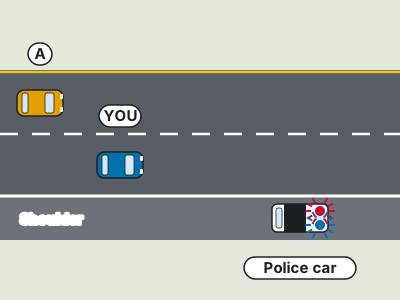
- Stop next to the emergency vehicle and wait
- Accelerate past it before another vehicle arrives
- Reduce speed and proceed with caution
- Turn off your headlights and continue at the limit
Show answer
Reduce speed and proceed with caution. Virginia gives drivers a fallback when a safe lane change around a stationary emergency vehicle is impossible: reduce speed and proceed with caution. Stopping beside the response vehicle blocks the working area, while accelerating increases exposure to people and equipment near the roadway. Turning off headlights offers no protection. Check mirrors and the next lane early, move over whenever that can be done safely, and otherwise pass slowly with a clear path and extra attention to traffic conditions.
Study this in the handbook: Emergency vehicles and stopped vehicles with flashing lights
19. On a dry road at 46 to 70 MPH, what following distance does the Virginia manual use?
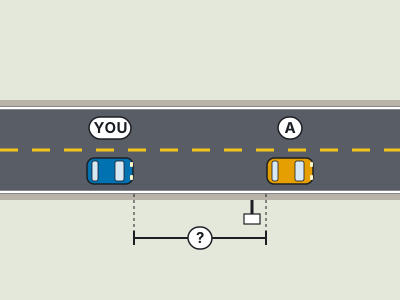
- One second
- Ten seconds
- Two seconds
- Four seconds
Show answer
Four seconds. Virginia's manual uses the two, three and four second rule to judge whether you are following far enough behind the vehicle ahead. On dry surfaces its table gives 2 seconds under 35 MPH, 3 seconds at 35 to 45 MPH, and 4 seconds at 46 to 70 MPH, the distance that lets the driver steer and brake out of a problem area. One and ten seconds are not in the table, and the manual says to add extra seconds for bad weather, heavy traffic, or poor pavement.
Study this in the handbook: Hand position, following distance and blind spots
20. What is Virginia's rule on radar detectors?
- It is illegal to use them in Virginia
- They are legal in passenger cars
- They are legal outside cities
- They are legal if mounted below the dash
Show answer
It is illegal to use them in Virginia. The Virginia manual states plainly that it is illegal to use radar detectors in Virginia, and it places the rule right after its speeding penalties: an extra $100 fine for 81 to 85 mph in a 65 mph zone, and a possible reckless driving charge for driving over 85 mph or 20 or more mph above the limit. The manual gives no exception for passenger cars, for roads outside cities, or for a detector mounted below the dash. The safe approach is to watch the posted limit rather than a device.
Study this in the handbook: Speed limits and reckless driving
QualitySpace is expanding to Virginia
We are a California-based independent insurance brokerage working on licensing in more states. We cannot help with Virginia insurance yet. Leave your email and we will let you know when we can.
Every question is written from the official Virginia Driver's Manual. Need paper? Printable VA practice test with answer key.
Last verified 2026-10-05. How we check every question · Study all 206 as flashcards
Frequently asked questions
How many questions are on this Virginia practice test?
This fixed set has 20 questions. It is test 2 of 10 from the 206 question Virginia bank. The real VA exam has a 10 question road sign section with 10 correct to pass, plus 30 knowledge questions with 24 correct to pass.
What is the passing score for the real Virginia test?
Part one: all ten road sign questions must be answered correctly; part two: you must correctly answer 24 of the 30 general knowledge questions That figure comes from the official Virginia source cited on the DMV facts page.
How does this fixed test relate to the full Virginia bank?
Each numbered test is a fixed set of questions in a fixed order, so you can retake the same test later and compare. Every test mixes road signs and the other topics in about the same proportion as the full bank. Tests 1 to 10 together cover 200 of the 206 questions in the Virginia bank, each once. The full practice page mixes the whole bank at random.
Last verified 2026-10-05. See the Virginia DMV facts page for sourced state details.
Return to the full Virginia practice test · Study road signs