
Test 1 of 10 · 20 questions · Free 2026
VA Permit Practice Test 1
Jump to the test ↓A fixed 20 question set from the Virginia bank with answers and plain English explanations. The real VA exam has a 10 question road sign section with 10 correct to pass, plus 30 knowledge questions with 24 correct to pass; take the full length version on the main practice page.
Question 1 of 20 · 0 right so far
All 20 questions in test 1
Every question below comes from the Virginia question bank on this page. Open a question to see the correct answer and the explanation. Nothing here is hidden behind a signup.
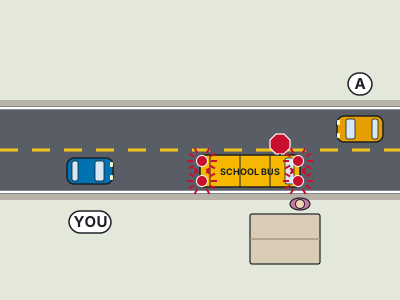
1. A stopped school bus displays flashing red lights and an extended stop sign. When may you resume driving?
- After all persons are clear and the bus moves again
- After waiting ten seconds, even if the bus remains stopped
- As soon as the nearest child reaches the sidewalk
- When traffic behind you begins passing
Show answer
After all persons are clear and the bus moves again. Drivers approaching from any direction on a highway, private road, or school driveway must stop for the specified school bus. The stop continues until every person is clear of the roadway and the bus moves again. A child's reaching the sidewalk is not enough if other people remain near the roadway, and a timed pause cannot replace the bus's movement. Traffic behind you also does not change the requirement. Watch the bus, keep the vehicle stopped, and use the bus beginning to move plus the roadway being clear as the practical release cue.
Study this in the handbook: When you must stop, school buses and stopping distance
2. In Virginia, how close to a railroad crossing may you park?
- No closer than 15 feet
- No closer than 25 feet
- No closer than 100 feet
- No closer than 50 feet
Show answer
No closer than 50 feet. The list of places where you may not park includes anywhere within 50 feet of a railroad crossing. Fifteen feet is the distance for a fire hydrant and for the entrance to a fire, ambulance or rescue squad station, and 20 feet is the distance for an intersection. Neither 25 nor 100 feet appears in the list. The same list bars parking within 500 feet of fire trucks or equipment stopped to answer an alarm.
Study this in the handbook: Special lanes, painted curbs and parking
3. When must you drive below a posted speed limit?
- Only when a police officer is following you
- When road construction or bad weather makes the posted speed unsafe
- Never, because the posted limit is always safe
- Only when another driver is traveling below the limit
Show answer
When road construction or bad weather makes the posted speed unsafe. A posted limit assumes ideal conditions, not every roadway situation. Virginia requires a slower speed when signs establish a school or work zone limit and when road construction or bad weather makes the posted speed unsafe. The claim that the limit is always safe confuses a maximum with a guarantee. Watch pavement, visibility, traffic, and work activity, then reduce speed early enough to preserve control and stopping room rather than waiting for enforcement.
Study this in the handbook: Speed limits and reckless driving
4. You have a green light, but a pedestrian is still in the intersection. What must you do before turning?
- Turn first because the green light gives absolute priority
- Allow the pedestrian to cross before turning
- Drive around the pedestrian in the adjacent lane
- Sound the horn until the pedestrian stops
Show answer
Allow the pedestrian to cross before turning. A green signal permits movement only when the driver can proceed safely. When a pedestrian remains in the street, Virginia directs the driver to allow that person to cross before turning. The signal does not erase the pedestrian's need to finish crossing, and using the horn or driving around the person creates an additional hazard. Check the crosswalk and the full turning path, yield patiently, and complete the turn only after the pedestrian is clear. This same caution applies when a light changes from red to green while someone is already in the street.
Study this in the handbook: Bicycles, motorcycles, trucks and other road users
5. What does a red arrow mean for movement in the direction of the arrow?
- Stop, and do not go that way unless a posted sign permits turning after a stop
- Continue straight through the intersection
- Treat it as a flashing yellow arrow
- Turn after yielding to oncoming traffic
Show answer
Stop, and do not go that way unless a posted sign permits turning after a stop. A red arrow prohibits movement in the arrow's direction while it is displayed. Stop if you intend to move that way and remain stopped unless a specifically posted sign permits a turn after stopping. The yield-and-turn choice describes a different signal condition and cannot override a Virginia red arrow. Watch the entire signal head, obey any posted exception, and remember that the arrow controls the indicated movement rather than granting permission to continue straight.
Study this in the handbook: Traffic signals and turns on red
6. What is the maximum speed of a low speed vehicle, and where may it be driven in Virginia?
- 45 mph, on any road except interstates
- 21 to 25 mph, on public roads with limits of 35 mph or less
- 35 mph, on any road
- 15 mph, on sidewalks
Show answer
21 to 25 mph, on public roads with limits of 35 mph or less. Low speed vehicles are electrically or gas powered four wheel vehicles with a maximum speed ranging from 21 to 25 mph. They may be operated on public roads with speed limits of 35 mph or less by licensed drivers or by learner's permit holders accompanied by a licensed driver, and they must meet federal safety standards and Virginia's passenger vehicle requirements. They do not belong on faster highways.
Study this in the handbook: Bicycles, motorcycles, trucks and other road users
7. When must Virginia police forward a written crash report to DMV?
- When a crash results in injury or death, or property damage over $3,000
- Only when someone dies
- For every crash regardless of damage
- Only when a driver requests it
Show answer
When a crash results in injury or death, or property damage over $3,000. Law enforcement officers are required to forward a written crash report to DMV when a traffic crash results in injury or the death of any person or total property damage in excess of $3,000. All crash information is recorded on the DMV record of each driver involved. Drivers must also exchange information, help the injured, and report a crash involving property damage, injury or death to the police; the 24 hour window applies when an unattended vehicle's owner cannot be found.
Study this in the handbook: Alcohol, drugs and DUI
8. What should you do at a steady yellow light if you have not entered the intersection?
- Speed up to beat the red light
- Treat it exactly like a green signal
- Stop only if another driver honks
- Stop, unless stopping would be unsafe
Show answer
Stop, unless stopping would be unsafe. A steady yellow light warns that the signal is about to change. If you have not entered the intersection, stop; if stopping would be unsafe, proceed cautiously. Speeding up is specifically contrary to the manual's instruction, and yellow is not equivalent to green. A horn from another driver does not determine the duty. Look ahead early, ease off the accelerator, and judge whether a controlled stop can be made before the line without creating a hazard behind you.
Study this in the handbook: Traffic signals and turns on red
9. On a Virginia learner's permit, your licensed supervisor is neither your legal guardian nor a sibling, including a half sibling or step sibling. What must be true about that driver?
- The driver is any adult passenger, even without a license
- The driver is at least 16 and has held a permit for six months
- The driver is at least 21, licensed, alert, and able to assist
- The driver is at least 25 but may be asleep during practice
Show answer
The driver is at least 21, licensed, alert, and able to assist. The person supervising a Virginia learner must normally be at least 21, hold a valid driver's license, stay alert, and be able to help while the learner drives. The manual allows one exception: a licensed legal guardian, brother, sister, half sibling, or step sibling may be 18, 19, or 20. Age alone is not enough, so an unlicensed adult cannot satisfy the requirement, and a 16 year old permit holder does not qualify. A sleeping passenger cannot provide the alert help the manual requires. Confirm the supervisor's license and readiness before the vehicle moves.
Study this in the handbook: Learner's permit, license and vehicle paperwork
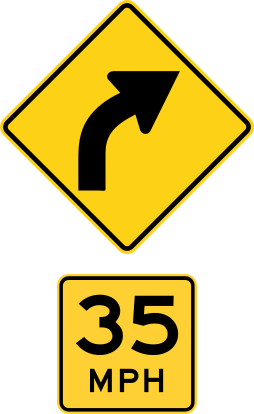
10. What does a Virginia Right Curve with Safe Speed Indicator sign tell you to do?
- Accelerate through the bend to maintain momentum
- Use the opposing lane to straighten the road
- Stop in the curve every time
- Slow down to the safe speed shown on the sign
Show answer
Slow down to the safe speed shown on the sign. Virginia's manual says a Right Curve with Safe Speed Indicator sign means the road ahead curves right, so slow down to the safe speed indicated. Diamond warning signs in general warn of special conditions or hazards ahead, and the manual tells drivers to slow down, drive with caution, and be ready to stop. For winding roads it adds that on all curves you should slow down for better control. Accelerating, crossing into opposing traffic, or stopping in the curve every time is not what the sign asks.
Study this in the handbook: Railroad crossings and work zones
11. After a Divided Highway Ends warning, what traffic direction should you expect?
- Traffic goes in both directions, and you should keep right
- All traffic continues one way around a median
- The roadway becomes a passing-only lane
- Vehicles must stop until a divider is rebuilt
Show answer
Traffic goes in both directions, and you should keep right. Divided Highway Ends warns that the median or divider will disappear and traffic will travel in both directions on the same roadway. Virginia tells drivers to keep right as the road changes. The one-way choice describes the beginning of a divided highway, not its end. Reduce speed if needed, watch for opposing vehicles as the separation vanishes, and settle into the right side before the roadway becomes undivided.
Study this in the handbook: Regulatory and warning signs
12. What penalties does Virginia list for selling or giving alcohol to a person under 21?
- A $50 fine only
- A warning for a first offense
- A fine up to $2,500, license suspension up to one year, and 12 months in jail
- A fine up to $500 with no license action
Show answer
A fine up to $2,500, license suspension up to one year, and 12 months in jail. Providing or selling alcohol to someone under 21, to an intoxicated person, or to someone a court has ordered not to drink exposes the adult to a fine up to $2,500, a mandatory license suspension of up to one year, and 12 months in jail. A $50 fine and a first offense warning understate the law. A $500 fine with no license action is wrong because the suspension is mandatory. The penalty applies even though the adult was not driving.
Study this in the handbook: DUI suspensions, open containers and underage drinking
13. What must a Virginia driver do before entering a roadway from a private driveway?
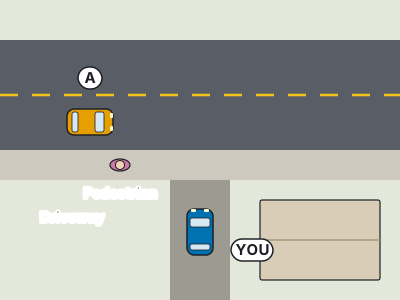
- Stop and yield to all traffic and pedestrians
- Slow down but continue if no car is nearby
- Yield only to vehicles traveling on the road
- Sound the horn and enter before approaching traffic
Show answer
Stop and yield to all traffic and pedestrians. A driver leaving a private road or driveway must stop and yield to all traffic and pedestrians. The obligation is broader than watching for vehicles, so the choice that excludes pedestrians is incomplete. Merely slowing, checking one direction, or sounding the horn does not replace the required stop and yield. Treat the driveway edge as a controlled entry point, and wait until both roadway users and people walking can move safely.
Study this in the handbook: Right of way, pedestrians and roundabouts
14. On an unmarked two-lane road, when may you pass a slow moving vehicle on the left?
- Whenever the vehicle ahead is traveling below 35 MPH
- When no signs prohibit passing and the way is clear
- Only after a double yellow line appears
- Only when an approaching vehicle flashes its headlights
Show answer
When no signs prohibit passing and the way is clear. On an unmarked two-lane road, Virginia permits passing a slow moving vehicle on the left when no sign prohibits passing and the way is clear. The absence of painted lines does not remove the need to check for oncoming traffic, hills, curves, pedestrians, or other hazards. A speed threshold is not the manual's test, and an approaching driver's headlight signal is not permission to pass. The key cue is the combination of no prohibiting sign and a clear path. Evaluate sight distance first, pass smoothly, and return only when there is room.
Study this in the handbook: Regulatory and warning signs
15. You hit an unattended parked vehicle in Virginia and cannot find the owner. What must you do?
- Drive away, since no one was present
- Wait at the scene for one hour then leave
- Leave an easily found note with your name, phone, date, time and damage description, and report to police within 24 hours
- Call your insurer only
Show answer
Leave an easily found note with your name, phone, date, time and damage description, and report to police within 24 hours. You must make a reasonable effort to find the owner of an unattended vehicle or other property damaged in a crash. If you cannot locate anyone, leave a note that can be found easily at the scene with your name, telephone number, the date and time of the crash, and a description of the damage. You must also report the crash to the police within 24 hours.
Study this in the handbook: Crashes, deer and traffic stops
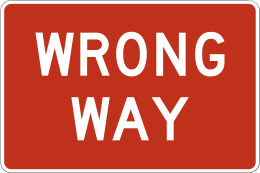
16. If you realize you have driven past a Do Not Enter or Wrong Way sign, what should you do?
- Speed up so opposing traffic cannot reach you
- Continue until the next traffic signal
- Back up in the travel lane at once
- Immediately slow down, pull over, and cautiously turn around
Show answer
Immediately slow down, pull over, and cautiously turn around. Passing the sign indicates that the vehicle may be pointed into opposing traffic. Virginia directs the driver to slow immediately, pull over, and turn around cautiously. Continuing extends the exposure, while accelerating makes the conflict harder to manage. Backing in a live travel lane adds another hazard and is not the manual’s direction. The recognition cue is the sign itself: once the mistake is noticed, reduce risk first by getting safely out of the lane.
Study this in the handbook: Sign colors and shapes
17. What does a Do Not Enter sign tell you about the direction of travel?
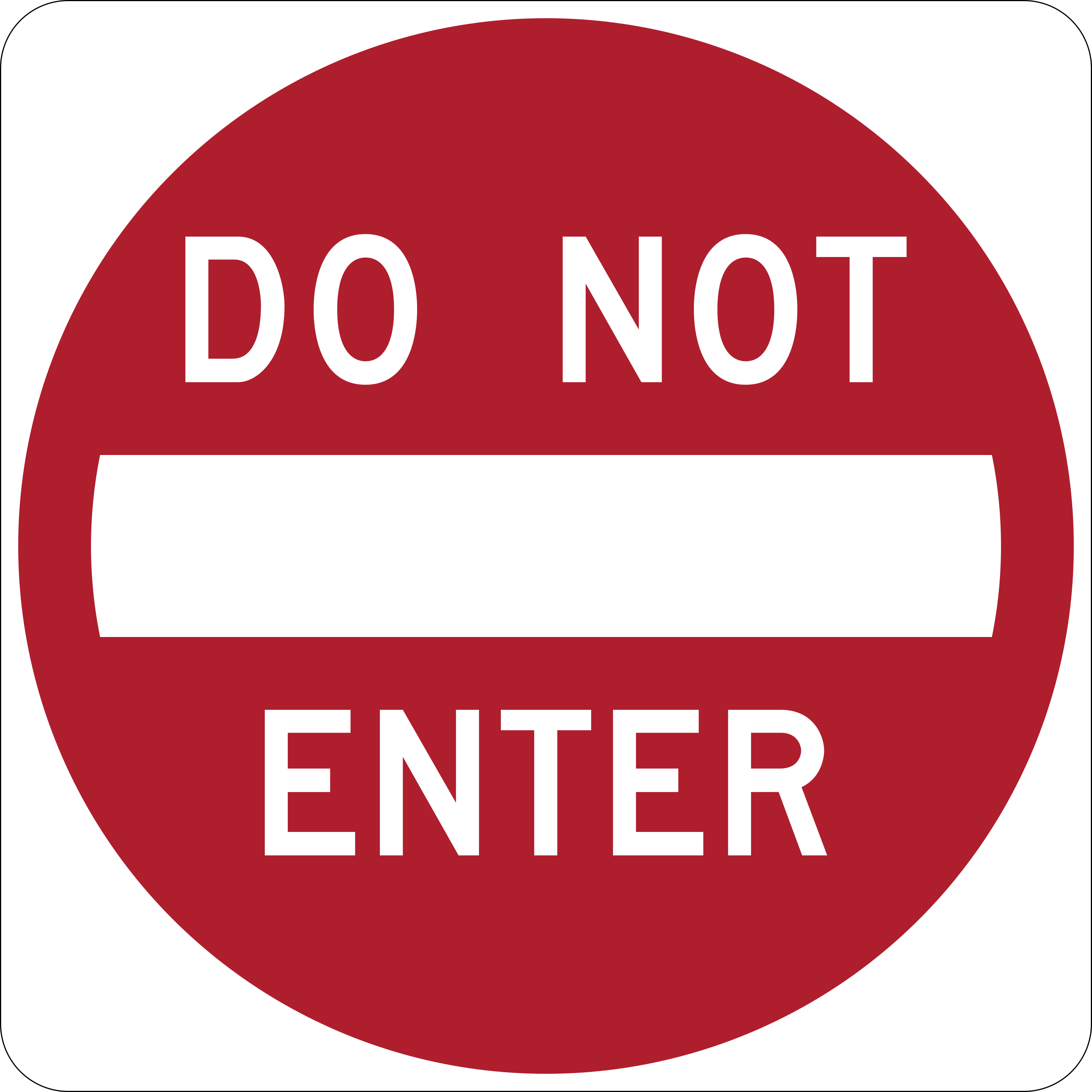
- The direction is open to local traffic only
- You cannot drive in that direction
- You may enter after stopping twice
- The road becomes two-way beyond the sign
Show answer
You cannot drive in that direction. Do Not Enter is a regulatory warning that the approach is prohibited. The sign does not create an exception for local drivers, and stopping does not turn an illegal entry into a legal one. A driver who crosses it may be traveling against vehicles headed the other way, with a serious head-on crash risk. The practical cue is simple: read the red restriction before entering a ramp, street, or roadway and choose another lawful route.
Study this in the handbook: Sign colors and shapes
18. When parking on a public road in Virginia, how should you position your vehicle?
- With the driver-side wheels on the centerline
- More than one foot from the curb
- As far from traffic as possible
- Facing against traffic on every road
Show answer
As far from traffic as possible. When parking on a public road, Virginia directs drivers to move as far from traffic as possible. If using a shoulder, pull as far onto it as possible; if next to a curb, pull close to it, because you may not park more than one foot from the curb. The centerline choice creates a hazard. On a two-way street, park on the right side of the road, so facing against traffic is not the rule; on a one-way road, you may park on either side. Look for a legal space that leaves moving traffic a clear path.
Study this in the handbook: Special lanes, painted curbs and parking
19. A Virginia teen gets a third demerit point conviction for a violation committed before age 18. What is the penalty?
- Revocation for one year or until age 18, whichever is longer
- A 90-day suspension
- A driver improvement clinic only
- Revocation for 30 days
Show answer
Revocation for one year or until age 18, whichever is longer. The third conviction for a violation committed under 18 leads to revocation of the driving privilege for one year or until the driver reaches 18, whichever is longer. For a 16-year-old that means waiting until 18, and for a 17 and a half year old it means the full year. The 90-day suspension is the second step and the clinic is the first. Thirty days is not part of this sequence.
Study this in the handbook: Suspensions, revocations and demerit points
20. When can speed-related reckless driving be considered a felony in Virginia?
- Whenever the driver is more than 20 MPH over the limit
- Whenever the driver receives a second speeding conviction
- Only when the vehicle is traveling over 85 MPH
- When the violation results in death and the operator’s license was suspended or revoked
Show answer
When the violation results in death and the operator’s license was suspended or revoked. The manual says a speed-related reckless-driving violation may be considered a felony when it results in death and the operator’s license was suspended or revoked at the time. Exceeding the limit by 20 MPH, traveling over 85 MPH, or receiving a repeat speeding conviction alone does not supply both conditions. Look for the paired facts: a death occurred, and the license already had the stated status. That combination raises the described consequence.
Study this in the handbook: Speed limits and reckless driving
QualitySpace is expanding to Virginia
We are a California-based independent insurance brokerage working on licensing in more states. We cannot help with Virginia insurance yet. Leave your email and we will let you know when we can.
Every question is written from the official Virginia Driver's Manual. Need paper? Printable VA practice test with answer key.
Last verified 2026-10-05. How we check every question · Study all 206 as flashcards
Frequently asked questions
How many questions are on this Virginia practice test?
This fixed set has 20 questions. It is test 1 of 10 from the 206 question Virginia bank. The real VA exam has a 10 question road sign section with 10 correct to pass, plus 30 knowledge questions with 24 correct to pass.
What is the passing score for the real Virginia test?
Part one: all ten road sign questions must be answered correctly; part two: you must correctly answer 24 of the 30 general knowledge questions That figure comes from the official Virginia source cited on the DMV facts page.
How does this fixed test relate to the full Virginia bank?
Each numbered test is a fixed set of questions in a fixed order, so you can retake the same test later and compare. Every test mixes road signs and the other topics in about the same proportion as the full bank. Tests 1 to 10 together cover 200 of the 206 questions in the Virginia bank, each once. The full practice page mixes the whole bank at random.
Last verified 2026-10-05. See the Virginia DMV facts page for sourced state details.
Return to the full Virginia practice test · Study road signs