
Test 2 of 10 · 20 questions · Free 2026
ME Permit Practice Test 2
Jump to the test ↓A fixed 20 question set from the Maine bank with answers and plain English explanations. The real ME exam is 30 questions, 80 percent to pass; take the full length version on the main practice page.
Question 1 of 20 · 0 right so far
All 20 questions in test 2
Every question below comes from the Maine question bank on this page. Open a question to see the correct answer and the explanation. Nothing here is hidden behind a signup.
1. What maximum speed applies when passing a Maine school during recess or during school opening and closing hours?
- 20 miles per hour
- 15 miles per hour
- 25 miles per hour
- 10 miles per hour
Show answer
15 miles per hour. The maximum near a school is 15 miles per hour during recess or while children are going to or from school during the school's opening or closing hours. This special period is narrower than every trip through a residential district, where a different default applies. A driver should use extreme care when uncertain about the timing. Watch for school activity and signs, reduce speed early, and avoid treating the school rule as permission to maintain a higher neighborhood speed while children are present.
Study this in the handbook: Speed limits and school zones
2. At what alcohol level does Maine identify operation of a motor vehicle as a criminal OUI offense?
- 0.05 grams per 100 milliliters of blood only
- 0.08 grams per 100 milliliters of blood or 210 liters of breath
- 0.10 grams per 100 milliliters of blood or 150 liters of breath
- 0.15 grams per 100 milliliters of blood only
Show answer
0.08 grams per 100 milliliters of blood or 210 liters of breath. Maine identifies 0.08 grams per 100 milliliters of blood or 210 liters of breath as the alcohol level for the criminal OUI offense described here. The breath and blood measures are paired alternatives, so the rule is not limited to a blood sample. The 0.15 figure is a higher level associated with more severe first conviction circumstances, not the basic threshold. Remember the two units together: blood uses 100 milliliters, while breath uses 210 liters.
Study this in the handbook: OUI law, implied consent and penalties
3. When you see this warning sign, what response does Maine advise?

- Move into the oncoming lane
- Accelerate to clear the area
- Stop in the travel lane immediately
- Reduce your speed
Show answer
Reduce your speed. Maine tells drivers to reduce speed when they see warning signs because the signs identify danger ahead. Slowing creates time to observe the roadway and respond to a person, vehicle, curve, or other hazard. Accelerating removes that safety margin, stopping in the travel lane can create a new hazard, and moving into oncoming traffic is unsafe. The pictured symbol is a prompt to become more cautious, not a command to make a sudden maneuver. Ease off the accelerator, scan ahead, and keep a controlled lane position.
Study this in the handbook: Speed limits and school zones
4. When approaching an intersection, what must you do if another vehicle has already entered it?
- Enter first if your vehicle is traveling faster
- Yield the right-of-way to that vehicle
- Sound the horn and force the other vehicle to stop
- Turn across its path if you have a larger vehicle
Show answer
Yield the right-of-way to that vehicle. A vehicle already inside the intersection has begun its movement through the conflict area. The approaching driver must yield rather than enter and create a crossing problem. Speed, vehicle size, and a horn do not change that obligation. Scan before crossing, look for traffic controls and pedestrians, and wait until the path is open. This is also a useful reminder that an approaching green light does not make it safe to enter when traffic ahead has blocked the intersection.
Study this in the handbook: Right of way at intersections and highways
5. How many young adults are killed each year by drinking and driving, according to the Maine handbook?
- Approximately 8,500
- About 100
- About 1 million
- About 500
Show answer
Approximately 8,500. Approximately 8,500 young adults are killed and an additional 40,000 are crippled or disfigured every year due to drinking and driving in this country. The handbook calls alcohol related crashes the leading cause of death for young people ages 16 to 24. Alcohol is a drug that has damaged or destroyed the lives of tens of millions of drinkers and their families. Protect your friends by not drinking and driving and by encouraging them to do likewise.
Study this in the handbook: How alcohol affects driving
6. What must every Maine driver involved in a fatal or likely fatal crash do?
- Submit to a chemical test
- Nothing unless arrested
- Post bail
- Surrender the license
Show answer
Submit to a chemical test. Every driver involved in a fatal motor vehicle accident, or an accident where a death is likely to occur, must submit to a chemical test. The requirement applies to every such driver, not only to someone who has been arrested or appears impaired. Failure to submit to the test results in a one year license suspension. Posting bail or surrendering a license is not the duty the handbook describes for these crashes.
Study this in the handbook: OUI law, implied consent and penalties
7. Which shape identifies a Maine stop sign?
- Down-pointing triangle
- Five-sided pentagon
- Four-sided rectangle
- Eight-sided octagon
Show answer
Eight-sided octagon. A stop sign has eight sides, making it an octagon, and it is red with white letters. The pentagon is associated with school warnings, the triangle is the yield shape, and a rectangle is used for many regulatory or guide signs. Recognizing the outline matters when weather, darkness, or foliage makes the lettering harder to read. Once the octagonal sign is visible, prepare to stop at the line or crosswalk, or at the nearest point before the intersection when neither is marked.
Study this in the handbook: Stop, yield, regulatory and guide signs
8. On an undivided Maine highway, what must a driver do when a school bus is stopped with red lights flashing?
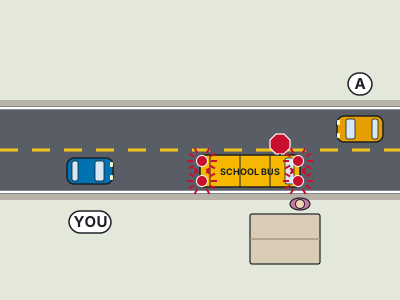
- Stop only if approaching from behind
- Pass slowly after checking for children
- Stop completely and wait until the bus resumes or the driver signals
- Move onto the shoulder and continue
Show answer
Stop completely and wait until the bus resumes or the driver signals. On an undivided highway, a stopped school bus with flashing red lights requires traffic approaching from either direction to make a complete stop. The driver waits while children board or leave and does not proceed until the bus moves or the school bus driver gives a signal. Looking for visible children is not a substitute for stopping. The divided-highway exception depends on a solid divider, so do not apply it to an undivided road.
Study this in the handbook: Intersections, lane changes, expressways and school buses
9. Up to what age must a Maine license applicant present a birth certificate or passport to prove date of birth?
- Up to age 18
- Up to age 16
- At any age
- Up to and including age 22
Show answer
Up to and including age 22. Birth certificates or passports are required from applicants up to and including age 22 to determine date of birth. Photocopies of birth certificates must carry an embossed seal or stamp of the issuing agency, and notarized copies are not acceptable. Older applicants may prove date of birth with other listed documents, but every applicant must still provide acceptable documentary evidence of legal presence in the United States before a license is issued or renewed.
Study this in the handbook: Getting a learner's permit and a license
10. What does a steady yellow traffic light warn the driver that the driver should do?
- Ignore the signal if no vehicle is nearby
- Accelerate because the light will stay yellow
- Stop only after crossing the intersection
- Begin slowing because the light is about to turn red
Show answer
Begin slowing because the light is about to turn red. A steady yellow light warns that the signal is about to change to red, so the driver should begin slowing. The aim is to clear the intersection safely without racing the signal. Accelerating treats a warning as permission to increase risk, and waiting until after the intersection is too late to respond. Check traffic behind you, brake smoothly when safe, and stop before the intersection if you can do so without causing a collision.
Study this in the handbook: Traffic signals, arrows and lane lights
11. Which months are identified as Maine's peak moose collision months?
- May and June
- January and February
- August and September
- November and December
Show answer
May and June. The manual identifies May and June as the peak months for moose collisions. Autumn incidents can also occur, and wildlife crashes are possible throughout the year, but those facts do not replace the specific peak period. November and December are therefore not the answer simply because deer activity is discussed in autumn. A practical cue is to connect late spring with moose collision risk and remain alert after sunset, when dark animals can be harder to see.
Study this in the handbook: Moose and deer
12. Which vehicles are exempt from Maine's title requirement?
- Vehicles more than 25 years old, motorcycles under 300 cc, and trailers with an unloaded weight of 3,000 pounds or less
- Any vehicle bought from a dealer
- No vehicles are exempt
- All vehicles under 10,000 pounds
Show answer
Vehicles more than 25 years old, motorcycles under 300 cc, and trailers with an unloaded weight of 3,000 pounds or less. Maine requires a certificate of title for most vehicles, but vehicles more than 25 years old, motorcycles with an engine size less than 300 cc, and trailers with an unloaded weight of 3,000 pounds or less are exempt. For other vehicles not bought from a Maine dealer, you complete a title application and submit the prior title or manufacturer's certificate of origin properly transferred to you.
Study this in the handbook: Title, registration, insurance and inspection
13. A Maine driver is convicted of vehicular manslaughter and alcohol was involved. What happens to the driver's license?
- It is revoked for exactly 5 years
- It is suspended for 150 days
- It is revoked for at least one year
- It is revoked permanently
Show answer
It is revoked permanently. Vehicular manslaughter brings revocation for at least 5 years, and when alcohol is involved the revocation is permanent. Five years is the minimum for a case without alcohol. One hundred fifty days is the first OUI minimum, far short of this penalty. At least one year is the revocation listed for a habitual offender. Maine treats a death caused by a driver under the influence as grounds for losing the license for life.
14. What determines whether a pass is safe after signs and lane markings are checked?
- The driver’s assessment of traffic and road conditions
- The speed of the vehicle being passed alone
- The presence of a passenger in the car
- Whether the vehicle has automatic headlights
Show answer
The driver’s assessment of traffic and road conditions. Only the driver can determine whether a pass is safe. Pavement markings and signs provide restrictions, but the driver must also judge sight distance, oncoming traffic, road width, speed, and escape space. A broken line does not guarantee a safe opening, and a clear view can disappear quickly near a hill or curve. Before moving left, search ahead and behind, signal, and abandon the maneuver if any condition changes. Safety requires a complete traffic assessment, not reliance on one marking alone.
Study this in the handbook: Passing and no passing zones
15. What does the number on this SPEED LIMIT sign represent?
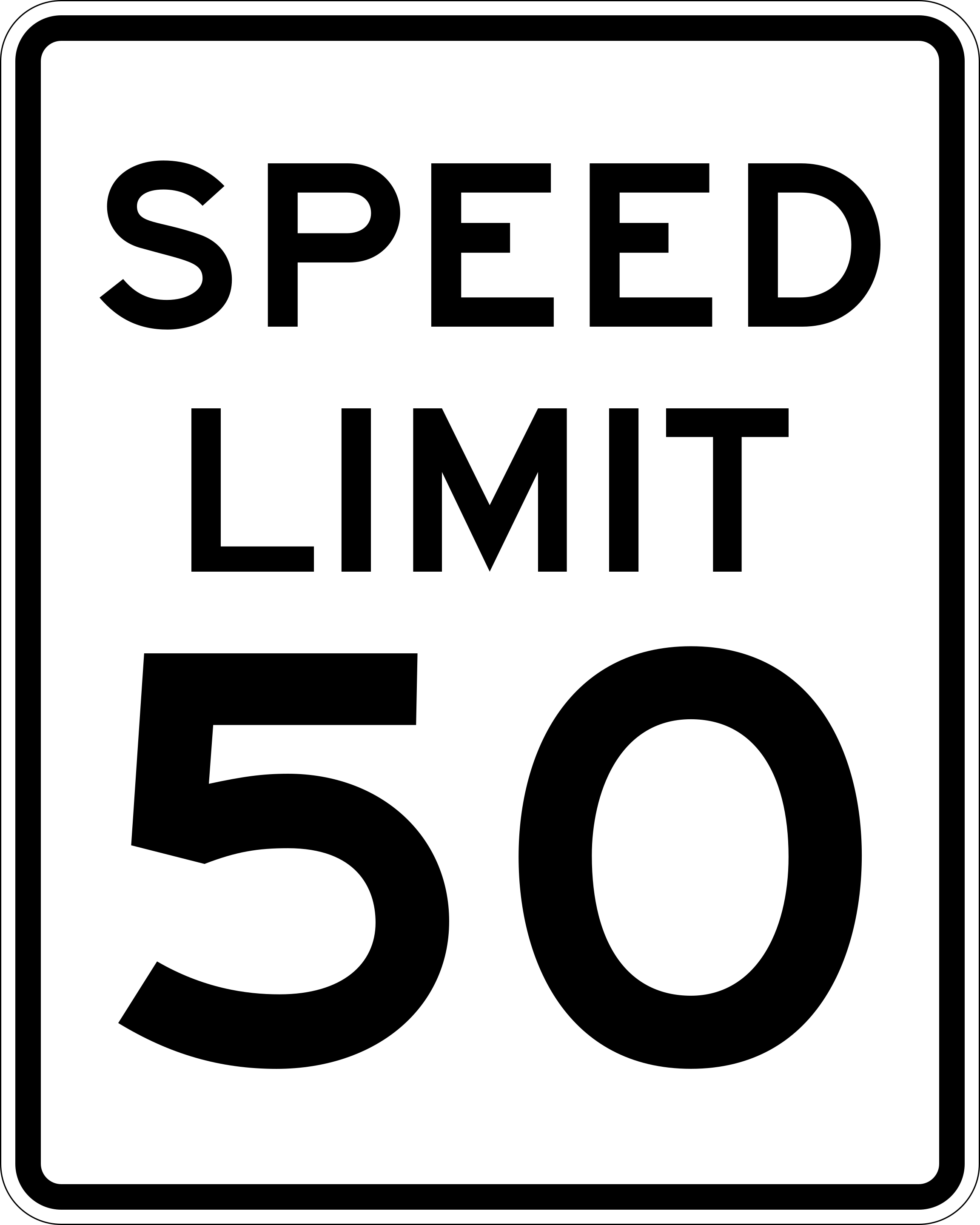
- A suggested speed that may always be exceeded safely
- The legal speed when conditions are ideal
- The minimum speed required in every weather condition
- A speed reserved for trucks and buses
Show answer
The legal speed when conditions are ideal. Maine describes black and white speed limit signs as indicating the legal speed when conditions are ideal. The posted number is not a guarantee that the same speed is safe during rain, ice, congestion, darkness, or another hazard. It is also not merely a suggestion, a universal minimum, or a commercial-vehicle-only rule. Drivers must reduce speed when conditions demand it, even if the posted limit is higher. The cue is to read the number as a maximum for ideal conditions, not permission to ignore risk.
Study this in the handbook: Warning, railroad and work zone signs
16. When approaching this YIELD sign, what must you do before entering or crossing the road?
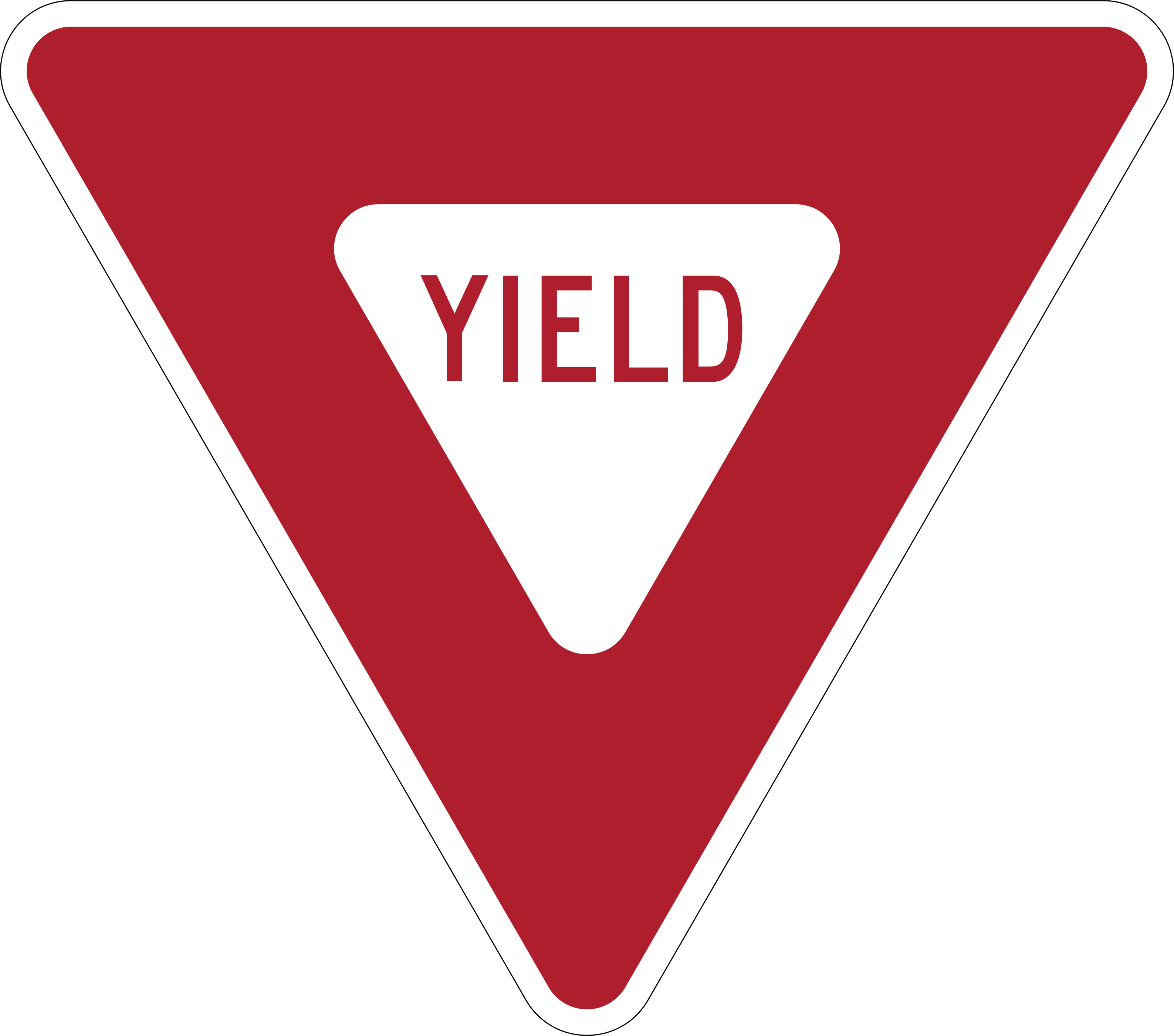
- Accelerate to enter before other traffic arrives
- Stop every time, even when the road is empty
- Slow down and yield to traffic or pedestrians with the right-of-way
- Continue without looking because the sign gives priority
Show answer
Slow down and yield to traffic or pedestrians with the right-of-way. A yield sign tells the driver to slow and wait for traffic to clear on the road being entered or crossed. The driver must yield to traffic or pedestrians that have the right-of-way before proceeding. A complete stop may be needed, but the sign does not require stopping in every empty-road situation. Accelerating or proceeding without checking reverses the sign's purpose. A good visual habit is to reduce speed early, scan both directions, and stop if the available gap is not safe.
Study this in the handbook: Warning, railroad and work zone signs
17. How many crashes occur between cars and large vehicles each year, according to the Maine handbook?
- About 1,000
- About 25,000
- Over 250,000
- About 5 million
Show answer
Over 250,000. Over 250,000 crashes occur between cars and large vehicles each year, and a loaded truck at 55 mph takes at least 335 feet to stop. Trucks have large blind spots, need room to turn, and cannot brake like a car, so stay out of the no zones, pass promptly, and never cut in front of a truck and slow down.
Study this in the handbook: Pedestrians, bicycles, motorcycles and large vehicles
18. What minimum following distance does Maine's manual recommend between your car and the vehicle ahead?
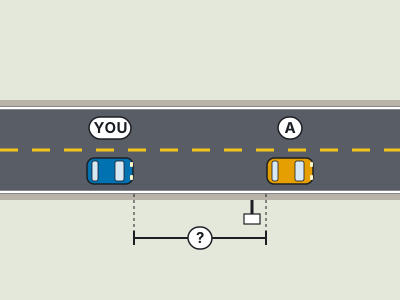
- One second at every speed
- At least four seconds
- One car length regardless of speed
- Exactly ten seconds in normal conditions
Show answer
At least four seconds. The manual sets at least four seconds as the normal following cushion. Measure it by watching the vehicle ahead pass a fixed point, then counting until your car reaches that point. One second and one car length may disappear too quickly when speed or road conditions change. Ten seconds is not the normal minimum. Add more space on slick roads, behind motorcycles or bicycles, and when following large vehicles.
Study this in the handbook: Following distance, headlights and signals
19. When an emergency vehicle approaches with a siren and flashing light, what must a Maine driver do?
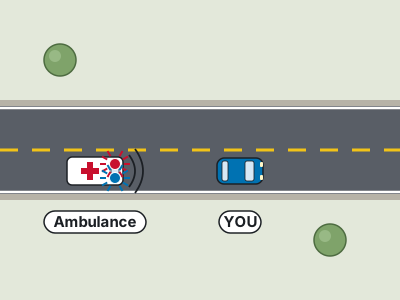
- Follow the emergency vehicle in its travel lane
- Continue through the intersection before checking mirrors
- Yield, move right clear of the intersection, and stop
- Pull left and stop beside the center line
Show answer
Yield, move right clear of the intersection, and stop. An emergency responder with the specified warning signals has priority. Move immediately to the right side of the roadway, clear of any intersection, and stop until the vehicle has passed. Remaining in the intersection can block the response path, while continuing forward treats the warning as optional. Check mirrors, signal the movement when appropriate, and stop where the vehicle has room to pass. This response applies to an active response vehicle, not merely a parked service vehicle with no warning operating. The practical cue is lights or a siren demanding a clear path.
Study this in the handbook: Emergency vehicles, move over and traffic stops
20. What happens to a Maine driver adjudicated for failing to produce evidence of insurance?
- Nothing on a first offense
- A $25 fine only
- They must file an SR-22 certificate or face suspension of license and registration privileges
- Vehicle confiscation
Show answer
They must file an SR-22 certificate or face suspension of license and registration privileges. If you are adjudicated of failure to produce evidence of insurance, you will be required to file proof of financial responsibility through an SR-22 insurance certificate or face suspension of your license and registration privileges. An uninsured motorist who causes injury or property damage of $1,000 or more may not drive until proof of financial responsibility or proper insurance is shown.
Study this in the handbook: Title, registration, insurance and inspection
QualitySpace is expanding to Maine
We are a California-based independent insurance brokerage working on licensing in more states. We cannot help with Maine insurance yet. Leave your email and we will let you know when we can.
Every question is written from the official Maine Driver's License Manual. Need paper? Printable ME practice test with answer key.
Last verified 2026-10-05. How we check every question · Study all 218 as flashcards
Frequently asked questions
How many questions are on this Maine practice test?
This fixed set has 20 questions. It is test 2 of 10 from the 218 question Maine bank. The real ME exam asks 30 questions and you need 24 correct.
What is the passing score for the real Maine test?
You must answer a minimum of 24 correctly to pass the test (24 of 30) That figure comes from the official Maine source cited on the DMV facts page.
How does this fixed test relate to the full Maine bank?
Each numbered test is a fixed set of questions in a fixed order, so you can retake the same test later and compare. Every test mixes road signs and the other topics in about the same proportion as the full bank. Tests 1 to 10 together cover 200 of the 218 questions in the Maine bank, each once. The full practice page mixes the whole bank at random.
Last verified 2026-10-05. See the Maine DMV facts page for sourced state details.