
Test 10 of 10 · 20 questions · Free 2026
ME Permit Practice Test 10
Jump to the test ↓A fixed 20 question set from the Maine bank with answers and plain English explanations. The real ME exam is 30 questions, 80 percent to pass; take the full length version on the main practice page.
Question 1 of 20 · 0 right so far
All 20 questions in test 10
Every question below comes from the Maine question bank on this page. Open a question to see the correct answer and the explanation. Nothing here is hidden behind a signup.
1. Under Maine's under-21 alcohol rule, may a driver drive after consuming any amount of alcohol?
- Yes, if the driver stays below 0.08 BAC
- No, driving after any amount is prohibited
- Yes, if the alcohol was consumed with food
- Yes, if the trip is less than five miles
Show answer
No, driving after any amount is prohibited. The manual says a person under 21 may not drive after consuming any amount of alcohol. The 0.08 option confuses the underage rule with an adult OUI threshold, while food and trip length do not create exceptions. Alcohol can slow reactions and delay reflexes even when a driver feels normal. For a test question, separate age based zero tolerance from the numeric thresholds discussed elsewhere in the OUI section. The practical cue is the driver's age: under 21 plus any alcohol means do not operate the vehicle, regardless of distance, meal, or apparent sobriety.
Study this in the handbook: Under 21, conditional licenses and open containers
2. What is the best way to reduce the chance of hydroplaning on a wet road?
- Increase speed to cross the water before sliding
- Use worn tires so water escapes more quickly
- Keep the tires in good condition and reduce speed
- Make frequent sharp steering changes to test traction
Show answer
Keep the tires in good condition and reduce speed. The manual identifies two practical defenses against hydroplaning: maintain tires in good condition and keep speed down on wet pavement. Worn tires lose contact at lower speeds, so the worn-tire choice reverses the safety advice. Speeding reduces the tires' ability to wipe water from the surface, while sharp steering changes can trigger a skid when contact is reduced. The cue is heavy rain or a visibly wet road: ease off the pace early and remember that tire condition affects how soon hydroplaning can begin.
Study this in the handbook: Speed limits and school zones
3. How many crashes each year does NHTSA attribute to sleepiness at the wheel, according to the Maine handbook?
- About 1,000
- About 10,000
- About 5 million
- As many as 240,000
Show answer
As many as 240,000. The National Highway Traffic Safety Administration estimates that each year as many as 240,000 accidents are related to sleepiness at the wheel. The handbook explains that too little sleep builds a sleep debt, and the only way to erase that debt is to get more sleep. At the first sign of drowsiness you must act rather than fight it: pull over at a rest stop or service area to stretch or nap, or change drivers if possible.
Study this in the handbook: Vision, fatigue and distractions
4. The pictured curvy road warning sign should prompt which driving choice?

- Speed up to clear the warning area quickly
- Slow down before the danger and remain ready to react
- Stop in the travel lane and wait for an escort
- Pass traffic by using the shoulder
Show answer
Slow down before the danger and remain ready to react. Maine's warning-sign guidance is preventive. These signs identify danger ahead, and the driver should reduce speed to create time for a response. A curvy road can require repeated steering adjustments, so rushing through it defeats the purpose of the warning. Stopping in a live lane is not the ordinary response to a warning sign and could create a new hazard. The shoulder is not a passing lane. The practical cue is to slow before reaching the first bend, look through the turns, and maintain a controlled path while watching for traffic, pedestrians, and changing pavement.
Study this in the handbook: Speed limits and school zones
5. Where are Maine traffic circles or roundabouts sometimes built?
- At intersections of heavily traveled streets and roads
- Only inside parking garages
- Only at railroad crossings
- At the end of every one-way street
Show answer
At intersections of heavily traveled streets and roads. Traffic circles and roundabouts are sometimes built where heavily traveled streets and roads meet. Their circular design manages intersecting movements around a center island, but it does not eliminate the need to yield or follow signs and pavement markings. Slow before entering, observe vehicles already circulating, and choose the correct lane for the intended exit. The important recognition cue is the circular intersection itself, where traffic flows around the island instead of crossing straight through a conventional junction.
Study this in the handbook: Turns, traffic circles and roundabouts
6. After a vehicle breaks down on the roadway, how far behind it should emergency flares be placed?
- About 20 to 30 feet
- About 200 to 300 feet
- About 500 to 600 feet
- Directly in front of the vehicle
Show answer
About 200 to 300 feet. Emergency flares placed well behind a disabled vehicle give approaching drivers advance notice that something is in or near the roadway. The manual specifies a range of 200 to 300 feet, not a short placement close to the car. A position directly in front would not warn traffic soon enough, while the 500 to 600 foot range is not the figure given for this breakdown procedure. After pulling away from traffic, turn on the flashers and make the disabled vehicle visible from a substantial distance.
Study this in the handbook: Collisions, crash reports and first aid
7. What hazard does this round yellow RXR sign warn you to approach?

- A roundabout with no train tracks
- A pedestrian-only plaza ahead
- A railroad crossing ahead
- A bicycle lane crossing the roadway
Show answer
A railroad crossing ahead. The round yellow sign with the RXR symbol warns that a railroad crossing is ahead. It gives the driver time to slow, look in both directions, listen, and be ready to stop. It is not a sign for a roundabout, pedestrian plaza, or bicycle lane. Rail equipment can approach quickly, and warning devices may not always be working, so the driver should not wait for a flashing light before becoming cautious. See the sign as an advance railroad warning and prepare before reaching the tracks.
Study this in the handbook: Warning, railroad and work zone signs
8. How large a gap does the Maine manual recommend for merging with traffic?
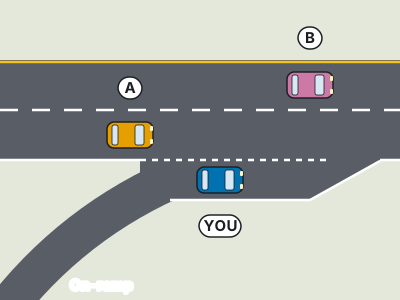
- A gap of exactly one car length
- A gap of one second
- A gap of four seconds
- A gap of ten vehicle lengths
Show answer
A gap of four seconds. Merging safely requires a four-second gap so both your vehicle and the car behind you have a safe following distance. The one-second and one-car-length choices are too small to provide dependable reaction room. Ten vehicle lengths is not the manual's measurement and varies with vehicle size. Do not squeeze into a narrow opening. If several lanes must be crossed, change one lane at a time.
Study this in the handbook: Following distance, headlights and signals
9. When may a driver in Maine turn right at a red traffic light?
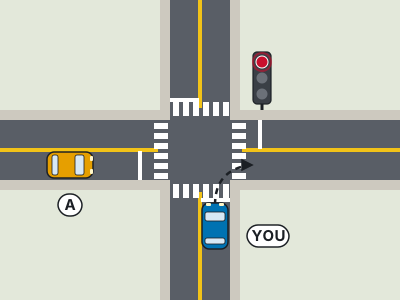
- After stopping, unless a sign prohibits it, and yielding to traffic and pedestrians
- Without stopping when no vehicle is visible
- Only after waiting for the light to turn green
- Before stopping if the turn is from a one-way street
Show answer
After stopping, unless a sign prohibits it, and yielding to traffic and pedestrians. Maine permits a right turn on red only after the driver stops, unless a posted sign forbids that turn. The turning driver must yield to pedestrians and all vehicle traffic. A clear-looking intersection does not erase the stop requirement, and a one-way street does not create an exception. Waiting for green is more restrictive than the stated rule, though it would avoid the risk of an improper turn.
Study this in the handbook: Traffic signals, arrows and lane lights
10. Who is exempt from Maine's seat belt law while delivering mail?
- A rural mail carrier of the United States Postal Service while engaged in delivery
- Anyone driving under 25 mph
- All delivery drivers
- No one is exempt
Show answer
A rural mail carrier of the United States Postal Service while engaged in delivery. A rural mail carrier of the United States Postal Service is not required to be secured in a seat belt while engaged in the delivery of mail. The handbook lists two other exceptions: a newspaper delivery person during actual delivery duties that require frequent entry into and exit from a vehicle, and a taxicab or limousine operator, who is not responsible for belting a passenger carried for a fee. Other delivery drivers and slow speeds are not listed exceptions.
Study this in the handbook: Seat position, seat belts and child safety
11. How much clear road does the Maine handbook say you need to pass at highway speed?
- About 200 feet
- Over 1,600 feet, about one third of a mile
- About 500 feet
- About 5 miles
Show answer
Over 1,600 feet, about one third of a mile. At highway speeds you will travel over 800 feet in 10 to 12 seconds, and so will the oncoming car, which means you need over 1,600 feet, about one third of a mile, to pass safely. Use your odometer to learn what that distance looks like. Oncoming vehicles that far away can seem to be standing still, and you should never pass when a curve or hill blocks your view.
Study this in the handbook: Passing and no passing zones
12. Why should a driver keep scanning the road instead of staring at one spot?
- To avoid checking mirrors while traveling straight
- To make the vehicle use less fuel at every speed
- To notice hazards early and gain time to change speed or direction
- To replace the need for turn signals near intersections
Show answer
To notice hazards early and gain time to change speed or direction. The manual connects continual searching with early hazard detection. Seeing a problem sooner gives you time to alter speed or direction before the situation becomes urgent. The fuel-saving claim is unrelated, and scanning does not eliminate mirror checks or signaling duties. A useful driving cue is to keep your eyes moving through the space ahead, then check the sides and rear as traffic conditions change. This search pattern is especially valuable near intersections, parked vehicles, curves, and places where another road user could appear suddenly.
Study this in the handbook: Vision, fatigue and distractions
13. How long does Maine law give you to notify the Bureau of Motor Vehicles after you change your name or address?
- 10 days
- 30 days
- 60 days
- 90 days
Show answer
30 days. Maine law requires notice to the Bureau of Motor Vehicles within 30 days of a name or address change. Ten days is shorter than the law requires, and 60 or 90 days are too long. Keeping the address current also matters because the renewal notice is mailed to the address on file about 45 days before the license expires. The same 30 day deadline covers a change of name as well as a change of address.
Study this in the handbook: Getting a learner's permit and a license
14. How long do demerit points stay on a Maine driving record?
- Until they are one year old
- Until they are two years old
- Until they are three years old
- They are never erased
Show answer
Until they are one year old. Maine erases demerit points from a driver's record when the points become one year old. Two and three years are longer than the period the handbook states. Points are not permanent. A driver can also lower a point total by completing an approved driver improvement course. A driver who reaches 6 points receives a warning, and 12 points or more brings a suspension. Because points drop off at one year, a year without new violations lets the total fall.
Study this in the handbook: Young driver restrictions, points and suspensions
15. How old must a Maine applicant be to get a driver's license without completing an approved driver education course?
- 16
- 17
- 21
- 18
Show answer
18. Maine allows a license at 16 only for an applicant who has completed an approved driver education course. Without that course, the applicant must be at least 18. Seventeen is still under the no course threshold. Twenty one is the age tied to other rules, such as the school bus license, not to skipping driver education. Completing the approved course is what allows a younger applicant to qualify at 16.
Study this in the handbook: Getting a learner's permit and a license
16. For how long is the first Maine license issued to a new applicant under age 21 provisional?
- One year
- Six months
- Two years
- Until the driver's 21st birthday
Show answer
Two years. The first license for a new applicant younger than 21 is provisional for two years. One year is the period stated for someone who is at least 21 when receiving a first license, which makes that choice an especially easy age-based mix-up. During the provisional period, a moving violation can trigger a 30 day suspension, with more severe consequences for later offenses. Remember the distinction as a timeline: under 21 means two provisional years, while a first license issued at 21 or older has a one year period.
Study this in the handbook: Young driver restrictions, points and suspensions
17. How should a driver cross Maine railroad tracks when the crossing is safe?
- Drive around any lowered barrier
- Stop on the tracks to check for a second train
- Shift gears while crossing to reduce speed
- Look both ways and cross quickly
Show answer
Look both ways and cross quickly. When crossing railroad tracks, Maine tells drivers to look both ways and cross quickly. The instruction is not permission to stop on the rails or to ignore signals and gates. If a train is present, wait until it is well down the track, and if a signal or barrier is active, wait for the crossing to show that movement is safe. Approach with enough space to clear the tracks completely, then continue without pausing on the crossing.
Study this in the handbook: Warning, railroad and work zone signs
18. What do Maine warning signs generally tell drivers?
- That a destination service is available immediately
- That the displayed speed is always the required minimum
- That the road is reserved for emergency vehicles
- That danger lies ahead and speed should be reduced
Show answer
That danger lies ahead and speed should be reduced. Warning signs alert drivers to danger ahead. Maine says drivers who see them should reduce speed so they have time to react if trouble develops. A warning is not automatically a minimum-speed instruction, nor does it reserve the roadway for emergency vehicles. Destination and service information belongs to guide signs, which are a separate category. The useful habit is to identify the hazard, ease off the accelerator before reaching it, and scan for traffic, people, pavement changes, or blocked sight lines. Yellow diamond signs are an early planning cue, not permission to continue unchanged.
Study this in the handbook: Speed limits and school zones
19. What does Maine's written driver's license test measure?
- Understanding of traffic laws, regulations, driving skills, vehicle handling, and highway signs
- Only the applicant's eyesight and peripheral vision
- Only the ability to control a vehicle during a road test
- Knowledge of vehicle repair and insurance billing
Show answer
Understanding of traffic laws, regulations, driving skills, vehicle handling, and highway signs. The written test checks understanding of traffic laws, regulations, driving skills, vehicle handling, and highway signs. Vision and peripheral vision belong to the separate vision screening, while vehicle control and reactions are assessed during the road test. Vehicle repair and insurance billing are not listed as the written test's scope. When distinguishing Maine's examinations, associate written testing with knowledge, vision screening with sight, and the road test with actual vehicle control.
Study this in the handbook: Young driver restrictions, points and suspensions
20. What is a shared center lane bordered by yellow lines intended for?
- Straight-through travel during heavy traffic
- Passing slower vehicles in either direction
- Left turns by traffic traveling in either direction
- Stopping for short-term roadside parking
Show answer
Left turns by traffic traveling in either direction. The shared center lane is a turning space, not a travel lane for moving straight or passing. Vehicles from either direction may enter it when preparing for a left turn, after checking mirrors, traffic ahead, and the blind spot. Using it as a shortcut through congestion can place opposing drivers into the same narrow area. Signal before moving into the lane, wait for a clear opening, and complete the left turn rather than continuing down the center.
Study this in the handbook: Lane markings, lane use and special lanes
QualitySpace is expanding to Maine
We are a California-based independent insurance brokerage working on licensing in more states. We cannot help with Maine insurance yet. Leave your email and we will let you know when we can.
Every question is written from the official Maine Driver's License Manual. Need paper? Printable ME practice test with answer key.
Last verified 2026-10-05. How we check every question · Study all 218 as flashcards
Frequently asked questions
How many questions are on this Maine practice test?
This fixed set has 20 questions. It is test 10 of 10 from the 218 question Maine bank. The real ME exam asks 30 questions and you need 24 correct.
What is the passing score for the real Maine test?
You must answer a minimum of 24 correctly to pass the test (24 of 30) That figure comes from the official Maine source cited on the DMV facts page.
How does this fixed test relate to the full Maine bank?
Each numbered test is a fixed set of questions in a fixed order, so you can retake the same test later and compare. Every test mixes road signs and the other topics in about the same proportion as the full bank. Tests 1 to 10 together cover 200 of the 218 questions in the Maine bank, each once. The full practice page mixes the whole bank at random.
Last verified 2026-10-05. See the Maine DMV facts page for sourced state details.