
Test 1 of 10 · 20 questions · Free 2026
ME Permit Practice Test 1
Jump to the test ↓A fixed 20 question set from the Maine bank with answers and plain English explanations. The real ME exam is 30 questions, 80 percent to pass; take the full length version on the main practice page.
Question 1 of 20 · 0 right so far
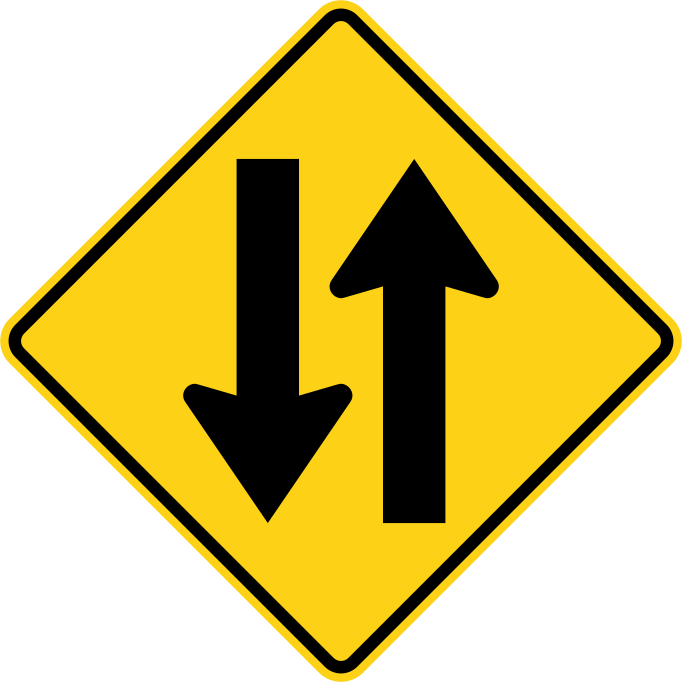
All 20 questions in test 1
Every question below comes from the Maine question bank on this page. Open a question to see the correct answer and the explanation. Nothing here is hidden behind a signup.
1. What kinds of information do Maine traffic signs provide?
- Only fuel prices and service hours
- Rules, hazards, and road locations
- Only weather forecasts
- Only vehicle registration instructions
Show answer
Rules, hazards, and road locations. Maine says traffic signs tell drivers about rules, hazards, and road locations. That broad purpose includes regulatory instructions, warnings, and information about where the roadway leads or what services are nearby. The other choices are too narrow and are not the function described in the manual. Read the sign category and symbol together: the same roadway may use different signs to control movement, warn of danger, or identify a location. This helps distinguish a warning from a required action.
Study this in the handbook: Traffic signals, arrows and lane lights
2. When changing lanes is unsafe near a stopped emergency vehicle, what must the driver do?
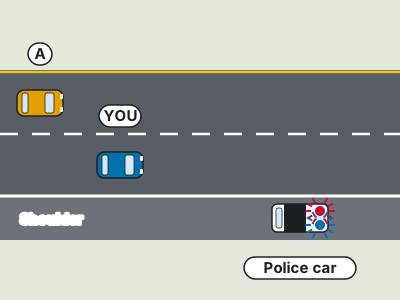
- Slow down and use caution while passing
- Maintain normal speed to avoid delay
- Stop in the travel lane beside the vehicle
- Pass on the shoulder without reducing speed
Show answer
Slow down and use caution while passing. The move-over rule does not make an unsafe lane change acceptable. When the adjacent lane cannot be entered safely, the driver should slow down and use caution while passing the stopped emergency vehicle. Normal speed leaves less time to react, and passing on the shoulder at speed is not the instruction. Look well ahead, reduce speed early, maintain control of the vehicle, and give the roadside activity as much clearance as the available lane permits.
Study this in the handbook: Emergency vehicles, move over and traffic stops
3. What color and markings do Maine warning signs usually have?
- Green with red lettering
- Blue with white lettering
- Yellow with black lettering or symbols
- White with black lettering only
Show answer
Yellow with black lettering or symbols. Maine describes warning signs as usually yellow with black lettering or symbols. That visual combination helps drivers recognize a warning before reading every detail of the sign. The blue, green, and white choices use colors associated with other sign purposes or omit the warning design described in the manual. Once the yellow and black pattern catches your attention, scan for the roadway condition, reduce speed when needed, and prepare to react. Color and markings are recognition cues, not permission to ignore the sign’s message.
Study this in the handbook: Traffic signals, arrows and lane lights
4. Under Maine's violation free credit system, what is the most credit points a driver can build up?
- Two
- Six
- Ten
- Four
Show answer
Four. Maine awards one violation free credit point for each calendar year with no convictions or suspensions, and a driver may accumulate up to four of these credits. Two is fewer than the cap. Six and ten are more than the law allows. The credit rewards a clean record over time, one calendar year at a time. Each credit point takes a full calendar year free of convictions or suspensions to earn.
Study this in the handbook: Young driver restrictions, points and suspensions
5. How should a Maine driver use right of way rules when another road user may not act as expected?
- Stop in every intersection even when traffic is clear
- Accelerate to force the other driver to yield
- Assume the legal priority guarantees safety
- Use the right of way sensibly and never insist on it
Show answer
Use the right of way sensibly and never insist on it. Maine's guidance says a driver with the right of way should use it sensibly and never insist on it. Legal priority does not protect a driver from another person's mistake, so accelerating to force compliance or assuming safety is guaranteed can create a crash. Stopping in every intersection is not the stated solution either. The practical cue is defensive awareness: check the actual situation, look for what other road users are doing, and preserve a safe escape option even when priority appears clear.
Study this in the handbook: Right of way at intersections and highways
6. When making a left turn, which traffic has priority over the turning vehicle?
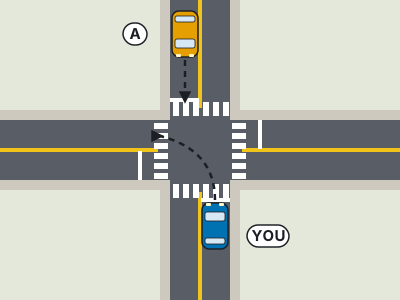
- Only vehicles approaching from behind
- Oncoming traffic that is close enough to create a hazard
- No traffic, because the turn signal creates priority
- Vehicles parked along the left curb
Show answer
Oncoming traffic that is close enough to create a hazard. A left turn crosses the path of vehicles traveling toward you, so the turn must wait when an oncoming vehicle is near enough to create danger. Signaling communicates intent but does not grant priority or make the other driver stop. Vehicles behind you and parked cars are not the traffic described by the manual's left-turn rule. Set up from the leftmost portion of your lane, watch the approaching lane, and turn only after the gap is safely available.
Study this in the handbook: Turns, traffic circles and roundabouts
7. What does a green arrow above a reversible lane permit you to do?
- Enter the lane only to park temporarily
- Use that lane during the time the arrow is displayed
- Use the lane against the indicated direction of travel
- Treat the lane as closed until a red X appears
Show answer
Use that lane during the time the arrow is displayed. A reversible lane changes its permitted direction at certain times, so the overhead signal controls whether entry is allowed. The green arrow authorizes use of that lane, while a red X means the lane cannot be used. Parking is not the purpose of the control, and a driver should never travel against the direction shown by the lane arrangement. Before entering, check the overhead display and the surrounding markings so you know which lanes are available at that moment.
Study this in the handbook: Lane markings, lane use and special lanes
8. How long do Maine's restrictions for a newly licensed driver under 18 remain in effect?
- 90 days
- 180 days
- 270 days
- Until the driver turns 21
Show answer
270 days. The Maine manual says the young driver restrictions are in effect for 270 days, counted from when the road test was passed. Maine Revised Statutes Title 29-A, section 1311 sets the same 270 day period and counts it from license issuance, and the period can run past the 18th birthday. Ninety days and 180 days both fall short of that period, and age 21 is a different milestone tied to the provisional license. A violation brings a suspension and adds another 270 days.
Study this in the handbook: Young driver restrictions, points and suspensions
9. What licensing consequence follows a violation of Maine's under 18 driver restrictions?
- The restriction period is extended by 270 days and may continue beyond age 18
- The restrictions end immediately at age 18
- The driver receives only a written warning
- The permit is renewed for another 2 years without suspension
Show answer
The restriction period is extended by 270 days and may continue beyond age 18. A violation brings a license suspension and a 270 day extension of the restrictions. The extension may carry the restrictions beyond the driver's 18th birthday, so turning 18 does not erase an unfinished penalty. A warning alone understates the consequence, and permit renewal is unrelated to this violation rule. The key cue is extension: the violation adds time to the existing restriction period rather than replacing it with a new age based deadline.
Study this in the handbook: Young driver restrictions, points and suspensions
10. What does Maine law prohibit a driver from doing when a posted speed limit is in effect?
- Slowing for a roadway hazard
- Driving below the posted limit in rain
- Choosing a speed below the number
- Exceeding the posted limit
Show answer
Exceeding the posted limit. Maine law makes it illegal to exceed the posted speed limit. The sign's number is a maximum, so a driver may need to travel more slowly when weather, traffic, visibility, or pavement conditions make that speed unsafe. A driver is not required to reach the displayed number, and a clear road does not authorize going above it. Distinguish this rule from Maine's default limits, which apply only when no different limit is posted. The practical cue is simple: read the sign as a ceiling, then adjust downward when conditions require.
Study this in the handbook: Speed limits and school zones
11. At what speeds may hydroplaning begin in most cars, according to the Maine handbook?
- Only above 70 mph
- As low as 30 to 40 mph
- Only above 55 mph
- Only above 100 mph
Show answer
As low as 30 to 40 mph. In most cars hydroplaning may begin at speeds as low as 30 to 40 mph, and the severity increases with speed until the tires may be totally riding on a film of water. In a bad rainstorm the tires may lose all contact with the road at 50 to 60 mph. To reduce the chances of hydroplaning, slow down during rainstorms, replace tires as soon as they become worn, and keep tires properly inflated.
Study this in the handbook: Night, rural, winter and wet weather driving
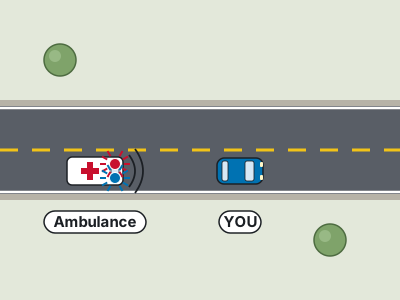
12. What must a Maine driver do when an emergency vehicle approaches with its siren and flashing light on?
- Stop in the middle of the intersection so it can go around
- Continue through the intersection before stopping in the next lane
- Follow the emergency vehicle closely to use its cleared path
- Pull to the road edge, stop, and avoid blocking an intersection
Show answer
Pull to the road edge, stop, and avoid blocking an intersection. An emergency vehicle needs a clear path, so move to the edge of the road and stop. If you are in an intersection, clear it first, then pull over. The choice about following within the vehicle's path is unsafe and separately restricted for fire trucks. Stopping in the intersection creates the obstruction the manual tells drivers to avoid. Check mirrors, signal if needed, and remain stopped until the vehicle passes.
Study this in the handbook: Emergency vehicles, move over and traffic stops
13. You are driving with high beams behind another vehicle in Maine. Within what distance must you switch to low beams?
- 300 feet
- 100 feet
- 200 feet
- 500 feet
Show answer
300 feet. Maine law requires dimming to low beams when following a vehicle within 300 feet and when meeting an oncoming vehicle within 500 feet. Five hundred feet is the oncoming distance, not the following distance. One hundred and 200 feet are closer than the law allows. The handbook also advises low beams in fog, snow, or heavy rain, because light from high beams reflects back and causes glare. Any fog auxiliary light must also be turned off.
Study this in the handbook: Following distance, headlights and signals
14. During the minimum suspension period for an OUI conviction, can a Maine driver get a work or limited license?
- No, there is no work or limited license during that period
- Yes, for driving to and from work only
- Yes, after the first 30 days
- Yes, if an employer signs a request
Show answer
No, there is no work or limited license during that period. Maine makes no provision at all for a work or limited license during the minimum suspension for an OUI conviction, so offenders are at first completely barred from driving. A commute exception, a 30 day waiting period, and an employer's request all describe hardship licenses that Maine does not offer during this period. Maine does run an ignition interlock program for OUI offenders, which the OUI Section can explain.
Study this in the handbook: OUI law, implied consent and penalties
15. A driver is convicted of a first OUI in Maine with an alcohol level of 0.10, took the test when asked, and had no other aggravating factor. What is the minimum fine?
- $250
- $500
- $600
- $1,000
Show answer
$500. For a first OUI conviction with an alcohol level of 0.08 to 0.14, Maine sets a mandatory fine of at least $500. The minimum rises to $600 when the driver refused a test, which is why $600 does not fit a driver who took the test. Two hundred fifty dollars is below the minimum. One thousand dollars is not the stated minimum. The same conviction also brings a license loss of at least 150 days, a reinstatement fee, and an alcohol and drug program.
Study this in the handbook: OUI law, implied consent and penalties
16. What can happen to a Maine driver whose license has been suspended three times within three years?
- A further suspension of up to 120 days
- Nothing beyond the third suspension
- Permanent revocation
- A $50 fee
Show answer
A further suspension of up to 120 days. Any person whose license has been suspended three times within a three year period by the Secretary of State or by a court may be subject to a further suspension for a period of up to 120 days. The added suspension recognizes a pattern rather than a single mistake. The handbook lists this discretionary rule separately from the mandatory suspensions, which allow no exceptions and no work license option.
Study this in the handbook: Young driver restrictions, points and suspensions
17. Which color scheme does the Maine manual give for regulatory signs?
- Orange backgrounds with purple markings
- Yellow backgrounds with blue markings only
- White backgrounds with black, red, or green markings
- Blue backgrounds with yellow markings only
Show answer
White backgrounds with black, red, or green markings. Regulatory signs use white backgrounds with black, red, or green letters or symbols. The color combination helps distinguish rules from yellow warning signs and orange work-zone signs, but the driver must still read the specific instruction. A white regulatory sign can govern speed, lane use, turning, parking, or direction. Treat its message as an enforceable traffic control, not as scenery or a service marker. Slow enough to read it before the point where the rule applies.
Study this in the handbook: Warning, railroad and work zone signs
18. The pictured yellow curved-arrow sign is a warning sign. What should you do when you see it?

- Stop immediately even when the roadway is clear
- Maintain speed because warning signs set the minimum speed
- Reduce speed so you have time to react to danger ahead
- Use the sign as permission to pass another vehicle
Show answer
Reduce speed so you have time to react to danger ahead. Maine describes warning signs as notices of danger ahead and tells drivers to reduce speed after seeing one. That gives you extra time to respond if the roadway changes or another hazard appears. Maintaining speed is risky because the sign is intended to prompt an adjustment, not confirm that current speed is safe. A full stop is not automatically required unless traffic, the hazard, or another control demands it. Passing is unrelated to the yellow warning symbol. Treat the curved arrow as an early cue to ease off the accelerator, scan beyond the bend, and be ready for conditions you cannot yet see.
Study this in the handbook: Speed limits and school zones
19. Why should a driver reduce speed after seeing a Maine warning sign?

- To increase the vehicle’s stopping distance
- To make the warning sign disappear
- To avoid obeying the next signal
- To have time to react if there is trouble
Show answer
To have time to react if there is trouble. Maine advises reducing speed after seeing a warning sign so the driver will have time to react if trouble appears. Extra time helps with a curve, merging traffic, a crossing, or another hazard that may be hidden until the vehicle gets closer. The other choices describe no safety benefit or reverse the purpose of slowing. Treat the sign as advance notice: ease off the accelerator, look farther ahead, and keep enough space to stop or steer safely if conditions change.
Study this in the handbook: Speed limits and school zones
20. At a Maine traffic circle, which vehicle has the right-of-way?
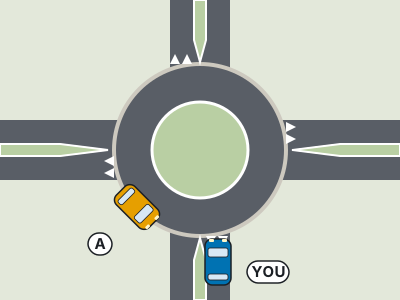
- The vehicle that reaches the entrance first
- The vehicle entering from the widest road
- The vehicle already in the circle
- The vehicle approaching from the left
Show answer
The vehicle already in the circle. At a traffic circle, a vehicle already in the circle has the right-of-way. An entering driver must slow, watch circulating traffic, and wait for a safe opening. Reaching the entrance first does not create priority, and a wider approach road does not change the rule. Proceed to the right around the center island, follow pavement markings, and use the exit signal when leaving. The location cue is decisive: circulating traffic has priority over traffic waiting to enter.
Study this in the handbook: Turns, traffic circles and roundabouts
QualitySpace is expanding to Maine
We are a California-based independent insurance brokerage working on licensing in more states. We cannot help with Maine insurance yet. Leave your email and we will let you know when we can.
Every question is written from the official Maine Driver's License Manual. Need paper? Printable ME practice test with answer key.
Last verified 2026-10-05. How we check every question · Study all 218 as flashcards
Frequently asked questions
How many questions are on this Maine practice test?
This fixed set has 20 questions. It is test 1 of 10 from the 218 question Maine bank. The real ME exam asks 30 questions and you need 24 correct.
What is the passing score for the real Maine test?
You must answer a minimum of 24 correctly to pass the test (24 of 30) That figure comes from the official Maine source cited on the DMV facts page.
How does this fixed test relate to the full Maine bank?
Each numbered test is a fixed set of questions in a fixed order, so you can retake the same test later and compare. Every test mixes road signs and the other topics in about the same proportion as the full bank. Tests 1 to 10 together cover 200 of the 218 questions in the Maine bank, each once. The full practice page mixes the whole bank at random.
Last verified 2026-10-05. See the Maine DMV facts page for sourced state details.