
Test 4 of 10 · 20 questions · Free 2026
ME Permit Practice Test 4
Jump to the test ↓A fixed 20 question set from the Maine bank with answers and plain English explanations. The real ME exam is 30 questions, 80 percent to pass; take the full length version on the main practice page.
Question 1 of 20 · 0 right so far
All 20 questions in test 4
Every question below comes from the Maine question bank on this page. Open a question to see the correct answer and the explanation. Nothing here is hidden behind a signup.
1. At what demerit point level does the Maine Secretary of State issue a warning to a driver?
- 3 points
- 6 points
- 8 points
- 12 points
Show answer
6 points. Under the Maine point system, a driver who reaches 6 points receives a warning from the Secretary of State. Three and 8 points are not the stated warning level. Twelve points is the level at which the license is suspended, not the warning level. Points are erased from the record once they are one year old. A driver who keeps adding points after the warning moves toward the 12 point suspension level.
Study this in the handbook: Young driver restrictions, points and suspensions
2. How should you respond when this skidding-car sign warns of a slippery road?

- Maintain the posted limit because the sign is advisory only
- Accelerate sharply to cross the slick area quickly
- Brake hard while turning to test the pavement
- Slow down and avoid hard braking or abrupt steering
Show answer
Slow down and avoid hard braking or abrupt steering. A slippery-road warning means the pavement may not provide enough tire grip for normal speed and abrupt control inputs. Slow before the hazard, steer smoothly, and avoid hard braking that could start a skid. Accelerating, testing traction while turning, or treating the sign as optional can reduce control. Rain, ice, wet leaves, and gravel are examples of conditions that make a road slippery. The visual cue should trigger a gentler speed and larger stopping margin before the vehicle reaches the slick section.
Study this in the handbook: Scanning, stopping distance and road conditions
3. What additional suspension period applies after an OUI conviction when the vehicle carried a passenger under 21?
- 90 additional days
- 30 additional days
- 60 additional days
- 275 additional days
Show answer
275 additional days. Maine adds 275 days to the OUI or refusal suspension when a passenger under the age of 21 was in the vehicle. The handbook's separate section for drivers under 21 mentions an additional 180 days for a young driver who carries passengers under 21, but the general additional suspension rule states 275 days, and that is the figure tested here. Shorter periods such as 30, 60 or 90 days do not match the rule. The added time is attached to the ordinary suspension, so carrying an underage passenger makes the total time without a license much longer.
Study this in the handbook: OUI law, implied consent and penalties
4. Which group contains Maine regulatory sign examples?
- No left turn, no U-turn, and left turn only
- Animal crossing, slippery road, and curve ahead
- Hospital, restaurant, and service station
- Route 1, Interstate 95, and county road
Show answer
No left turn, no U-turn, and left turn only. Maine lists common regulatory signs that include no-left-turn, no-right-turn, left-turn-only, no-U-turn, and straight-or-turn-right movements. These examples show that regulatory signs control a driver's permitted path rather than merely describing the roadway. Read the displayed symbol and follow the movement it allows or forbids. A no-U-turn sign does not prohibit every turn, and a left-turn-only sign does not authorize going straight. Match the maneuver to the specific sign before entering the intersection.
Study this in the handbook: Warning, railroad and work zone signs
5. What fine applies to exceeding the posted speed limit in a Maine school zone?
- Twice the usual fine
- The usual fine with no change
- Half the usual fine
- A fine only when children are absent
Show answer
Twice the usual fine. Maine imposes a fine twice the usual amount for exceeding the posted speed limit in a school zone. The increased penalty is tied to speeding in that school setting, not to every ordinary speeding violation or every trip through a residential street. A driver should watch for school-zone signs and flashing school controls, then stay below the posted maximum when conditions require. The memory cue is the penalty multiplier: school-zone speeding can cost double, so reducing speed before reaching the zone is safer than braking late.
Study this in the handbook: Speed limits and school zones
6. If an emergency vehicle approaches while the driver is in an intersection, what should the driver do before pulling over?
- Follow the emergency vehicle through the intersection
- Stop immediately in the intersection
- Clear the intersection, then pull over and stop
- Turn left without checking traffic
Show answer
Clear the intersection, then pull over and stop. Drivers must make room for emergency vehicles using lights and sirens. If already in an intersection, clear it first so the intersection does not become blocked, then pull to the side and stop. Stopping in the middle can trap cross traffic and the emergency vehicle, while following it is unsafe and unlawful in some circumstances. Scan ahead, choose the nearest safe edge, and remain stopped until the emergency vehicle has passed.
Study this in the handbook: Emergency vehicles, move over and traffic stops
7. A Maine driver is convicted of passing a stopped school bus with its red lights flashing. What license suspension does the handbook list?
- 7 days
- 30 days
- 90 days
- One year
Show answer
30 days. Passing a stopped school bus with red lights flashing is on Maine's list of convictions that may bring a 30 day suspension, together with offenses such as failure to stop for a police officer and operating alone on a permit. Seven days is shorter than the listed period. Ninety days is the upper limit for eluding, roadblock, and street racing convictions. One year is not the period listed for this offense.
8. A 16 year old got a Maine license last month and wants to drive a school friend home. When may the friend ride along?
- Only if a licensed operator at least 20, licensed for 2 years, sits beside the driver
- Any time during daylight hours
- Only if the friend is 18 or older
- Only if a parent signs a permission note
Show answer
Only if a licensed operator at least 20, licensed for 2 years, sits beside the driver. During the restricted period a Maine licensee under 18 may carry only immediate family members, unless a licensed operator rides in the seat beside the driver. That operator must be at least 20, must have held a valid license for 2 years, and must be licensed for the class of vehicle being driven. Daylight does not lift the passenger rule, and neither does the friend's age or a parent's note. Immediate family includes parents, siblings, grandparents, stepfamily, a spouse, and certain foster, exchange student, and ward relationships.
Study this in the handbook: Young driver restrictions, points and suspensions
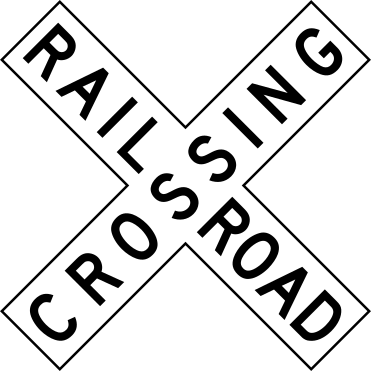
9. At this railroad crossbuck, what must you do if a train or railroad vehicle is coming?
- Cross quickly without looking if no lights flash
- Drive around the gate if the crossing looks clear
- Stop on the tracks until the train passes
- Stop behind the stop line or before the tracks
Show answer
Stop behind the stop line or before the tracks. Maine's white X-shaped railroad crossing sign marks the crossing itself. When a train or railroad vehicle is coming, the driver must stop behind the stop line or before the tracks. Driving around a gate is unsafe and prohibited, while stopping on the tracks creates a dangerous obstruction. A dark signal does not remove the need to look and listen. Keep the vehicle clear of the rails and wait for a safe indication before crossing, especially where more than one track may be present.
Study this in the handbook: Warning, railroad and work zone signs
10. What must a Maine driver do when school children are crossing a street?
- Yield only when a crossing guard is present
- Always yield the right-of-way
- Proceed if the driver reached the street first
- Honk and continue at reduced speed
Show answer
Always yield the right-of-way. Maine requires drivers to always yield the right-of-way to school children crossing a street. The rule does not depend on a crossing guard, the driver's arrival time, or a warning horn. Children can move unpredictably, so the safest response is to slow, stop as needed, and wait until the crossing is clear. This pedestrian rule appears with other situations requiring a yield, including marked crosswalks and cars crossing sidewalks. The key cue is the child's presence in the crossing path: priority belongs to the child, and the driver must not press forward simply because traffic conditions seem favorable.
Study this in the handbook: Pedestrians, school children and blind pedestrians
11. Under current Maine law, where must a child under 12 ride when possible?
- In the front seat beside the driver
- In the rear seat
- In a pickup truck bed whenever available
- Only in a federally approved booster seat
Show answer
In the rear seat. Maine directs the operator to secure a child younger than 12 in the rear seat of a vehicle when that is possible. The handbook adds a condition that the child weighs less than 100 pounds, but the current statute text, marked as amended in 2019, states only the age, so age alone controls this placement rule. It is not a requirement for one particular type of restraint, and an open cargo area is not the passenger seating the rule describes. The separate child restraint and seat belt rules still apply.
Study this in the handbook: Seat position, seat belts and child safety
12. For which age group are motor vehicle crashes the primary cause of death, according to the Maine handbook?
- People over 65
- Infants only
- People between 40 and 60
- People between the ages of 1 and 34
Show answer
People between the ages of 1 and 34. Approximately 45,000 people die in motor vehicle accidents in the United States each year, and such crashes are the primary cause of death for people between the ages of 1 and 34. Lap and shoulder belts, used properly, reduce the risk of serious or fatal injury by 40 to 55 percent, and Maine law requires the operator and passengers to be properly secured in a seat belt.
Study this in the handbook: Seat position, seat belts and child safety
13. What do posted speed limits tell a Maine driver?
- The speed every driver must maintain
- The fastest lawful speed under ideal conditions
- A recommended speed for poor weather
- The minimum speed on every road
Show answer
The fastest lawful speed under ideal conditions. A posted speed limit is a maximum, not a required travel speed. Maine explains that the displayed number tells drivers they cannot go faster than that speed, while road and weather conditions can require slowing down. The phrase does not promise that the roadway is safe at the listed number. A driver who reduces speed for rain, ice, traffic, or limited visibility is following the safety principle rather than violating the sign. Use the number as an upper boundary and choose your speed from current conditions.
Study this in the handbook: Speed limits and school zones
14. What does a solid center line on the driver’s side of the road mean?
- The lane is reserved for bicycles
- Passing is required before the line ends
- Passing is prohibited on that side
- The road becomes one-way
Show answer
Passing is prohibited on that side. A solid center line on your side marks a no-passing condition. The driver must remain behind the vehicle ahead until the marking and surrounding conditions permit a legal pass. The line does not require a pass, create a bicycle lane, or change the road into a one-way street. Pay attention to both the pavement and the sight distance ahead. If the solid line is beside your lane, treat it as a clear signal to wait rather than cross into opposing traffic.
Study this in the handbook: Passing and no passing zones
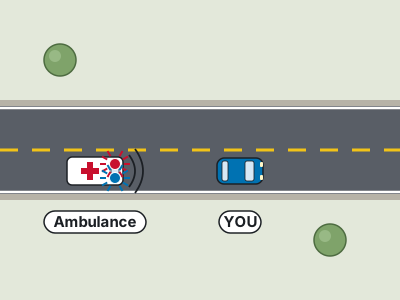
15. On a Maine road, where should a driver move when a responding emergency vehicle has lights and a siren on?
- Stop in the middle of the intersection
- Keep moving until the emergency vehicle passes on its own
- Pull to the edge of the road and stop
- Follow closely so other traffic must yield
Show answer
Pull to the edge of the road and stop. A driver must yield when an emergency vehicle uses its flashing lights and siren. Pull to the edge of the road and stop, while avoiding a position that blocks an intersection. Continuing forward leaves the emergency vehicle without a clear path, and stopping in the intersection creates the very obstruction the rule warns against. Following behind is unsafe and unlawful in the fire-truck situation described elsewhere. Check mirrors, clear the intersection if necessary, then stop where the responding vehicle can pass freely.
Study this in the handbook: Emergency vehicles, move over and traffic stops
16. When should a driver avoid passing based on the center line?
- When there is a solid center line on the driver's side
- When there is a broken center line on the driver's side
- When the road has two lanes in the same direction
- When the vehicle ahead is traveling below the posted limit
Show answer
When there is a solid center line on the driver's side. A solid center line on the driver's side marks a situation where passing should not begin. The line signals that the driver may not have enough sight distance or safe space to move into opposing traffic. A broken line on the driver's side can permit passing, but it still requires a clear view and a safe opening. Two lanes moving in the same direction do not create this specific no-passing condition, and a slower vehicle ahead is not a reason to cross a solid line. Check the pavement marking before considering any maneuver.
Study this in the handbook: Passing and no passing zones
17. What information do guide signs commonly provide about roads and destinations?
- A warning that every nearby lane is closed
- Only the distance required for an emergency stop
- The exact tire pressure for the vehicle ahead
- Intersecting roads, cities, towns, and points of interest
Show answer
Intersecting roads, cities, towns, and points of interest. Guide signs help a driver navigate by identifying intersecting roads, directing travel toward cities and towns, and marking points of interest. Their purpose is orientation and route guidance, not tire maintenance, universal lane closures, or emergency stopping distances. Green, brown, and blue can all be used for this sign category, so the message should be read together with the color and surrounding roadway. Check the sign early enough to choose a route without a sudden lane movement.
Study this in the handbook: Stop, yield, regulatory and guide signs
18. According to the Maine handbook, which drink has about the same amount of alcohol as a 12 oz. can of beer?
- A 4 oz. glass of table wine
- A 12 oz. glass of table wine
- A 3 oz. shot of 100 proof hard liquor
- A 20 oz. wine cooler
Show answer
A 4 oz. glass of table wine. The handbook says a 12 oz. can of beer holds about the same alcohol as a 1 oz. shot of 100 proof liquor, a 4 oz. glass of table wine, or a 10 oz. wine cooler. A 12 oz. glass of wine holds about three times as much. A 3 oz. shot is three times the 1 oz. equivalent, and a 20 oz. wine cooler is double the 10 oz. equivalent. Beer drinkers are not consuming less alcohol per drink than people who drink wine or liquor.
Study this in the handbook: How alcohol affects driving
19. How close to a crosswalk may you not park under the rules listed in the Maine handbook?
- Within 5 feet
- Within 10 feet
- Within 15 feet
- Within 30 feet
Show answer
Within 15 feet. Parking within 15 feet of a crosswalk is not allowed. The same 15 foot distance applies to the driveway entrance of a fire station or directly across from it. Ten feet is the fire hydrant distance. Five feet is too close, and 30 feet is not a Maine parking distance for crosswalks. The handbook also lists entrances to schools, churches, theaters, hotels, hospitals and public places during designated hours as places not to park.
20. According to the Maine handbook's cost example, what could one drink over the legal limit end up costing a driver?
- About $500, the minimum fine
- About $1,500
- Well over $7,000
- Under $1,000 once insurance is counted
Show answer
Well over $7,000. The handbook adds up towing, bail, a lawyer, the fine, an alcohol education course, a three year insurance surcharge, lost work time, and the reinstatement fee, and says one drink over the limit could cost well over $7,000. The $500 figure is only the minimum fine, one piece of the total. About $1,500 and under $1,000 leave out most of the costs, especially the insurance surcharge, which is the largest item in the example.
Study this in the handbook: How alcohol affects driving
QualitySpace is expanding to Maine
We are a California-based independent insurance brokerage working on licensing in more states. We cannot help with Maine insurance yet. Leave your email and we will let you know when we can.
Every question is written from the official Maine Driver's License Manual. Need paper? Printable ME practice test with answer key.
Last verified 2026-10-05. How we check every question · Study all 218 as flashcards
Frequently asked questions
How many questions are on this Maine practice test?
This fixed set has 20 questions. It is test 4 of 10 from the 218 question Maine bank. The real ME exam asks 30 questions and you need 24 correct.
What is the passing score for the real Maine test?
You must answer a minimum of 24 correctly to pass the test (24 of 30) That figure comes from the official Maine source cited on the DMV facts page.
How does this fixed test relate to the full Maine bank?
Each numbered test is a fixed set of questions in a fixed order, so you can retake the same test later and compare. Every test mixes road signs and the other topics in about the same proportion as the full bank. Tests 1 to 10 together cover 200 of the 218 questions in the Maine bank, each once. The full practice page mixes the whole bank at random.
Last verified 2026-10-05. See the Maine DMV facts page for sourced state details.