
Test 8 of 10 · 20 questions · Free 2026
ME Permit Practice Test 8
Jump to the test ↓A fixed 20 question set from the Maine bank with answers and plain English explanations. The real ME exam is 30 questions, 80 percent to pass; take the full length version on the main practice page.
Question 1 of 20 · 0 right so far
All 20 questions in test 8
Every question below comes from the Maine question bank on this page. Open a question to see the correct answer and the explanation. Nothing here is hidden behind a signup.
1. What must a Maine applicant under 18 complete to obtain a learner's permit?
- A two year driving record
- A commercial driver course
- A motorcycle endorsement exam
- An approved driver education course
Show answer
An approved driver education course. Applicants younger than 18 must complete an approved driver education course before obtaining a Maine learner's permit. The commercial and motorcycle options concern different licensing needs, not the ordinary under 18 permit requirement. A driving record cannot exist for the required period as a substitute for instruction. Pair this course rule with the separate minimum permit age of 15 and the written knowledge examination. The practical cue is the applicant's age: under 18 adds driver education, while the permit process also requires passing the knowledge test and arranging qualified supervision.
Study this in the handbook: Getting a learner's permit and a license
2. What should a Maine driver do when a moose is standing in or near the roadway?
- Get out and chase the moose away
- Drive around the moose on the shoulder
- Slow down, stay in the vehicle, and give the moose room and time to leave
- Honk repeatedly and pass at normal speed
Show answer
Slow down, stay in the vehicle, and give the moose room and time to leave. The manual calls for extreme caution, slower speed, remaining in the vehicle, and allowing the moose room and time to wander away. Driving around the animal can put the vehicle into its path, while getting out can expose the driver to an unpredictable animal and create danger for other motorists. Honking and passing normally do not provide the patient separation the situation requires. The cue is space and patience: reduce speed, stay inside, and wait for a safe roadway.
Study this in the handbook: Moose and deer
3. Unless posted otherwise, what is the maximum speed outside any business, residential, or built-up area in Maine?
- 25 mph
- 45 mph
- 55 mph
- 65 mph
Show answer
45 mph. Maine's default maximum is 45 miles per hour outside business, residential, or built-up areas, unless a different limit is posted. Twenty five mph is the default inside a business district, residential district, or built-up area. Fifty five and 65 mph are not among the unposted default maximums the handbook lists, so they apply only where a sign sets them. Conditions can still require a slower speed than the default.
Study this in the handbook: Speed limits and school zones
4. What must a Maine driver do before reaching the start of a no-passing zone?
- Move onto the shoulder
- Complete the pass
- Increase speed after entering the zone
- Continue beside the other vehicle
Show answer
Complete the pass. Maine requires a driver to finish a pass before reaching the beginning of a no-passing zone. A driver who is already beside another vehicle cannot assume the solid marking allows extra time to complete the maneuver. Check the road ahead before starting, and do not begin a pass that cannot be completed legally with adequate space. Hills, curves, intersections, bridges, and railroad crossings can shorten the available view. The cue is plan the entire pass, not just the first move around the vehicle.
Study this in the handbook: Passing and no passing zones
5. By how much do properly used lap and shoulder belts reduce the risk of serious or fatal injury, according to the Maine handbook?
- 40 to 55 percent
- 100 percent
- 5 percent
- 10 percent
Show answer
40 to 55 percent. When used properly, lap and shoulder belts can reduce the risk of a serious or fatal injury by 40 to 55 percent. Wear the lap belt low across the hips and the shoulder belt across the chest, never behind the back. Infants under age 2 should always ride in the back seat facing the rear, and every passenger must be belted under Maine law.
Study this in the handbook: Seat position, seat belts and child safety
6. While turning at a green light, when must a driver yield to pedestrians?
- Only when the driver has a red light
- When pedestrians are crossing with the light
- Only when a crossing guard is present
- Never, because the vehicle has the green light
Show answer
When pedestrians are crossing with the light. A green light does not erase a pedestrian's crossing priority. When a vehicle turns a corner, it must yield to pedestrians who are crossing with the light. The red-light choice confuses the driver's signal with the pedestrian's permitted movement, and a crossing guard is not required for the duty to apply. Before turning, check the crosswalk and the area beside the corner, then let pedestrians clear the vehicle's path. The practical cue is that both road users may have a green indication at the same time.
Study this in the handbook: Pedestrians, bicycles, motorcycles and large vehicles
7. What does a yellow traffic light signal before it changes to red?
- The driver must accelerate through the junction
- The intersection is clearing and the driver should slow
- The driver may ignore cross traffic
- The driver must stop in the intersection
Show answer
The intersection is clearing and the driver should slow. A yellow light clears the intersection before the signal turns red, so a driver should use caution and begin slowing. It is not a general instruction to accelerate, and it does not justify stopping in the middle of the junction. Judge the vehicle's position, traffic, and stopping distance while reducing speed smoothly. The useful cue is transition: yellow signals that the green phase is ending and the driver should prepare for the red phase rather than race it.
Study this in the handbook: Traffic signals, arrows and lane lights
8. What is the minimum age to obtain a Maine learner's permit?
- 16 years
- 14 years
- 15 years
- 18 years
Show answer
15 years. A Maine learner's permit applicant must be at least 15 years of age. Sixteen is the minimum age discussed for a regular driver's license, which makes it a likely but incorrect answer when the question concerns the permit. Applicants under 18 also need an approved driver education course and must pass the written knowledge examination. The memory cue is the progression: permit at 15, then later licensing requirements at 16 or 18 depending on education. Age alone does not authorize solo driving, because the permit requires a qualified licensed driver beside the learner.
Study this in the handbook: Getting a learner's permit and a license
9. The pictured yellow sign belongs to which category, and what does that category indicate?

- A warning sign indicating danger ahead
- A railroad crossing with a gate
- A lane reserved for left turns only
- The end of a divided highway
Show answer
A warning sign indicating danger ahead. The pictured yellow sign is part of Maine's warning-sign category. Warning signs alert drivers to danger ahead and are commonly diamond shaped with black lettering or symbols on yellow. An intersection is one example of the danger that may be shown, so the driver should expect another road to meet or cross the route. A railroad crossing uses separate signs and signals, while a shared center lane is a lane-use control rather than a warning category. Reduce speed and search for cross traffic before entering the warned area.
Study this in the handbook: Speed limits and school zones
10. You are driving in the right lane. What does this lane-ends warning require you to anticipate?

- The right lane becomes a permanent truck lane
- A new lane will open on the right for passing
- Your lane will end and you must merge into the remaining lane
- The roadway will immediately become two-way
Show answer
Your lane will end and you must merge into the remaining lane. The lane-ends symbol warns that the marked lane will not continue. The driver should look for a safe gap, signal, check mirrors and blind spots, and merge into the remaining lane before the pavement narrows. Waiting until the stripe disappears can force a sudden move or a stop. The sign does not add a passing lane, designate a permanent truck lane, or announce two-way traffic. Start planning as soon as the warning is visible and cooperate with nearby drivers during the merge.
Study this in the handbook: Traffic signals, arrows and lane lights
11. When passing a stopped emergency vehicle on the roadside in Maine, what is the required response?
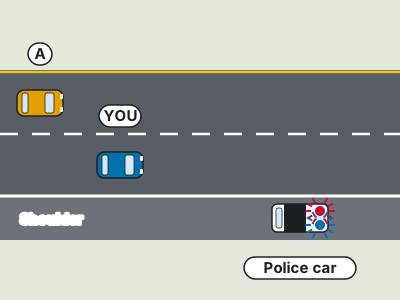
- Pass on the shoulder without reducing speed
- Maintain speed because the emergency vehicle is stopped
- Stop in the adjacent lane until the vehicle is towed
- Slow and yield, moving over to the next lane when possible
Show answer
Slow and yield, moving over to the next lane when possible. Maine directs drivers approaching a stopped emergency vehicle on the roadside to slow and yield the right of way. If possible, the driver should move over to the next lane; if that lane change is unsafe, the driver should slow down and use caution while passing. Maintaining speed ignores the hazard, and stopping in a live lane or using the shoulder creates additional risk. The cue is two parts: move over when safe, otherwise slow down and pass carefully.
Study this in the handbook: Emergency vehicles, move over and traffic stops
12. Of the supervised practice hours a Maine applicant under 21 must log before the road test, how many must be night driving?
- 5 hours
- 15 hours
- 10 hours
- 20 hours
Show answer
10 hours. Maine requires at least 10 hours of night driving within the 70 hour practice minimum for applicants under 21. Five hours is half the requirement. Fifteen and 20 hours are more than the law sets. A parent, stepparent, guardian, or spouse certifies the practice time on a form from the Secretary of State. The accompanying driver must be at least 20 years old and must have held a valid license for 2 years.
Study this in the handbook: Getting a learner's permit and a license
13. Maine's open container law bars drinking or open containers in the passenger area. Which situation is one of the listed exceptions?
- A passenger holding an open can in the back seat of a sedan
- The driver holding an open bottle while stopped at a red light
- A front seat passenger in a pickup holding an open can
- A passenger drinking in the living quarters of a motor home
Show answer
A passenger drinking in the living quarters of a motor home. The open container law makes the operator responsible if the operator or a passenger in the passenger area drinks alcohol or has an open container. One listed exception is a passenger who has an open container or drinks in the living quarters of a motor home, trailer, semi-trailer, or truck camper. The back seat of a sedan and the cab of a pickup are passenger areas, so those are violations. Stopping at a light does not change anything for the driver. Other exceptions cover containers behind the last upright seat of a vehicle without a trunk, paying passengers in for-hire vehicles other than taxicabs, and licensed off-premise caterers.
Study this in the handbook: Under 21, conditional licenses and open containers
14. How many points does completing a Maine Driving Dynamics Course deduct from a driver's point total?
- Three points
- One point
- Five points
- All points on the record
Show answer
Three points. An approved driver improvement course such as the Maine Driving Dynamics Course deducts three points from the point total. One point is too few, and five points confuses the deduction with the five hour length of the course. The course never wipes out every point. The deduction can be used only once in any twelve month period, though anyone may take the course, even with no record.
Study this in the handbook: Young driver restrictions, points and suspensions
15. What shapes may Maine regulatory signs have?
- Only red octagons
- Only yellow diamonds
- Only green circles
- Square, rectangular, or a special shape
Show answer
Square, rectangular, or a special shape. Maine regulatory signs can be square, rectangular, or a special shape. Their form differs from the diamond used for most warning signs and the distinctive shapes used for some stop or yield controls. Regulatory signs communicate rules, so the driver should read the symbol or words and prepare to obey the instruction. Do not classify a sign by color alone. First identify its shape and message, then determine whether it controls direction, speed, lane use, turning, parking, or another movement.
Study this in the handbook: Warning, railroad and work zone signs
16. According to a study cited in the Maine handbook, how much did texting raise crash risk for truck drivers?
- Twice the risk
- 23 times the risk of a crash or near crash
- No change
- Half the risk
Show answer
23 times the risk of a crash or near crash. The study revealed that truck drivers who texted while driving had 23 times the risk of being involved in a crash or a near crash incident. The handbook notes that 91 percent of Americans have a cell phone and that text messaging has grown enormously, and it states that use of a mobile telephone or handheld electronic device is prohibited by law when driving in Maine. A text takes eyes, hands and mind off the road at once.
Study this in the handbook: Vision, fatigue and distractions
17. What may a blue guide sign help you locate?
- Hospitals, service stations, restaurants, or hotels
- The legal speed for ideal road conditions
- A no passing zone on the left side
- A mandatory lane reserved for left turns
Show answer
Hospitals, service stations, restaurants, or hotels. Blue is one of the colors used for guide signs, which help drivers find services and points of interest. The manual specifically includes hospitals, service stations, restaurants, and hotels among the places these signs can help locate. Speed limits and lane restrictions belong to regulatory signs, while a no passing zone is a warning or regulatory message with another design. Use the guide information to plan the next movement without mistaking it for an instruction to change speed or lane immediately.
Study this in the handbook: Stop, yield, regulatory and guide signs
18. In about what share of fatal crashes are alcohol and other drugs contributing factors, according to the Maine handbook?
- About 95 percent
- About 2 percent
- About 40 percent
- About 10 percent
Show answer
About 40 percent. Alcohol and other drugs are contributing factors in about 40 percent of all fatal crashes, and over half of fatally injured drivers have an alcohol level of .06. Roughly 8,500 young adults are killed and 40,000 more crippled or disfigured each year in this country because of drinking and driving. The handbook also warns that alcohol impairs good judgment, and the more a driver drinks, the more rapidly that judgment goes from bad to deadly.
Study this in the handbook: How alcohol affects driving
19. On snow or ice, how does stopping distance compare with dry pavement?
- It can take three to twelve times as much distance
- It is always exactly the same
- It is cut in half because tires grip snow better
- It increases by only one vehicle length
Show answer
It can take three to twelve times as much distance. Snow and ice greatly reduce available traction, so Maine warns that stopping can take three to twelve times the dry-pavement distance. The exact increase depends on conditions, speed, tires, and braking, which is why the manual pairs the figure with a safe following distance. The equal, half-distance, and one-length choices underestimate the hazard. Slow down early and leave room before you need to brake.
Study this in the handbook: Night, rural, winter and wet weather driving
20. At a four-way stop, two vehicles arrive at the same time beside each other. Which driver has the right-of-way?
- The driver on the left
- The driver on the right
- The driver going uphill
- The driver with the brighter headlights
Show answer
The driver on the right. When two vehicles reach a four-way stop at the same time beside each other, the driver on the right has the right-of-way. This is different from the arrival-first rule, which controls when one vehicle reaches the intersection before the other. Direction of travel, vehicle size, and lighting do not replace the side based rule. Both vehicles must stop first, then the driver on the left yields. The practical cue is to picture the two stopped cars side by side: identify the vehicle to your right, let it proceed, and continue only after the intersection is clear.
Study this in the handbook: Right of way at intersections and highways
QualitySpace is expanding to Maine
We are a California-based independent insurance brokerage working on licensing in more states. We cannot help with Maine insurance yet. Leave your email and we will let you know when we can.
Every question is written from the official Maine Driver's License Manual. Need paper? Printable ME practice test with answer key.
Last verified 2026-10-05. How we check every question · Study all 218 as flashcards
Frequently asked questions
How many questions are on this Maine practice test?
This fixed set has 20 questions. It is test 8 of 10 from the 218 question Maine bank. The real ME exam asks 30 questions and you need 24 correct.
What is the passing score for the real Maine test?
You must answer a minimum of 24 correctly to pass the test (24 of 30) That figure comes from the official Maine source cited on the DMV facts page.
How does this fixed test relate to the full Maine bank?
Each numbered test is a fixed set of questions in a fixed order, so you can retake the same test later and compare. Every test mixes road signs and the other topics in about the same proportion as the full bank. Tests 1 to 10 together cover 200 of the 218 questions in the Maine bank, each once. The full practice page mixes the whole bank at random.
Last verified 2026-10-05. See the Maine DMV facts page for sourced state details.