
Test 21 of 25 · 20 questions · Free 2026
ME Permit Practice Test 21
Jump to the test ↓A fixed 20 question set from the Maine bank with answers and plain English explanations. The real ME exam is 30 questions, 80 percent to pass; take the full length version on the main practice page.
Question 1 of 20 · 0 right so far
All 20 questions in test 21
Every question below comes from the Maine question bank on this page. Open a question to see the correct answer and the explanation. Nothing here is hidden behind a signup.
1. You have parked at a curb and are about to get out of the car. Which side should you use if you can?
- The street side, after checking traffic behind you
- Either side, since the car is fully parked
- The side facing the nearest shop entrance
- The curb side, away from passing traffic
Show answer
The curb side, away from passing traffic. A parked car should empty away from moving traffic. Get out of your car on the curb side if you can, so passing cars and bicycles never meet your open door. The street side remains a fallback that demands a careful check for traffic behind you, especially bicycles, before any door opens. A shop entrance has nothing to do with which side is safer. Choose the curb side whenever the parking place allows it, and save the street side for cases with no curb side exit.
2. When following a motorcycle, how much following distance should you keep at minimum?
- At least 4 seconds back
- Two seconds back
- One car length back
- No special distance applies
Show answer
At least 4 seconds back. Motorcycles stop and swerve on scales cars cannot match. When following a motorcycle, stay at least 4 seconds back, doubling the cushion so a sudden bike stop or debris dodge does not become your rear end collision. Two seconds leaves reaction margins sized for car following car. Car lengths shrink and stretch with speed, failing as a measure. Count four full seconds past a fixed point before your bumper arrives at the same mark.
Study this in the handbook: Pedestrians, bicycles, motorcycles and large vehicles
3. A police officer directs traffic against what a signal shows. What does Maine law say about ignoring that officer?
- Signals always outrank officers
- Officer directions are helpful hints
- Refusing police orders is illegal
- Obedience is required only at crashes
Show answer
Refusing police orders is illegal. Human direction outranks lights and signs at the scene. It is illegal to refuse or fail to obey police orders, so an officer waving traffic through a red light creates the lawful path at that moment. Treating directions as advice invites gridlock and citations alike. Crash scenes hold no monopoly on officer authority. Watch the officer, follow each gesture promptly, and resume signal obedience once past the directed zone.
Study this in the handbook: Stop, yield, regulatory and guide signs
4. Your friend forgot a license at home and asks to borrow yours for a drive. How does Maine law treat lending it?
- Allowed within families
- Allowed with written note
- Allowed for short drives
- Illegal for anyone else
Show answer
Illegal for anyone else. A license certifies one person identity and qualifications, nobody else. It is illegal to lend your license to anyone else, even a trusted friend or relative facing a single short trip. Written notes cannot transfer the state certification your photograph carries. The borrower drives unlicensed and you share responsibility for the deception. Refuse the loan, offer a ride instead, and keep your credential attached to the only driver it names.
Study this in the handbook: Getting a learner's permit and a license
5. How far behind a large vehicle can its rear blind spot extend, hiding your car completely?
- Up to 20 feet
- Up to 500 feet
- Up to 200 feet
- Trucks have no rear blind spot
Show answer
Up to 200 feet. Trailer doors erase following cars from mirror view for surprising distances. Large vehicles have huge blind spots, up to 200 feet behind them, where a following car disappears entirely from the driver awareness. Twenty feet barely clears the bumper zone of an ordinary sedan. Five hundred exaggerates even these cavernous blind areas. If you cannot see the truck mirrors, the driver cannot see you, so back off or move aside until those mirrors return your reflection.
Study this in the handbook: Pedestrians, bicycles, motorcycles and large vehicles
6. At which places must you reduce speed because cars and people move in many directions at once?
- Long straight rural highways with light traffic
- Expressway lanes built for steady highway speed
- Shopping centers, parking lots, and downtown areas
- Wide bridges with lanes moving the same way
Show answer
Shopping centers, parking lots, and downtown areas. Crowded places shrink the time and space you have to react. Shopping centers, parking lots, and downtown areas are packed with cars and people moving in different directions at the same time, so speed must come down there. Long rural straights and expressway lanes are built for steadier flow, though conditions can still demand slowing. Same direction bridge lanes mix far less crossing movement. Slow most where paths cross without warning, and scan for doors, carts, and people stepping out between parked cars.
7. Maine allows passing on the right in one situation involving a left-turning vehicle. What must also be true?
- The vehicle ahead is moving below the speed limit
- A second lane runs in the same direction
- You have flashed your headlights twice
- The shoulder is wide enough to use
Show answer
A second lane runs in the same direction. Passing on the right is normally discouraged because drivers do not expect it. Maine allows the move in two narrow cases, one of which is a vehicle turning left when two or more lanes run in the same direction. A slow vehicle by itself is not permission, and headlight flashes create no right to pass. The shoulder is never a passing lane. Cue: confirm the vehicle ahead is committed to a left turn and that a second same-direction lane gives you room.
Study this in the handbook: Lane markings, lane use and special lanes
8. At an uncontrolled intersection, two cars arrive at about the same time. Who should receive the right-of-way?
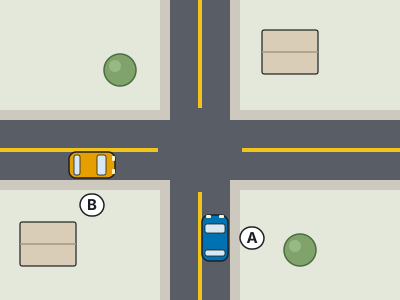
- The car on the wider road
- The car traveling fastest
- The car on the other driver's right
- The car that sounds its horn first
Show answer
The car on the other driver's right. Maine's right-of-way rules say that when two cars enter an uncontrolled intersection at about the same time, the driver must yield to the car on the right. Speed does not create priority, and a wider roadway does not automatically control an intersection without signs or signals. A horn is a warning device, not a right-of-way assignment. Even when another vehicle technically must yield, the manual advises drivers not to depend exclusively on these rules. Slow down, look for traffic and pedestrians, and be ready to yield if the situation is unclear or another driver proceeds unexpectedly.
Study this in the handbook: Right of way at intersections and highways
9. You park facing downhill on the right side of a street with a curb. Which way should you turn the front wheels?
- To the left, toward the center of the road
- Straight ahead, parallel with the curb
- To the right, toward the curb
- Either direction, because the curb stops the car
Show answer
To the right, toward the curb. When a car is parked downhill beside a curb, the front wheels should be turned so a downhill roll is stopped by that curb. For a car parked on the right side of the street, that means turning the wheels to the right, toward the curb. Turning left points a rolling car toward the center of the road. Straight wheels do not aim the tires into the curb, and the curb can help only when the wheels are positioned to meet it.
10. A pedestrian starts crossing a Maine street in the middle of a block where there is no crosswalk. What must you do?
- Stop only if the pedestrian is in your lane
- Continue because you have the right-of-way
- Sound the horn and drive around the pedestrian
- Yield and let the pedestrian cross
Show answer
Yield and let the pedestrian cross. Maine requires drivers to yield to pedestrians even when they are crossing where no crosswalk is painted. The duty is not limited to marked crossings or to people already in your lane; someone stepping out mid block still gets the right-of-way. Continuing because the car technically has priority, sounding the horn, or stopping only for a pedestrian directly ahead all miss that point. Cue: scan the whole roadway, including mid block gaps between parked cars, and be ready to stop.
Study this in the handbook: Pedestrians, bicycles, motorcycles and large vehicles
11. Which experience behind the wheel counts as a danger sign of drowsiness?
- Struggling to keep eyes open
- Remembering every mile clearly
- Feeling hungry at noon
- Enjoying the radio
Show answer
Struggling to keep eyes open. Fatigue announces itself through specific lapses worth memorizing. You must make a conscious effort to keep your eyes open is one listed danger sign, alongside yawning, lane drifting, and forgetting recent miles. Crisp recall of every mile points the opposite way, toward alert driving. Hunger and music enjoyment carry no sleep warning by themselves. Spot even one true danger sign and pull off for a short nap before continuing.
Study this in the handbook: Vision, fatigue and distractions
12. In a reverse two-point turnaround, how far past a driveway should you drive before backing in?
- One car length
- Three car lengths
- Half a car length
- About 100 feet
Show answer
One car length. In the reverse two-point turnaround, the driver passes the driveway or alley by roughly one car length, then stops and backs into it. That spacing puts the rear of the car at a useful angle without overshooting the opening. Three car lengths or 100 feet would leave the turn too far behind, and half a car length does not give enough room to swing the rear into the drive. Cue: put one car length between your car and the mouth of the driveway before reversing.
13. A driver on a conditional license after OUI is found operating at 0.08 or higher. How is the new suspension measured?
- A flat 30 days
- The periods for second or third OUI convictions
- A verbal warning for a first lapse
- Loss of the vehicle plates only
Show answer
The periods for second or third OUI convictions. High alcohol on a conditional license escalates the penalty sharply. A conditional licensee found operating with 0.08 grams or more faces suspension for the same periods which apply to second or third OUI convictions. Thirty days treats a serious relapse like a minor paperwork slip. Warnings and plate actions leave the license itself untouched, which the rule refuses to do. Any drinking while conditional courts a repeat offender sentence.
Study this in the handbook: OUI law, implied consent and penalties
14. In a manual transmission car, what speed range does second gear serve?
- 15 to 25 mph
- 5 to 10 mph
- 30 to 40 mph
- 45 to 55 mph
Show answer
15 to 25 mph. Gear ranges match engine power to road speed in steps. Second gear lets you go 15 to 25 mph, depending on engine horsepower and whether the transmission has three, four, or five speeds. Five to ten belongs to first gear pulling away from rest. Thirty upward belongs to higher gears cruising. Learn each range by sound and feel so shifts arrive before the engine strains or lugs.
15. What headlight duty applies to motorcyclists riding on Maine roadways?
- Headlights on at all times while operating
- Headlights only after dark
- Headlights only in rain
- No headlight requirement applies
Show answer
Headlights on at all times while operating. Motorcycles vanish easily in traffic, so Maine demands constant visibility. Motorcyclists are always required to have their headlights on when operating a motorcycle on Maine roadways, day and night, rain and shine. Darkness only or weather only rules leave daylight hours unprotected, when most riding and crashing occurs. A lit headlight gives car drivers one more chance to register a narrow vehicle before turning across its path.
Study this in the handbook: Following distance, headlights and signals
16. Your vehicle is stuck in snow. Which actions can improve traction and help it escape?
- Spin the wheels while keeping them turned
- Keep the wheels straight, shovel around them, and add grit
- Use full throttle to rock the vehicle
- Leave the wheels turned while rocking between gears
Show answer
Keep the wheels straight, shovel around them, and add grit. When a vehicle is stuck, Maine says not to spin the wheels. Keep them as straight as possible, shovel snow from around them, and use traction mats, sand, or cat litter to add grip. If the vehicle still cannot pull out, gently rock it between reverse and drive. Spinning or using full throttle can dig the tires deeper, while turned wheels make the path less direct. Clear the snow first and add traction before trying again.
Study this in the handbook: Night, rural, winter and wet weather driving
17. Driving in fog, why should headlights be switched to low beam?
- High beams save battery in fog
- To stop self glare in fog
- Low beams are legally brighter
- Fog requires no lights
Show answer
To stop self glare in fog. Fog turns high beams into a glowing wall inches ahead. Put headlights on low beam to prevent the glaring reflection of your own lights in the fog, keeping the beam under the densest reflective layer. Battery savings never motivate beam choice in survival visibility. Brighter claims reverse which setting actually helps here. Lights on low, speed down, edge markings as guides, and fog driving stays possible until even that fails.
Study this in the handbook: Night, rural, winter and wet weather driving
18. Rain begins soaking the roadway. How do wet roads compare with icy roads for danger?
- Wet roads are always safe
- Only flooded roads matter
- Rain improves tire grip
- As risky as ice, so slow down
Show answer
As risky as ice, so slow down. Rain slicked pavement punishes dry road habits nearly like ice. Wet roads can be as dangerous as icy roads, so always reduce your speed during wet road conditions, lengthening following distance before spray and film steal traction. Fresh rain lifts oil into a skating layer during the first minutes. Grip improves only in driver imagination. Slow down when the wipers start, not after the first slide teaches the lesson.
Study this in the handbook: Night, rural, winter and wet weather driving
19. How does the fatal accident rate of night driving compare with daytime driving?
- About equal per mile
- Nearly three times greater at night
- Half the daytime rate
- Ten times greater at night
Show answer
Nearly three times greater at night. Darkness multiplies lethality far beyond traffic volumes. The fatal accident rate for night driving is nearly three times greater than for daytime driving, even though there are fewer miles driven at night, because restricted visibility compresses every reaction. Equal or half rates flatter a period that punishes small errors severely. Ten times overshoots the stated multiplier into fiction. Slow down after sunset, widen following gaps, and treat every unseen stretch as occupied.
Study this in the handbook: Night, rural, winter and wet weather driving
20. Mid skid recovery, why must the wheel be turned back the other way as the car straightens?
- To signal a turn
- Straightening needs no correction
- To test the steering
- You start a fresh skid
Show answer
You start a fresh skid. Recovery overshoot plants the next accident. As soon as the car begins to straighten out, turn the wheel back the other way so that the car won't over correct; if you fail to turn the wheel back, you will start a new skid in the opposite direction. Signaling and testing have nothing to do with counter steering timing. Small, prompt corrections walking the wheel left and right continue until the car tracks straight and true again.
Study this in the handbook: Night, rural, winter and wet weather driving
Every question is written from the official Maine Driver's License Manual. Need paper? Printable ME practice test with answer key.
Last verified 2026-10-05. How we check every question · Study all 500 as flashcards
Frequently asked questions
How many questions are on this Maine practice test?
This fixed set has 20 questions. It is test 21 of 25 from the 500 question Maine bank. The real ME exam asks 30 questions and you need 24 correct.
What is the passing score for the real Maine test?
You must answer a minimum of 24 correctly to pass the test (24 of 30) That figure comes from the official Maine source cited on the DMV facts page.
How does this fixed test relate to the full Maine bank?
Each numbered test is a fixed set of questions in a fixed order, so you can retake the same test later and compare. Every test mixes road signs and the other topics in about the same proportion as the full bank. Tests 1 to 25 together cover every question in the Maine bank once. The full practice page mixes the whole bank at random.
Last verified 2026-10-05. See the Maine DMV facts page for sourced state details.