
Test 11 of 25 · 20 questions · Free 2026
ME Permit Practice Test 11
Jump to the test ↓A fixed 20 question set from the Maine bank with answers and plain English explanations. The real ME exam is 30 questions, 80 percent to pass; take the full length version on the main practice page.
Question 1 of 20 · 0 right so far
All 20 questions in test 11
Every question below comes from the Maine question bank on this page. Open a question to see the correct answer and the explanation. Nothing here is hidden behind a signup.
1. Your car stalls on railroad tracks, a train approaches, and the car will not move. What should you do?
- Keep trying the starter
- Stop trying, get away
- Push the car alone
- Stay belted inside
Show answer
Stop trying, get away. Trains cannot swerve, stop quickly, or forgive delay. If your car stalls on railroad tracks, if a train is coming and you are not having any success moving your vehicle, stop trying and get away, moving away from the tracks at an angle toward the train so debris misses you. Solo pushing places you beside tons of steel at impact. Seat belts inside a struck car offer no protection worth having. Abandon the car early; vehicles replace, people do not.
Study this in the handbook: Collisions, crash reports and first aid
2. Your car has air bags fitted. How does that change the need to wear safety belts?
- Belts become unnecessary
- Belts are needed only on highways
- Belts still required on every trip
- Belts are needed only at night
Show answer
Belts still required on every trip. Air bags supplement belts rather than replacing them. Always wear safety belts, even if you have air bags, and use belts to gain full protection during a crash, since bags alone cannot hold occupants in position. Highway only or night only limits invent conditions the belt rule never recognizes. An unbelted rider can slide under or strike a deploying bag off center. Buckle on every trip length, road type, and hour.
Study this in the handbook: Seat position, seat belts and child safety
3. On a dark road in Maine, driving faster than about what speed means you cannot stop within the distance your headlights show?
- 35 miles per hour
- 50 miles per hour
- 65 miles per hour
- 25 miles per hour
Show answer
50 miles per hour. Headlights let a driver see clearly only about 250 feet ahead, so the manual treats speeds above roughly 50 miles per hour on a dark road as driving blind. The problem is not reaction time alone; it is that the lit distance is shorter than the distance needed to stop. Thirty five would be cautious enough, but it is not the threshold the manual names, and 25 is lower still. Sixty five is well past the point where the visible roadway runs out. Cue: on an unlit road, keep your speed within what your low beams reveal.
Study this in the handbook: Speed limits and school zones
4. How does Maine treat licenses held by drivers under 21 regarding provisional status?
- They become full licenses at 18
- Provisional status ends after the road test
- They are provisional only during the first month
- All are provisional and open to immediate suspension until 21
Show answer
All are provisional and open to immediate suspension until 21. Youth licenses carry provisional strings all the way to adulthood. All licenses issued to minors, meaning people under 21 years of age, are considered provisional and subject to immediate suspension until the individual attains age 21. Full status at eighteen confuses voting age with licensing tiers. One month or a passed road test cannot cut short a status defined by the twenty first birthday. Drive the whole provisional span as if one ticket could park the car.
Study this in the handbook: Under 21, conditional licenses and open containers
5. Driving becomes more difficult under which emotional states listed for Maine drivers?
- Calm, rested, and alert states after full sleep
- Only after arguments
- Worried, excited, afraid, angry, sad
- Hungry at mealtimes
Show answer
Worried, excited, afraid, angry, sad. Feelings steer the car through the hands that hold the wheel. It is more difficult to drive well when you are worried, excited, afraid, angry, or sad, because emotions affect your ability to think, see, and respond to hazards as well. Calm rest sharpens every one of those faculties instead. Mealtime hunger distracts modestly beside grief or rage at full flood. Postpone departure, walk, nap, or hand over keys until control returns to the driver seat.
6. A Maine license carries a corrective lenses restriction. What must that driver do while driving?
- Wear corrective lenses while driving
- Wear lenses only at night
- Carry lenses in the glove box
- Wear lenses only for the test
Show answer
Wear corrective lenses while driving. Restrictions printed on a license bind every mile driven under it. One of the more common restrictions is the requirement that a licensee who has corrective lenses must wear them while driving, not merely possess them nearby. Night only wear leaves daylight hazards blurred for restricted eyes. Glove box storage satisfies nobody vision at the moment of need. Put the lenses on before the engine starts and keep a spare pair within reach.
7. A passenger under 19 rides in a pickup truck. Where must that young passenger normally ride?
- Inside the cab compartment
- In the open truck bed
- Standing behind the cab
- On the tailgate seated
Show answer
Inside the cab compartment. Truck beds expose young riders to ejection without restraint. When a passenger, under 19 years of age, is transported in a pick-up truck, that passenger must ride in the passenger compartment of that pick-up truck, with narrow exceptions for workers, licensed hunters traveling to hunts, parade participants, and belted manufacturer seats outside. Bed, tailgate, and standing positions all place the rider outside survival structure. Put young passengers inside the cab and save bed space for secured cargo.
Study this in the handbook: Moose and deer
8. Which sequence makes a lane change safest on a Maine road?
- Signal, swing, then check mirrors
- Change first, signal during the move
- Find a gap, signal, look again, then change
- Check once at trip start
Show answer
Find a gap, signal, look again, then change. Order matters when cars occupy the space beside you. Find a gap in traffic, signal, and then look again before changing lanes, refreshing the picture in the final moment before tires cross the line. Signaling after swinging warns nobody in time to react. One early check cannot cover vehicles accelerating into the gap afterward. Gap, signal, second look, smooth move: rehearse the rhythm until every change follows it automatically.
Study this in the handbook: Turns, traffic circles and roundabouts
9. An oncoming car flashes a turn signal as you wait to turn across its path. Why is turning on that signal alone risky?
- Signals always mean an instant turn
- Oncoming cars must stop for you
- Signals are illegal to trust at all
- May turn later, or forgot the signal
Show answer
May turn later, or forgot the signal. A blinking light announces intention, not commitment. Do not turn into a lane just because an oncoming vehicle has a turn signal on; the driver may plan to turn after they pass you or may have forgotten to turn their signal off. Treating every blink as an instant turn invites a head on meeting. Waiting costs seconds while misreading costs far more. Turn when the oncoming car actually slows and commits, not when its lamp first winks.
Study this in the handbook: Turns, traffic circles and roundabouts
10. While backing a vehicle, when may the driver stop looking to the rear?
- Only when fully stopped
- After the first few feet
- Once mirrors show clear pavement
- After honking once
Show answer
Only when fully stopped. Backing demands eyes where the car is actually heading. Continue looking to the rear until you are fully stopped, because children, posts, and pets can enter the path during the final feet. Mirrors narrow the picture and hide low obstacles directly behind. A honk announces presence without revealing what approaches. Twist, look through the rear window, and hold that gaze until motion truly ends.
11. Who may operate a motorized bicycle or tricycle on Maine roads?
- Anyone age 14 or older without a license
- Only holders of a commercial license
- Licensed driver, permit holder, or endorsed rider
- Only riders who complete a bus driver course
Show answer
Licensed driver, permit holder, or endorsed rider. Motorized bicycles and tricycles still sit inside the licensing system. Operation requires a valid license of any class, an appropriate learner permit, or a license endorsed for motorcycle or moped use. Letting any fourteen year old ride unlicensed ignores that credential floor entirely. Commercial licensing overshoots in the other direction. Check the rider carries one of the three listed credentials before the machine rolls onto a public way.
Study this in the handbook: Getting a learner's permit and a license
12. Why keep the front wheels straight while waiting in an intersection to turn left?
- To avoid being pushed into oncoming traffic
- So the steering wheel cannot move while you wait
- So oncoming drivers can see your tires
- So you can accelerate before the light changes
Show answer
To avoid being pushed into oncoming traffic. While you wait for a gap to turn left, the front wheels should point straight ahead. If another vehicle strikes you from behind, straight wheels let your car be pushed forward rather than shoved across the center line into opposing traffic. Locking the wheel is not the reason, and visibility of tires or a quicker start does not justify the risk. Cue: hold the wheel straight until you actually begin the turn, then steer smoothly.
Study this in the handbook: Lane markings, lane use and special lanes
13. Where should you position a parked car relative to the driving lanes?
- Close enough for the driver to step out
- With the left tires on the lane line
- As far from the lanes as the road allows
- Directly beside a traffic signal
Show answer
As far from the lanes as the road allows. A parked car should sit as far from moving traffic as the road permits. On a street with a shoulder, that means pulling fully onto it; with a curb, it means parking close to the curb. Leaving a door's width into the lane, straddling the line, or stopping beside a signal all reduce clearance and put people at risk. Cue: before stepping out, glance at how much of your car remains in the travel lane, and move it fully clear.
Study this in the handbook: Intersections, lane changes, expressways and school buses
14. What may a driver do in a lane marked by a flashing yellow X?
- Enter it only to pass on the shoulder
- Drive straight through it at any time
- Use it as a parking lane until the signal changes
- Use it only for a left turn
Show answer
Use it only for a left turn. A flashing yellow X is a lane-use control, and Maine reserves that lane for left turns. It is not a general travel lane, a parking area, or a passing shoulder. The straight-through choice would ignore the overhead restriction. Watch the signal over your lane before moving into it, then complete only the maneuver allowed by that display. A green arrow has a different meaning and permits use of its lane.
Study this in the handbook: Traffic signals, arrows and lane lights
15. You pass this school sign during the school day. No lights are flashing, but children are outside near the road. What does the Maine manual require?

- Keep the regular limit because the lights are not flashing
- Obey the slower school zone speed limit
- Slow down only if a crossing guard is on duty
- Use the horn to warn the children and keep your speed
Show answer
Obey the slower school zone speed limit. Maine says that in a school zone you must obey a slower speed limit when lights are flashing or when children are present outside. Either condition is enough, so the absence of flashing lights does not let you keep the regular speed while children are outside. A crossing guard is not required for the slower limit to apply, although where a guard is present you must stop and yield as signaled. Using the horn instead of slowing does not meet the rule. Slow down, scan for children, and be ready to stop.
Study this in the handbook: Pedestrians, bicycles, motorcycles and large vehicles
16. A large vehicle ahead is already slowing or stopping for a hazard. What must you never do?
- Pass or pull in front of it.
- Slow down behind it.
- Wait behind it until the hazard clears.
- Follow at a safe distance.
Show answer
Pass or pull in front of it.. Maine says never to pass or pull in front of a large vehicle that is already slowing or stopping. Its driver has based the braking decision on the open space ahead, and cutting into that space can remove the room needed to stop safely. Slowing behind, waiting for the hazard to clear, and following at a safe distance preserve that room. The large vehicle's braking response should be treated as an early warning about the road ahead.
17. What must a Maine driver do after hitting a dog, cat or livestock?
- Nothing, animal strikes are not reportable
- Move the animal off the road and leave
- Call 911 only if the car is damaged
- Take reasonable steps to notify the owner, or local law enforcement or animal control if the owner cannot be found
Show answer
Take reasonable steps to notify the owner, or local law enforcement or animal control if the owner cannot be found. Operators involved in non reportable accidents involving injury or death of a dog, a cat or livestock must take reasonable steps to notify the owner, or if the owner cannot be located, local law enforcement or animal control. Leaving the scene or treating the strike as unimportant does not meet that duty. Separately, an accident with any injuries or with property damage of $2,000 or more must be reported to the police or local sheriff.
Study this in the handbook: Collisions, crash reports and first aid
18. You park facing uphill on a Maine street where there is a curb. Which way should you turn the front wheels?
- To the right, toward the curb.
- Straight ahead with the parking brake set.
- To the left only on a steep hill.
- To the left, toward the center of the road.
Show answer
To the left, toward the center of the road.. On an uphill park beside a curb, Maine directs you to turn the front wheels left, toward the center of the road. If the vehicle rolls backward, the curb can stop the rear of the front tire rather than letting the car move into traffic. Turning right is for parking downhill or uphill without a curb. Straight wheels leave the car without the curb-catching position, and hill steepness does not change the rule. Set the parking brake and shift into park or gear after positioning the wheels.
19. When entering a Maine roundabout, which vehicles must an approaching driver yield to?
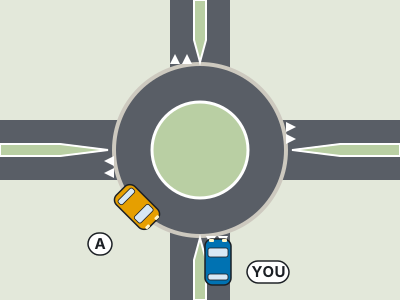
- Only vehicles behind the entering car
- Vehicles already in the circle or roundabout
- Vehicles waiting on the outside shoulder
- No vehicles if the entering car signals
Show answer
Vehicles already in the circle or roundabout. Approaching traffic must yield to vehicles already in the traffic circle or roundabout unless an officer or traffic control device directs otherwise. Signaling does not cancel that obligation, and a vehicle behind the entrant has no special priority. Look left for circulating traffic before proceeding to the right around the raised center island. The manual also calls for extreme caution when entering and leaving. A useful cue is location: the vehicle already inside the circle has priority over the vehicle waiting to enter, even when the entrant believes there is enough room to accelerate through.
Study this in the handbook: Turns, traffic circles and roundabouts
20. How far ahead should an expert driver keep looking while driving?
- Five seconds ahead
- Twenty to thirty seconds ahead
- One car length ahead
- Only to the next intersection
Show answer
Twenty to thirty seconds ahead. Seeing early converts emergencies into ordinary adjustments. An expert driver tries to keep looking 20 to 30 seconds ahead, spotting brake lights, merges, and hazards while options remain plentiful. Five seconds shrinks reaction budgets to crisis size at highway pace. Fixating on the car ahead or the next corner blinds you to the wider pattern. Lift your gaze down the road, sweep the sides, and let distant information steer present decisions.
Study this in the handbook: Scanning, stopping distance and road conditions
Every question is written from the official Maine Driver's License Manual. Need paper? Printable ME practice test with answer key.
Last verified 2026-10-05. How we check every question · Study all 500 as flashcards
Frequently asked questions
How many questions are on this Maine practice test?
This fixed set has 20 questions. It is test 11 of 25 from the 500 question Maine bank. The real ME exam asks 30 questions and you need 24 correct.
What is the passing score for the real Maine test?
You must answer a minimum of 24 correctly to pass the test (24 of 30) That figure comes from the official Maine source cited on the DMV facts page.
How does this fixed test relate to the full Maine bank?
Each numbered test is a fixed set of questions in a fixed order, so you can retake the same test later and compare. Every test mixes road signs and the other topics in about the same proportion as the full bank. Tests 1 to 25 together cover every question in the Maine bank once. The full practice page mixes the whole bank at random.
Last verified 2026-10-05. See the Maine DMV facts page for sourced state details.