
Test 6 of 10 · 20 questions · Free 2026
ME Permit Practice Test 6
Jump to the test ↓A fixed 20 question set from the Maine bank with answers and plain English explanations. The real ME exam is 30 questions, 80 percent to pass; take the full length version on the main practice page.
Question 1 of 20 · 0 right so far
All 20 questions in test 6
Every question below comes from the Maine question bank on this page. Open a question to see the correct answer and the explanation. Nothing here is hidden behind a signup.
1. If a driver is later found innocent of OUI, what happens to the administrative suspension issued by the Secretary of State?
- It changes to a warning only
- It is automatically erased
- It remains in effect
- It applies only after a second OUI
Show answer
It remains in effect. The Maine manual says the administrative suspension issued by the Secretary of State remains in effect even if the driver is later found innocent of OUI. The suspension is a separate administrative action, so an acquittal does not automatically erase it. The choices describing an automatic erasure, a warning only, or a second-offense requirement add conditions that the passage does not state. Keep the two processes distinct: the criminal case and the administrative suspension can produce different outcomes. That distinction is the key cue when a question mentions a later finding of innocence.
Study this in the handbook: OUI law, implied consent and penalties
2. How are speeding fines handled in a Maine work zone?
- They are doubled
- They are reduced by half
- They are waived if workers are absent
- They are unchanged from the ordinary fine
Show answer
They are doubled. A work zone carries an enhanced financial consequence for speeding: Maine doubles the fine. The unchanged option is tempting if a driver thinks a work zone only changes lane markings or worker presence, but the manual expressly adds a monetary penalty. This rule accompanies the instruction to slow down, stay ready to stop, and avoid tailgating. Treat orange signs, workers, and altered roadway patterns as an immediate speed warning. The doubled fine applies to speeding in the work zone, so waiting until workers are visible is not a safe way to interpret the restriction.
Study this in the handbook: Warning, railroad and work zone signs
3. When may a Maine driver legally travel below the posted speed without violating the slow driving rule?
- When the reduced speed is necessary for safety
- Whenever the driver wants to conserve fuel
- Only when following a motorcycle
- Whenever the driver is at least 10 miles below the limit
Show answer
When the reduced speed is necessary for safety. Maine permits reduced speed when it is necessary for safety, even though unnecessary slow driving may interfere with normal traffic movement. Fuel conservation, following a motorcycle, and an arbitrary ten mile difference are not stated exceptions. The rule asks why the driver is slow, not simply how far below the posted number the vehicle travels. A hazard, poor surface, limited visibility, or weather condition can justify slowing, while convenience alone does not create that safety basis.
Study this in the handbook: Speed limits and school zones
4. A 17 year old passed the Maine road test two months ago. During which hours is this driver barred from driving?
- Between 11 p.m. and 5 a.m.
- Between 1 a.m. and 6 a.m.
- Between 12 a.m. and 5 a.m.
- Between 9 p.m. and 6 a.m.
Show answer
Between 12 a.m. and 5 a.m.. A Maine licensee under 18 may not drive between 12 a.m. and 5 a.m. while the new driver restrictions apply, which is 270 days from passing the road test. The window starts at midnight, not at 11 p.m. or 9 p.m., and it ends at 5 a.m., not 6 a.m. Violating any of the restrictions brings a license suspension and another 270 days of restrictions.
Study this in the handbook: Young driver restrictions, points and suspensions
5. What does a yield sign tell a driver to do before entering or crossing a road?
- Slow down and wait for traffic to clear
- Accelerate into the first available gap
- Wait for a green signal at the sign
- Stop for exactly ten seconds
Show answer
Slow down and wait for traffic to clear. A yield sign tells a driver to slow down and wait for traffic to clear on the road being entered or crossed. The driver gives way to vehicles or pedestrians with the right-of-way, stopping when the gap is not safe. A yield sign does not require a green signal, a ten-second pause, or entry into the intersection before looking. Approach under control, scan the conflict area, and continue only when the road user with priority has cleared or a safe gap is available.
Study this in the handbook: Warning, railroad and work zone signs
6. After an uninsured Maine motorist causes $1,000 or more in injury or damage, when may they drive again?
- After 30 days
- Only after showing proof of financial responsibility or proper insurance
- Immediately, if the damage is paid
- After paying a $100 fee
Show answer
Only after showing proof of financial responsibility or proper insurance. If an uninsured motorist causes an injury or property damage of $1,000 or more, they may not operate a vehicle until proof of financial responsibility or proper insurance has been shown. Failure to produce evidence of insurance separately requires an SR-22 filing or suspension of license and registration. Carry the insurance card whenever you drive, and keep the policy current on every registered vehicle.
Study this in the handbook: Title, registration, insurance and inspection
7. What action is required at a flashing red traffic light before entering?
- Use it only as a signal to change lanes
- Continue without slowing if cross traffic is absent
- Treat it as a green arrow
- Stop and look both ways before entering
Show answer
Stop and look both ways before entering. A flashing red signal requires a stop followed by a careful check in both directions before entering. The driver must not roll through simply because the intersection appears empty. It is not equivalent to a green arrow and does not direct a lane change. Some railroad crossings use flashing red lights as well, where the driver waits for the signal to stop and any barrier to rise. The useful habit is full stop, visual check, then cautious entry when the route is clear.
Study this in the handbook: Traffic signals, arrows and lane lights
8. What does a red circle with a red slash across a symbol mean on a regulatory sign?
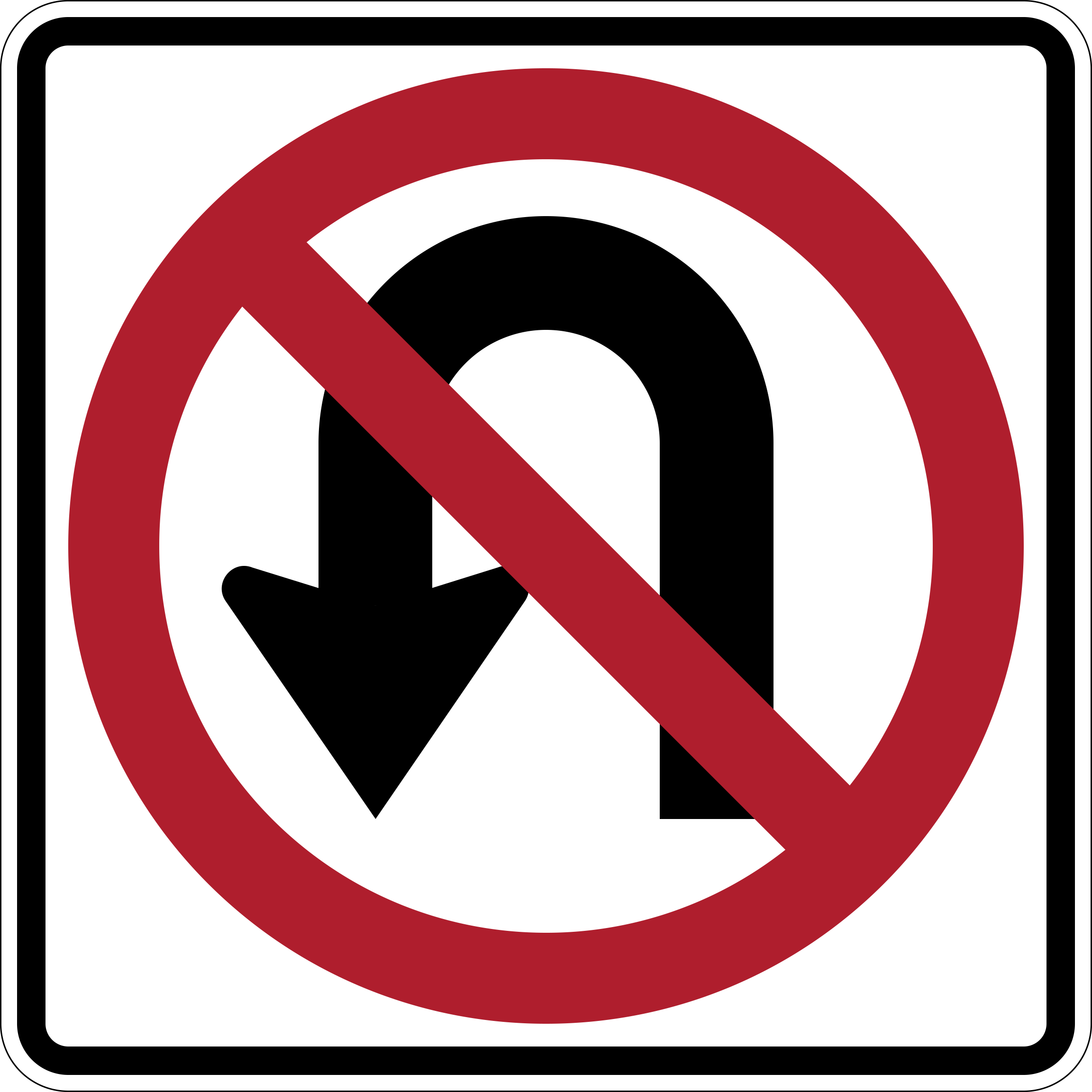
- The action shown by the symbol is prohibited
- The action shown is required after a complete stop
- The sign marks a service area for that activity
- The road is reserved for commercial vehicles
Show answer
The action shown by the symbol is prohibited. A red circle with a red slash means the activity shown by the symbol is not allowed. The symbol supplies the specific prohibition, so a driver should identify what is crossed out and avoid that action. It is not a command to perform the activity after stopping, a marker for a service area, or a designation for commercial traffic. A useful driving cue is to treat the slash as a clear no symbol and look for another lawful movement when the sign blocks the intended maneuver.
Study this in the handbook: Warning, railroad and work zone signs
9. What does this crossed right-turn arrow prohibit?
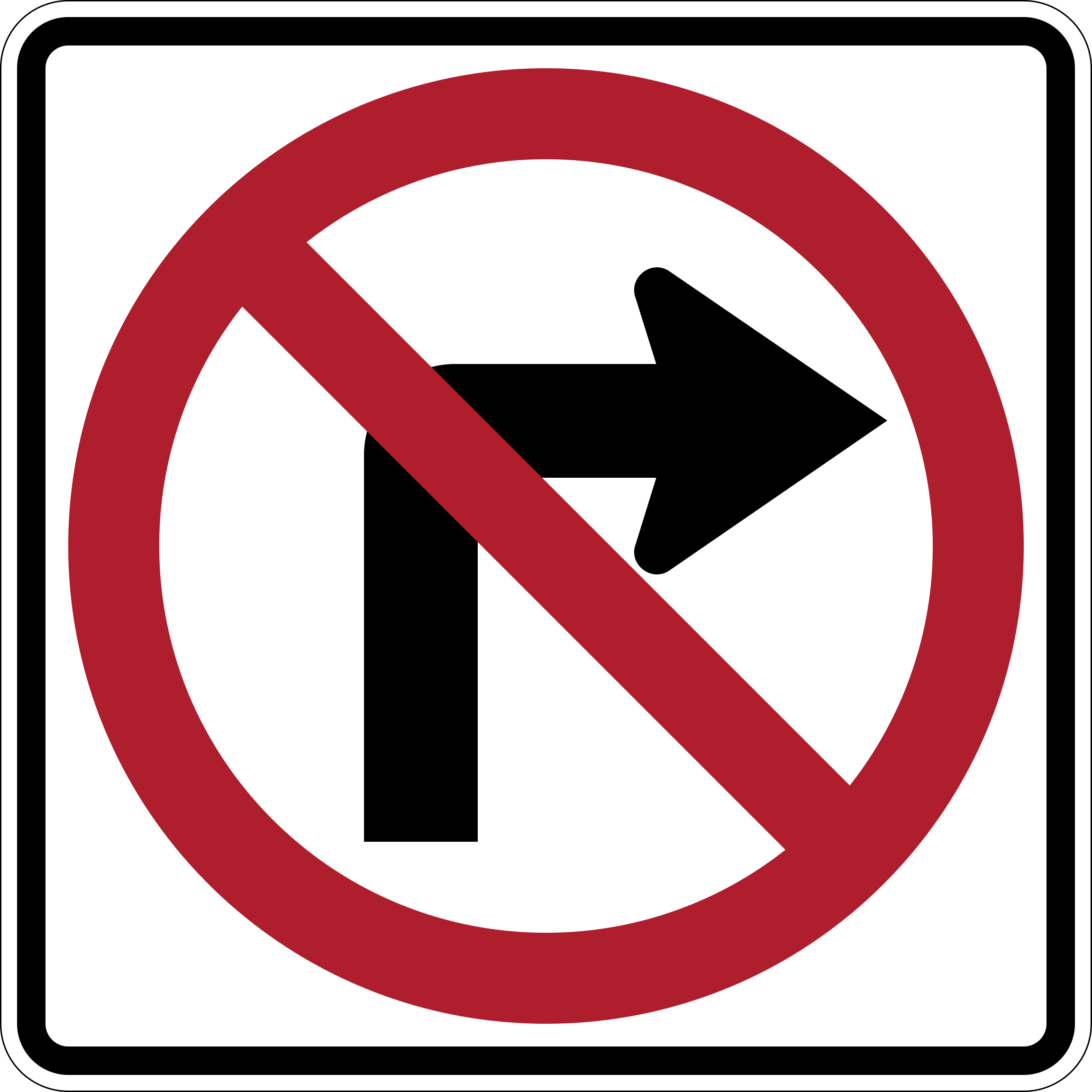
- Yielding to a pedestrian before a permitted turn
- Driving straight through the intersection
- Parking along the right curb anywhere on the block
- Turning right at the sign
Show answer
Turning right at the sign. A red slash over a right-turn arrow means right turns are prohibited at the posted point. It does not close the road to straight travel, create a blanket parking ban for the entire block, or remove the duty to yield when another movement is allowed. The driver should remain in a legal lane, obey the signal or other sign, and continue to an intersection where a right turn is permitted. Match the slash to the arrow rather than treating it as a general no-driving symbol.
Study this in the handbook: Warning, railroad and work zone signs
10. A Maine driver holding a conditional license after an OUI refuses an alcohol test. What suspension follows?
- 90 days, served at the same time as earlier suspensions
- One year, served at the same time as earlier suspensions
- None if the driver is later found innocent
- Two years, added to any earlier OUI suspension
Show answer
Two years, added to any earlier OUI suspension. A conditional licensee who refuses an alcohol test is suspended for two years, and that penalty is added to any suspension already imposed for the OUI conviction rather than running at the same time. Ninety days and one year are shorter than the stated period. Being found innocent later does not erase an administrative suspension, since the Secretary of State's suspension stays in effect even after an OUI acquittal.
Study this in the handbook: OUI law, implied consent and penalties
11. When no signs, symbols, or police are present, what still determines right-of-way at an intersection in Maine?
- The first driver to sound the horn
- Set right-of-way rules
- The widest vehicle
- The driver traveling on the smoother pavement
Show answer
Set right-of-way rules. Maine uses established right-of-way rules when an intersection has no signs, symbols, or police directing traffic. Those rules organize who proceeds, but they do not guarantee safety or excuse a driver from looking carefully. The horn, vehicle width, and pavement quality do not assign legal priority. The manual specifically advises a driver with the right-of-way to use it sensibly and never insist on it. The cue is a two part response: apply the normal rule, then scan for hazards and yield when safety requires it rather than treating priority as protection.
Study this in the handbook: Right of way at intersections and highways
12. What fine range applies in Maine to a driver who fails to yield to a visually impaired pedestrian?
- Minimum $25, maximum $250
- Minimum $100, maximum $500
- Minimum $200, maximum $2,000
- Minimum $50, maximum $1,000
Show answer
Minimum $50, maximum $1,000. A driver who fails to yield to a visually impaired pedestrian commits a traffic infraction with a fine of at least $50 and up to $1,000. The other ranges do not match the handbook. A person using a white cane or guide dog always has the right of way, and a driver who sees one in the roadway must stop at least 10 feet away and wait until the person is out of danger.
Study this in the handbook: Pedestrians, school children and blind pedestrians
13. Which bicycle riders in Maine are required to wear helmets on public ways?
- All riders under 12
- All riders under 18
- All riders under 16
- Riders of every age
Show answer
All riders under 16. Maine requires every person under 16 riding a bicycle on a public way to wear a helmet and to sit on a passenger seat when carried as a passenger. Under 12 leaves out riders aged 12 to 15. Under 18 and every age go beyond the legal requirement, although the handbook advises every rider to wear an approved bicycle helmet correctly. A helmet should be replaced after any impact or once it is five years old.
Study this in the handbook: Pedestrians, bicycles, motorcycles and large vehicles
14. If you must move an injured crash victim in Maine, how does the handbook say to do it?
- Lift by the arms and legs
- Carry the victim over your shoulder
- Roll the victim to the side of the road
- Put your arms under the victim, grab the clothing, and pull headfirst
Show answer
Put your arms under the victim, grab the clothing, and pull headfirst. Do not move an injured person unless it is absolutely necessary because of a fire or other life threatening danger. If you must move the victim, keep the back and neck as straight as possible by putting your arms under the victim, grabbing hold of their clothing and pulling the victim headfirst away from danger. The handbook also advises covering the victim with a blanket or coat to maintain body temperature and help prevent shock.
Study this in the handbook: Collisions, crash reports and first aid
15. What should you do if a front tire blows out while you are driving?
- Slam on the brakes before steering
- Keep control, avoid slamming the brakes, and slow safely
- Accelerate hard to stabilize the tire
- Turn sharply toward the nearest lane
Show answer
Keep control, avoid slamming the brakes, and slow safely. A tire blowout can create a strong pull and demands calm vehicle control. Maine's guidance says not to panic or slam on the brakes. Grip the steering wheel firmly, steer straight, ease off the accelerator, and let the vehicle slow gradually. Brake gently only if necessary, then pull off the road in a safe place and use the emergency flashers. Slamming the brakes can worsen the loss of control, while hard acceleration does not repair the tire. A sharp lane movement can place the vehicle in another road user's path.
Study this in the handbook: Brake failure, blowouts and other vehicle problems
16. When it is safe to change lanes near a stopped emergency vehicle, what should a Maine driver do?
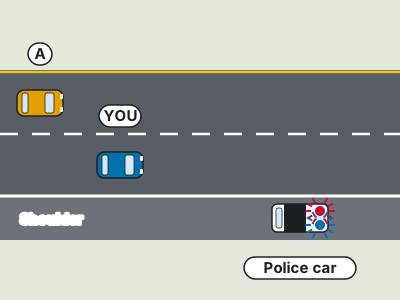
- Remain beside the vehicle at the same speed
- Move over to the next lane after slowing and yielding
- Use the shoulder without checking for traffic
- Stop in the adjacent lane until responders leave
Show answer
Move over to the next lane after slowing and yielding. When a stopped emergency vehicle is on the roadside, Maine says to slow and yield, then move over to the next lane if possible. Moving over gives the stopped emergency vehicle more room. A driver should check the next lane before changing position, because the move-over instruction does not cancel ordinary collision-avoidance duties. If traffic makes the lane change unsafe, use the separate fallback of slowing and passing with caution. The cue is move over when safe, otherwise reduce speed and give the scene room.
Study this in the handbook: Emergency vehicles, move over and traffic stops
17. How should you respond to a flashing yellow traffic light in Maine?
- Accelerate because the signal gives priority over all traffic
- Stop and remain stopped until a green light appears
- Slow down, proceed with caution, and be prepared to stop
- Treat the signal as permission to ignore pedestrians
Show answer
Slow down, proceed with caution, and be prepared to stop. A flashing yellow light calls for caution rather than the complete stop required by a flashing red signal. Maine tells drivers to slow down and proceed carefully while remaining prepared to stop for any traffic. A flashing yellow does not give the driver priority, so acceleration and disregard for people on foot are unsafe. Waiting for a green light is more restrictive than the stated response of slowing and proceeding with caution. The visual cue is the intermittent yellow display: reduce speed, scan the intersection, and continue only when the path is safe.
Study this in the handbook: Traffic signals, arrows and lane lights
18. What does Maine's inspection require of the catalytic converter?
- It may be removed on vehicles over 10 years old
- It must be properly installed and not changed in any way
- It must be replaced every two years
- It is optional on trucks
Show answer
It must be properly installed and not changed in any way. The catalytic converter must be properly installed and not changed in any way, and the fuel inlet must not be changed either. The inspection also checks the exhaust system for holes, leaks and excessive noise, the fuel system for holes and leaks, and the speedometer and odometer for proper, untampered operation. A converter that has been removed or altered does not meet this standard, and the handbook lists no age, schedule, or vehicle type exception.
Study this in the handbook: Title, registration, insurance and inspection
19. What do Maine warning signs tell drivers?
- They warn of danger ahead
- They announce the legal speed for ideal conditions
- They identify services such as hospitals and restaurants
- They give police orders that replace every traffic signal
Show answer
They warn of danger ahead. Maine uses warning signs to alert drivers to danger ahead, giving them time to adjust speed and attention. The speed limit choice describes black and white regulatory signs, not warnings. Service locations belong to guide signs, while a police officer's directions are separate traffic controls. A yellow diamond with a black symbol should prompt an early scan for the hazard and a readiness to slow or stop.
Study this in the handbook: Traffic signals, arrows and lane lights
20. What braking distance does the Maine handbook give at 50 mph on dry pavement with good brakes?
- About 500 feet
- About 30 feet
- About 158 feet
- About 1,000 feet
Show answer
About 158 feet. At 50 mph on dry pavement with good brakes, braking alone can take about 158 feet, and that comes after perception and reaction time. Headlights let you see clearly only about 250 feet ahead, so at night you must drive slowly enough to stop within that distance. Give yourself extra following distance before reducing speed or turning, and add more on wet or icy pavement.
Study this in the handbook: Scanning, stopping distance and road conditions
QualitySpace is expanding to Maine
We are a California-based independent insurance brokerage working on licensing in more states. We cannot help with Maine insurance yet. Leave your email and we will let you know when we can.
Every question is written from the official Maine Driver's License Manual. Need paper? Printable ME practice test with answer key.
Last verified 2026-10-05. How we check every question · Study all 218 as flashcards
Frequently asked questions
How many questions are on this Maine practice test?
This fixed set has 20 questions. It is test 6 of 10 from the 218 question Maine bank. The real ME exam asks 30 questions and you need 24 correct.
What is the passing score for the real Maine test?
You must answer a minimum of 24 correctly to pass the test (24 of 30) That figure comes from the official Maine source cited on the DMV facts page.
How does this fixed test relate to the full Maine bank?
Each numbered test is a fixed set of questions in a fixed order, so you can retake the same test later and compare. Every test mixes road signs and the other topics in about the same proportion as the full bank. Tests 1 to 10 together cover 200 of the 218 questions in the Maine bank, each once. The full practice page mixes the whole bank at random.
Last verified 2026-10-05. See the Maine DMV facts page for sourced state details.