
Key points
Yield to pedestrians in a marked crosswalk when there are no traffic lights or police.
Source: Handbook p. 6-2
“When pedestrians are in a marked crosswalk and there are no traffic lights or police at the intersection.”
Maine Driver's License Manual, Handbook p. 6-2When turning a corner, yield to pedestrians crossing with the light.
Source: Handbook p. 6-2
“When the car is turning a corner and the pedestrians are crossing with the light.”
Maine Driver's License Manual, Handbook p. 6-2Cars coming out of a driveway or alley must stop before the sidewalk and wait for pedestrians.
Source: Handbook p. 6-2
“Cars coming out of driveway or alley must stop before the sidewalk and wait for pedestrians and traffic.”
Maine Driver's License Manual, Handbook p. 6-2Always yield the right of way to school children crossing a street.
Source: Handbook p. 6-2
“Always yield the right-of-way to school children crossing a street.”
Maine Driver's License Manual, Handbook p. 6-2Do not pass any vehicle stopped for pedestrians in a crosswalk.
Source: Handbook p. 6-2
“Do not pass any vehicle that has stopped for pedestrians in a crosswalk.”
Maine Driver's License Manual, Handbook p. 6-2A person with a white cane or guide dog always has the right of way; stop at least 10 feet away.
Source: Handbook p. 6-12
“In either case, this person always has the right of way. If you see anyone in the roadway with a white cane or guide dog, stop at least 10 feet away and wait until the person is out of danger.”
Maine Driver's License Manual, Handbook p. 6-12Failing to yield to a visually impaired pedestrian brings a fine from $50 to $1,000.
Source: Handbook p. 6-12
“An operator who fails to yield the right-of-way to a visually impaired pedestrian is liable for a traffic infraction with a minimum $50 and maximum $1,000 fine.”
Maine Driver's License Manual, Handbook p. 6-12You must yield to pedestrians in a crosswalk, marked or unmarked.
Source: Handbook p. 6-12
“You must yield to pedestrians in a crosswalk, marked or unmarked.”
Maine Driver's License Manual, Handbook p. 6-12
Numbers to know
| Number | What it means | Manual |
|---|---|---|
| 10 feet | stop at least this far from a person with a white cane or guide dog | Handbook p. 6-12 |
| $50 to $1,000 | fine for failing to yield to a visually impaired pedestrian | Handbook p. 6-12 |
Recognize these signs

Pedestrian crossing 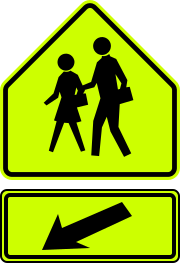
School crossing
3 questions from the Maine practice test
1. What must a Maine driver do when school children are crossing a street?
- Yield only when a crossing guard is present
- Always yield the right-of-way
- Proceed if the driver reached the street first
- Honk and continue at reduced speed
Show answer
Always yield the right-of-way. Maine requires drivers to always yield the right-of-way to school children crossing a street. The rule does not depend on a crossing guard, the driver's arrival time, or a warning horn. Children can move unpredictably, so the safest response is to slow, stop as needed, and wait until the crossing is clear. This pedestrian rule appears with other situations requiring a yield, including marked crosswalks and cars crossing sidewalks. The key cue is the child's presence in the crossing path: priority belongs to the child, and the driver must not press forward simply because traffic conditions seem favorable.
2. How far away must a Maine driver stop for a person in the roadway using a white cane or guide dog?
- At least 50 feet
- At least 3 feet
- At least 20 feet
- At least 10 feet
Show answer
At least 10 feet. A driver who sees a person in the roadway using a white cane or guide dog must stop at least 10 feet away and wait until that person is out of danger. The smaller distances do not provide the separation specified by the manual, and 50 feet is not the stated minimum. The pedestrian always has the right-of-way, so the driver should not roll forward or rely on a horn to clear the path. Use the visual cue of the cane or guide dog, stop with space, and remain stopped until the visually impaired person has safely passed.
3. What must a Maine driver do when a pedestrian with a guide dog or white cane is crossing?
- Proceed first if the traffic light is green
- Sound the horn and continue if the pedestrian pauses
- Pass behind the pedestrian without slowing
- Come to a complete stop and yield
Show answer
Come to a complete stop and yield. A pedestrian using a guide dog or carrying a white cane is visually impaired, and Maine requires the driver to come to a complete stop. A horn does not replace yielding, and passing close behind someone who may not see the vehicle creates serious danger. A green light also does not cancel the driver's duty to yield. Stop with enough room, remain alert, and wait until the crossing is clear.
Practice this topic
Lock it in with right of way questions from the free Maine practice test. Every answer comes with a plain English explanation.
Source: the Maine Driver's License Manual, Section 6: Rules of the Road. This lesson is a plain English summary, not the law itself; where it differs, the manual and the statute govern. Last checked 2026-09-27.