
Test 7 of 10 · 20 questions · Free 2026
ME Permit Practice Test 7
Jump to the test ↓A fixed 20 question set from the Maine bank with answers and plain English explanations. The real ME exam is 30 questions, 80 percent to pass; take the full length version on the main practice page.
Question 1 of 20 · 0 right so far
All 20 questions in test 7
Every question below comes from the Maine question bank on this page. Open a question to see the correct answer and the explanation. Nothing here is hidden behind a signup.
1. Red lights are flashing at a Maine railroad crossing. How far from the crossing must you stop?
- At least 5 feet
- At least 10 feet
- At least 15 feet
- At least 50 feet
Show answer
At least 15 feet. When railroad crossing lights are flashing, stop at least 15 feet from the crossing and wait until they go out or the way is clear in both directions. Five and 10 feet are closer than the handbook allows. Fifty feet is farther than required and is not the stated minimum. Never drive around a crossing gate or barrier. Wait until the lights go out or until you can see that the way is clear in both directions.
Study this in the handbook: Warning, railroad and work zone signs
2. In a Maine school zone, how does the handbook define school opening and closing hours for the 15 mph limit?
- One hour before the school day starts to one hour after it ends
- Only while a crossing guard is present
- The whole school day, from 7 a.m. to 4 p.m.
- Half an hour before the school day starts to half an hour after it ends
Show answer
Half an hour before the school day starts to half an hour after it ends. A five sided school sign means you must slow to 15 mph during recess, when children are going to or leaving school, and during opening or closing hours, which run from half an hour before the start of the school day to half an hour after the end. One hour is twice the stated window. A crossing guard is not required for the limit to apply, and the handbook sets no fixed clock hours. Exceeding the posted limit in a school zone brings twice the usual fine.
Study this in the handbook: Warning, railroad and work zone signs
3. When must drivers in Maine report a crash to the police or local sheriff?
- Only when property damage is over $5,000
- When property damage is $500 or more
- When anyone is injured or property damage is $2,000 or more
- Only when a vehicle has to be towed
Show answer
When anyone is injured or property damage is $2,000 or more. Maine requires drivers to report a crash to the police or local sheriff when anyone is injured or property damage reaches $2,000 or more. Five thousand dollars is too high and $500 too low. Towing is not the test. Failing to report can lead to criminal charges and a license suspension. The separate $1,000 figure in the handbook concerns uninsured motorists who cause injury or damage, not the crash reporting threshold.
Study this in the handbook: Collisions, crash reports and first aid
4. A Maine driver with a conditional license after an OUI is found driving with a small amount of alcohol, below 0.08. What happens?
- Nothing, because the level is below 0.08
- A one year suspension without a preliminary hearing
- A warning letter only
- A 30 day suspension after a court hearing
Show answer
A one year suspension without a preliminary hearing. The reinstated license after an OUI is conditioned on driving with no alcohol at all. A conditional licensee caught operating with any amount of alcohol loses the license for one year, without a preliminary hearing. The 0.08 adult limit does not protect this driver. A warning letter or a 30 day suspension understates the penalty. Operating at 0.08 or more brings the longer suspension periods used for second or third OUI convictions.
Study this in the handbook: OUI law, implied consent and penalties
5. At a single-lane rural bridge, which driver has the right of way?
- The driver with the larger vehicle
- The driver traveling downhill
- The first driver to reach the bridge
- The driver who sounds the horn first
Show answer
The first driver to reach the bridge. On a single-lane bridge, the first driver to reach the bridge has the right of way. Because opposing vehicles cannot pass comfortably on the narrow structure, approaching drivers should notice who arrived first and take turns rather than forcing a meeting on the bridge. A larger vehicle, downhill direction, or horn blast does not replace the manual’s stated order. Reduce speed as the bridge approaches, check for traffic, and be ready to wait when another vehicle has already arrived.
Study this in the handbook: Night, rural, winter and wet weather driving
6. What does an orange diamond or rectangular work zone sign warn drivers about?
- A recreational area with no traffic changes
- A hospital or emergency room entrance
- Road work and people working on or near the road
- A permanent route number and county boundary
Show answer
Road work and people working on or near the road. Orange work zone signs identify road construction or maintenance activity and warn that workers may be close to moving traffic. They can accompany messages about reduced speed, detours, machinery, or surface changes. The color does not identify hospitals, recreation sites, or route numbers. Once the warning appears, reduce speed, watch for cones and barriers, and be prepared to stop or follow a flagger. Work zones can remain hazardous even when no workers are immediately visible.
Study this in the handbook: Warning, railroad and work zone signs
7. What does a red and white inverted triangle sign identify?
- A railroad crossbuck
- A yield sign
- A school-zone warning
- A route-number marker
Show answer
A yield sign. A yield sign has a red and white inverted-triangle design, although some older signs may use yellow and black. Its shape identifies the sign before the driver reads the word. The driver must still slow, check the road being entered or crossed, and give priority to traffic or pedestrians who have the right-of-way. A yield sign is not a command to stop for a fixed period, and it does not grant priority to the entering vehicle. Recognize the triangle, then make the safe decision from the traffic gap.
Study this in the handbook: Stop, yield, regulatory and guide signs
8. What must a driver do at a steady red traffic light before entering the intersection?
- Stop only when a pedestrian is present
- Slow down and enter if no cross traffic is visible
- Stop before the intersection and wait behind the stop line or crosswalk until green
- Use the shoulder to bypass the signal
Show answer
Stop before the intersection and wait behind the stop line or crosswalk until green. A steady red traffic light means stop. Maine requires the driver to stop before entering the intersection and wait behind any stop line or crosswalk until the light turns green. An empty view does not convert red into a yield, and a pedestrian is not required to be present before the stop applies. The shoulder cannot be used to evade a traffic control. A permitted right turn is a separate movement that still requires a stop and yielding, unless posted otherwise. See the red display, stop at the marked position, check the path, and wait for the authorized signal or movement.
Study this in the handbook: Traffic signals, arrows and lane lights
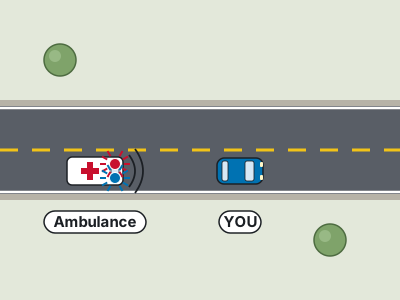
9. An emergency vehicle approaches with its siren and flashing lights on. What must you do?
- Turn left immediately without checking traffic
- Stop in the intersection so the emergency vehicle can go around
- Speed up and remain directly ahead of it
- Drive to the right side, clear the intersection, and stop
Show answer
Drive to the right side, clear the intersection, and stop. Maine requires drivers to yield when an emergency vehicle has its flashing lights and siren activated. Move to the right side of the roadway, get clear of any intersection, and stop until the emergency vehicle has passed. Stopping in an intersection blocks the route the responder may need, while speeding up preserves the conflict rather than removing it. A sudden unchecked left turn can create another collision. The cue is the combination of lights and siren: signal if needed, clear the intersection, pull right, stop, and wait until the emergency vehicle is safely by.
Study this in the handbook: Emergency vehicles, move over and traffic stops
10. What headlights should a Maine driver use in fog, rain, or snow?
- No lights if the road is familiar
- High beams only
- Parking lights without headlights
- Low beams
Show answer
Low beams. Maine recommends low beams in fog, rain, or snow because high beams can reflect from the moisture and create glare. Parking lights alone do not provide the required forward illumination, and familiarity with the road does not improve visibility. Reduce speed as well, since the usable sight distance may be short. If conditions become so heavy that you cannot see properly even when driving slowly, pull off the road and wait until the conditions improve.
Study this in the handbook: Night, rural, winter and wet weather driving
11. After seeing a Maine warning sign, what should a driver do?

- Reduce speed and leave time to react
- Accelerate before the hazard
- Ignore it unless a police officer repeats it
- Cross the center line for a better view
Show answer
Reduce speed and leave time to react. Maine advises drivers to reduce speed when warning signs identify danger ahead, giving them time to react if trouble develops. The driver should use that extra time to scan the roadway and manage the vehicle before reaching the hazard. Accelerating, ignoring the sign, or crossing the center line creates unnecessary risk and does not follow the manual’s guidance. The practical sequence is simple: recognize the warning, ease off the accelerator, look ahead, and stay in the proper lane while preparing for the condition shown.
Study this in the handbook: Speed limits and school zones
12. What should a driver watch for at night because a moose's eyes may not reflect headlights like a deer's eyes?
- A reflective orange triangle
- A pair of bright eye reflections
- A flashing red light on its body
- The moose's dark silhouette
Show answer
The moose's dark silhouette. Because moose are taller, their eyes usually do not reflect headlight beams in the same way deer eyes do. The manual tells drivers to watch for the moose's silhouette instead. Bright eye reflections are the cue associated with deer, while an orange triangle identifies a slow moving vehicle, not wildlife. At night, scan beyond the immediate lane and keep speed appropriate for visibility so there is time to respond to a dark shape near the road.
Study this in the handbook: Moose and deer
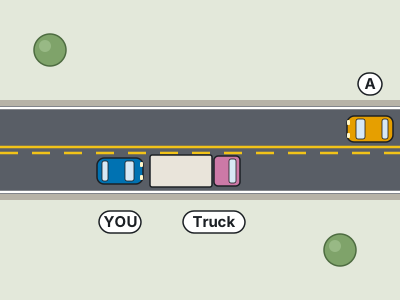
13. What does a broken yellow center line on your side of a two-way road allow?
- Passing only after turning on hazard flashers
- Passing when the roadway is clear and safe
- No passing until a traffic signal appears
- Traveling only in the opposite direction
Show answer
Passing when the roadway is clear and safe. A broken center line on the driver's side may permit a pass, but only after the driver confirms that the passing lane has no oncoming cars and conditions are safe. The marking does not guarantee that a pass is wise or remove the need to judge distance and visibility. Hazard flashers and a traffic signal are unrelated to this lane rule. Look ahead for road users, curves, hills, and obstructions before crossing the center line, and return only when there is enough space.
Study this in the handbook: Passing and no passing zones
14. What is the average perception time for an alert driver, according to the Maine manual?
- Three quarters to one second
- Two to three seconds
- Four to five seconds
- One tenth of a second
Show answer
Three quarters to one second. The manual places an alert driver's average perception time at three quarters to one second. Perception time is the interval needed to recognize that a stop is necessary, before physical braking begins. The longer ranges overstate the stated average, while one tenth of a second understates the time available in real driving. This interval is one part of total stopping distance, which also includes reaction and braking distance. Keep extra space when speed, visibility, or attention is less favorable than the ideal conditions used for the estimate.
Study this in the handbook: Scanning, stopping distance and road conditions
15. During a police traffic stop at night, what lighting step helps the officer see inside the vehicle?
- Turn on the vehicle's inside lights
- Turn off every light, including the headlights
- Flash high beams repeatedly at the officer
- Use only the hazard lights and keep the cabin dark
Show answer
Turn on the vehicle's inside lights. During a nighttime traffic stop, the manual directs the driver to turn on the inside lights so the officer can see inside the vehicle. Keeping the cabin dark makes the interaction harder to observe, and flashing high beams is not a listed step. Hazard lights may communicate a stopped vehicle but do not illuminate the passenger compartment. Move to a safe spot, turn off the engine, keep hands visible, and use the interior light as part of a calm, predictable stop procedure.
Study this in the handbook: Emergency vehicles, move over and traffic stops
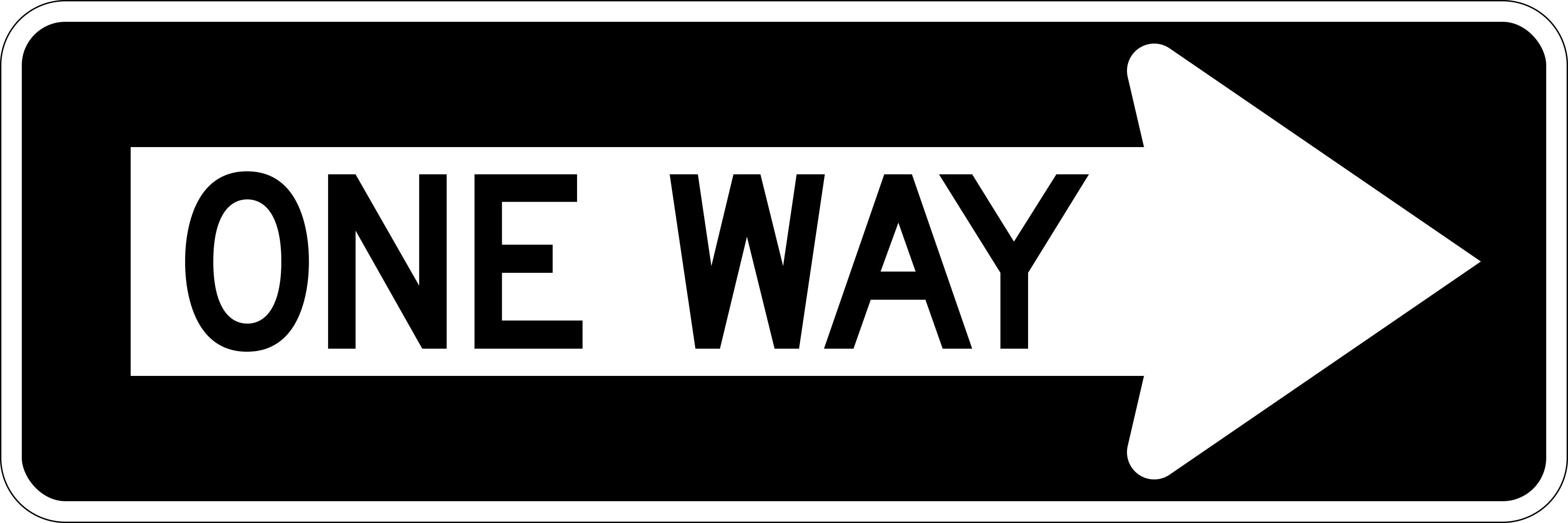
16. What does the arrow on this ONE WAY sign tell you about traffic?
- Traffic must turn around at the next block
- Traffic may move only in the arrow's direction
- The street has a reversible center lane
- Vehicles may travel either way after yielding
Show answer
Traffic may move only in the arrow's direction. On a one-way street, traffic moves only in the direction shown by the arrow. A driver may not turn or travel opposite that direction, even if the street appears clear. The sign does not announce a reversible lane, require a U-turn, or permit two-way travel after yielding. Check the arrow before turning onto the street and continue with the permitted flow. If a route requires the opposite direction, use another street rather than crossing into oncoming movement.
Study this in the handbook: Stop, yield, regulatory and guide signs
17. How long must a person under 21 hold a Maine learner's permit before applying for a road test?
- 6 months from the permit's issue date
- 30 days from the permit's issue date
- 12 months after completing the road test
- Until age 21 regardless of issue date
Show answer
6 months from the permit's issue date. Before applying for a road test, a person under 21 must have held the learner's permit for six months from its issue date. That waiting period is separate from the practice driving total, a minimum of 70 hours including 10 hours of night driving with a qualified licensed driver. Thirty days is far too short, and the clock does not run from a road test or wait until age 21. The useful sequence is permit issuance, six months of holding it, supervised practice, and then the road test application. Check the date on the permit rather than guessing from the driver's birthday.
Study this in the handbook: Getting a learner's permit and a license
18. What examination must an applicant pass to obtain a Maine learner's permit?
- A commercial vehicle road test
- A driver knowledge written examination
- A motorcycle skills test
- A vision screening only
Show answer
A driver knowledge written examination. A Maine learner's permit applicant must pass the driver knowledge written examination. The age requirement remains separate, because a person must also be at least 15, but age alone does not complete the permit process. A road test is a later licensing step, not the examination named here. The written test checks whether the applicant understands the rules before supervised driving begins. Keep the sequence in mind: meet the age threshold, pass the knowledge exam, then operate only with the required licensed supervisor.
Study this in the handbook: Getting a learner's permit and a license
19. What can happen to a Maine driver's license after refusing an alcohol test?
- The Secretary of State can impose an administrative suspension of up to 6 years
- The license is suspended for exactly 30 days
- The refusal has no licensing consequence without a conviction
- The driver receives only a warning and may keep driving
Show answer
The Secretary of State can impose an administrative suspension of up to 6 years. Refusing an alcohol test can trigger an immediate administrative suspension by the Secretary of State for up to six years. The suspension does not require a prior court action, so the statement that nothing happens without a conviction misses the separate administrative process. Thirty days is not the stated maximum, and a warning does not describe the licensing consequence. The study cue is implied consent: operating in Maine means accepting the test process, with refusal creating its own suspension exposure.
Study this in the handbook: OUI law, implied consent and penalties
20. How far away must a Maine driver stop for a person in the roadway using a white cane or guide dog?
- At least 50 feet
- At least 3 feet
- At least 20 feet
- At least 10 feet
Show answer
At least 10 feet. A driver who sees a person in the roadway using a white cane or guide dog must stop at least 10 feet away and wait until that person is out of danger. The smaller distances do not provide the separation specified by the manual, and 50 feet is not the stated minimum. The pedestrian always has the right-of-way, so the driver should not roll forward or rely on a horn to clear the path. Use the visual cue of the cane or guide dog, stop with space, and remain stopped until the visually impaired person has safely passed.
Study this in the handbook: Pedestrians, school children and blind pedestrians
QualitySpace is expanding to Maine
We are a California-based independent insurance brokerage working on licensing in more states. We cannot help with Maine insurance yet. Leave your email and we will let you know when we can.
Every question is written from the official Maine Driver's License Manual. Need paper? Printable ME practice test with answer key.
Last verified 2026-10-05. How we check every question · Study all 218 as flashcards
Frequently asked questions
How many questions are on this Maine practice test?
This fixed set has 20 questions. It is test 7 of 10 from the 218 question Maine bank. The real ME exam asks 30 questions and you need 24 correct.
What is the passing score for the real Maine test?
You must answer a minimum of 24 correctly to pass the test (24 of 30) That figure comes from the official Maine source cited on the DMV facts page.
How does this fixed test relate to the full Maine bank?
Each numbered test is a fixed set of questions in a fixed order, so you can retake the same test later and compare. Every test mixes road signs and the other topics in about the same proportion as the full bank. Tests 1 to 10 together cover 200 of the 218 questions in the Maine bank, each once. The full practice page mixes the whole bank at random.
Last verified 2026-10-05. See the Maine DMV facts page for sourced state details.