
Test 9 of 10 · 20 questions · Free 2026
ME Permit Practice Test 9
Jump to the test ↓A fixed 20 question set from the Maine bank with answers and plain English explanations. The real ME exam is 30 questions, 80 percent to pass; take the full length version on the main practice page.
Question 1 of 20 · 0 right so far
All 20 questions in test 9
Every question below comes from the Maine question bank on this page. Open a question to see the correct answer and the explanation. Nothing here is hidden behind a signup.
1. In Maine, who can ask the Secretary of State to suspend a minor's license or instruction permit by filing a notarized written request?
- The minor's driver education instructor
- The minor's auto insurance company
- Only a juvenile court judge
- A person who signed the minor's license or permit application
Show answer
A person who signed the minor's license or permit application. Whoever signed a minor's application for a license or instruction permit, usually a parent, guardian, or spouse who is at least 18, may later file a notarized written request that the minor's license or permit be suspended. The handbook gives this power to the signer, not to a driver education instructor or an insurance company. A court is not needed for this request.
2. How many hours of supervised practice driving must a Maine applicant under 21 complete before taking the road test?
- At least 40 hours
- At least 50 hours
- At least 70 hours
- At least 100 hours
Show answer
At least 70 hours. Before a Maine applicant under 21 can apply for a road test, the applicant must complete a minimum of 70 hours of driving with a licensed driver at least 20 years old who has held a license for 2 years. Forty and 50 hours fall short of that minimum. One hundred hours is more than the law requires. The applicant must also hold the learner's permit for 6 months, and the practice hours must begin after the permit is issued.
Study this in the handbook: Getting a learner's permit and a license
3. How should a driver approach an intersection where buildings or trees block the view of the cross street?
- Maintain speed because the obstruction protects the vehicle
- Edge forward slowly until the cross street can be seen
- Drive into the cross street before looking to save time
- Use the horn as a substitute for checking both directions
Show answer
Edge forward slowly until the cross street can be seen. A blocked view requires a controlled approach. Maine advises edging forward slowly until the driver can see the cross street, while remaining ready to stop. Maintaining speed reduces the time available to detect a vehicle, and moving into the crossing before looking places the front of the vehicle in hidden traffic. A horn may warn someone but cannot reveal every hazard. Treat a building, tree, fence, or parked-car row as a cue to creep forward only as visibility improves.
Study this in the handbook: Intersections, lane changes, expressways and school buses
4. What kind of information is normally conveyed by a yellow diamond-shaped traffic sign?
- A legal parking payment requirement
- A warning of danger ahead
- A route number for an interstate
- A guide to hotels and restaurants
Show answer
A warning of danger ahead. Yellow diamond-shaped signs are warning signs. They alert drivers to danger or a roadway change ahead, such as a curve, merging traffic, a school area, or a pedestrian crossing. They are different from regulatory signs, which communicate enforceable controls, and guide signs, which point toward destinations or services. A yellow diamond should prompt a driver to scan ahead, moderate speed when needed, and prepare for the condition shown by the symbol or words.
Study this in the handbook: Traffic signals, arrows and lane lights
5. How early should a Maine driver signal before a lane change or turn?
- At least 100 feet before the change or turn
- Only after entering the new lane
- At least 10 feet before the maneuver
- Only when another vehicle is visible
Show answer
At least 100 feet before the change or turn. Maine advises signaling as early as possible, with at least 100 feet before a change or turn. Early notice lets other drivers understand your plan and react without a sudden conflict. Signaling after entering the lane is too late, and ten feet gives little warning. The duty does not depend on seeing another vehicle because a hidden car, cyclist, or pedestrian may still be affected by the movement.
Study this in the handbook: Following distance, headlights and signals
6. When must Maine drivers turn on their headlights because of visibility or wiper use?
- Only when visibility falls below 100 feet
- When visibility is too dim to see 1,000 feet ahead or the windshield wipers are in constant use
- Whenever the vehicle is stopped at a red light
- Only after sunset, never during rain or fog
Show answer
When visibility is too dim to see 1,000 feet ahead or the windshield wipers are in constant use. Maine requires headlights when visibility is too dim to see 1,000 feet ahead or whenever the windshield wipers are in constant use. The rule therefore covers weather and other low-visibility conditions before darkness arrives. A 100-foot threshold is far too limited, a stopped red light does not trigger the rule by itself, and rain or fog can require lights before sunset. Turning them on also helps others see your vehicle.
Study this in the handbook: Following distance, headlights and signals
7. What must you do at a stop sign when there is no stop line or crosswalk?
- Stop only after the front bumper enters the intersection
- Stop at the point nearest the intersection where you can see approaching traffic
- Roll through if no vehicle is visible on the main road
- Stop beside the nearest parked vehicle
Show answer
Stop at the point nearest the intersection where you can see approaching traffic. If a stop line or crosswalk is absent, Maine directs the driver to stop at the point nearest the intersection that allows a view of approaching traffic. The vehicle must be fully stopped before any part enters the intersection. Entering first defeats the required stopping position and can put the vehicle in the path of cross traffic. Rolling through is not a stop, even when the road appears empty. A parked vehicle is not the reference point. Use the intersection edge as the cue, stop completely, look for vehicles and pedestrians, and proceed only when safe.
Study this in the handbook: Warning, railroad and work zone signs
8. A 17 year old Maine driver, with no job duty or parent's request as a reason, is caught transporting liquor in a car. What license suspension does the handbook list?
- At least 30 days
- At least 7 days
- At least 90 days
- None on a first offense
Show answer
At least 30 days. Illegal transportation, possession, or consumption of liquor by a minor in a motor vehicle carries a mandatory suspension of at least 30 days, with no work license option. Seven days is below the minimum, and 90 days is not the listed figure. The suspension is mandatory, so there is no free first offense. A minor may transport alcohol only in the scope of employment or at the request of a parent or guardian.
Study this in the handbook: Young driver restrictions, points and suspensions
9. Apart from bad weather, during what period does Maine law require headlights to be on?
- From 30 minutes after sunset to 30 minutes before sunrise
- Anytime from sunset to sunrise
- Only from 9 p.m. to 5 a.m.
- Only on roads without streetlights
Show answer
Anytime from sunset to sunrise. Maine law requires headlights anytime from sunset to sunrise. A rule that waits until half an hour after sunset is not what the handbook states, because Maine's requirement starts right at sunset. A clock based window and a streetlight exception are not part of the law either. Headlights are also required whenever visibility is too dim to see 1,000 feet ahead or the wipers are in constant use.
Study this in the handbook: Following distance, headlights and signals
10. If your brakes stop working while driving, what should you try first?
- Pump the brake pedal rapidly and hard several times
- Turn off the engine and remove the key while moving
- Apply the parking brake sharply at full force
- Shift into reverse immediately
Show answer
Pump the brake pedal rapidly and hard several times. Maine's brake failure procedure begins with pumping the brake pedal rapidly and hard several times. If that does not work, apply the parking brake slowly to avoid locking the rear wheels, and be ready to release it if you start to skid. Then shift to a lower gear, look for a place to slow to a stop, and use the horn and lights to warn other drivers. Turning off the engine comes only later, if the parking brake also fails, and shifting into reverse is not one of the listed steps. Keep control and work through the sequence in order.
Study this in the handbook: Brake failure, blowouts and other vehicle problems
11. What is the Maine registration fee for a passenger vehicle?
- $10
- $100
- $250
- $35
Show answer
$35. The registration fee for a passenger vehicle is $35, and the fee for pickup trucks with a maximum gross vehicle weight of 6,000 pounds is also $35. Excise tax is paid to the town before registration, and sales tax questions go to Maine Revenue Services. Any motor vehicle, mobile home, trailer or semitrailer driven on Maine roads must be registered.
Study this in the handbook: Title, registration, insurance and inspection
12. Under current Maine law, how must a child who is 2 years of age or older and weighs less than 55 pounds be secured?
- With a lap belt only, in any seat
- In a child restraint system with an internal harness
- With no restraint if the trip is under one mile
- By a front seat air bag in place of a restraint
Show answer
In a child restraint system with an internal harness. Maine law requires the operator to secure a child who is 2 years of age or older and weighs less than 55 pounds in a child restraint system with an internal harness, following the seat and vehicle manufacturers' instructions. If the child outgrows the height limit of that system, a federally approved belt positioning seat is used instead. A lap belt alone, an air bag, or skipping the restraint for a short trip does not meet the rule. A violation is a traffic infraction with a fine of $50 for a first offense, and the court may not suspend the fine.
13. Speeding by how much over the limit puts a Maine driver on the list of convictions that may bring a 30 day suspension?
- 10 mph or more over the limit
- 15 mph or more over the limit
- 30 mph or more over the limit
- 20 mph or more over the limit
Show answer
30 mph or more over the limit. Maine lists speeding by 30 miles per hour or more over the speed limit among the convictions that may bring a 30 day suspension. Ten, 15, and 20 mph over are still speeding violations, but they are not the threshold on this list. Traveling 30 mph or more over the limit is also one of the aggravating factors that raises the penalty for an OUI conviction.
14. When an aggravating circumstance applies to a first OUI conviction, what minimum jail sentence is listed?
- At least 48 hours
- At least 12 hours
- At least 24 hours
- No jail sentence
Show answer
At least 48 hours. Maine lists at least 48 hours in jail when a first OUI conviction includes an aggravating circumstance. The 12 hour and 24 hour choices understate the minimum, while no jail sentence ignores the listed penalty. The manual also notes a longer 96 hour minimum when the driver refuses a test, but the general aggravated minimum remains 48 hours. On the exam, look for the separate aggravated category rather than the ordinary first conviction fine and license suspension. The useful cue is that aggravating facts trigger a jail term.
Study this in the handbook: OUI law, implied consent and penalties
15. What mandatory license suspension does Maine list for a conviction of driving to endanger?
- No suspension, only a fine
- At least 7 days
- At least 30 days
- At least 150 days
Show answer
At least 30 days. Driving to endanger is on Maine's list of mandatory suspensions, with a suspension of at least 30 days and no work license option. A fine alone is not enough, because the suspension is mandatory. Seven days is shorter than the stated minimum. One hundred fifty days is the minimum license loss for a first OUI conviction, not for driving to endanger.
Study this in the handbook: Young driver restrictions, points and suspensions
16. What do solid white lines generally separate on the roadway?
- A vehicle lane and a railroad track
- Opposing traffic lanes where passing is always allowed
- Traffic lanes moving in the same direction with different uses
- Only lanes reserved for emergency vehicles
Show answer
Traffic lanes moving in the same direction with different uses. Solid white lines separate lanes traveling in the same direction when those lanes have different uses. They also discourage changing lanes, so the marking deserves more caution than a broken white line. Yellow markings divide opposing directions, which makes the choice “Opposing traffic lanes where passing is always allowed” a color and function mix-up. The marking does not identify a railroad track or an emergency-only lane by itself. Before crossing a white line, confirm that the lane change is allowed, signal, check mirrors and the blind spot, and move only with adequate space.
Study this in the handbook: Lane markings, lane use and special lanes
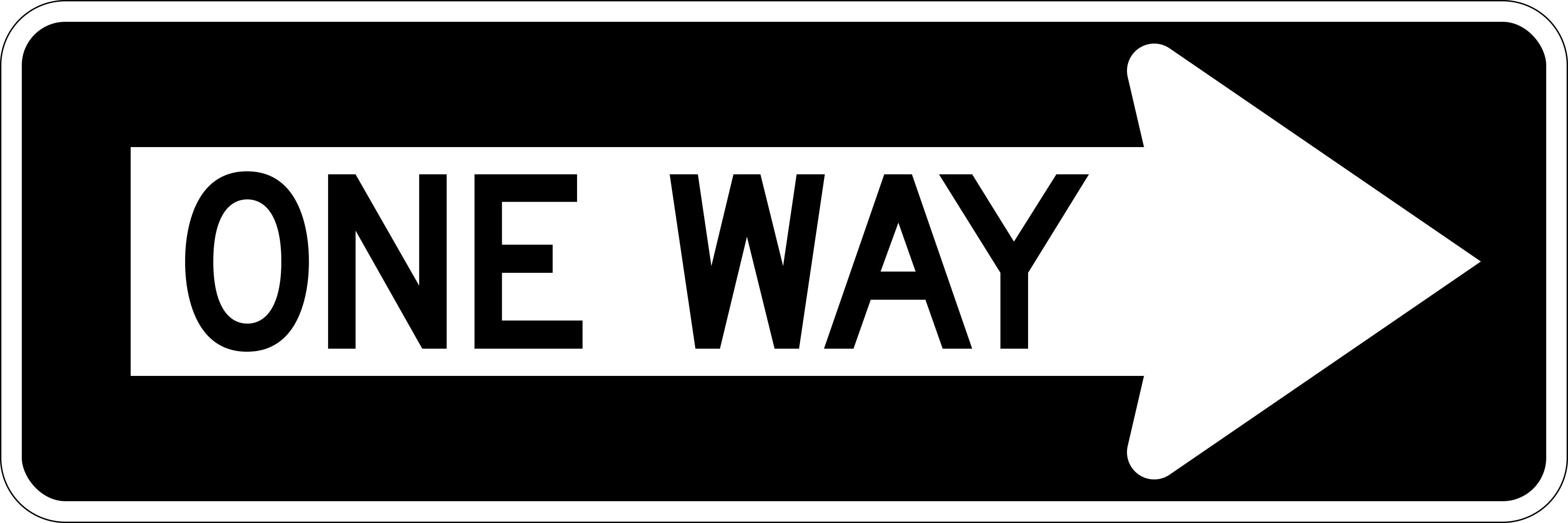
17. What rule applies when traffic is traveling on a one-way street?
- Traffic may reverse direction whenever the street is empty
- Traffic may move against the arrow after yielding
- Traffic may use the shoulder to travel the opposite way
- Traffic moves only in the direction of the arrow
Show answer
Traffic moves only in the direction of the arrow. On a one-way street, vehicles must travel in the direction shown by the arrow. The arrow establishes the permitted movement, so turning against it or using the shoulder to oppose traffic creates a wrong-way conflict. An empty street does not change the rule, and yielding does not authorize movement in the opposite direction. Stop or correct the route only when it can be done safely and lawfully.
Study this in the handbook: Stop, yield, regulatory and guide signs
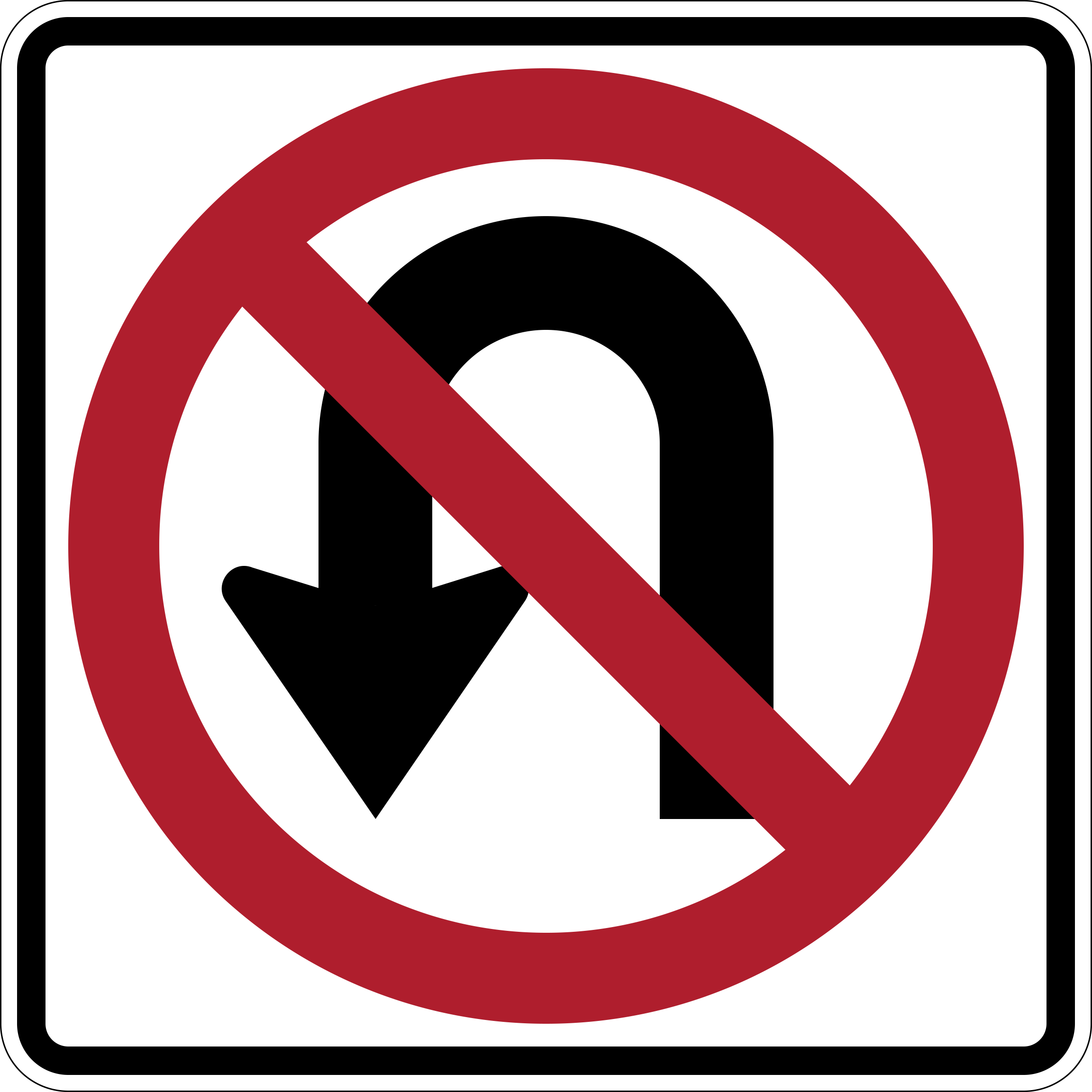
18. What does a red circle with a red slash across a symbol mean on some Maine regulatory signs?
- The sign gives a recommended speed
- You must make the pictured movement
- The sign marks a service location
- You cannot do certain things
Show answer
You cannot do certain things. Maine explains that some regulatory signs place a red circle and slash across a symbol to show that a particular action is prohibited. The choice saying you cannot do certain things captures that restriction without assuming every slashed sign bans the same maneuver. The other choices reverse the meaning, describe a service sign, or confuse a prohibition with speed guidance. Identify the symbol first, then apply the slash to that movement. The visual cue is the red slash over the pictured action.
Study this in the handbook: Warning, railroad and work zone signs
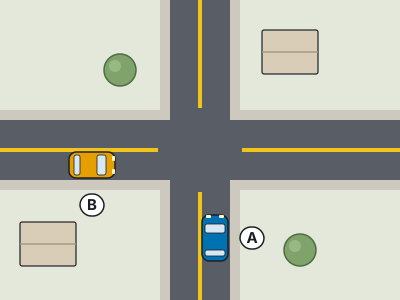
19. Two cars enter an uncontrolled intersection at about the same time. Which vehicle should yield?
- The larger vehicle always proceeds first
- The vehicle on the right yields to the vehicle on the left
- The vehicle on the left yields to the vehicle on the right
- Neither vehicle yields if both drivers are moving slowly
Show answer
The vehicle on the left yields to the vehicle on the right. At an uncontrolled intersection, neither a signal nor a stop sign assigns the movement order. When arrival is approximately simultaneous, the driver on the left must yield to the vehicle on the right. Vehicle size and low speed do not replace that rule. Even with priority, the driver on the right should remain alert rather than forcing a path through. A strong cue is to reduce speed before the crossing, identify the other vehicle's position, and be ready to stop if the situation is unclear.
Study this in the handbook: Right of way at intersections and highways
20. What is the safest sequence when a gas pedal remains stuck while you are driving?
- Shift to neutral, brake smoothly, steer to safety, then turn off the engine
- Pump the gas pedal repeatedly and continue at the same speed
- Turn the key off immediately while keeping the vehicle in drive
- Release the steering wheel so the vehicle can slow by itself
Show answer
Shift to neutral, brake smoothly, steer to safety, then turn off the engine. Neutral removes the engine's drive force from the wheels, allowing braking and steering to bring the vehicle under control. The manual then directs the driver toward a safe place to pull off and says to turn off the engine as the car stops. Pumping a stuck pedal does not free it, and the engine is turned off only as the car comes to a stop. Keep your eyes on the road, use gentle inputs, and seek assistance rather than driving again if the pedal may stick another time.
Study this in the handbook: Brake failure, blowouts and other vehicle problems
QualitySpace is expanding to Maine
We are a California-based independent insurance brokerage working on licensing in more states. We cannot help with Maine insurance yet. Leave your email and we will let you know when we can.
Every question is written from the official Maine Driver's License Manual. Need paper? Printable ME practice test with answer key.
Last verified 2026-10-05. How we check every question · Study all 218 as flashcards
Frequently asked questions
How many questions are on this Maine practice test?
This fixed set has 20 questions. It is test 9 of 10 from the 218 question Maine bank. The real ME exam asks 30 questions and you need 24 correct.
What is the passing score for the real Maine test?
You must answer a minimum of 24 correctly to pass the test (24 of 30) That figure comes from the official Maine source cited on the DMV facts page.
How does this fixed test relate to the full Maine bank?
Each numbered test is a fixed set of questions in a fixed order, so you can retake the same test later and compare. Every test mixes road signs and the other topics in about the same proportion as the full bank. Tests 1 to 10 together cover 200 of the 218 questions in the Maine bank, each once. The full practice page mixes the whole bank at random.
Last verified 2026-10-05. See the Maine DMV facts page for sourced state details.