
Test 12 of 25 · 20 questions · Free 2026
ME Permit Practice Test 12
Jump to the test ↓A fixed 20 question set from the Maine bank with answers and plain English explanations. The real ME exam is 30 questions, 80 percent to pass; take the full length version on the main practice page.
Question 1 of 20 · 0 right so far
All 20 questions in test 12
Every question below comes from the Maine question bank on this page. Open a question to see the correct answer and the explanation. Nothing here is hidden behind a signup.
1. You are driving on a gravel or dirt road. Why should you slow down and add following distance?
- The loose surface may cause a skid when stopping
- Loose gravel gives tires better braking grip
- Gravel roads stay dry while paved roads stay wet
- Following distance matters less on loose gravel
Show answer
The loose surface may cause a skid when stopping. Loose surfaces betray tires that trusted pavement. There is less traction on gravel or dirt roads, so slow down and increase your following distance as these surfaces may cause a skid when stopping your vehicle. Assuming better grip inverts the traction reality completely, and drying order varies with weather and shade rather than favoring gravel. Skid risk makes the gap ahead matter more, not less. Gentle braking, gentle steering, and a longer cushion carry you across loose stretches without sliding toward the vehicle ahead.
Study this in the handbook: Night, rural, winter and wet weather driving
2. A truck beside you drifts left while its right signal blinks. What might that signal alone be telling you?
- The driver is changing lanes left
- Sole warning of a right turn
- The signal is broken always
- Trucks signal opposite turns
Show answer
Sole warning of a right turn. Wide turns make truck signals look like riddles. Many times, the signal may be the only indication that the vehicle is about to turn right when it seems to be moving left, as the driver swings wide to clear the corner. Reading the drift as a left lane change pulls you into the turning path the rear wheels will carve. Broken signal assumptions ignore a deliberate warning. Trust the blinker, grant the swing, and stay clear of the inside.
3. What change to the fuel inlet is permitted on a Maine vehicle at inspection?
- Larger filler for speed
- It must not be changed in any way
- Any change with a receipt
- Change allowed on older cars
Show answer
It must not be changed in any way. Fuel system originality guards against leaks and vapor hazards. The fuel inlet must not be changed in any way from its designed form, whatever receipts or vehicle age a driver presents. Larger fillers speed fueling while defeating caps and vapor controls engineered for the tank. Receipts document a modification without making it compliant. Keep the inlet factory stock and replace damaged parts with correct equivalents that preserve the sealed system.
Study this in the handbook: Title, registration, insurance and inspection
4. After a second OUI conviction, what must an offender show before Maine reinstates the license, beyond serving the suspension?
- A letter from an employer
- A new vehicle registration
- Proof of liability insurance
- Completion of a bus course
Show answer
Proof of liability insurance. Repeat OUI offenders face an insurance gate at reinstatement. All second and subsequent OUI offenders will have to demonstrate proof of liability insurance before being allowed to have their license reinstated. A fresh registration proves plates, not financial responsibility after repeat offenses. Employer letters speak to work need, which cannot substitute for coverage. Arrange the insurance filing early so reinstatement day is not lost to paperwork delays.
Study this in the handbook: OUI law, implied consent and penalties
5. You reach an intersection as a bicyclist approaches to cross or enter. How should the cyclist be treated?
- As an obstacle to beat through
- Wave the rider into your bumper path
- Bikes always stop for cars
- Yield as you do for pedestrians and other vehicles
Show answer
Yield as you do for pedestrians and other vehicles. Intersections rank among the deadliest places for bicycle riders. Yield to bicyclists at intersections, just like you do for pedestrians and other vehicles, checking twice because narrow profiles hide behind pillars and parked cars. Beating a rider through the gap risks a side impact the cyclist cannot survive unscathed. Blanket bike yielding to cars inverts the stated duty. Slow, make eye contact when possible, and let the rider clear before proceeding.
Study this in the handbook: Pedestrians, bicycles, motorcycles and large vehicles
6. A single truck is rated at 26,001 pounds and tows a unit rated at 9,000 pounds. Which Maine license class fits?
- Class A
- Class C
- Class B
- Motorcycle endorsement only
Show answer
Class B. Class B fits a single vehicle rated at 26,001 pounds or more, including one towing a unit that stays at or below 10,000 pounds. Class A demands a heavier towed unit above that 10,000 pound line, which the 9,000 pound trailer fails to reach. Class C is the standard car license and cannot cover this weight class. Compare the trailer rating first; once it stays under the threshold, the single vehicle class controls.
Study this in the handbook: Getting a learner's permit and a license
7. How are bicyclists supposed to announce turns and stops to other traffic?
- By shouting street names
- No signaling is expected
- By ringing bells only
- With hand signals
Show answer
With hand signals. Riders communicate with arms because bikes lack blinkers. Bicyclists are supposed to signal their intentions with hand signals, extending an arm to show turns and stops before making them. Bells warn of presence without direction, and shouting fades under traffic noise. Expecting silence leaves drivers guessing at every corner. Watch rider hands as carefully as car blinkers, and grant the announced move the same respect you give any signal.
Study this in the handbook: Pedestrians, bicycles, motorcycles and large vehicles
8. You must cross several lanes to reach an exit lane. How should the crossing be done?
- In one swift diagonal move
- One lane at a time
- While stopping to wait for all lanes
- Without signaling between lanes
Show answer
One lane at a time. Wide sweeps across traffic multiply blind spot risks. If you must cross several lanes, change lanes one at a time, verifying each new lane before committing to the next. Stopping mid highway to survey every lane invites rear impacts from flowing traffic. Each lane still deserves its own signal and shoulder check. Stair step across with pauses in each lane, and every driver around you can read the plan unfolding.
Study this in the handbook: Following distance, headlights and signals
9. Your pass is finishing and you are ready to return right. What steps complete the move?
- Signal, shoulder check, then return
- Return silently once alongside
- Brake hard in the passing lane
- Return when the passed car honks
Show answer
Signal, shoulder check, then return. Returning deserves the same ceremony as leaving the lane. Signal and check over your shoulder before returning to the right lane, confirming the passed car sits fully behind with space to spare. Silent returns surprise a driver who may be accelerating underneath you. Braking in the passing lane invites rear impact from followers. Signal, glance, steer back smoothly, adjust speed, and cancel the signal to close the maneuver.
Study this in the handbook: Passing and no passing zones
10. Why should you slow early when following a tank truck carrying flammable liquids toward a railroad crossing?
- It stops only when gates drop
- It is exempt from stopping
- It must stop at every crossing
- It crosses tracks without slowing
Show answer
It must stop at every crossing. A tank truck carrying flammable liquids treats every crossing as a mandatory halt. It must stop at all railroad crossings, so expect the stop and slow down early to allow plenty of room for stopping. Assuming gates control its behavior misses stops on quiet crossings without gates or lights. An exemption runs opposite to the special duty placed on this kind of load. Ease off the accelerator whenever such a truck nears rails ahead of you and leave a cushion that forgives a firm halt at the crossing.
11. Another vehicle ahead has stopped to yield to a pedestrian in a crosswalk. What must you never do?
- Stop behind the vehicle.
- Look for pedestrians in the crosswalk.
- Remain stopped until the crosswalk is clear.
- Pass the stopped vehicle.
Show answer
Pass the stopped vehicle.. A stopped vehicle at a crosswalk may hide a pedestrian from your view. Maine prohibits overtaking or passing a vehicle that is stopped or slowing to yield to a pedestrian in the crosswalk. Stopping behind the vehicle, looking for more people, and remaining stopped until the crossing is clear protect the pedestrian who may emerge into your lane. The stopped car is a warning that the crossing still requires your full attention, not an invitation to pass.
Study this in the handbook: Pedestrians, bicycles, motorcycles and large vehicles
12. Your car lacks emergency flashers and breaks down on the highway. How can other drivers be warned?
- Leave the headlights off
- Wave a cloth from the window
- Use the proper turn signal
- Honk at passing cars
Show answer
Use the proper turn signal. Older cars without flashers still carry a warning tool. If your car doesn't have flashers, use the proper turn signal to mark the disabled vehicle for approaching drivers. Cloth waving works only while someone dares stand near traffic to wave it. Dark cars vanish at night exactly when warning matters most. Set the signal toward traffic, add flares if carried, and move occupants away from the lane side.
Study this in the handbook: Following distance, headlights and signals
13. You are passing a motorcycle on a two lane road. How much of your lane should you give it?
- Half your lane, shared with the motorcycle
- A whole lane, with no sharing of your lane
- Only the edge of your lane beside it
- Enough room for its mirrors only
Show answer
A whole lane, with no sharing of your lane. A motorcycle needs a full lane to stay safe beside you. Give motorcycles a full lane and do not attempt to share the lane, because the rider moves side to side to see, be seen, and avoid objects on the road. Half a lane or a lane edge squeezes that movement into your path. Mirror room alone ignores the wobble and swerve space a rider needs at speed. Wait until you can move fully over, pass with the whole lane between you, and return only when clear.
Study this in the handbook: Pedestrians, bicycles, motorcycles and large vehicles
14. What is the correct ignition sequence for starting the engine in Maine guidance?
- Start first, check gauges later
- Brake, dash check, then start
- Headlights high, then start
- Roll forward while starting
Show answer
Brake, dash check, then start. Starting well begins before the engine ever turns. To start the engine, apply the brake, turn the ignition to the on position to check the lights and gauges for fuel level, ABS, and air bags, then turn the ignition switch to start, with the vehicle in park. Gauges checked afterward warn about failures already in motion. Rolling starts surrender control at the most mechanical moment. Brake, dash check, start, low beams, locked doors: the calm order every trip deserves.
15. What does the pictured yellow pennant-shaped sign tell a driver?
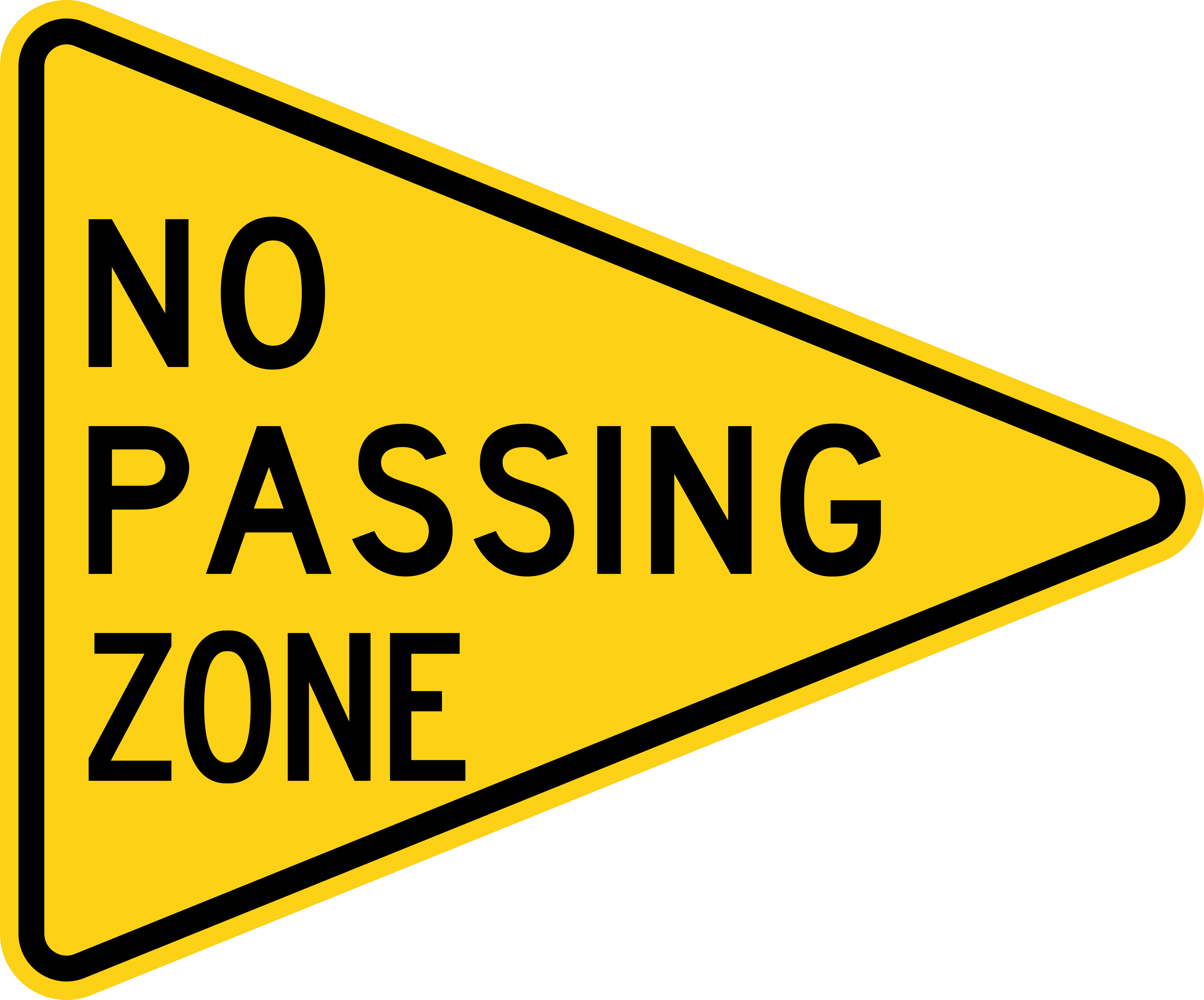
- Passing is prohibited in the no-passing zone
- Passing is required before the next hill
- The road is reserved for bicycles
- A work zone begins immediately
Show answer
Passing is prohibited in the no-passing zone. Maine identifies the yellow pennant on the left as a NO PASSING ZONE sign. A driver may not pass where that pennant appears, so the passing maneuver must be completed before reaching the beginning of the no-passing zone. The sign does not command a driver to pass, reserve the lane for bicycles, or by itself identify construction. The concrete cue is both shape and placement: a yellow pennant at the left edge marks a restriction on passing. Stay behind the vehicle ahead, maintain a safe gap, and wait for a legal passing area with adequate sight distance.
Study this in the handbook: Passing and no passing zones
16. How far ahead do headlights let you see clearly, according to the Maine handbook?
- About one mile
- About 1,000 feet
- About 50 feet
- Only about 250 feet
Show answer
Only about 250 feet. Headlights will let you see clearly only about 250 feet ahead, so never drive so fast that you cannot stop within the distance you can see with your lights; the handbook says that above about 50 mph on a dark road you are really driving blind. Maine law requires headlights anytime from sunset to sunrise, whenever visibility is too dim to see 1,000 feet ahead, and whenever the wipers are in constant use. High beams let you see twice as far as low beams, so use them when there are no oncoming vehicles.
Study this in the handbook: Scanning, stopping distance and road conditions
17. On a three-lane section of the Maine Turnpike, which lanes may a truck other than a pickup truck use?
- The two farthest right-hand lanes
- Any lane when traffic is light
- The far-left lane when passing
- The center lane unless signs say otherwise
Show answer
The two farthest right-hand lanes. On three-lane sections of the Maine Turnpike or Interstate 95, a truck tractor or other truck may operate only in the two farthest right-hand lanes. Pickup trucks are specifically excluded from this restriction. Light traffic does not open the left lane to a restricted truck, and a truck is not limited to the center lane alone. Check the vehicle type before applying the lane rule, since an ordinary pickup truck is treated differently from the trucks covered by this provision.
Study this in the handbook: Lane markings, lane use and special lanes
18. Before leaving a parked car, what should you do to keep it from rolling?
- Set the brake and shift to park
- Leave the engine idling in neutral
- Turn the wheels toward the curb only
- Press the brake pedal and hold it
Show answer
Set the brake and shift to park. A parked car must be secured against rolling. Maine lists two steps: apply the parking brake and move the gear selector to park, or to first or reverse in a manual transmission. Idling in neutral leaves nothing holding the car, wheel angle alone does not lock the drivetrain, and a foot on the pedal ends when the driver steps out. Cue: brake on, gear engaged, engine off before you open the door.
19. How much should you reduce speed when the road is covered with packed snow, according to the Maine manual?
- By about 15 miles per hour
- By 5 to 10 miles per hour
- To a crawl
- To half your normal speed
Show answer
To half your normal speed. On packed snow, Maine's guidance is to cut your speed to half of what you would use on a dry road. That is a bigger reduction than the 5 to 10 mile per hour cut advised for a merely wet road, because packed snow offers far less grip. A crawl is the recommendation for ice, which is slicker still. Fifteen miles per hour is not the figure tied to packed snow, and applying the wet road reduction there leaves too much speed. Cue: white, hard packed snow in the wheel tracks calls for half speed.
Study this in the handbook: Scanning, stopping distance and road conditions
20. You are overtaking another vehicle on the highway. How long should you ride alongside it?
- No longer than you must
- As long as traffic allows
- For at least ten seconds
- Until the driver notices you
Show answer
No longer than you must. Side by side driving stacks two cars inside one escape space. Do not stay alongside another vehicle any longer than you must; complete the pass briskly and restore a gap ahead or behind. Lingering invites disaster if either driver drifts, brakes, or blows a tire. Ten second minimums and waiting for acknowledgment prolong the exposure deliberately. Pass with purpose, clear the other car fully, and return only with real space in the mirror.
Study this in the handbook: Intersections, lane changes, expressways and school buses
Every question is written from the official Maine Driver's License Manual. Need paper? Printable ME practice test with answer key.
Last verified 2026-10-05. How we check every question · Study all 500 as flashcards
Frequently asked questions
How many questions are on this Maine practice test?
This fixed set has 20 questions. It is test 12 of 25 from the 500 question Maine bank. The real ME exam asks 30 questions and you need 24 correct.
What is the passing score for the real Maine test?
You must answer a minimum of 24 correctly to pass the test (24 of 30) That figure comes from the official Maine source cited on the DMV facts page.
How does this fixed test relate to the full Maine bank?
Each numbered test is a fixed set of questions in a fixed order, so you can retake the same test later and compare. Every test mixes road signs and the other topics in about the same proportion as the full bank. Tests 1 to 25 together cover every question in the Maine bank once. The full practice page mixes the whole bank at random.
Last verified 2026-10-05. See the Maine DMV facts page for sourced state details.