
Test 6 of 10 · 20 questions · Free 2026
KS Permit Practice Test 6
Jump to the test ↓A fixed 20 question set from the Kansas bank with answers and plain English explanations. The real KS exam is 25 questions, 80 percent to pass; take the full length version on the main practice page.
Question 1 of 20 · 0 right so far

All 20 questions in test 6
Every question below comes from the Kansas question bank on this page. Open a question to see the correct answer and the explanation. Nothing here is hidden behind a signup.
1. The pictured merge warning sign should be read as what type of sign?
- A red regulatory command that requires an immediate stop
- A yellow warning of a roadway condition or hazard ahead
- A blue guide sign naming a destination
- A white sign declaring a parking restriction
Show answer
A yellow warning of a roadway condition or hazard ahead. The yellow diamond and merging arrows place this image in the warning sign group. Warning signs give advance notice of a possible danger, hazard, or special roadway situation ahead. This image does not require an immediate stop, identify a destination, or establish a parking rule. Look beyond the sign for the entering traffic, check mirrors and blind spots, and adjust speed or lane position with care. A merge warning calls for cooperation and preparation before the paths of vehicles come together.
Study this in the handbook: Traffic lights and arrows
2. A 15-year-old holds a Kansas instruction permit. When is the teen eligible to take the Driver's License Test?
- After holding the permit 30 days
- After holding the permit one full year or reaching 17, whichever comes first
- After holding the permit six months
- Only after turning 18
Show answer
After holding the permit one full year or reaching 17, whichever comes first. An applicant under 17 must hold the instruction permit for one full year or until reaching 17, whichever comes first, before taking the Driver's License Test. Thirty days and six months are far shorter than the rule. Eighteen is wrong because the wait ends at 17 at the latest. The test itself has three parts: a pre-trip vehicle safety inspection, a basic vehicle control skills test, and a road test.
3. What following interval does the handbook recommend under prime conditions?
- Two seconds
- Four seconds
- Half a second
- Ten seconds in every situation
Show answer
Two seconds. Under prime conditions, the handbook recommends measuring a safe following distance with the two-second rule. The interval is a practical way to preserve time for a sudden stop or turn, rather than a fixed number of car lengths that changes with speed. Four seconds is the adverse-condition rule, not the ordinary baseline. A half-second gap is too short, and ten seconds is not required in every situation.
Study this in the handbook: Following distance, scanning and space
4. What does the sharp right-angle arrow warn a driver to anticipate?

- A straight roadway where passing is always permitted
- A sharper change in direction that calls for lower speed
- A traffic signal that requires an immediate U-turn
- A parking area with a mandatory stopping lane
Show answer
A sharper change in direction that calls for lower speed. The right-angle arrow represents a sharper turn than a gentle bend, so approach at a speed that lets you remain in control. Do not wait until the middle of the turn to make a major braking decision. The symbol is not a passing authorization, a U-turn command, or a parking instruction. Check for an advisory speed or additional plaque, then position the vehicle correctly and steer smoothly through the turn.
Study this in the handbook: Safe speed and stopping distance
5. What wireless-device rule applies to a Kansas 15-year-old with a restricted license?
- No wireless devices while driving, except for illegal activity or emergency help
- Hands-free calls are always required but texting is allowed
- Wireless devices are allowed until the driver reaches age 16
- Only navigation devices are prohibited while the vehicle moves
Show answer
No wireless devices while driving, except for illegal activity or emergency help. A 15-year-old with a restricted license may not use wireless communication devices while driving, except to report illegal activity or summon emergency help. The handbook therefore creates a narrow emergency exception, not a general hands-free privilege. Allowing texting reverses the safety rule, and the restriction does not expire simply because the vehicle is being driven before age 16. Navigation devices are not singled out as the only prohibited equipment in this passage. The recall cue is no wireless use during driving, with two urgent exceptions.
Study this in the handbook: Restricted license at 16 and the unrestricted license
6. A new resident moves to Kansas with a valid license from another state. By when must the driver have a Kansas driver's license?
- Within 90 days of moving to Kansas
- Within 10 days of moving to Kansas
- Within 30 days of moving to Kansas
- Only when the old license expires
Show answer
Within 90 days of moving to Kansas. Kansas gives a new resident 90 days after the move to get a Kansas driver's license. Ten and 30 days are shorter deadlines that the handbook does not set. Waiting until the old license expires is also wrong, because the clock starts with the move, not with the other state's expiration date. Visitors and certain nonresidents, such as students and military members, are handled separately.
Study this in the handbook: Instruction permit, farm permit and the 15 year old restricted license
7. You are about to turn right in Kansas and a bicyclist is ahead. What does the handbook say?
- Pass quickly, then turn
- Turn from the bike lane
- Honk so the cyclist stops
- Do not pass the bicyclist immediately before the turn; slow down and let the cyclist clear the intersection
Show answer
Do not pass the bicyclist immediately before the turn; slow down and let the cyclist clear the intersection. Give bicyclists as much space as possible and consider their speed when you pass. If you are about to make a right turn, you must not pass a bicyclist immediately before the turn. To avoid a collision, slow down and let the cyclist clear the intersection before making your turn. Turning from a bike lane is not the instruction, and sounding the horn close to a bicyclist can startle the rider into your path. After passing a bicyclist, do not slow down or stop quickly, because a motor vehicle's brakes are more powerful than a bicycle's.
Study this in the handbook: Pedestrians, bicycles, motorcycles and trucks
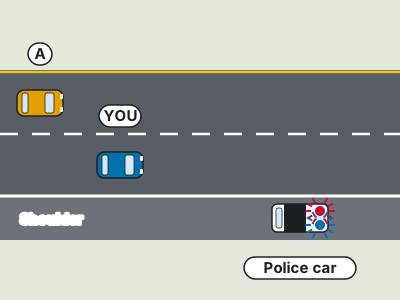
8. When approaching a stationary emergency vehicle with flashing lights on a multilane road, what should you do if safe?
- Follow the emergency vehicle closely after it moves
- Stop in the lane beside the emergency vehicle
- Pass on the shoulder without reducing speed
- Move into a lane that is not next to the stopped vehicle
Show answer
Move into a lane that is not next to the stopped vehicle. Kansas guidance protects responders by asking drivers to create lateral space. On a road with two or more lanes in each direction, change into a lane away from the stopped emergency vehicle when that maneuver is safe. If changing lanes cannot be done, reduce speed and continue with due caution. Passing on the shoulder or remaining beside the vehicle at normal speed removes the protective buffer. Look well ahead, signal early, and leave room for workers who may be near the vehicle.
Study this in the handbook: Emergency vehicles, move over and traffic stops
9. What shape and color pattern identifies most Kansas warning signs?
- White with green lettering, usually circular
- Yellow with black lettering or symbols, usually diamond shaped
- Blue with white lettering, usually rectangular
- Red with white lettering, usually octagonal
Show answer
Yellow with black lettering or symbols, usually diamond shaped. Most warning signs use a yellow background with black letters or symbols and a diamond outline. They alert you to a danger, special condition, or change ahead, so the message calls for early speed adjustment and attention rather than an immediate command to stop. A red octagon is reserved for the stop sign, while rectangular blue or green signs generally provide services or route information. When a yellow diamond appears, scan beyond the sign, check traffic around you, and prepare for the condition it announces.
Study this in the handbook: Warning signs
10. Why should you wait to move in front of a large vehicle until its whole front is visible in your rear-view mirror?
- The rear-view mirror shows only the truck's license plate
- The truck cannot see any vehicle in its side mirrors
- Large vehicles are required to stop immediately after a pass
- The large vehicle needs more stopping distance than a car
Show answer
The large vehicle needs more stopping distance than a car. Large vehicles need substantially more distance to stop than passenger cars. Before moving back into the lane ahead of one, wait until the vehicle's entire front appears in your rear-view mirror. That visual cue gives the truck a safer cushion if traffic slows and prevents cutting off a vehicle that cannot brake as quickly. Seeing only part of the front means the gap is still too small. Complete the pass smoothly, maintain a predictable speed, and leave room for the truck's longer stopping response.
Study this in the handbook: Pedestrians, bicycles, motorcycles and trucks
11. What fine does the Kansas handbook list for a first DUI conviction?
- $100 to $250
- $5,000
- $750 to $1,000 plus court costs
- No fine, only community service
Show answer
$750 to $1,000 plus court costs. A first DUI conviction in Kansas brings a fine of $750 to $1,000 plus court costs, a sentence of at least 48 hours in jail or 100 hours of community service, suspension of the license, and a requirement to drive with an ignition interlock device. Second and later convictions carry much worse penalties. The fine is not optional and not a token amount, and community service is an alternative to jail, not to the fine.
Study this in the handbook: DUI law, implied consent and penalties
12. What should a driver do when an emergency vehicle approaches with flashing red lights or a siren?
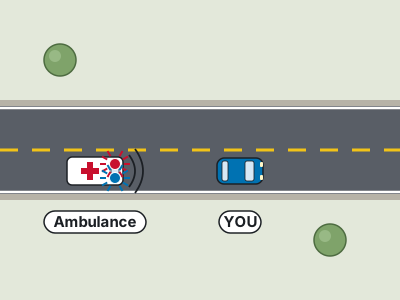
- Drive right and stop without blocking an intersection
- Follow behind the emergency vehicle through traffic
- Stop in the center of the intersection
- Continue at the same speed if the lane is clear
Show answer
Drive right and stop without blocking an intersection. When an emergency vehicle approaches with flashing red lights or a siren, the handbook directs drivers to move immediately to the right and stop without blocking any intersection. Following the emergency vehicle is specifically unsafe, and stopping in the intersection prevents other traffic from clearing. A clear lane does not cancel the duty to yield. The visual cue is simple: emergency lights or siren means right, stop, and leave the intersection open for the responding vehicle.
Study this in the handbook: Emergency vehicles, move over and traffic stops
13. At a Kansas intersection, what sequence follows a flashing red signal before entry?
- Wait for a steady green light before moving
- Slow without stopping and continue through
- Stop, look both ways, and yield as at a stop sign
- Turn only if the vehicle behind has stopped
Show answer
Stop, look both ways, and yield as at a stop sign. A flashing red traffic light requires a complete stop before the stop line, crosswalk, or intersection. The handbook then directs the driver to use the stop-sign procedure: look both ways and yield the right-of-way before entering. Merely slowing fails to satisfy the signal, and waiting for a steady green light adds a condition the passage does not require. The vehicle behind you does not determine permission to proceed. See flashing red, stop fully, check both directions, and enter only when safe.
Study this in the handbook: Traffic lights and arrows
14. How should following distance change when conditions are adverse?
- Use a four-second following rule
- Keep exactly one second behind the vehicle ahead
- Use the same gap as in ideal conditions
- Follow more closely so other drivers cannot merge
Show answer
Use a four-second following rule. The handbook uses two seconds as a measuring rule in prime conditions and four seconds when conditions are adverse. Rain, poor roads, traffic, and sudden stops all reduce the margin available to react, so the longer interval gives the driver more space. A one-second gap or the ordinary ideal-condition interval leaves too little room. Use the four-second count whenever weather or road conditions make stopping more difficult.
Study this in the handbook: Following distance, scanning and space
15. Kansas bars a U-turn anywhere other drivers cannot see your vehicle for at least what distance?
- 100 feet
- 200 feet
- 500 feet
- 1,000 feet
Show answer
500 feet. Do not make a U-turn on a curve, near the top of a hill, or anywhere other drivers cannot see you for at least 500 feet. One hundred feet is the signaling distance and 200 feet is the gap for returning to your lane when an oncoming vehicle approaches, so neither is the U-turn standard. One thousand feet overstates it. Local ordinances and posted signs can also prohibit U-turns.
Study this in the handbook: Turn signals, U turns and passing
16. What action does a red and white downward-pointing triangle direct a driver to take?
- Stop and wait for a green signal
- Slow and allow right-of-way traffic to cross
- Enter immediately before cross traffic
- Turn around at the next opening
Show answer
Slow and allow right-of-way traffic to cross. The downward pointing red and white triangle is a yield sign. Its instruction is to slow down and let traffic that already has the right of way cross before you enter. A complete stop might be necessary if traffic requires it, but the sign is not the same command as an octagonal stop sign and does not require waiting for a green light. Entering before cross traffic reverses the required priority. Turning around has no connection to the sign. Slow early, evaluate the crossing path, and yield before moving into it.
Study this in the handbook: Regulatory signs
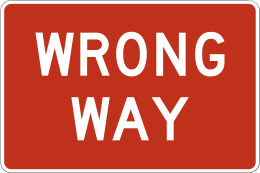
17. What does a WRONG WAY sign indicate about your vehicle?
- It is entering a truck-only route
- It is approaching a rough pavement section
- It may use the shoulder as a passing lane
- It is moving in the wrong direction
Show answer
It is moving in the wrong direction. A Wrong Way sign tells the driver that the vehicle is traveling against the permitted direction. The handbook notes that this sign can appear on an expressway ramp beyond a Do Not Enter sign or after turning incorrectly onto a one-way street, alley, or driveway. Rough pavement and truck restrictions use different messages. Treat the sign as an immediate direction problem and stop the wrong-way movement safely.
Study this in the handbook: Regulatory signs
18. At an uncontrolled intersection, what must a driver do when another vehicle is already entering from a different highway?
- Yield only if the other vehicle is turning left
- Accelerate to claim the intersection
- Yield to the vehicle already in the intersection
- Proceed because no signs mean no right-of-way rule
Show answer
Yield to the vehicle already in the intersection. Kansas requires an approaching driver to yield to a vehicle that has already entered the intersection from a different highway. The driver should not accelerate to seize the space. The turning direction of the other vehicle does not remove its established priority, and the absence of signs does not suspend right-of-way rules. Approach with enough control to stop, identify whether the intersection is occupied, and let the vehicle already inside clear before proceeding. The visual cue is position, not size or speed: the vehicle in the intersection has priority over the one still approaching.
Study this in the handbook: Right of way at intersections
19. Unless posted otherwise, what is the maximum speed in a Kansas urban district?
- 20 mph
- 40 mph
- 30 mph
- 55 mph
Show answer
30 mph. Kansas sets the default maximum at 30 miles per hour in any urban district, unless a different limit is posted. The 20 mph figure is associated with properly marked school zones or business districts, not every urban district. Forty and 55 mph are not the handbook's default answer for this category. Identify the district before selecting a speed, then look for a posted exception. A useful comparison is 30 mph for an urban district and 20 mph for a properly marked school zone or business district. Conditions can still require driving slower under the basic speed law.
Study this in the handbook: Kansas speed limits
20. Kansas lists places such as an intersection, a crosswalk at an intersection, and within 15 feet of a fire hydrant. What does the handbook say about parking at those places?
- The rule applies only after sunset
- Parking is allowed if hazard lights are on
- Only commercial vehicles may park there
- Parking is not allowed at those listed locations
Show answer
Parking is not allowed at those listed locations. Kansas introduces its restricted parking locations with a direct rule: parking is not allowed at the places that follow. Those locations include intersections, crosswalks, fire hydrants, driveways, tunnels, and signed no-parking areas. Hazard lights do not cancel a parking prohibition, and the rule is not limited to commercial vehicles or nighttime hours. When you see a marked restriction or recognize one of the listed locations, choose a different place to leave the vehicle. Check the curb, nearby signs, and surrounding roadway before opening the door.
Study this in the handbook: Where not to park and parking on hills
QualitySpace is expanding to Kansas
We are a California-based independent insurance brokerage working on licensing in more states. We cannot help with Kansas insurance yet. Leave your email and we will let you know when we can.
Every question is written from the official Kansas Driving Handbook. Need paper? Printable KS practice test with answer key.
Last verified 2026-10-05. How we check every question · Study all 211 as flashcards
Frequently asked questions
How many questions are on this Kansas practice test?
This fixed set has 20 questions. It is test 6 of 10 from the 211 question Kansas bank. The real KS exam asks 25 questions and you need 20 correct.
What is the passing score for the real Kansas test?
You must score an 80% to pass the knowledge test That figure comes from the official Kansas source cited on the DMV facts page.
How does this fixed test relate to the full Kansas bank?
Each numbered test is a fixed set of questions in a fixed order, so you can retake the same test later and compare. Every test mixes road signs and the other topics in about the same proportion as the full bank. Tests 1 to 10 together cover 200 of the 211 questions in the Kansas bank, each once. The full practice page mixes the whole bank at random.
Last verified 2026-10-05. See the Kansas DMV facts page for sourced state details.