
Test 10 of 10 · 20 questions · Free 2026
KS Permit Practice Test 10
Jump to the test ↓A fixed 20 question set from the Kansas bank with answers and plain English explanations. The real KS exam is 25 questions, 80 percent to pass; take the full length version on the main practice page.
Question 1 of 20 · 0 right so far
All 20 questions in test 10
Every question below comes from the Kansas question bank on this page. Open a question to see the correct answer and the explanation. Nothing here is hidden behind a signup.
1. Unless a sign sets a different limit, what is the Kansas maximum speed on a county or township road?
- 35 mph
- 45 mph
- 65 mph
- 55 mph
Show answer
55 mph. The handbook lists 55 miles per hour as the default maximum on any county or township road, unless otherwise posted. The 65 mph choice belongs to state or federal highways. The 35 and 45 mph choices are not the listed default for this road type. Road classification matters more than a driver's preferred pace, and a posted limit can change the baseline. A good recall cue is the ascending pair in the rural list: 55 for county or township roads, 65 for state or federal highways, and 75 only for a specially designated separated multilane highway that is posted.
Study this in the handbook: Kansas speed limits
2. Which sign treatment may identify a school zone, school crossing, or pedestrian crossing?
- Flashing red only
- Solid blue
- Brown and white
- Fluorescent yellow
Show answer
Fluorescent yellow. The handbook says some warning signs may be fluorescent yellow, including signs for school zones, school crossings, and pedestrian crossings. That color treatment helps draw attention to locations where children or people on foot may enter the roadway. Blue is associated with service information, brown commonly guides travelers toward recreational or cultural locations, and a flashing red signal is a traffic control device rather than the sign color described here. When fluorescent yellow appears near a school or crossing, reduce speed and search actively for people.
Study this in the handbook: Warning signs
3. When turning left at an intersection, which approaching traffic must you yield to?
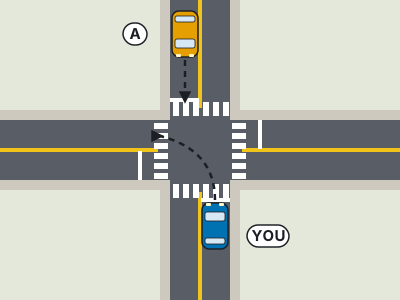
- Only vehicles that are already behind you
- Vehicles going straight or turning right from the opposite direction
- No vehicles, if your turn signal is on
- Vehicles entering from a driveway behind the intersection
Show answer
Vehicles going straight or turning right from the opposite direction. A left turn crosses the path of opposing traffic, so the turning driver must yield to oncoming vehicles that are going straight or turning right. Activating a signal communicates intent but does not give permission to cross in front of another vehicle. Traffic behind you is not the central conflict, and a driveway vehicle behind the intersection does not create the handbook’s left-turn rule. Before moving, check the opposing lane and pedestrians, then complete the turn only after the path is clear.
Study this in the handbook: Right of way at intersections
4. What may a driver do when a dashed yellow line separates opposing lanes and a safe gap is available?
- Park on the line until traffic clears
- Cross at any time without checking traffic
- Pass, while checking that the lane entered is clear
- Treat it exactly like two solid yellow lines
Show answer
Pass, while checking that the lane entered is clear. Dashed yellow lines divide opposing traffic but may mark a passing zone. A driver may pass when a safe gap exists and the lane being entered is clear of traffic. The marking never grants permission to cross blindly, park on the centerline, or ignore road conditions. Two solid yellow lines communicate a different restriction. Check ahead and behind, signal, pass only when needed, and return after the entire front of the passed vehicle is visible in the rearview mirror.
Study this in the handbook: Work zone, guide and incident signs
5. When does Kansas law require headlights to be turned on, according to the handbook?
- Only between sunset and sunrise
- Only when it snows
- Only on unlit highways
- Whenever the windshield wipers are used
Show answer
Whenever the windshield wipers are used. The handbook notes that many states, including Kansas, require you to turn on your headlights whenever the wipers are used on the vehicle. On rainy, snowy, or foggy days it can be hard for other drivers to see your vehicle, even in daylight, and lit headlights make it easier to see. The handbook also suggests turning the headlights on when it begins to get dark, noting that some newer vehicles have automatic sensors and that turning the lights on a little early helps other drivers see you.
Study this in the handbook: Night driving, fog and floods
6. What does a dashed white line between lanes traveling in the same direction permit?
- Crossing only to pass on the shoulder
- Crossing to change lanes when a safe gap is available
- Never crossing under any circumstance
- Traveling in opposite directions on either side
Show answer
Crossing to change lanes when a safe gap is available. Dashed white lane markings separate traffic moving in the same direction and may be crossed for a lane change when a safe gap exists. The marking does not guarantee that the next lane is clear or that changing is wise at that moment. Check mirrors and the blind spot, signal, judge the speed of nearby traffic, and move only when the lane can accept the vehicle. A solid white line signals a stronger restriction, while yellow markings separate opposing traffic.
Study this in the handbook: Lane markings and special lanes
7. Which electronic-device use does Kansas specifically prohibit while driving?
- Dialing a phone number
- Listening to a weather report through a GPS device
- Writing, sending, or reading a written communication
- Using a phone for a hands-free conversation
Show answer
Writing, sending, or reading a written communication. Kansas law prohibits using an electronic device to write, send, or read a written communication while driving. Text messages and email fall within that rule. The handbook separately says GPS devices and weather reports are not included, and it notes that talking or dialing is not specifically illegal under this provision, although any distraction remains dangerous. The safest cue is to handle messages before moving or pull into a safe parking area first.
Study this in the handbook: Where not to park and parking on hills
8. A school bus is stopped to pick up children on a two-lane road. When may a driver who meets the bus continue?
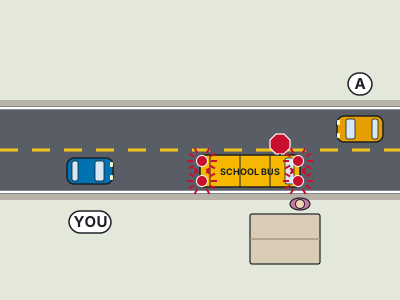
- As soon as the driver sees no children in the roadway
- After the bus retracts its STOP signal and turns off its red lights
- After slowing to 15 mph and passing on the shoulder
- When the bus driver waves traffic through while the red lights remain on
Show answer
After the bus retracts its STOP signal and turns off its red lights. When a school bus is stopped to pick up or let off children, Kansas requires an approaching or overtaking driver to stop. The vehicle must remain stopped until the STOP signal is retracted and the red lights are turned off. Seeing no children does not replace the required signal condition because a child may still enter the roadway. Slowing to 15 mph or using the shoulder does not make passing legal, and a wave cannot override active red lights. Treat the bus signals as the controlling cue and wait for both release conditions.
Study this in the handbook: School buses and required stops
9. What action does the crossed right-arrow sign prohibit?
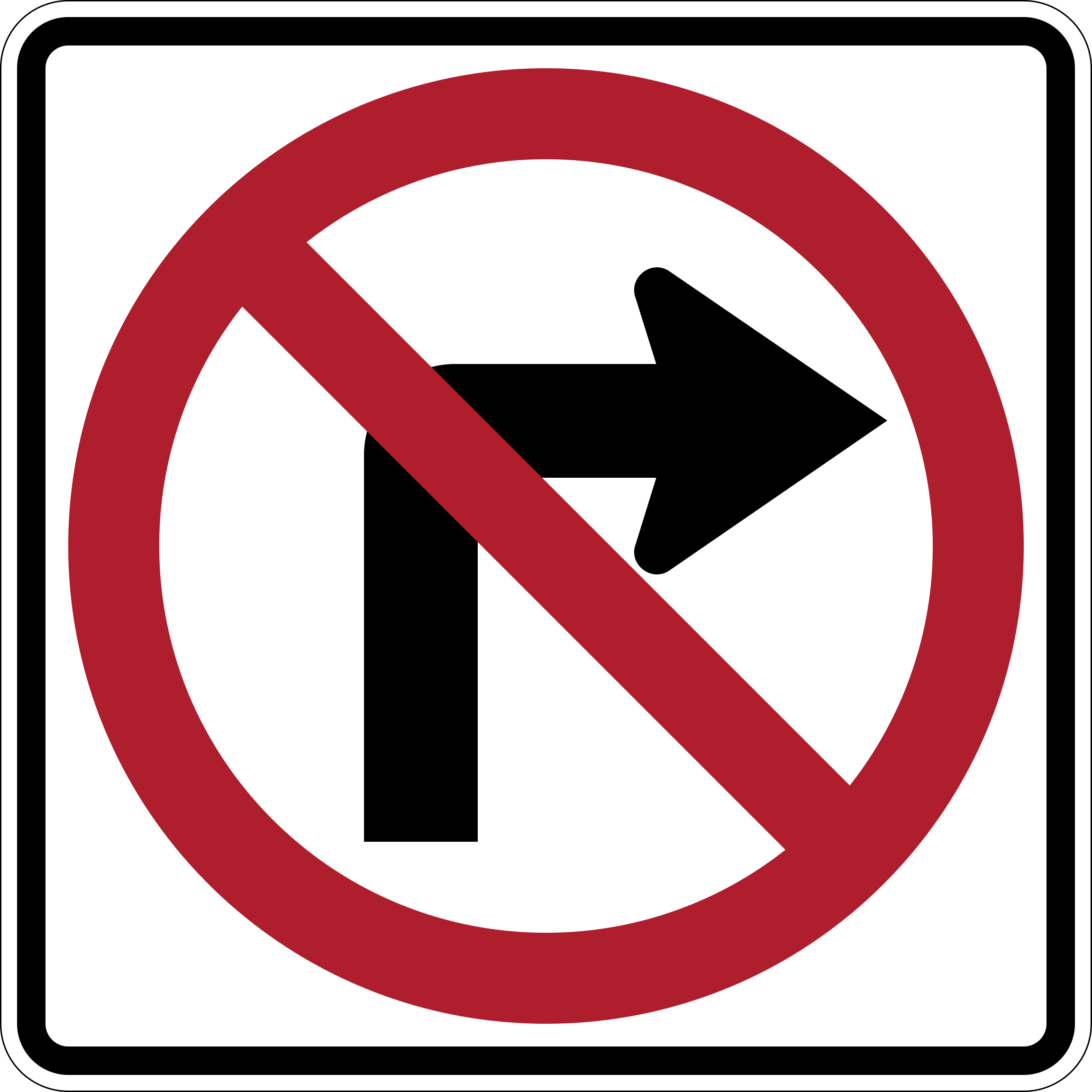
- Making a legal left turn from a permitted lane
- Driving straight in the marked lane
- Stopping for a pedestrian before the corner
- Turning right where the sign is posted
Show answer
Turning right where the sign is posted. A red circle and slash over the right-turn arrow prohibits the right-turn movement at that location. The sign does not automatically close the lane to straight travel, prevent a required stop for a pedestrian, or ban a separately permitted left turn. The pictured arrow identifies the restricted action. Check for additional controls before proceeding, because a no-right-turn sign does not replace the intersection's signal or right-of-way rules.
Study this in the handbook: Kansas speed limits
10. What license consequence does Kansas describe for refusing a requested BAC test the first time?
- A seven-day warning suspension
- A one-year loss of the driver's license
- A two-year loss of the driver's license
- No license consequence if the driver was not arrested
Show answer
A one-year loss of the driver's license. Kansas implied consent means a licensed driver has agreed to a lawfully requested test when an officer suspects impaired driving. The handbook states that refusing a BAC test can cost the driver's license for one year, and K.S.A. 8-1014 sets a one year suspension for every refusal occurrence, followed by a period of driving only with an ignition interlock device that grows with each refusal, starting at two years after a first refusal. A seven day warning understates the consequence, and a two year loss confuses the later interlock restriction with the suspension itself. Remember the sequence as request, refusal, one year suspension, then interlock.
Study this in the handbook: DUI law, implied consent and penalties
11. Until when should a Kansas infant ride in a rear facing infant seat in the back seat?
- From birth to at least age one and at least 20 pounds
- Until 6 months, regardless of weight
- Until age 4 or 40 pounds
- Until age one or 10 pounds, whichever comes first
Show answer
From birth to at least age one and at least 20 pounds. The handbook says infants should ride rear facing in the back seat from birth to at least age one and until they weigh at least 20 pounds. Both conditions apply, so stopping at 6 months or at 10 pounds is too early. Age 4 is the cutoff for the federally approved child safety seat rule, not the rear facing stage; toddlers over one year and at least 20 pounds move to a forward facing seat.
Study this in the handbook: Seat belts, child seats and air bags
12. According to the Kansas handbook, how much rushing water can carry away most vehicles?
- About 6 feet
- About 6 inches
- About 4 feet
- About 2 feet
Show answer
About 2 feet. Two feet of rushing water can carry away most vehicles, and just 6 inches reaches the bottom of most passenger cars and can cause loss of control or stalling. Six inches is the depth that reaches the car's floor, not the depth that sweeps it away. Four and six feet overstate the danger threshold. Do not drive through flooded areas; turn around and find another route.
Study this in the handbook: Night driving, fog and floods
13. How many questions does the Kansas knowledge test require an applicant to answer?
- 25 questions
- 20 questions
- 30 questions
- 40 questions
Show answer
25 questions. The Kansas knowledge test requires an applicant to answer 25 questions about traffic laws and identify certain signs. The 20-question choice understates the number, while 30 and 40 overstate it. This test is not limited to signs or to one narrow subject: the handbook says it covers Kansas traffic laws and road signs. A practical memory cue is to pair 25 with the knowledge test and remember that the applicant must also recognize signs by shape, color, or symbol. That detail distinguishes this exam from the separate driving test on a designated route.
Study this in the handbook: License tests, renewal and losing your license
14. What should a driver do when a green light is showing but traffic blocks the far side of the intersection?
- Enter because green always gives permission
- Wait until there is room to clear the intersection
- Stop in the middle and wait
- Use the shoulder to get around the queue
Show answer
Wait until there is room to clear the intersection. Kansas prohibits entering an intersection, crosswalk, or railroad crossing unless there is enough space on the other side for the vehicle to get all the way across. A green signal does not override that space requirement. The green-always choice ignores the blockage, while stopping in the middle would leave the vehicle obstructing the intersection. Using the shoulder is unrelated and unsafe. The practical cue is to look beyond the signal before moving: if the exit is full, remain behind the stop line until a complete crossing is possible.
Study this in the handbook: Right of way at intersections
15. On which roadway does Kansas require moving away from a stopped emergency vehicle when safe?
- Only a parking lot with marked emergency spaces
- Only a one-lane rural road with no shoulder
- A street or highway with at least two lanes in each direction
- Any roadway, even when no emergency lights are displayed
Show answer
A street or highway with at least two lanes in each direction. The Kansas rule applies when the street or highway has two or more lanes in each direction and the stationary emergency vehicle is using flashing warning lights. Move to a lane that is not next to the vehicle when that maneuver is safe. The rule is not limited to rural roads or parking lots, and flashing warning lights are part of the stated condition. If changing lanes cannot be done safely, slow down and pass with due caution.
Study this in the handbook: Right of way at intersections
16. In fog or other conditions that make the roadway difficult to see, how should you adjust your speed?
- Increase speed to spend less time in the poor visibility
- Keep the maximum limit because fog does not change the legal speed
- Reduce speed because the posted maximum assumes ideal conditions
- Drive at the minimum posted speed regardless of what you can see
Show answer
Reduce speed because the posted maximum assumes ideal conditions. A posted maximum is not a promise that the same speed is safe in every environment. The handbook specifically lists fog and any condition that makes the roadway hard to see as reasons to slow down. The basic speed rule also requires a reasonable and prudent speed for the road, weather, vehicle, and driver condition. Reducing speed gives you more time to identify lane edges, stopped traffic, and hazards. Use the visible roadway as your guide, not the number on the sign alone.
Study this in the handbook: Kansas speed limits
17. On a regulatory sign, what does a red slash over a symbol tell you?
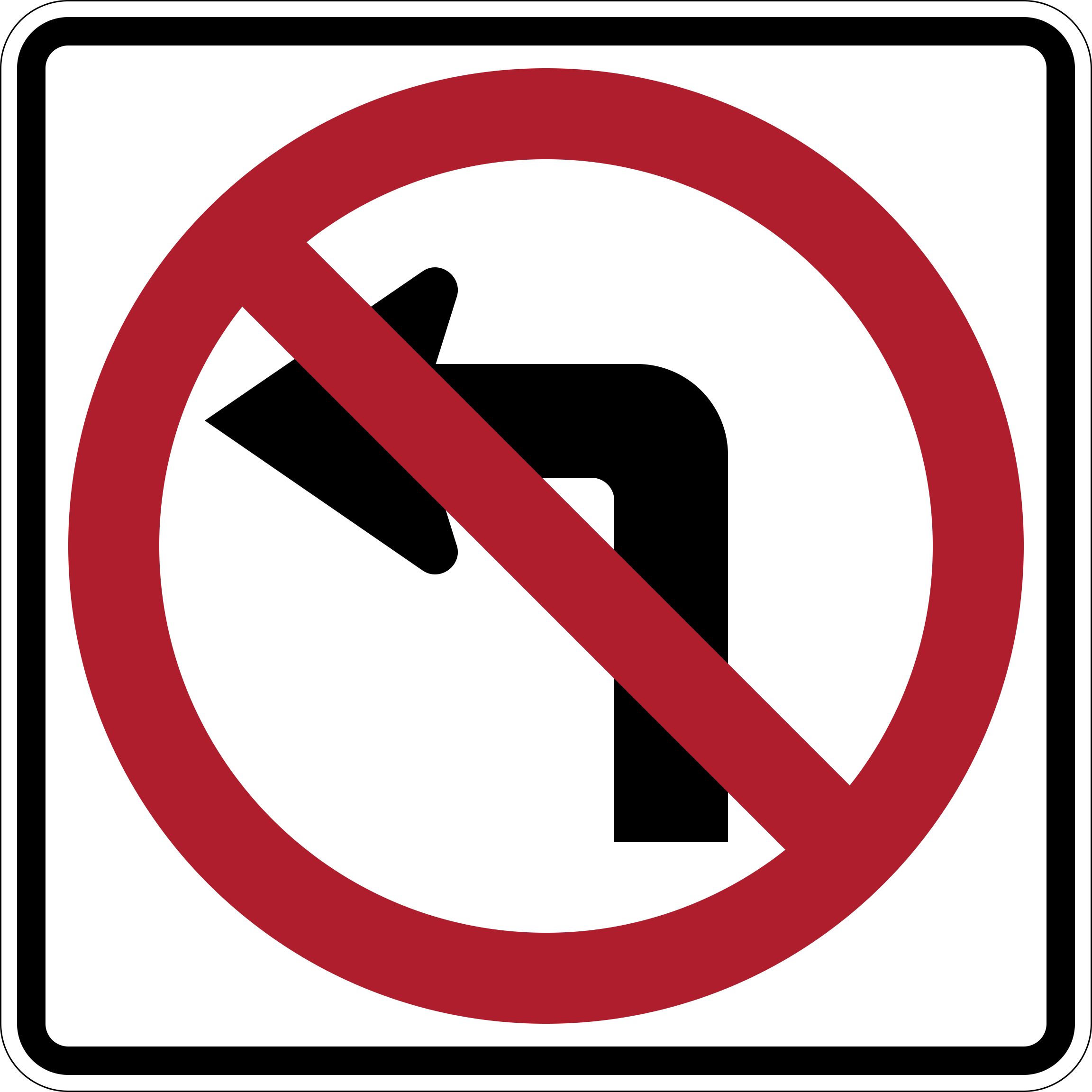
- The action represented by the symbol is prohibited
- The action is recommended when traffic is light
- The symbol identifies a service available ahead
- The sign warns that the action may occur unexpectedly
Show answer
The action represented by the symbol is prohibited. A red circle and slash over a symbol means the action shown is prohibited. Regulatory signs communicate laws about traffic direction, lane use, turning, speed, parking, and other special situations, so the crossed symbol is a command to avoid that movement at the posted location. It is not a recommendation, a service marker, or a general warning that the action might happen. Read the symbol inside the slash carefully, then choose a permitted movement and obey any lane markings or additional signs nearby.
Study this in the handbook: Kansas speed limits
18. What kind of information does a white rectangular sign with black lettering generally provide?
- A traffic law or other regulatory requirement
- A warning about a changing road surface
- Directions to a campground or museum
- The location of fuel and hospital services
Show answer
A traffic law or other regulatory requirement. White signs with black, red, or green letters or symbols commonly serve as regulatory signs. They tell drivers about laws involving direction, lane use, turning, speed, parking, or another special situation. A speed limit sign is a familiar example because its instruction must be obeyed. Orange signs identify work zones, and green, brown, or blue guide signs provide route or service information. When a white rectangular sign states a limit or required movement, treat it as an enforceable instruction.
Study this in the handbook: Kansas speed limits
19. On the Kansas age requirements list, what is the minimum age for a non-commercial Class C license with no restricted status?
- 15
- 18
- 17
- 21
Show answer
17. The handbook's age list puts the non-commercial Class C license at 17 years of age or older. Fifteen is the age for the restricted Class C license, and 16 is listed for less restricted privileges, which carry limits until a 16-year-old has held that license for six months. Eighteen is the minimum for non-commercial Class A or B, and 21 is the age for interstate commercial licenses and for the adult who supervises a permit holder.
20. How many moving violation convictions within what period can lead to a Kansas license suspension?
- Three within a twelve month period
- Two within six months
- Five within two years
- Six within three years
Show answer
Three within a twelve month period. The first ground for suspension in the handbook is conviction of three moving violations within a twelve month period. Two in six months is fewer than the stated number. Five in two years and six in three years stretch both the count and the time window beyond what the handbook lists. Other suspension grounds include refusing a chemical test, failing to appear in court, and letting liability insurance lapse.
Study this in the handbook: License tests, renewal and losing your license
QualitySpace is expanding to Kansas
We are a California-based independent insurance brokerage working on licensing in more states. We cannot help with Kansas insurance yet. Leave your email and we will let you know when we can.
Every question is written from the official Kansas Driving Handbook. Need paper? Printable KS practice test with answer key.
Last verified 2026-10-05. How we check every question · Study all 211 as flashcards
Frequently asked questions
How many questions are on this Kansas practice test?
This fixed set has 20 questions. It is test 10 of 10 from the 211 question Kansas bank. The real KS exam asks 25 questions and you need 20 correct.
What is the passing score for the real Kansas test?
You must score an 80% to pass the knowledge test That figure comes from the official Kansas source cited on the DMV facts page.
How does this fixed test relate to the full Kansas bank?
Each numbered test is a fixed set of questions in a fixed order, so you can retake the same test later and compare. Every test mixes road signs and the other topics in about the same proportion as the full bank. Tests 1 to 10 together cover 200 of the 211 questions in the Kansas bank, each once. The full practice page mixes the whole bank at random.
Last verified 2026-10-05. See the Kansas DMV facts page for sourced state details.