
Test 14 of 25 · 20 questions · Free 2026
KS Permit Practice Test 14
Jump to the test ↓A fixed 20 question set from the Kansas bank with answers and plain English explanations. The real KS exam is 25 questions, 80 percent to pass; take the full length version on the main practice page.
Question 1 of 20 · 0 right so far
All 20 questions in test 14
Every question below comes from the Kansas question bank on this page. Open a question to see the correct answer and the explanation. Nothing here is hidden behind a signup.
1. You sit on a two-way Kansas street facing red, wanting to turn left onto a one-way street. When is that ever allowed?
- After stopping, onto a one-way street where allowed
- Never; left turns on red are banned in every Kansas case
- From any lane as long as the one-way street runs either way
- Without stopping, whenever the one-way street looks empty
Show answer
After stopping, onto a one-way street where allowed. Kansas permits narrow left on red exceptions: after a full stop and a check for traffic and pedestrians, turning from a one-way street onto another one-way street, or from a two-way street onto a one-way street where allowed. A No Turn on Red sign erases the permission at that corner. Turning without stopping or onto streets running the wrong direction breaks the exception shape. These are precision allowances, so every condition, stop, direction, and receiving street, must fit before the wheels roll.
Study this in the handbook: Traffic lights and arrows
2. What is the main safety benefit of looking well down the roadway?
- It replaces the need to check the sides and rear
- It guarantees that no vehicle can enter the travel path
- It allows the driver to ignore nearby pedestrians
- It gives more time to see problems and adjust speed or lane position
Show answer
It gives more time to see problems and adjust speed or lane position. Looking far ahead helps a driver notice vehicles, people, signs, and changing traffic before they become immediate hazards. That early warning allows time to reduce speed or change lanes smoothly instead of using emergency braking or steering. The technique does not guarantee a clear path, eliminate the need for side and rear searches, or excuse ignoring nearby pedestrians. Make a long visual search part of every roadway scan.
Study this in the handbook: Following distance, scanning and space
3. A Kansas driver insists they feel perfectly sharp after drinks, yet their BAC measures .03. What does the handbook say about vision at that level?
- Vision is already impacted, since impact begins at .02 BAC
- Vision stays fully normal until the general violation level of .08 is reached on a breath test reading
- Feeling sharp proves vision is unaffected, because self assessment overrides the BAC number in Kansas law
- Only drivers under twenty one suffer vision effects below the .08 threshold used for adult violations
Show answer
Vision is already impacted, since impact begins at .02 BAC. Vision is among the first faculties alcohol taxes. The handbook fixes the onset plainly: vision is impacted at .02 BAC for all drivers, distorting focus and the distance and speed judgments built on sight. A .03 driver who feels sharp is demonstrating the companion problem, impaired judgment about impairment. The .08 figure marks the general per se violation, not the beginning of harm. Color distinction and reaction processing degrade along the same early curve, which is why driving after any drinking starts compromised.
Study this in the handbook: How alcohol and drugs affect driving
4. Light snow dusts a Kansas bridge after you pass this skidding-car sign. What is the right response?

- Keep normal speed because bridges freeze last in Kansas
- Reduce speed and be ready for a slippery roadway
- Brake firmly once on the bridge to test the surface grip
- Steer sharply side to side to warm the tires up faster
Show answer
Reduce speed and be ready for a slippery roadway. The skidding vehicle symbol warns the surface ahead can turn slippery. Reduce speed before you reach it and prepare for longer stops and gentler steering. Bridges deserve special respect because cold air beneath them freezes their decks before ordinary pavement, as do shaded spots and overpasses. Testing grip with firm braking can start the skid you fear. On wet roads generally, about ten miles per hour below recommended speeds restores margin; packed snow demands half speed or more.
Study this in the handbook: Safe speed and stopping distance
5. Fluorescent pink signs redirect your Kansas highway around a hazardous spill. How should you treat them?
- As optional guidance meant only for commercial trucks
- As decorations marking the edge of the spill cleanup
- As temporary incident directions to slow, prepare to stop, and follow detours
- Pink signs rank below ordinary lane markings in a spill
Show answer
As temporary incident directions to slow, prepare to stop, and follow detours. Fluorescent pink with black lettering is the incident palette: crashes, spills, closures, and detours from unplanned events. These signs tell you to prepare to stop or that roadways ahead are closed or detoured, and they deserve the same obedience as orange work zone devices. Lane paint cannot outrank live incident directions. Every vehicle class follows them. Crews in the incident zone work steps from live lanes, so early slowing and early merging protect people you may not see until the last moment.
Study this in the handbook: Work zone, guide and incident signs
6. Why is alcohol especially dangerous for the brain function that driving decisions depend on?
- It raises confidence, and confidence equals better judgment
- Judgment is the last ability alcohol touches
- It strikes the brain areas controlling judgment early
- Alcohol affects only muscles, never thinking skills
Show answer
It strikes the brain areas controlling judgment early. Judgment is the brain centered store of experience and knowledge you apply instantly to new problems, and alcohol attacks the areas controlling it early. That is why impaired drivers sincerely believe they are fit to drive: the very tool that would correct them is impaired. Vision blurring, color confusion, and slowed reactions follow the same pattern. New drivers learning complex skills feel the effects even more strongly. Any plan that relies on an impaired person judging their own impairment is built on the broken part.
Study this in the handbook: How alcohol and drugs affect driving
7. Another vehicle hits your Kansas car from the side. Why will frontal air bags not help much?
- Side impacts never injure anyone seriously
- Your body is thrown toward the struck side, where belts protect you
- Air bags deploy only in rear collisions in Kansas
- Belts should be unbuckled to move with the impact
Show answer
Your body is thrown toward the struck side, where belts protect you. Each crash direction throws your body differently. A side hit throws you toward the struck side, and frontal air bags are not positioned to help there. Your lap and shoulder belts keep you behind the wheel, ready to steer or brake so the vehicle does not strike something else next. Rear hits demand bracing against the seat back and head restraint. Front impacts call for a glancing angle when possible. Belts are the constant in every direction.
Study this in the handbook: Emergency braking, skids and vehicle failures
8. Centerline paint shows a solid yellow line beside a dashed yellow line in Kansas. When may you pass?
- From either side of the road, since one of the two lines is dashed
- Only from the dashed-line side, when a safe gap exists
- From the solid side only during daylight
- Passing is banned for both directions equally
Show answer
Only from the dashed-line side, when a safe gap exists. Paired lines speak to each direction separately. If the dashed line is on your side, you may pass when a safe gap in oncoming traffic exists. If the solid line is on your side, passing from your direction is closed even though opposing drivers may use their dashed side. Two solid lines close passing both ways, though turning across them can still be allowed with gaps. Read your own side of the paint before judging any pass.
Study this in the handbook: Work zone, guide and incident signs
9. How much rushing water reaches the bottom of most passenger cars and can cause loss of control or stalling in Kansas?
- About 2 feet of water
- About 5 feet of water
- About 6 inches of water
- Water depth never affects passenger cars
Show answer
About 6 inches of water. Floodwater deceives drivers because shallow looking sheets hide depth and current. Six inches of water already reaches the bottom of most passenger cars, enough to cause loss of control or stalling. Two feet of rushing water can carry most vehicles away entirely. Water also hides dips and can wash out the road surface beneath a harmless looking puddle. The rule for flooded roads has no depth exception: turn around and find another route, or wait on higher ground.
Study this in the handbook: Night driving, fog and floods
10. When returning to your parked car on a Kansas street, how should you approach the driver door?
- From behind the vehicle, walking with your back to moving traffic
- Only after traffic stops completely for you
- From the front, key in hand, facing oncoming traffic
- By walking in the travel lane beside your car
Show answer
From the front, key in hand, facing oncoming traffic. Approach the driver door from the front of your vehicle, key ready in your hand. Facing oncoming traffic as you walk lets you judge gaps and step back if a vehicle veers close. Approaching from behind puts your back to the very traffic you need to time. Traffic owes you no stop outside a crosswalk, so wait at the curb for a safe moment. Once inside, check mirrors and traffic before pulling away from the curb.
Study this in the handbook: Where not to park and parking on hills
11. Why should you leave extra space ahead when carrying a heavy load or pulling a trailer in Kansas?
- Heavy loads make brakes respond faster than usual
- Trailers shorten the vehicle stopping distance
- Weight only matters when driving downhill in mountains
- Extra weight lengthens stopping time and reduces steering ability
Show answer
Extra weight lengthens stopping time and reduces steering ability. Added weight works against both stopping and steering. A heavily loaded vehicle or one pulling a trailer needs more distance to halt and answers steering inputs less eagerly. Building a larger cushion ahead compensates for both limits. The same thinking applies behind large vehicles whose drivers cannot see you and whose bulk blocks your own view. Space is the universal substitute for the performance your vehicle has temporarily lost. Plan passes and stops earlier than usual.
Study this in the handbook: Following distance, scanning and space
12. The sun is low behind you as you drive a Kansas road in the early morning. What should you remember about oncoming drivers?
- Glare may hide your turn signals or your vehicle
- They see you better because the sun lights your car
- They must dim their headlights even in daytime
- They will always yield to you
Show answer
Glare may hide your turn signals or your vehicle. Bright sunlight in the early morning or late afternoon creates glare when driving into the sun. The handbook says wearing sunglasses, keeping windows clean, and using the vehicle's sun visors can reduce glare. It also tells you that when the sun is behind you, oncoming drivers may not be able to see your turn signals or your vehicle because of glare. Allow extra room and do not assume they have noticed you.
Study this in the handbook: Night driving, fog and floods
13. You see this sign at a marked crosswalk in the middle of a Kansas block, and a person steps into the crosswalk. What should you do?
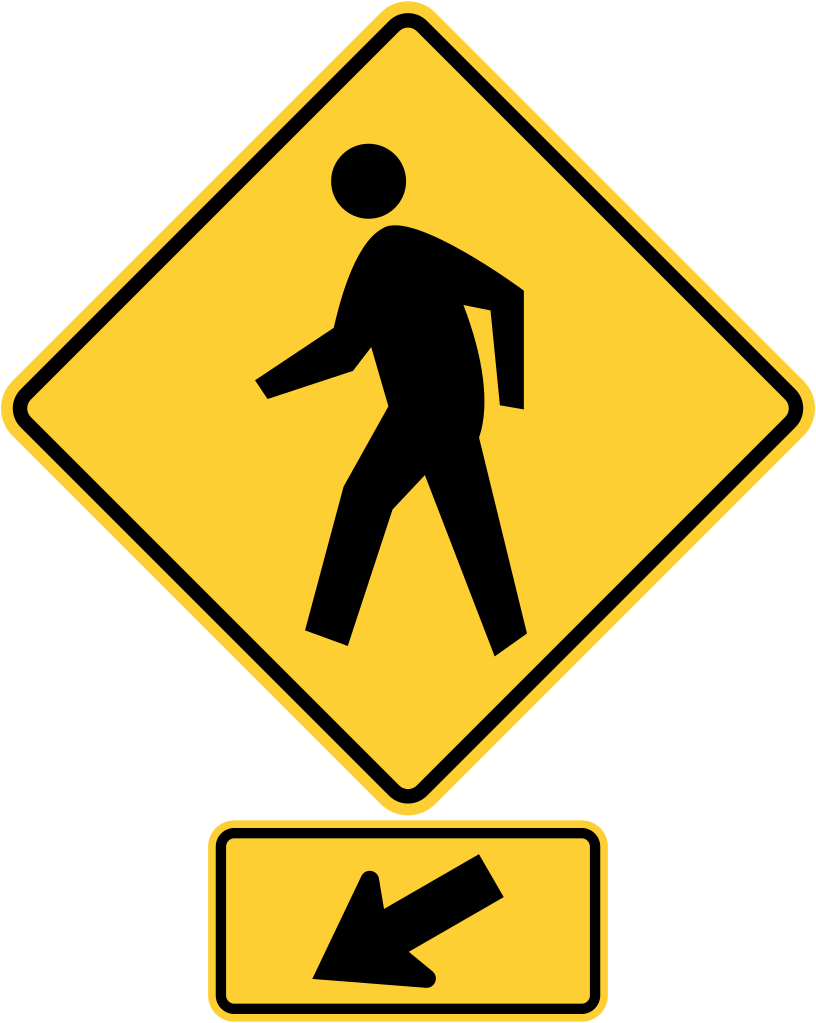
- Yield as you would at a corner
- Keep going, since no intersection is here
- Honk to warn the person to wait
- Slow down but pass in front of the person
Show answer
Yield as you would at a corner. Crosswalks exist at all intersections where a sidewalk meets the street, and not all of them have markings. Mid-block crosswalks require you to yield as you would at a corner, and mid-block crossings have warning signs and pavement markings. A walking figure sign with an arrow points out where the crosswalk is. When someone is in or entering it, stop and let the person cross, because you must yield to a pedestrian in a crosswalk.
Study this in the handbook: Pedestrians, bicycles, motorcycles and trucks
14. What can hard braking after you have already entered a Kansas curve cause?
- It straightens the vehicle automatically in the lane
- The tires can lose traction and the vehicle can skid
- It improves grip by loading the front tires
- Curve braking has no effect on traction at all
Show answer
The tires can lose traction and the vehicle can skid. Speed for a curve belongs to the approach, not the middle. Once inside the bend, hard braking can break the tires loose because momentum already pushes the vehicle toward the outside. The safe pattern is to slow beforehand to a pace that allows slight, constant acceleration through the turn. Poor traction, following traffic, or a blind exit all argue for an even slower entry. Smooth inputs keep the tires gripping through the whole arc.
Study this in the handbook: Safe speed and stopping distance
15. You enter a Kansas roundabout. Which direction do you travel, and who yields to you?
- Travel counterclockwise; circulating traffic yields to no one entering
- Travel clockwise around the island for a shorter path
- Circulating drivers must yield to every entering vehicle
- Enter in either direction when the circle looks empty
Show answer
Travel counterclockwise; circulating traffic yields to no one entering. Roundabouts choreograph one flow: entering traffic yields to traffic already circulating, then travels counterclockwise around the raised center island at about fifteen to twenty miles per hour. You enter to the right and steer left around the island. Nobody inside owes entering vehicles a yield; your gap is your responsibility to find. Signal right before your exit, hold your lane in multi-lane designs, and give trucks room rather than riding beside them. Wrong direction entry converts the whole design into a head-on generator.
Study this in the handbook: Driveways, yield signs and roundabouts
16. How do air bags and safety belts work together in a Kansas crash?
- Air bags replace safety belts in vehicles that have both
- Belts should be skipped when air bags are present
- Air bags alone handle side and rear crashes fully
- Bags are supplemental and work best with belts worn
Show answer
Bags are supplemental and work best with belts worn. Air bags carry the word supplemental for a reason: they are designed to work best in combination with safety belts. In a crash bags inflate from the steering wheel or instrument panel extremely rapidly, then deflate, cushioning a belted occupant who stays positioned correctly. Unbelted occupants can meet the bag out of position or be thrown in side and rear impacts bags do not address. Keep at least ten inches between your chest and the steering wheel center, and hold the wheel outside edges.
Study this in the handbook: Seat belts, child seats and air bags
17. The school bus ahead in Kansas has turned off its red lights and pulled in its stop arm. When may you proceed?
- Once children have fully left the roadway and it is safe
- Immediately, the very moment the red lights on the bus go dark
- As soon as the bus begins rolling forward
- Once your lane beside the bus looks clear
Show answer
Once children have fully left the roadway and it is safe. Dark lights end the formal stop, but children may still be crossing, walking along the roadside, or darting back for a dropped item. Watch both sides of the road and proceed only when it is safe, after children have completely left the roadway. A rolling bus can hide a child stepping out from behind it. Your lane looking empty is not the whole picture. A few patient seconds at every bus stop protect the least predictable people in traffic.
Study this in the handbook: School buses and required stops
18. What makes driving aggressive rather than merely careless in the Kansas handbook?
- Any mistake made by a new driver in traffic
- Driving at the speed limit in the left lane
- Feeling angry while driving calmly and lawfully
- An intentional act or offense that endangers people or property
Show answer
An intentional act or offense that endangers people or property. Aggressive driving has an intent element: an individual intentionally commits an action or moving traffic offense that endangers other persons or property. The behavior list includes speeding, tailgating, erratic lane changes, poor signaling, disobeying control devices, rude gestures, threats, and chasing. Honest mistakes and private feelings, without endangering acts, sit elsewhere. Prevention is self management: relax, obey limits, allow realistic travel time, and stay courteous and forgiving. Around aggressors, get out of the way and never answer in kind.
Study this in the handbook: Fatigue, distractions and driver responsibility
19. You must cross several lanes on a Kansas highway to reach an exit. How should you make the move?
- Change lanes one at a time, checking each lane
- Cross all lanes in one smooth sweep when mirrors look clear
- Signal once and drift across without pausing
- Wait for a police escort in heavy traffic
Show answer
Change lanes one at a time, checking each lane. Each lane hides its own traffic, and no single glance can certify several lanes at once. Move one lane at a time, repeating mirror, signal, and shoulder checks for every step. That rhythm also avoids the congestion and multi vehicle crashes that sweeping moves cause. If the exit cannot be reached safely lane by lane, continue to the next exit instead. Missing an exit costs minutes; forcing one can cost far more.
Study this in the handbook: Following distance, scanning and space
20. At 55 to 60 mph on a Kansas road, how far ahead must you be able to see before starting to pass?
- About 5 seconds of travel ahead
- At least one-third of a mile, 20 to 25 seconds ahead
- Only to the top of the next hill
- One vehicle length for each mile per hour
Show answer
At least one-third of a mile, 20 to 25 seconds ahead. A pass at fifty five to sixty miles per hour consumes a long stretch of opposing lane. You need to see at least one third of a mile, roughly twenty to twenty five seconds ahead, before starting. Hills and curves that block that view must be treated as hiding an oncoming vehicle. If the sight line falls short, stay in line. The same twenty to twenty five second window also governs railroad crossings ahead during a pass.
Every question is written from the official Kansas Driving Handbook. Need paper? Printable KS practice test with answer key.
Last verified 2026-10-05. How we check every question · Study all 500 as flashcards
Frequently asked questions
How many questions are on this Kansas practice test?
This fixed set has 20 questions. It is test 14 of 25 from the 500 question Kansas bank. The real KS exam asks 25 questions and you need 20 correct.
What is the passing score for the real Kansas test?
You must score an 80% to pass the knowledge test That figure comes from the official Kansas source cited on the DMV facts page.
How does this fixed test relate to the full Kansas bank?
Each numbered test is a fixed set of questions in a fixed order, so you can retake the same test later and compare. Every test mixes road signs and the other topics in about the same proportion as the full bank. Tests 1 to 25 together cover every question in the Kansas bank once. The full practice page mixes the whole bank at random.
Last verified 2026-10-05. See the Kansas DMV facts page for sourced state details.